
A few years ago I watched a friend make the same domestic blunder for the fourth time. Rather than fully understanding it.
He was a clever one. The kind of person who could break down complex concepts in minutes. The one everyone turned to for advice.
But there he was again, heartbroken, frustrated, and asking himself how he had ended up at the same place again.
Different person. Another town. Not the same year.
Same error.
I was watching him talk and I saw something funny.
He could see where the people were going wrong. He knew what was coming. He saw patterns. But as for his own life, it was as if all that intelligence had gone away.
At first I thought him strange. That’s when I started to listen.
I saw successful entrepreneurs going into toxic partnerships time after time. I saw brilliant students procrastinate before every major exam. I’ve seen talented writers drop projects in the middle. I have seen intelligent people choose comfort over growth, again and again.
And then I saw something filthy.
I was doing it as well.
The truth is, being smart won’t save you from repeating mistakes. And sometimes it makes you even better at excusing them.
One of Charlie Munger’s most memorable speeches includes an idea that seems almost too simple to be of any importance.
Munger once said that generally it’s more important not to be stupid than to try to be brilliant.
It lingered.
Most people believe that smart choices lead to success. But many a successful person would say otherwise.
“Success is often a matter of not doing the same stupid things over and over again.”
Consider it.
Most people know what they should do. They know they should be exercising. They know they should be saving money. They know they should stop wasting hours scrolling through. They know they should be having those tough conversations, not avoiding them.
The problem is not information.
Repetitive.
The same mistake returns in another disguise. And we welcome it each time.
A story shared on line by a founder fascinated me.
His first company failed because he put his trust in the wrong people. He got the message. So he thought.
Then a few years later he started another company. This time it would be different, he told himself. And then he went into business with someone who had the exact same red flags as his last business partner.
The company was almost ruined.
In hindsight, he confessed to something potent. He forgot the lesson. That is why he did not make the same mistake. He said it again, wanting a different ending.
That one really got to me.
Most of our blunders we don’t make because we don’t know any better. Hope is what makes them do it.
We think this time will be different. This time the relationship is going to work. This time the chance is real. This time it’s a different person. This time, we won’t get hurt.
The details vary.
The pattern remains the same.
Smart people have a special problem. They rely too much on their reasoning.
When the evidence conflicts with their desires, they don’t change their desires. They make better explanations. This is called rationalisation, psychologists say.
The smarter you are, the easier it gets.
A bad decision is going to be hard for the average reasoning person to justify. It is possible for an intelligent person to argue the case for almost anything.
They don’t use intelligence to know the truth. They use intelligence to defend their pre-existing wants.
That is not safe.
Because now everything is a reasonable mistake. Every wrong decision looks right. All the signals are explained away. And every failure is somebody else’s fault.
Here’s a great example of that told by a retired truck driver.
Long time ago he was driving through a dangerous mountain road in a storm. A sign warned drivers to slow down. He paid no mind to it.
Nothing.
A week later he ignored another warning sign. Again nothing happened. He grew more confident in the months that followed.
Not because he was good at it.
Because he had lived.
And one night he reached another sharp turn. He drove as he used to. He nearly drove off the road this time. He’d been lucky. His confidence was based on luck.
Not expertise.
That story fits so many people’s lives to a T. We repeat mistakes because we didn’t punish ourselves for the last mistake immediately.
The consequences arrive late. By the time they arrive, the habit is already established. You need to shift the mindset too Like girl
Mistakes are often thought to be because of lack of knowledge.
I disagree with that.
The majority of errors are emotional re-runs. Someone keeps choosing un-available partners. Not because they don’t know better. Why? Because when you are familiar it is comfortable.
Nobody ever quits procrastinating. Not because they don’t get deadlines. Because temporary relief is a good feeling.
A person spends money without care. Not because budgeting is hard. That’s because the emotional payoff is instant.
Knowledge attacks logic. Patterns combat emotion.
The emotions tend to rule.
Thanks for reading Growth in Echoes! Share It with Your Friends & Family who Need to Read This
Whether people think he is a genius or a goof, Elon Musk has talked again and again about learning by failing.
One idea he keeps coming back to is that feedback matters. Most people don’t like feedback because it feels bad.
They are protecting their egos. The problem is that protected egos lead to repeated mistakes. When someone criticises us, we have two choices.
We can stand up for ourselves. Or we can research on our own.
One is to defend comfort. The other brings about growth.
Sadly comfort feels better in the moment. And this is why so many smart people are stuck.
Here is what I have seen again and again.
The first mistake is usually a mistake.
The second mistake is an emotional one.
Mistake number three is identity.
I made a mistake, people don’t say anymore.
They start saying, “This is all me.”
Then it is hard to grow. Because now changing your behaviour feels like changing your self. And that is something humans fight tooth and nail to prevent.
It was for this reason that there was a period when I kept putting off important work.
Motivation was my excuse. I blamed the time. I blamed distractions. I blamed everything but the truth.
The truth was easy.
I was scared. Fear of publishing. Don’t want to get criticised. I was afraid my work wouldn’t be good enough.
But when I did realise this, everything changed. Efficiency wasn’t the problem.
The trouble was fear.
And every productivity system failed me until I addressed the fear. This is how a lot of mistakes that repeat work. The problem you see is usually not the real problem. The real problem is underneath.
It was for this reason that there was a period when I kept putting off important work.
Motivation was my excuse. I blamed the time. I blamed distractions. I blamed everything but the truth.
The truth was easy.
I was scared. Fear of publishing. Don’t want to get criticised. I was afraid my work wouldn’t be good enough.
But when I did realise this, everything changed. Efficiency wasn’t the problem.
The trouble was fear.
And every productivity system failed me until I addressed the fear. This is how a lot of mistakes that repeat work. The problem you see is usually not the real problem. The real problem is underneath.
Powerful is familiarity.
Final days I saw a post of person on substack about his biggest regret.
“I waited decades,” he said. Wait for him to be ready. waiting for the right time. Waiting for fear to go away.
Finally he saw something devastating. The perfect moment never arose. His worst mistake was not failing.
It was procrastination”
What haunted him was not what he did. It was what he never tried.
That is often in my head.
Many smart people are not failing because of bad decisions. They are failing for want of decisions. They spend so much time analysing that they don’t move.
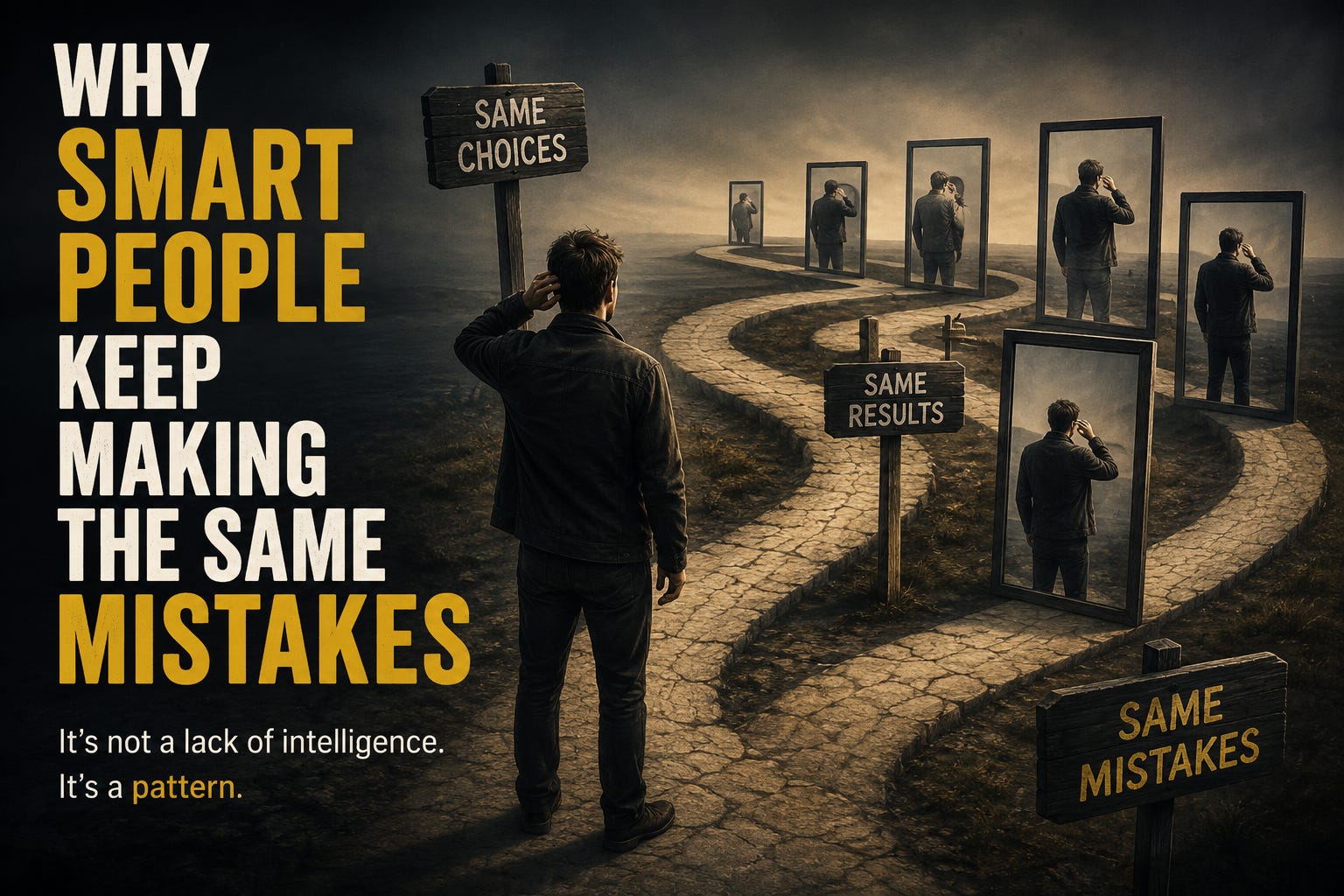
I’ve watched people for years and I’ve seen a pattern. The majority of repeated mistakes stem from one of four sources:
Fear
Ego
Comfort
Faith
Fear keeps you stuck. Ego makes us blind. Comfort makes us passive. Hope tells us the pattern has changed.
A different life. Different set of circumstances.
Same four forces.
When I encounter a problem I’ve seen before, I ask one question:
“What role am I playing in creating this outcome?”
It’s uncomfortable. Sometimes it hurts.
But it does have rapid patterns. Since repeated screw-ups generally have one common denominator.
Us.
The instant we stop blaming circumstances, luck, timing or other people we add something incredibly valuable.
Control
And control is the beginning of change.
Smart people don’t repeat the same mistakes over and over out of lack of intelligence. They repeat the same blunders because intelligence alone cannot conquer emotion.
Power is knowledge. Awareness matters.
But neither one matters if we refuse to confront the patterns driving our behaviour.
The most successful people I know aren’t the smartest. They’re simply most honest with themselves. They recognise patterns faster. They’re quicker to accept uncomfortable truths. They make mistakes sooner.
By doing so, they avoid cycles that trap everyone else.
So next time you’re faced with a familiar problem, take a moment. Ask yourself:
Is this some new mistake? Or is it a new version of an old mistake?
The answer may change everything.
No posts
Comments
Nothing yet. Say the first thing.
Sign in to join the conversation.