

With trust in medical institutions dropping precipitously, now more than ever, patients are questioning the so-called authorities. In fact, 1 in 6 parents now say that they will skip or delay injecting their children against diseases other than COVID-19 and the flu.
Clearly, there’s a sea-change occurring, which is why patients are also beginning to question their doctors directly.
Is your primary care physician actually acting on your best behalf, or because of undisclosed ulterior motives?
If you’re not sure, you’re not alone.
Fortunately, there are various steps you can take, practical and actionable, that can help answer this pertinent question. In an ideal world, modern allopathic doctors as we know them would not exist. They’d help with medical emergencies and acute injuries, but they wouldn’t regularly prescribe drugs, many times taken for years or even life.
In an ideal world, we would all embrace more naturopathic remedies and pursue holistic approaches to health & wellness.
However, for people who are dependent on medication, it’s important to know the warning signs.
Is your doctor truly on your side?
Here are 6 signs your physician may be bribed or corrupted, and what you can do…
Do you notice your doctor has a clear preference for costlier, brand-name drugs over generics that are equally effective?
According to one analysis of Medicare Part D prescribers, researchers found that gift recipients prescribed 7.8% more branded drugs, more claims per patient, and medications $50 more expensive per claim.
Even smaller gifts of under $500/year correlated with higher costs and branded rates.
That said, the larger the gift, the stronger the impacts.
Another systematic review found similar preference biases:
“Out of the 19 studies, 15 found a consistent association between interactions promoting a medication, and inappropriately increased prescribing rates, lower prescribing quality, and/or increased prescribing costs.”
So what can an informed consumer and patient do?
The first step is to look your doctor up. If you go to OpenPaymentsData, you can quickly find information about your physician’s associations. You can search by either name or National Provider Identifier (NPI):
Also, be vigilant when in the clinical setting.
Next time your doctor is prescribing a medication or suggesting a medication, ask explicitly: “Is there a generic equivalent? Why brand-name?”
It’s your right to request the cheapest effective option or therapeutic alternatives. If you feel you’re being pressured into using a more expensive product, get a second opinion or use pharmacist consultation.
GoodRx can help with price comparisons, as can insurance formulary lists, which you can typically find by logging into your provider's member portal (such as UnitedHealthcare Prescription Drug Lists, Aetna Medication Search, or Cigna Prescription Drug Lists), checking the member services number on your insurance card, or reviewing your plan's Evidence of Coverage.
Ideally, you want a doctor who has received minimal or no general - ‘non-research’ - payments.
As you can imagine, samples are a major marketing tool.
For many pharmaceutical sales representatives, they’re the bread & butter. Drug reps routinely use samples to gain access to physicians and other prescribers, and it’s inarguable that sample provision is closely intertwined with visits by drug reps.
Of course, only drugs with the highest profit margins are sampled.
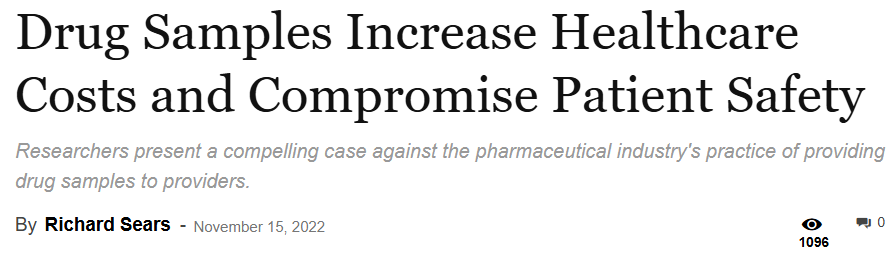
While physicians may believe that samples save patients money, in reality it’s the opposite: patients who receive samples have higher overall out-of-pocket costs. Nonetheless, pharmaceutical marketers pitch samples as a low-risk way to deal with diagnostic uncertainty. Which is ironic, given that there is no evidence that samples aid diagnosis.
If anything, sample availability may compromise patient safety by steering patients towards newer drugs, for which adverse effects have not been well-documented.
At the end of the day, it’s clear:
“Samples are not a charitable activity, but are instead a highly effective form of drug marketing. Sampling of branded drugs increases drug costs for everyone. Only a cohesive effort by clinicians, legislators and policymakers can end this practice.”
So, if you’re looking to overcome or circumvent this issue, be frank.
Decline samples and ask for a written prescription for the preferred (often generic) alternative. Inquire about first-line treatments first, and always ask about cost differences.
You can also use patient assistance programs and mail-order discount programs, such as Blink Health, Rx Outreach, Amazon Pharmacy, or Good Pill Home Delivery.
Comments
Nothing yet. Say the first thing.
Sign in to join the conversation.