
This year, the month of July marks two important celebrations. First, it’s disability pride month: a dedicated time to celebrate the strengths and achievements of the disability community worldwide. Lots of suggestions available online for things to read and folk to follow to get your fix of pride! Personally, I come back to this short article by Mac Zamani from time to time, and it always hits the right notes.
Second, it’s the tenth anniversary of the Disability Leadership Institute. Founded by the inimitable Christina Ryan in 2016, the DLI has been a leading voice in lifting community expectations of people with disability as leaders, and developing the concept and practice of disability leadership as a distinct discipline.
Disability leadership is not simply about a person with disability being a leader (though it is of course that, in part). Disability leadership is a unique leadership practice which leverages our attributes, strengths, and requirements as people with disability: not in spite of disability, but because of disability. In disability leadership, we throw out the narrative that disability is something to be overcome, or that our capacity just needs to be sufficiently ‘built’ to be capable of executing leadership. Instead, we identify our skills of excellence and hone our self-awareness, self-compassion - and yes, pride - to develop a powerful toolkit to lead in our own ways.
I am not, generally, a “leadership course” person. I have sat through enough of them over the years, run by and for people who have never had to think about access, disclosure, or the particular exhaustion of being some kind of token (queer, disabled, young person, culturally marginalised, pick one…) in the room, to be wary of the genre.
But this year, I took a deep breath and enrolled in one through the DLI, supported by the Sue Salthouse Leadership Fund and the Morgan Family and Perth College OGA Bursary Trustees. I went in with cautious optimism, armed with my confidence in Christina and her team to deliver something nuanced, rights-based, and interesting. And, I’m pleased to say I was not disappointed.
Overall, the difference in partaking in a development opportunity designed by and for people with disability versus a stock-standard option is night and day. For reasons I’ll explore shortly, seeing disability as a leadership asset and parameter rather than a limiting factor to be overcome is a game-changer.
Here are some of my musings and reflections from those eight weeks of learning alongside disability leaders around Australia. Not a sponsored post, but maybe it should be - my DMs are open!
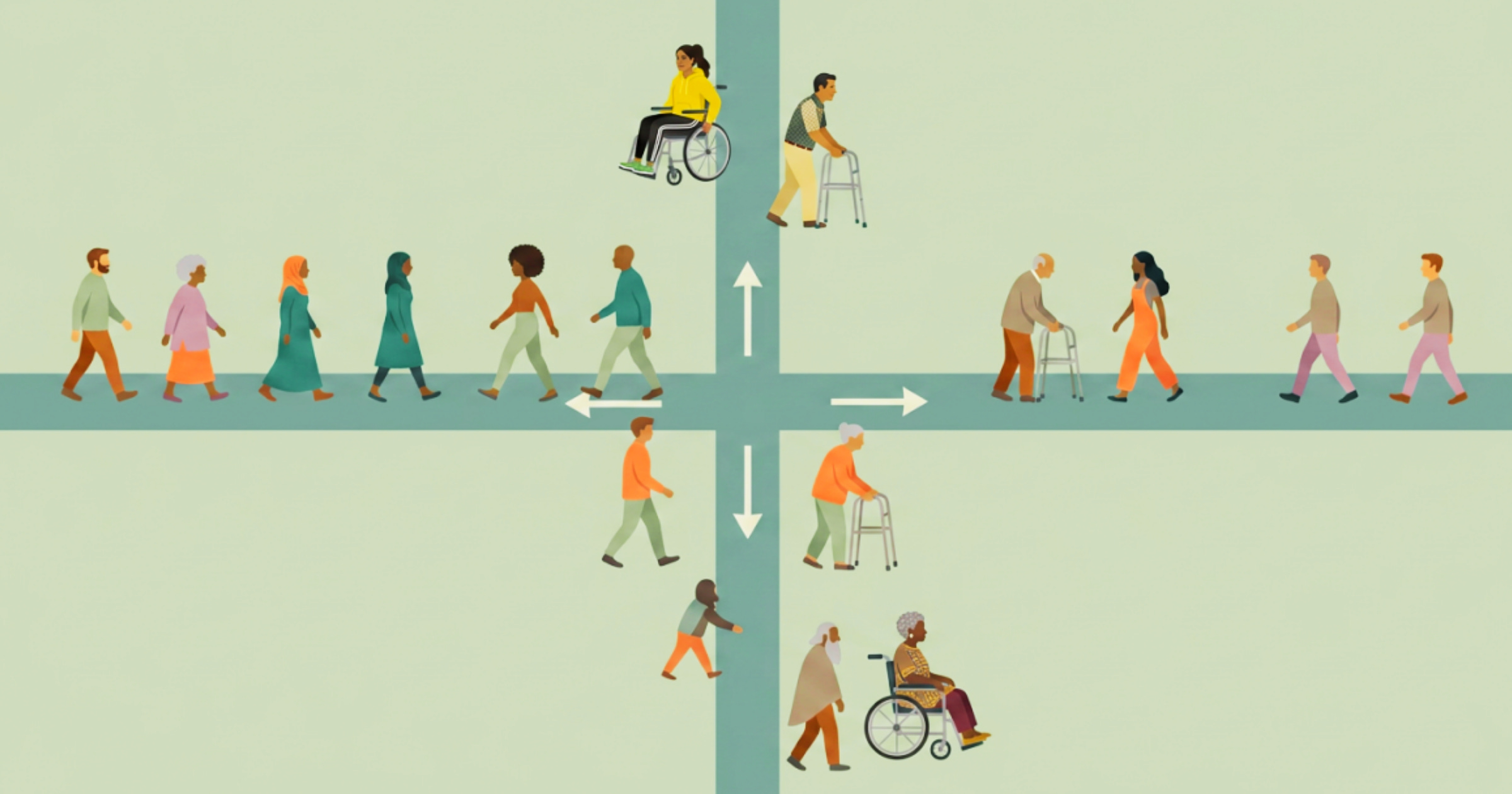
Something I hadn’t come across before was the useful distinction between horizontal and vertical development. Horizontal development targets discrete skills, knowledge, technical competence: the things you can easily put on a CV in a bullet list. Vertical development is less tangible, but just as important. Vertical skills encompass how you make meaning, hold complexity, take perspective, and lead through uncertainty when there is no clean answer available. Another way: horizontal skills are the tools in your toolbox, and vertical skills constitute your framework for deciding which tools to use in which situations. To me, this is a more useful framing than soft vs. hard skills which recognises the inherent value and essential nature of both.
Most professional development targeted directly at people with disability is horizontal: another certificate, another competency framework, another training module to build our capacity as if that’s the barrier to us gaining a seat at the table. None of that is wasted, but it’s also not where the leadership challenge sits, in my opinion. Disability leadership doesn’t just require expertise. It requires systems-thinking, adaptability, and values-based judgment under conditions that are rarely tidy or designed with us in mind. You are constantly making calls about competing priorities, limited resources, and lived experience realities that don’t fit neatly into a conventional framework. That’s vertical work, and it’s largely invisible in how mainstream conversations about leadership play out without acknowledging the contexts we operate in.
Across those eight weeks, we kept coming back to a central theme: disability leaders may disproportionately develop strong, post-conventional leadership capacities because of repeated exposure to structural barriers, isolation, and challenges. Constantly navigating systems that weren’t built for us and confronting ableism on the daily builds a kind of leadership capability that more conventional development paths don’t consider. Call it trial by fire, making diamonds under pressure, or learning the hard way. When you work with a disability leader, you can be sure you’re going to get some creative, out-of-the-box thinking, because that’s what we’ve needed to develop to survive and thrive.
I don’t think leadership courses can train this capability, but they can help us to identify our own sources of development under pressure and the strengths which have emerged from them. I can think of a few moments in my career which certainly fit the bill here. I’m sure you can too, or perhaps you’ve observed a colleague or a friend going through one. We could spend time and energy lamenting that they happened (I certainly have), but we can also take the lessons and strengths forward and use them against the systems that put us in those positions in the first place.
I’m instinctively suspicious of “manage your energy” content in professional contexts. Most of it seems to be, for me, somewhere between unhelpful and actively frustrating, because it tends to individualise problems that are structural: under-resourcing, unclear role expectations, and the relentless emotional labour that comes with advocacy and systems critique work.
Christina’s framing was different and much more useful. Developing a personal leadership style that draws on my strengths - or skills of excellence! - requires noticing things. Noticing when I am operating at my best, what knocks me off course, what helps me recover and re-engage. That’s a different exercise to being told to set boundaries in the abstract, or to apply one-size-fits-all suggestions about working styles that aren’t grounded in the reality of my neurotype, working context, or weekly patterns. It’s concrete enough to act on, but flexible enough to be relevant. As a PDAer, my brain needs me to come up with my own solutions rather than be given them in order to be able to take them on.
Obviously, self-management doesn’t fix structural problems, and we shouldn’t be prescribing it as if it does. But it can help us get the best out of ourselves on our own terms. Then, we’ll be better positioned to be able to tackle those structural problems when we choose to step into the fray.
A small, practical shift: I’ve landed on a single sentence that now does a lot of work for me.
I’m Ebe Ganon-Davey: I’m an independent disability advocate and researcher, predominantly working in higher education, inclusive employment, and human rights contexts.
I know it sounds minor. It isn’t. Anyone doing cross-sector work, especially work that spans research, advocacy, governance, and whatever else seems to appear on my calendar, knows the cost of constantly re-explaining yourself to new audiences. Having a clean, accurate version of this on hand has reduced the context-switching tax and let me present myself with more consistency across very different rooms. Especially helpful for someone who can get easily distracted and overwhelmed in a room of new people!
The horizontal/vertical distinction is now sitting underneath how I think about my own professional development approach, which is very helpful for prioritisation. The reframe on “being the only one” is shaping how I talk about representation and resourcing in the governance spaces I work in. And, the shift in how I think about self-management is informing how I structure my own time across my PhD, advocacy, community engagement, and downtime, rather than assuming I should simply be doing more of all of them.
If you’re a training and development manager or HR practitioner looking for learning engagements for your disability leaders, please don’t pick something generic because it’s easy and the supplier is on the right panel. This article hopefully illuminated why that doesn’t work.
Instead, offer something tailored, disability-led, contemporary, and grounded in human rights and emancipation. If it’s not the DLI or something like it, maybe it’s a smaller local practitioner with lived experience. If you genuinely care about supporting the development of your disabled leaders, this is essential. Community connection builds trust, pride, and confidence.
If you’re someone navigating leadership in this sector, whether formally or simply by virtue of being the only disabled person in rooms that assume you aren’t, I’d be curious to hear what’s helped you build the vertical, judgment-based side of leadership, not just the credentialed side. Drop it in the comments if you’d like to share with the Higher Hopes community 🙏
More information:
Check out the Foundations of Disability Leadership program and other offerings by the DLI.
Read a couple of articles about disability pride from the Centre for Accessibility Australia, Right to be Heard, and the Cerebral Palsy Alliance.
Finally, applications for the Hannah Morgan Endeavour Award are open again and all young Perth College alumni are eligible to apply - not sure if I have any ex-PC readers who got lost and found their way here at some point!
Apologies for remaining typos in this article. My keyboard needs a clean and my ‘L’ key is misbehaving and I got to the end of my patience quotient by the end of the piece!
No posts
Comments
Nothing yet. Say the first thing.
Sign in to join the conversation.