
Dear reader: I admit that in the last month or so I’ve felt backed up against a sort of creative impasse. I will always love perfume, and there are a number of (mostly Chicago-based) houses I feel so strongly about I want to do my best to cover and promote no matter the circumstance. That said, between my full time job at Diptyque and trying to keep a critical artistic practice perfume feels difficult to write about in the present moment. I’ve spoken about some of the broader industry trends recently – but needless to say I feel more and more pressingly that after I finish up a few articles I have in the works, I want to slowly shift into trying to write a full length book expounding on the subject of my master’s thesis (more information TBD). In the very long meantime, I plan to regularly use this blog to flex my writing muscles in broader criticism primarily related to the realm of literature, religion, and film. Needless to say, on that note, I was absolutely blown away seeing Kevin Walker and Jack Auen’s recent film “Chronovisor” at the inaugural Tone Glow Film Festival (shoutout Joshua Minsoo Kim and Tone Glow). I feel as if above all else, I am uniquely qualified to speak about this film from a lived academic and Christian perspective – and as you will read, I feel very strongly that this perspective is invaluable in understanding the greater meaning of its relation to its most visible themes of scholarly research, conspiratorial obsession, and historical inter-textuality.
Kevin Walker and Jack Auen’s “Chronovisor” is, at it’s core, a research project. It is also a gripping mystery film in line with more pulpy Vatican conspiracy from the mind of Dan Brown, but the actual institution of the Roman Catholic Church is merely an incidental stage by which the principal subject – the research process itself – is permitted to spread like bacterium on a petri dish. The film begins directly in media res: we follow Columbia professor Beatrice Courte (played by the actual Behavioral Science professor Anne-Laure Sellier) from after-class department dinners, to dimly-lit University libraries, and to her own personal study. There is almost no genuine dialogue between characters. I would go so far as to say there are barely even scenes with more than one character on the screen. The narrative is constructed instead via diegetic communication. Phone calls, receiving faxes, requesting analog library holds, opening boxes of mail, and most importantly, the reading of myriad books become the mechanism by which scenes are set and the plot is established. Through Courte’s careful perusing of archival material in all kinds of languages, we slowly learn the goal of her research: in the 1960s an Italian Benedictine monk named Father Pellegrino Ernetti claimed to have invented a machine that was able to detect, decode, and reconstruct electromagnetic radiation and sound waves left behind from history itself to create miniature reconstructions of past events. There were other figures with reported shadowy involvement with this process: famed physicist Enrico Fermi and former Nazi scientist Wernher von Braun among them, but the actively cloistered Fr Ernetti was both the invention’s mastermind and its representative ambassador. In essence, this Chronovisor was purported to be a high-tech analog television that could use unseen ripples of past time to tune into any given moment in history. The machine was obviously never publicly debuted, but there are multiple controversial paper trails of this invention’s fruits – lost transcripts of Hellenic tragedies, and countless references to what might well be the very reason this technology was created: the ability to witness firsthand the crucifixion of Jesus Christ.
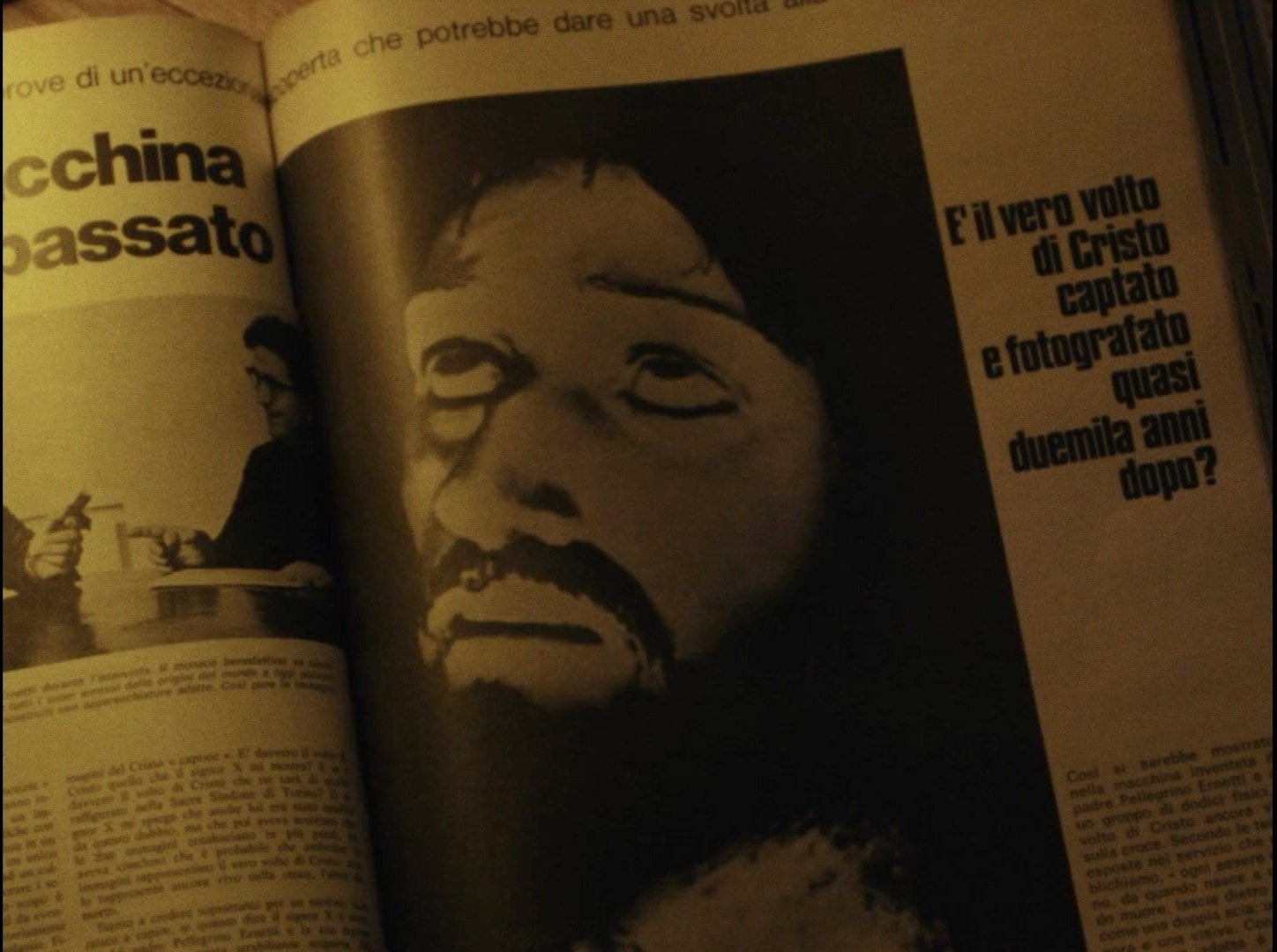
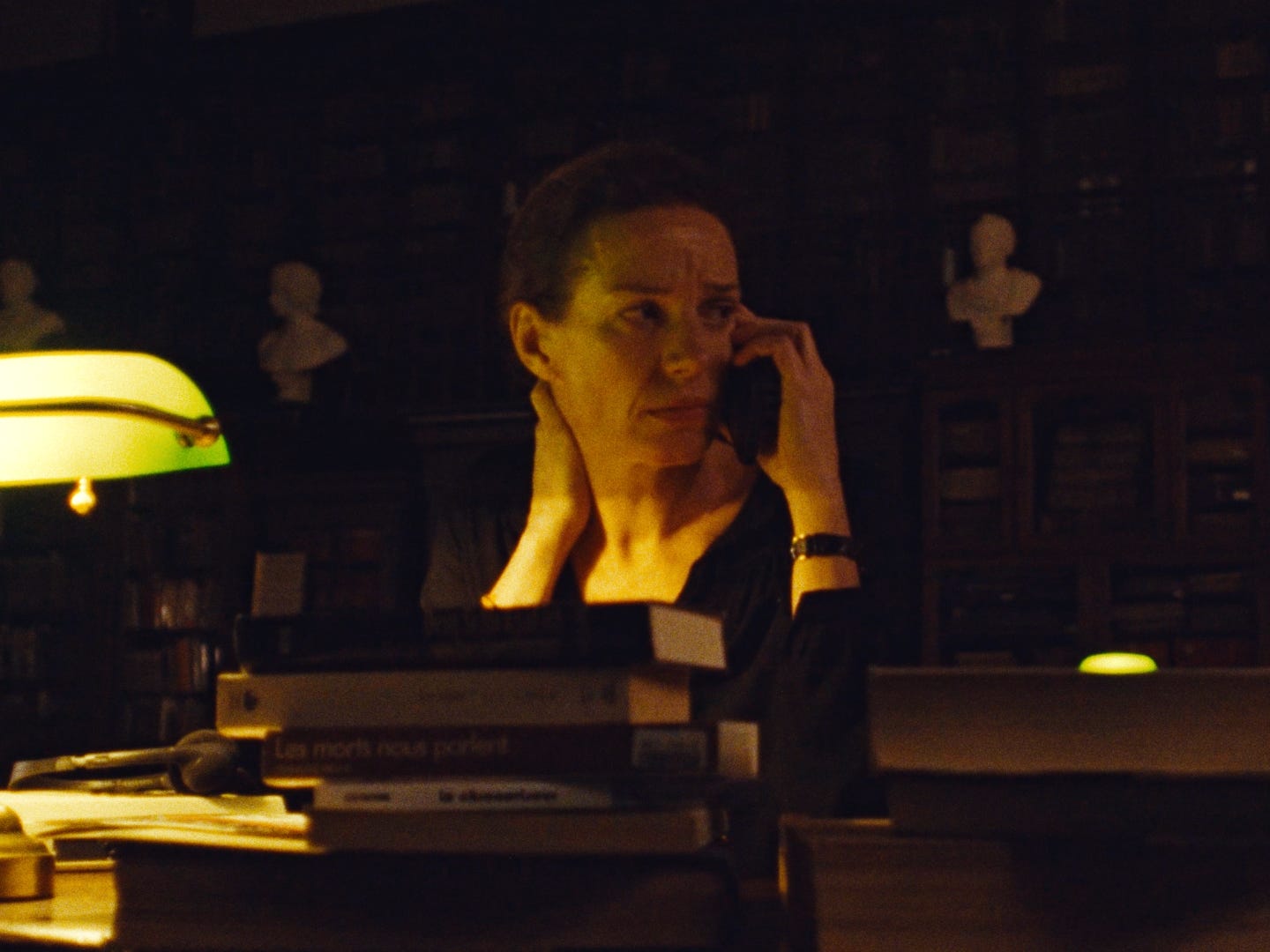
Our protagonist Courte is a successful albeit tightly wound scholar of neuroscience specializing in memory, and seemingly holds a personal interest in parapsychology. From the very beginning she demonstrates her obvious shrewd intelligence, and thus her interest in the Chronovisor continually seems to run the knife’s edge between thought-provoking conceptual exercise and true conspiratorial belief. In fact, this tension is in my mind the film’s real emotional heart. She starts the on-screen research process very much connected with the academy at large. We see her amongst her colleagues, she borrows from University libraries, and yet the subtle expressions of Anne-Laure Sellier’s fantastic performance from the beginning bely a tentative belief in the device’s real functionality. Between forged photographs published in Italian newspapers and retired Priests giving sincere testaments to Ernetti’s brilliance, the real name for Courte’s belief is hope. To waver like this, between scared and shameful suspicion and endlessly motivating conviction, is in fact the very essence of the Christian faith. True belief in miracles – in the resurrection of the dead and life of the world to come – is as delicate as its implications are world-altering. One could just as easily believe that a monk in the 1950s built a television to broadcast the crucifixion of a man who lived two millennia ago as one could believe this very same man was God incarnate and rose from the grave on the third day. If we are to understand Courte as part-pilgrim, unknowingly embarking on a non-linear journey towards faith in the Chronovisor, we must also assert her confidently as an unconventional but sound researcher – for in fact the very essence of research is faith. To answer a question one must first ask a question, and to ask a question one must consider something without knowing if it is true. To take this even further into scripture, the apostle Thomas’ assertion that “except I shall see in his hands the print of the nails, and put my finger into the print of the nails, and thrust my hand into his side, I will not believe” (John 20:25) is a reasonable demonstration of the scientific method, and itself becomes a path towards miraculous faith in the risen lord. Many outside of the academy imagine the research process as a slow but steady march towards that which is already true. In my experience that notion could not be farther from reality. To research is to fumble aimlessly through the dark for a series of successive doors, not knowing whether the place you end up in will feel anywhere like truth. This film is ultimately an elaborate portrayal of Beatrice Courte’s own life-altering research process, one that sees her move beyond the classical Western notion of experimenter as physically and emotionally separated from her experiment, and into a more holistic and unabashedly parasocial type of obsession. This high-stakes game of life-consuming research is familiar to anyone with a graduate degree, but also subtly relates itself to the vocation of religious discovery. What is academic burnout but the dark night of the soul, and what is unexpectedly finding Jesus but a rediscovery of your work’s true purpose. Maybe I’m biased, but as someone to whom both of those things has happened, the feeling was similar enough to me.
If the subject of this movie is research, the main actress is the slew of tactile artifacts by which information is stored and conveyed. The film’s texture is palpable: the grain of a page, the shine off VHS tape, the pointillism of images printed in foreign newspapers. This leads to a specific experimental technique I have not yet mentioned. Frequently, as a means of translating the materials currently being read by our polyglot heroine (she fluently speaks up to four languages in this film!), Walker and Auen superimpose illuminated English text over choice lines, both as a means of translating things for a presumedly anglophone audience, and selectively drawing our attention to certain key parts of the text. This process feels far more drawn from the rich tradition of superimpository text in video art, as opposed to the normative conventions of narrative film. I think more of artists like Theresa Hak Kyung Cha, whose work deals with the substance of translation and the aesthetics of signs than I think of detective novels or National Treasure. Via this artistic choice, the act of translation is made unmistakable, and languages elide into each other seamlessly. This itself is another larger motif of “Chronovisor:” the degree to which language ceases in Courte’s interior world to be a barrier to thought, but a textural element in how thought is conveyed. I might even go so far as to liken this to the gift of tongues at Pentecost, in which God’s Holy Spirit gave the apostles sudden mastery over foreign languages, and their preaching of the gospel was enabled to travel across the world. These illuminated, translated, and excerpted words form a visual aesthetics of knowledge-building, where inert and analog substances become conduits into historical mysteries and altered states of mind.
Walker and Auen’s camera frequently lingers on terse close-ups of Beatrice Courte’s eyes. Sellier’s delicate performance shines here, with frequent shaky and sleep-deprived contractions against brightening light alluding to the notion of the human eye itself as a camera. There is an excerpt of text frequently flashed and transcribed during and between scenes – one itself directly alluding to one’s own consciousness, one’s own sensory input being harvested as mere data collection to form a grand interpersonal repository of memory over time. The narrator references themselves as a director’s tool, their eyes and their sight aiding the construction of some grand Hitchcockian movie drama. This eerie idea is not only the process by which recorded history perpetuates itself, but also the direct mechanism of the Chronovisor technology. At what I consider the film’s climax, Courte accidentally cuts her finger on a book page’s edge. From this moment on, her character becomes a decisive believer in the Chronovisor’s real functional existence. It’s a subtle scene, but one that belies the final eradication of the Western research dynamic – one where the researcher herself is protected, kept at an unbiased scholarly distance, from the emotional reality of her research. The idealized scholar is able to come home from the library or the classroom and completely disengage. This itself is a product of a Capitalist culture that allies research with work, and keeps workers alienated from their labor. The best scholars are wounded by their research. I know very few academics who truly feel as if the vulnerability of inquiry is a one way street. As Courte pricks her finger on a book about Ernetti, his creation makes its way into her bloodstream. She makes connections no one has made before, and in a reconstructed VHS tape from a distant relative to Ernetti, stares at a shaky video testimony that the Chronovisor technology is not only undoubtedly real, but comes with a Faustian cost. Ernetti was indeed able to grant users the ability to witness past historical events, but in doing so, those events seep into your own personal memory, and the boundaries of the individual’s own distinct life and experiences begin to blur. Careful readers will recognize this as an illustrative exaggeration of the very real process of historical research. In learning about the past, we surrender ourselves to it. In true and honest attempt to resolve the matter of history – to get to the bottom of myriad jagged unknowns and misty correlations – we surrender the naive notion of our own lives as uniquely different or more worthwhile as the ones that came before it. In knowledge, comes the crushing weight of a thousand unsaid stories and unresolved wrongs. In Flannery O’Connor’s The Violent Bear It Away, a mad kidnapper muses:
“The world was made for the dead. Think of all the dead there are,” he said, and then as if he had conceived the answer for all the insolence in the world, he said, “There’s a million times more dead than living and the dead are dead a million times longer than the living are alive,”
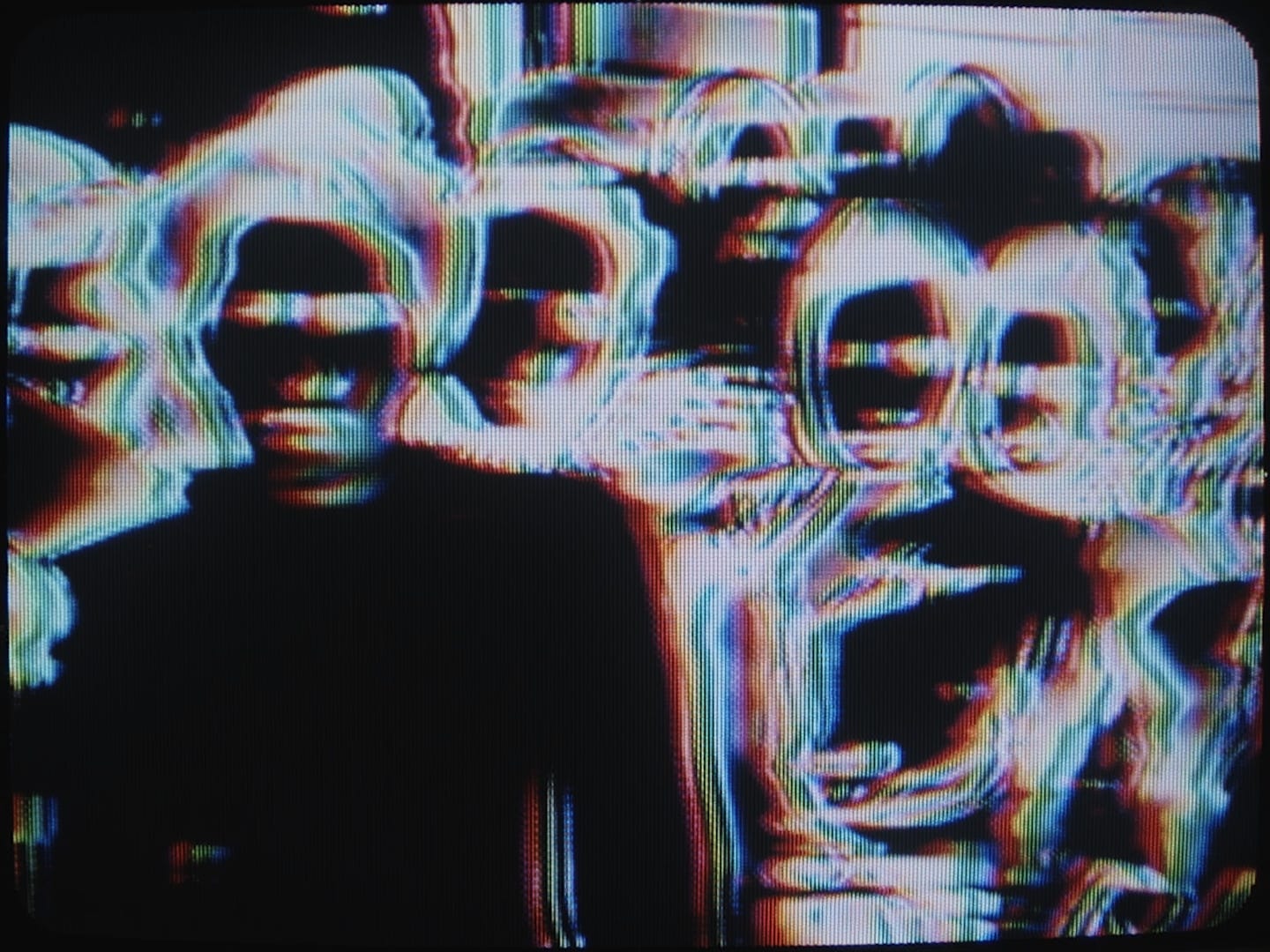
This is the real cost of using the Chronovisor. The crushing weight of history, of true and honest understanding of the past dissolves the ego. One’s mind is merged into the grand deposit of thought that came before it, and the scholar with insignificant personal motivations becomes merely a tool by which a larger story is told. After learning this, Courte journeys out to a remote island where one of Ernetti’s research partners was rumored to have stolen and kept the true Chronovisor for himself, warping his mind beyond repair with constant addictive use of the device. It is here, in this impossibly eerie and tense moment, that the central doubt behind this conspiracy’s truth is explicitly done away with, and the film shifts from a more conceptual exercise in belief to a true sci-fi. It’s all real. The delirious madman who stole the Chronovisor, and the dusty machine itself standing haphazardly in his bedroom. Courte slowly inches towards the clunky analog set she has seen and heard countless reports of, and the doubting Thomas has now seen and touched the pierced risen hands of his lord and his God. She fires up the machine, and the narrative film as we are accustomed to watching comes to an end. There is a sense in which I would be completely satisfied with the narrative stopping there. With a feeble assurance of founded faith, our heroine lead to the ends of the earth in search of an experience we can never see and she could never describe. Instead, the story is utterly exploded, and a sequence portraying the output and effects of the Chronovisor serves as an ecstatic moment of complete ego death, and the self’s utter dissolution under the great burden of humankind. This sequence is utterly haunting, and could easily serve as its own short film. Against ethereal droning sounds the machine casts feedback loops utterly drenched with analog texture and 80s-era video artifacting. It is perfectly held at the boundary of gauche and genuinely terrifying. Both what we might have expected to see looking into the Chronovisor, and something altogether beyond. We see Christ’s crucifixion – plain and simple, cast against a void-like sky and innumerable faceless bystanders. We linger on eternity itself, the weight of this mighty act and the cost of its wager in the mass anonymous humanity of the crowds. Immediately this disruption of time is met with consequences. Pasolini-like passion visuals merge with existing footage of Courte entering the building. Past memories, our own sight as audience and their own recording as filmmakers begin to seep into the Chronovisor’s view. The fourth wall collapses, Courte-as-character now becomes a performance viewed by Courte-as-audience, we as real flesh and blood audience members feel implicated. Our own eyes, our own documentation is implied to also be part of this cinematic reality. The film becomes not just something that is projected, but the substance of the film, where it happens, expands into including the audience itself. Minor White, an American photographer steeped in the legacy of Barthes, once wrote:
“Camera and eye are together a time machine with which the mind and human being can do the same kind of violence to time and space as dreams.”
This is the film’s central thesis. The research project, and the project of research altogether are mechanisms by which we intervene forcefully into time – and vice versa - are sequential instances in which the surreal, dream-like internal logic of the psyche is pricked, hurt beautifully and irreparably, by the sublime immensity of reality and truth. In this respect, to inquire meaningfully is to mechanize the self, to knowingly trade a depersonalization of one’s individual mind for knowledge impossible to holistically view from one’s own personal experience. Yes, this process is a mystical or even explicitly religious venture, but in high doses it pushes mankind dangerously close to the brink of madness. To successfully complete a research project is really just a matter of gathering around the ancient communal psychedelic regression circle a-la something like Dune’s Spice Agony or the hokey Mayan ritual pastiche in Altered States; drinking exactly enough mysteriously brewed hallucinogenic as to provide meaningful visions of your past self, but not enough to shatter your mind altogether.
Needless to say, the finished film makes for an utterly enthralling viewing experience. Straddling the boundary between stylish thriller and genuine paranormal investigation, falling into the universe of “Chronovisor” feels like staying up reading until four in the morning hunched over a dim reading light, right eyelid twitching on and off uncontrollably. Moreover, as a Diptyque employee I must call attention to the impeccable set design choice to have an unidentified 70g mini Diptyque candle (Mimosa? that feels most in character) burning on Beatrice’s stylishly messy oh-so-European office desk. If you’re going to spiral into conspiratorial obsession over secret Vatican time travel technology, you might as well do it in style.
‘Eat your Lipstick’ is a blog by Audrey Robinovitz, @foldyrhands
Audrey Robinovitz is a multidisciplinary artist, altar girl, and self-professed perfume critic. Her work intersects with the continued traditions of fiber and olfactory arts, post-structural feminism, and radical orthodox theology. At this very moment, she is most likely either smelling perfume or taking pictures of flowers.
No posts
Comments
Nothing yet. Say the first thing.
Sign in to join the conversation.