
On October 3, French photojournalist Antoni Lallican was hit and killed by a Russian FPV drone near a small village in Eastern Ukraine, some 20 kilometers from the frontline. Working alongside him, Ukrainian photojournalist Georgiy Ivanchenko was critically injured and had to undergo leg amputation surgery.
Le Monde wrote an English-language tribute to Antoni Lallican that you can read here. Reporters Without Borders published their first findings about the attack here.
Georgiy Ivanchenko is now facing a gruelling period of hospitalisation, recovery and rehabilitation. His friends have started a crowdfunding campaign to support him, in which you can participate from abroad using PayPal, at this address: ukrainianphotographers@gmail.com
KYIV—On October 12, dozens of Ukrainian outlets ran a story with the same headline: “Сили оборони звільнили село Малі Щербаки на Запоріжжі” — “Defense forces have liberated the village of Maly Sherbaky in the Zaporizhzhya region”. The articles were all based on a Telegram post published by the 24th assault battalion ‘Aidar’ claiming Ukrainian forces had advanced into the village following an offensive conducted with the 33rd assault regiment. Along with the message was a video showing soldiers in ghillie suits posing with their units’ flags in front of a destroyed brick house. The Telegram post doesn’t actually use the word “liberated”, going instead with a more prosaic assessment: “the settlement is under the control of the Ukrainian defence forces.”
The Ukrainian war monitoring project DeepState updated its map on October 13, but didn’t declare Maly Sherbaky ‘liberated’: the village went from partially Russian-controlled to squarely into the grey zone. Movement has been quite limited in this part of the frontline: one year ago exactly, DeepState had Maly Sherbaky marked as under Ukrainian control but a mere two kilometers from the frontline. It was in the exact same position one year before that, in 2023. And yet again the same in October 2022.
It’s hard to overstate just how insignificant Maly Sherbaky was, even before the war. It then had just 355 inhabitants, according to official data. A rectangle 1 kilometer long and 1,5 kilometers wide at the intersection of two roads. Five streets in total, one farm at its southern edge, another at the north-western corner. The insignificance is even in the name: “Maly Sherbaky” translates to “small Sherbaky”, little brother to the nearby village of Sherbaky.
The headlines about the events around Maly Sherbaky made me think about liberation and when, exactly, the term starts losing its meaning. Since I’ve started covering this war, I feel like I’ve only witnessed once what anyone would—probably based on watching World War 2 movies—instinctively think of as a “liberation”, when I entered Kherson a few days after it was taken back by Ukrainian forces in 2022: smiling kids lining up the streets and waving flags, locals spontaneously gathering on the central square, embracing soldiers and queuing up to take selfies with them, everywhere a genuine, overwhelming relief and euphoria.
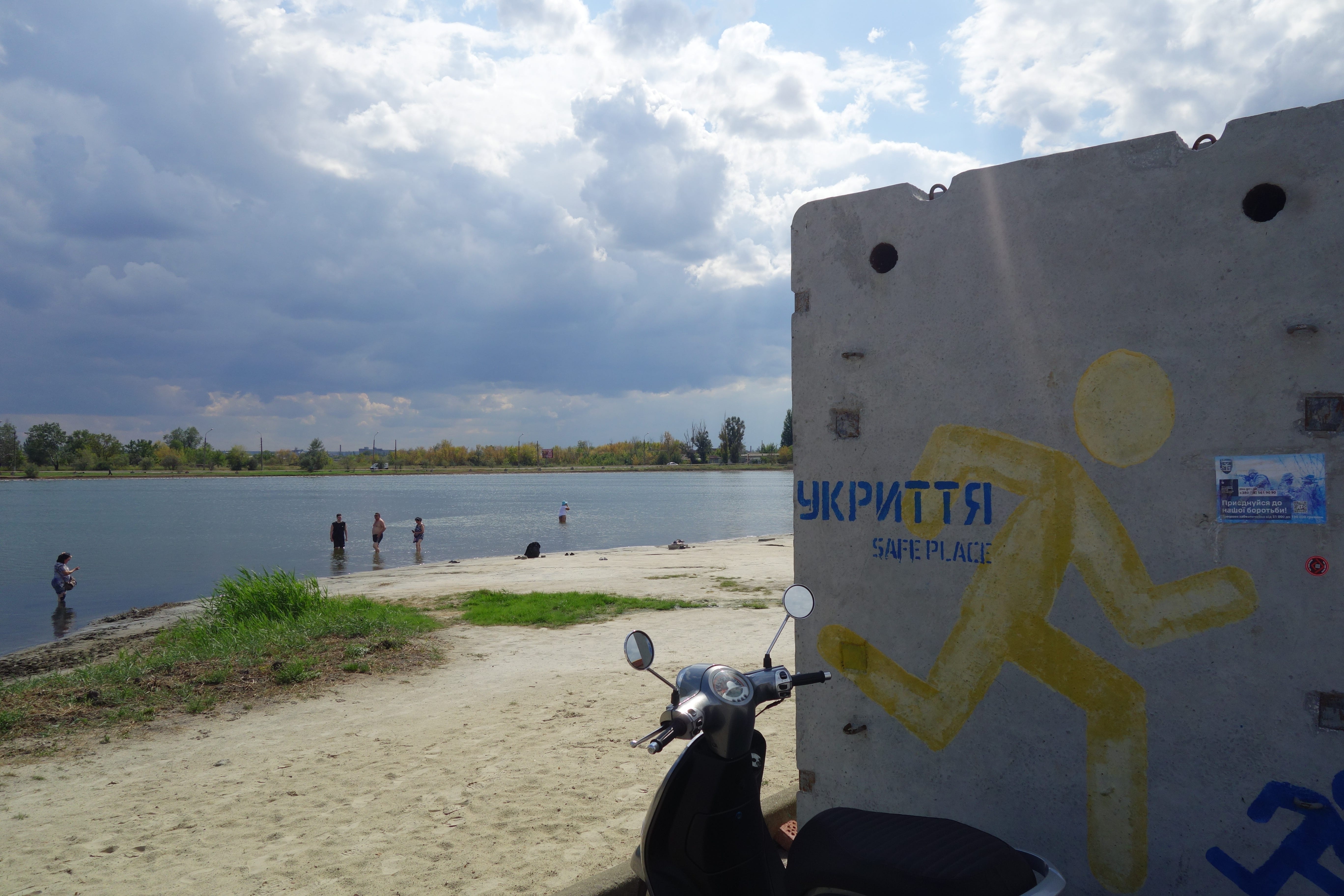
There was really nothing like that a few weeks before, when I arrived in Izyum and then Kupyansk, recently liberated following the stunning September ‘22 Ukrainian offensive. The relief was there, but so often overshadowed by exhaustion and trauma—people were gathering up under the rain near a ravaged building to recharge their phones at the only available generators, while an old man was talking about the bodies lying in the streets until just a few days ago. Kupyansk was different still, as the Russian forces were still close, just on the other side of the river: artillery was firing on both sides, and panicked locals (who had been living under occupation but away from the frontline since the beginning of the war) looked for ways to flee. Still, there was relief and even sometimes joy, insofar as there were people to express relief and joy.
I know nothing about Maly Sherbaky. But the fact it’s been an unbelievable three years right on the frontline—albeit in one of the quieter areas of the front—makes it easy to think that Maly Sherbaky almost certainly doesn’t exist anymore, not in any real sense of the term. That almost all of the 300 or so people who lived there have long fled or been killed. Maly Sherbaky wasn’t liberated because it is still a war zone, while liberation implies peace, even if temporary and fleeting. But, more importantly, because there is nothing and no one to liberate there anymore.
The Village Ukraine (in Ukrainian) | ‘Sir, I’m fucking exhausted’: How soldiers go on leave | September 23
Two soldiers talk about the uncertain and all-too-rare break in the military: how it is requested, how it is often rejected, why it is so rare, how it feels when it finally happens. It’s a look at the war through the lens of those precious few days of rest that soldiers constantly think about.
It’s not possible to release more than 30% of personnel at once. And since we lacked people who could perform the tasks, they released us one by one. So the next person in line had to wait until the previous one returned. Because of this, the second half of the leave (another 15 days [soldiers are in theory guaranteed 30 days of leave a year]) almost never came around. This was the case in the first unit, in the second, and in the current one—the brigades are different, but the problem is the same everywhere.
[...]
Combat units constantly suffer casualties and may remain in their positions almost continuously due to a lack of personnel to replace them. There are different front lines. There is the so-called ‘zero’ line—places where combat operations are directly conducted. People practically never leave this area. For example, for four people to leave a dugout, four more must immediately take their place. If someone is wounded and drops out of the schedule, the others are forced to hold their positions longer while he is away. In such cases, rotations become less frequent. The situation is similar on the front line, but it is a little easier to get out. Starting from the second line, it is much easier to rotate, because that is where most of the personnel are located.
Hromadske (in Ukrainian) | ‘I’m starving’: Why are the salaries of soldiers causing outrage, and will they be raised? | October 2
Soldiers’ pay has been a near-constant issue in this war, and one that came at the forefront in recent weeks as the parliament began discussing the 2026 state budget.
This piece by Hromadeske does a good job of laying out the issue by focusing on the soldiers serving in the rear. For frontline troops, the problem has sometimes been a very different one, with some volunteers raising the alarm about soldiers spending all of their salary and combat duty bonuses in online gambling.
But here, the issue is about the much bigger number of soldiers serving in the rear for a salary of some 20,000 hryvnias (around $480), a sum very often significantly lower than what they earned before they joined or were mobilized and, crucially, one that doesn’t keep up with the rising prices of rent in most of the major cities.
(As a sidenote, rent prices are also a very real issue closer to the frontline: soldiers live not in bases that could be targeted at any point but in flats or village dachas scattered across the frontline regions, and the high demand means prices have skyrocketed)
The issue becomes of course even more acute when it comes to skilled jobs, as the pay cut that a typical IT worker would take when going to the military becomes a motivation to avoid military service.
Ukrainska Pravda (in Ukrainian) | AWOL: How the back-to-service mechanism works, and what’s wrong with it | October 14
A long investigation into the issue of desertion in the Ukrainian military. The eye-catching figure is that 200,473 of the 289,600 cases opened by the Ukrainian general prosecutor for AWOL and desertion since the beginning of the invasion were opened in the previous 12 months.
But I think more important is this sentence: “AWOL and desertion have become one of the only ways for soldiers to transfer between units”.
This puts the staggering number mentioned above in a different perspective: desertion has effectively become necessary to the workings of the Ukrainian military, as a way to cope with or compensate for dysfunctions within the army. As Ukrainska Pravda points out, it’s been used as the de facto best way to switch between brigades, particularly when the parliament voted last year a law waiving criminal liability for desertion if the soldier came back to the army—various units then began running ads specifically dedicated to attracting soldiers who had deserted within their brigades.
But it’s also become a pressure valve to compensate for the lack of terms of service or prospects of demobilization: exhausted soldiers reaching their breaking point or faced with incompetent commanders always have this option of simply leaving. It of course remains illegal, and soldiers have faced jail sentences for desertion. But, importantly, I think desertion is largely socially accepted in the Ukraine of 2025: very few people are going to dare to judge a soldier who decided to flee after fighting two or three years on the frontline.
Stories from legacy Western media published these past few days
Financial Times / Military briefing: Ukraine races to intercept Russian drones
The Washington Post / Her grandma saved her from the Russians, then chose to say goodbye
The New York Times / Ukraine’s Formula for Peace: Fewer Talks, More Weapons
The Wall Street Journal / Russian Drones Turn the Streets of Kherson Into a Civilian Kill Zone
The Globe and Mail / A front beyond the front
No posts
Comments
Nothing yet. Say the first thing.
Sign in to join the conversation.