
Friends, foes, and other h*es,
Hey hey! It’s KB, slithering into your inbox like a snake in tall grass. Over the last few years, I’ve heard, loud and clear, (mostly young) queer readers say “I don’t want more sad queer books.” This message has, inevitably, trickled down to some emerging queer writers I’ve taught, who worry that their poems, essays, and stories are “trauma porn” or “not necessary” and such. My first reaction to these claims was to dismiss them as gibberish, but that doesn’t quite make discourse go away, does it? It also echoes similar things people are saying about queer movies/TV, queer plays, and more.
I’m going to put this want (argument? feedback?) to the fire AFTER some updates.
I’ve got a new poem called “Grave Error” out at The New Republic! This one’s dedicated to my late best friend, Travis E. Green. <3 Thanks to Rowan Ricardo Phillips for publishing it.
I’ve got 2 new poems — one of which is available online — out with Harvard’s Transition Magazine! V happy to have my queer, Black music-influenced pieces from a book I’m working on in this prestigious mag.
I wrote a piece about my journey with finding my birth dad, and how it’s all tied up in my transness, with Newsweek. Thanks to Rheana Murray for the opportunity! A longer version of this piece is also in my memoir, Pretty.
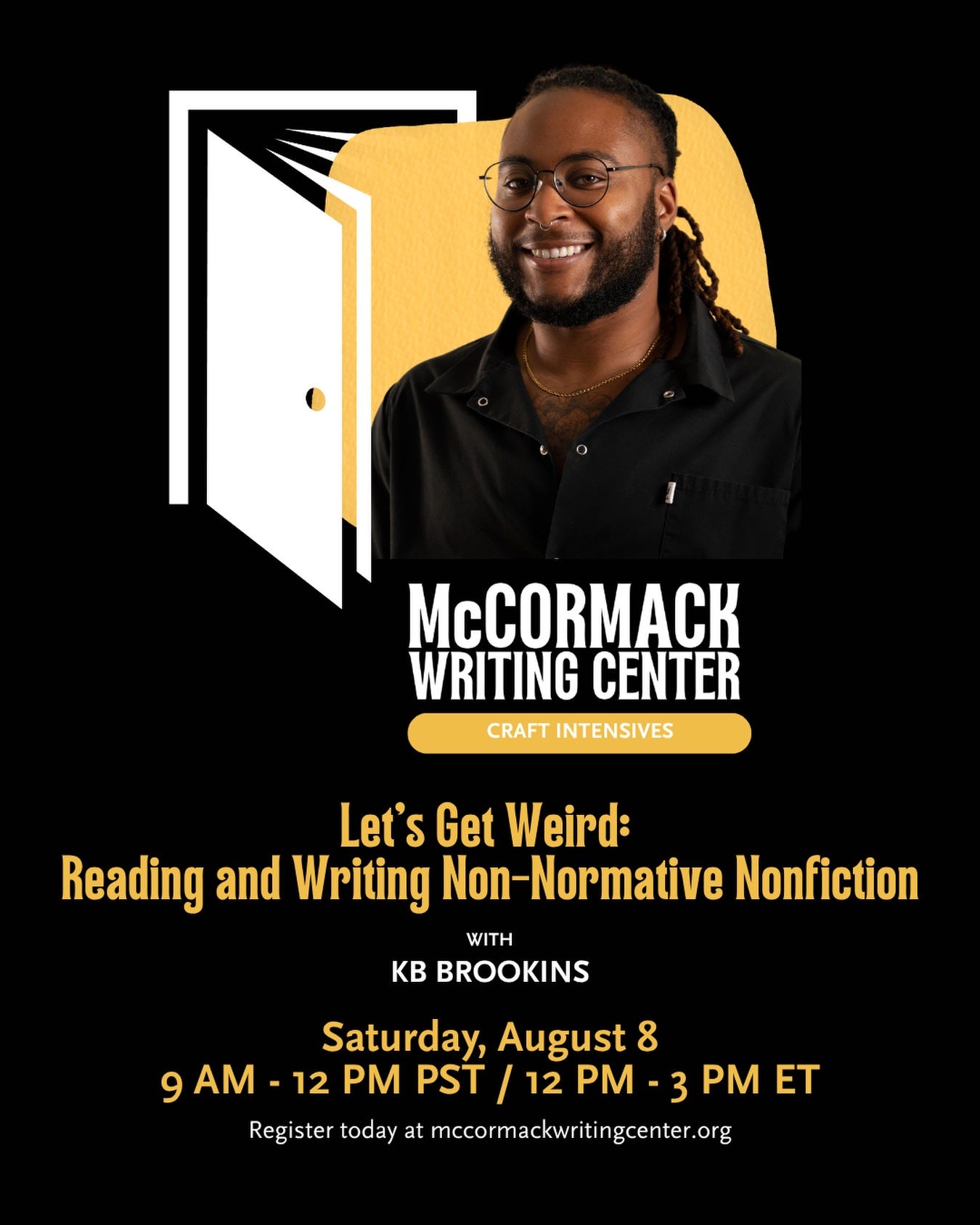
Have you found yourself stuck on exactly how to write an essay or memoir? Have you felt hung up on the form, or felt bored by your own language? I’ve got a virtual class for that!
Can’t say much quite yet, but know that new short stories are ON THE WAY.
Thanks for reading Out Of This World! This post is public so feel free to share it.
Let me start this uptop with saying that I write sad queer books. My memoir has jokes and millennial nostalgia, but also mentions abuse, transphobia, and religious trauma. My poetry books deal extensively in Black trans Texan aliveness, yes, but they also go into hard shit I’ve experienced! I talk about toxic masculinity in queer/trans communities, anti-queer/woman/human Texas politics, environmental injustice — a lot of shit that’s bad, admittedly! “I don’t want sad queer lit” makes a certain sense to me cause it’s not always fun to write.
There’s a great essay by Katherine Packert Burke called “It’s All Just Torture Porn: A Record of Failed Attempts to Explain What Trans Lit is “For”” that makes some great points about this topic, too. Burke astutely points out that “a lot of literature is about being miserable.” And that’s true! A book that starts with and ends with a character being happy and facing no adversity at all would not be picked up by any publisher. Writers and readers are after change. Half of all the bad Goodreads reviews I’ve ever read say some flavor of “not enough happened.” We crave change. When you say you don’t want sad queer lit, you’re inevitably making a case against happy lit too; often, but not always, sad lit turns to happy lit by the end.
I guess I should also disclose that I am a walking stereotype. I had those moments while reading books and watching movies/TV growing up where I asked, “Why is there no one like me? Why are there no Black, or queer, or trans, or neurodivergent, or working class, or fat, or Texan characters like me? Why when a character is one of those things, they can’t be another too?” My parents, both Black and evangelical Christian, didn’t have an answer. The librarian in my then-mid-sized, conservative Texas city have an answer. I asked that question and was met with silence — a silence that enveloped me until I found those books (and wrote them myself) when I was an adult.
I figure that deleting “sad queer books” would exacerbate this issue. No “sad queer lit” would mean more mini-KB’s wondering why they’re not on the shelves.
In Dr. Danielle Fuentes Morgan’s amazing book Laughing to Keep From Dying, she talks about how Black comics have infused revolutionary thought into their punchlines. They often go into the heavy because, simply, them and their audiences experience heavy lives. Racism at work, in public space, in their friendships. If comic’s goal is to be relatable to anyone that could potentially be at their show, why would they make their art devoid of it?
That’s also how I approach this conversation about queer lit.
Unfortunately, we don’t live in a world where queer and trans people don’t face hardships simply because we’re queer and trans. Everyday, LGBTQIA+ folks are covertly and overtly discriminated against. If every queer writer en masse ceased to include that reality in their work, it wouldn’t be comforting. It would be denying (and suppressing) our reality. When folks say “I don’t want sad queer books,” what I hear is “I want the world to change.” Me too. But until it does, we need writers to tell these stories.
My last point (for now): it makes sense to not want the only books on the shelves related to queer people to be deeply traumatic books. It makes sense to want to see a balance of happy and sad endings in the stacks. Queer people experience joy; we have happy days! It makes sense to want your literature to acknowledge that. For those who want balanced queer lit, perhaps consider: happiness and sadness are not a binary.
In my experience, happiness lives right next to sadness. When I went to my dad’s funeral, someone cracked a joke about how he couldn’t sing, and the whole congregation laughed. One day, I crashed my car in a way that made ice cream splatter all over my face. Of course, I was furious about my car, but I laughed about the ice cream. Embedded in Leslie Feinberg’s Stone Butch Blues, an unmistakably sad queer book, is a beautiful story about labor organizing. In Pretty, I paired a scene of a boy being transphobic toward me with a silly joke about shitting in lunchables.
Happiness and sadness (or anger, grief, disappointment, etc) are like two sides of the same coin. They are important enough, in my opinion, to be considered a literary device.
Queer literature has the right, and the necessity, to be sad. It has the right to any emotional landscape. We are living in a queer literary renaissance — where queer writers are making #sadbooks and #happybooks all the time. And they should be. I want to live in a world where we can read emotions and experiences that are understood as “sad” in a book and be grateful, or curious. I at least want to live in a world where when we aren’t in the space to ingest sadness, we just put down the damn book.
That’s it for the week, friends. I’ve got more coherent thoughts on this in a book that I’m working on… :) What queer books have you read recently?
Till next time!
Love, Peace, & Chicken Grease,
KB
No posts
Comments
Nothing yet. Say the first thing.
Sign in to join the conversation.