

Information fills a space. Editorial thinking builds a reputation.
That’s where the last piece landed. Content marketing built audiences for a decade. The volume since AI arrived has flattened the value of producing more of it.
For experts, founders, and solo practice owners who want to build genuine authority around their ideas, producing content in the conventional sense is no longer enough. The bar has moved, the opportunity has shifted, and if we keep producing the same old stuff, we’re going to drown in a sea of sameness.
There is a better way to think about this, and like any new approach, it starts with a different question.
The institutional communicator asks: What do we need to say?
The content marketer asks: What will perform?
Neither starts with: What is worth making?
This is the question we now need to be asking before we even start writing a word, or hitting ‘record’ for a podcast or video.
This is editorial thinking. While that shift might sound subtle, it’s not.
The starting point changes everything. Who you are serving changes. What your audience takes away from your work changes. What you decide to publish changes. Indeed, what you decide not to publish changes just as much.
A content marketer serves the audience in order to serve the organisation. An ‘Editor Creator’ serves the audience, full stop.
I introduced the concept of setting an editorial standard for the content we produce in a previous article - ‘Content marketing is exhausted. Long live editorial integrity’.
In this article, I dig deeper into the practice of what I call ‘Editorial Creator Mode’.
That is, running a micro publication, podcast, or video channel rather than mindlessly feeding a content calendar, regardless of platform, format, audience size, or which side of that conversion-engine-versus-reputation-building line you sit on. Some people slip into it without naming it. Others have built their entire reputation on it, sometimes without recognising that’s what they did.
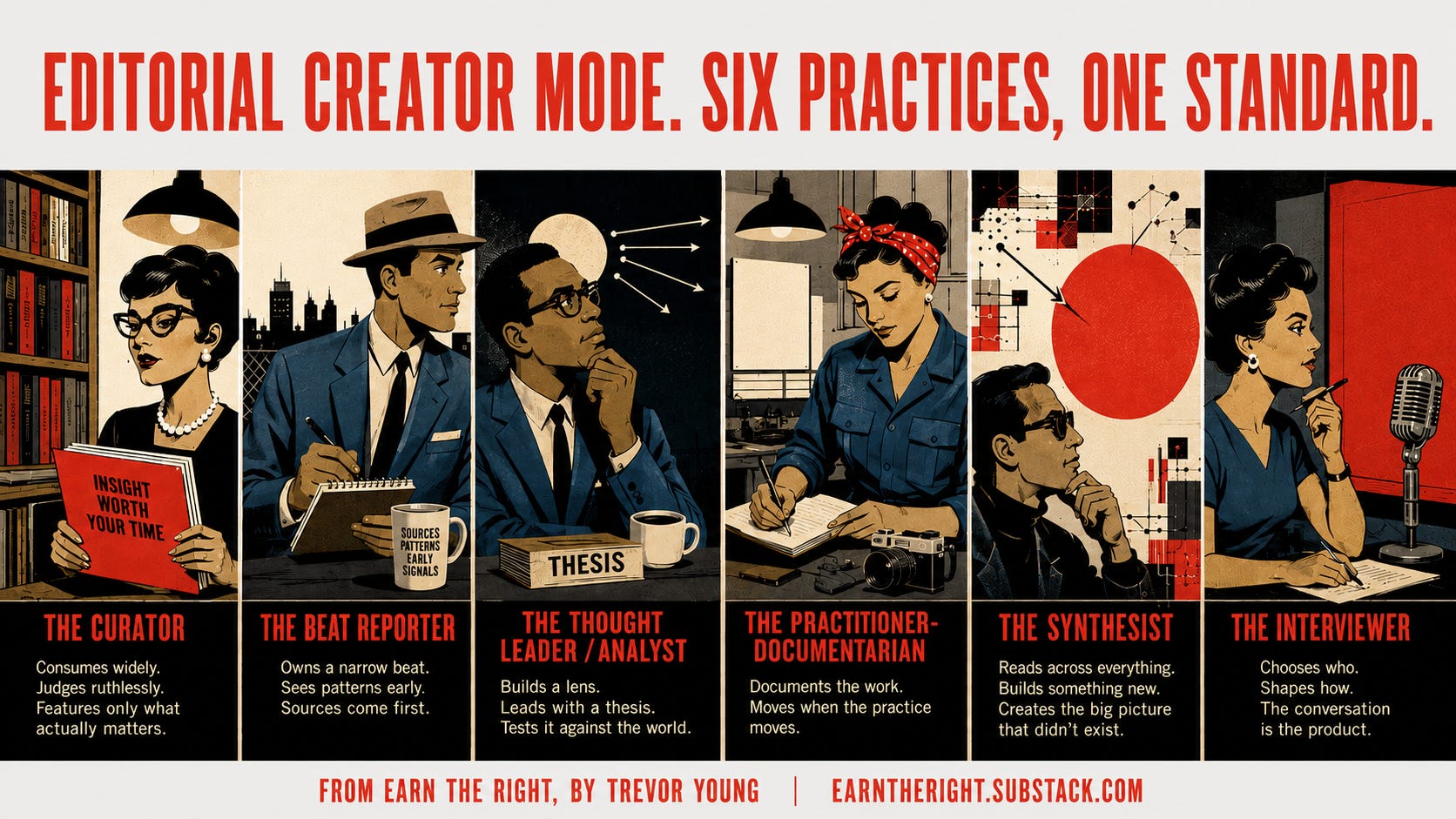
Editorial Creator Mode isn’t one shape. The people doing it well - the Editor Creators - split into a small number of recognisable types, each solving the same underlying problem - what is worth making - in a different way.
Following are the six types of Editor Creator. Do you see yourself in any of these?
Every field produces more material than any one person can process: whitepapers, research reports, presentations, panel discussions, newsletter articles, essays, social posts, books, YouTube videos, live-streams, podcasts.
The volume keeps climbing and let’s face it, most of it is forgettable.
Enter the curator.
The curator’s authority comes from solving the noise problem on someone else’s behalf: consuming content widely so the audience doesn’t have to, then exercising the judgement to feature only what actually matters.
This looks deceptively simple from the outside, a list of links with a sentence on each, but the skill is entirely in the selection. Anyone can aggregate. AI can do it with a click of a mouse.
But few people can be trusted to aggregate well, consistently, issue after issue, without padding the list to look busy or missing the one item that mattered, adding value along the way. The curator’s reputation is built one correct call at a time, and it’s lost the moment the filter starts letting crap through.
What does this look like in action?
Clint Gibler runs tl;dr sec, a newsletter that filters the security industry’s flood of conference talks, research papers, and tooling releases down to what’s worth a practitioner’s time. He doesn’t claim to have the best original take in the room. He claims to have read everything in the room and knows which five things in it actually matter this week.
In newspaper terms, a beat reporter (or beat writer) is a journalist who covers a specific topic, sector, or institution over an extended period. Rather than bouncing between random breaking news, they develop deep expertise in an area like politics, sports, education, or business, cultivating a network of sources to help them break exclusive stories.

Like its newspaper namesake, the Editorial Creator version of the beat reporter doesn’t try to cover a whole field. They claim a single narrow patch of it and refuse to leave. Over years, that narrowness becomes the advantage. A loyal relevant audience builds. Sources start coming to them first. Patterns that would look like noise to an outsider register instantly as significant, because the creator has seen the early version of this pattern.
The authority here isn’t a worldview or a framework, it’s depth of sourcing and the discipline to stay put. Most people get bored of one topic long before the expertise and authority compounds into something rare. The beat reporter sticks around, and the payoff is a kind of credibility that can’t be faked by someone parachuting in for a single hot take.
Kim Zetter has covered cybersecurity and digital conflict for over two decades, much of it now through her independent newsletter Zero Day. Readers come back not for a take, but for the confidence that someone is actually watching, and has been the whole time.
This archetype generates original thinking and puts a name to it. Some apply one durable lens to a changing world, reading whatever’s happening through the same worldview each time. Others are constantly producing fresh takes and new ideas, and what makes the work recognisably theirs isn’t repetition, it’s that every take comes from the same underlying point of view.
The hard part isn’t having a view. It’s holding it when a more popular one has emerged, and saying so when the evidence points the other way. That’s the line between someone with real authority and someone running an opinion column with a flattering label.
Michael Kitces reads the financial advice industry through a business-model lens he built from years working inside it.
Quantitative hedge fund manager, Patrick Boyle, follows whatever's moving in markets and the economy each week through a trained sceptic's eye, willing to willing to follow a story past the point where it costs him ad revenue.
Historian Heather Cox Richardson interprets the day's politics through historical context, built from decades of training most commentators don't have.
Ben Felix and Rand Fishkin do the same in investing and digital marketing respectively, each willing to state a position - whether it's Felix on evidence-based investing or Fishkin on the reality of zero-click search - that costs them the more exciting take.
Author Chip Conley belongs here too, reading midlife through a framework built from social science research rather than his own lived experience of it.
This authority comes from doing the work, not interpreting it from a distance.
The editorial output is a record of an ongoing practice, and it moves when the practice moves, not when the news cycle does.
There is no fixed thesis being applied to the world. There is a business, a client roster, an experiment, and the public documentation of what’s actually happening inside it - through a newsletter, a blog, on social media, or via YouTube.
The test separating this archetype from the thought leader/analyst is simple: Could a smart outsider with no operating history produce the same material?
For a documentarian, the answer is no. The lived experience is the substance of the work, not merely a credential sitting behind it. This archetype is rare in a useful way, since it can’t be faked or outsourced, only lived and then written down honestly.
Author and consultant, David C. Baker, publishes deal-level detail on positioning, valuing, and selling marketing and creative firms, drawn from hundreds of equity transactions his firm has led.
Lenny Rachitsky brings a practitioner’s lens shaped by his years at Airbnb, where he moved through product and growth work before becoming a product leader. He isn't your average tech-pundit or career advice coach; the stronger point is that his authority comes from having operated inside product at scale before writing about it publicly.
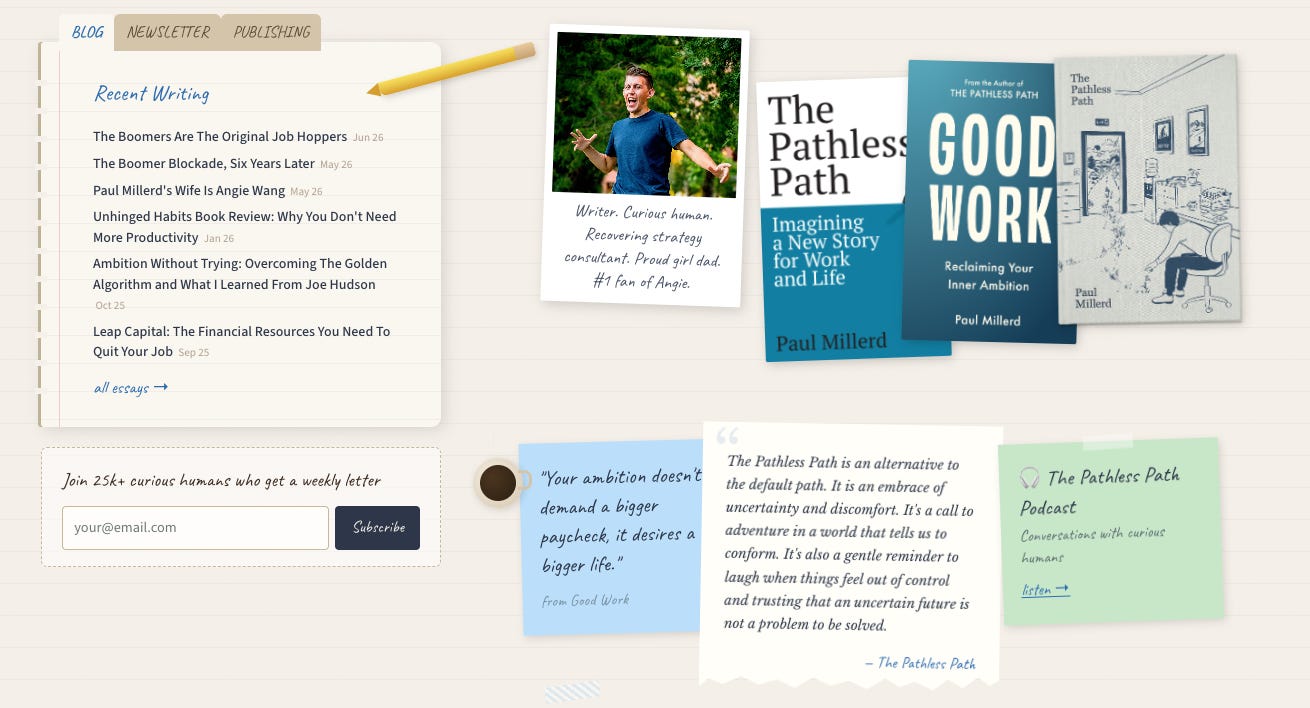
Paul Millerd (‘The Pathless Path’) and Rochelle Moulton both create content from inside the businesses and experiments they're actually running, and that proximity is what makes the work sharper and more useful to the people reading it.
The synthesist reads across the same wide field as the curator - the reports, the interviews, the data, the individual stories - but their output is different. Whereas a curator points back at the sources, a synthesist builds something new from them.
That’s the test: can the published piece stand on its own as something to agree or disagree with, or is it really simply a map back to other people’s work.
“Here are five things worth your time this week” isn’t an argument, it’s a selection. “People who reach a certain level of success share this one pattern, regardless of industry” is an argument, built from many cases, but standing or falling on its own.
This is harder than it looks because the temptation is to summarise rather than synthesise, to report what several sources said rather than what their accumulation actually reveals. The synthesist’s value is entirely in that second move, the leap from many data points to a reimagined body of work.
Polina Pompliano built The Profile first as a curator, selecting standout long-form journalism and surfacing it for readers with a clear point of view. Over time, that practice developed into something more analytical: original profiles, cross-cutting patterns, and a body of work that does more than point back to sources. Her book, drawn from hundreds of profiles, extends that same pattern-recognition approach into a broader argument about recurring traits among exceptional people. The progression is useful to notice, though it reads more as a considered evolution than a neat and fully documented conversion from one mode to another.
Maria Popova followed a related but distinct path. The Marginalian began in 2006 as Brain Pickings, openly grounded in curation across science, philosophy, art, and culture. Over time, that curatorial impulse deepened into a more recognisably original voice, with curation functioning less as a list-making exercise and more as a way of building an intellectual point of view through sustained reading and reflection. By the time she renamed the project in 2021, the balance had shifted noticeably toward long-form essaying and book-length synthesis, even if curation remained part of the method.
An interviewer’s editorial judgement shows up entirely in two decisions: who gets the invitation, and what happens once they’re in the room having a conversation with the host/s.

This archetype treats the conversation itself as the finished editorial product, not a raw transcript to be mined for content elsewhere, though interviews are generally repurposed across other channels for promotional purposes. By putting the interview front and centre, it changes everything about how the conversation gets run.
The craft lives in the questions and in the refusal. A guest will often arrive with a polished pitch ready to deploy regardless of what’s actually asked. A weak interviewer lets that pitch stand in for an answer. A strong interviewer with editorial chops notices, redirects, and pushes until something honest replaces it.
Selection matters too, since who gets booked says as much about the show’s standard as anything written.
It’s also worth noting the editorial judgement here doesn’t have to sit with one person. Unemployable, an Australian podcast and YouTube channel, runs four rotating hosts across panel discussions with entrepreneurs and wealth builders who’ve actually done the thing they’re talking about. Guests disclose real numbers and real failures. The hosts say out loud what most financial commentators soften or avoid. None of that depends on one editor’s individual eye, the standard is held collectively, by the format and the group, rather than by a single named interviewer. That’s a real variant of the archetype, not a weaker version of it: the editorial discipline that separates Unemployable from the thousands of business podcasts that never ask a hard question lives in the team’s shared willingness to push, not in any one host’s craft.
Not every editorial creator fits neatly inside the six types above, and a couple of patterns are worth flagging on their own.
Codie Sanchez treats editorial output as the on-ramp to a larger business. Her Contrarian Thinking newsletter runs practical playbooks on small businesses, often grounded in interviews and real operator examples, and the content clearly supports her broader courses, funds, and deal-flow business. That makes it a distinct pattern from the six archetypes above, and worth naming separately rather than folding into them.
Editorial integrity isn’t only individuals.
HubSpot is the clearest example at scale. What began as a traditional content marketing hub has evolved into a serious owned-media operation across newsletters, podcasts, and YouTube, with editorial output now playing an explicit role in how the company reaches and educates its audience. Its media expansion includes the direct acquisition of The Hustle, combined with strategic partnerships and network distribution for independent brands like Starter Story, Mindstream, and Futurepedia. The team has shown a willingness to cut formats that don’t earn their place. The content remains editorially separate from the product, but the two are managed in service of the same business. That combination has worked because HubSpot has never pretended the media side exists for anything other than strategic value.
None of this is a competition for the most prestigious lane.
Synthesists and beat reporters are rare for a reason, while expert practitioners tend to land naturally in analyst or documentarian mode because that’s where their actual expertise lives.
The useful question isn’t which archetype sounds best. It's which one best matches your expertise, what you have real access to - whether that's sources, lived practice, or the right people to talk to - and the work you're already doing.
That’s the practice. The standard it has to clear is a different piece, coming soon.
Onwards!
~ Trevor
Here’s a free diagnostic to find out. The Authority Gap Diagnostic will show you exactly where you stand and what to prioritise first.
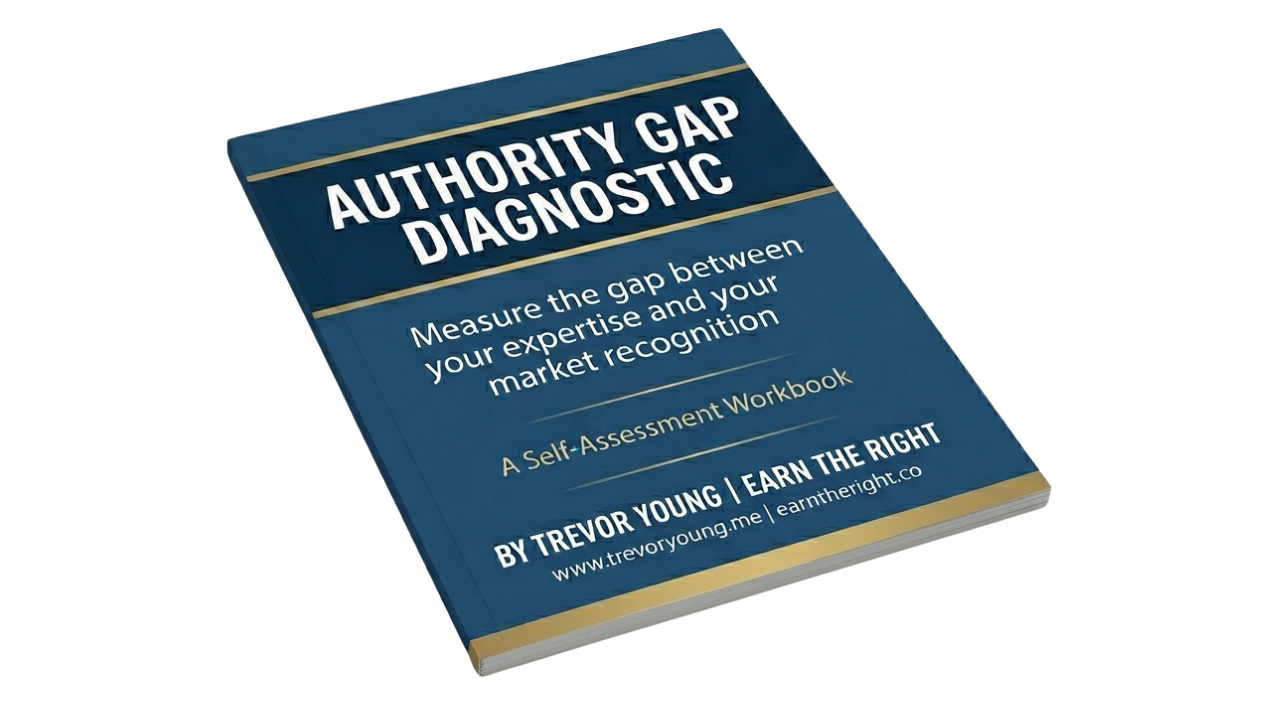
The Authority Gap Diagnostic is a 13-question self-assessment tool. It takes about five minutes. Your results tell you where the gap sits, which of five common authority patterns fits your situation, and what to prioritise first.
The Authority Gap Diagnostic is free to download - here’s the link.
Comments
Nothing yet. Say the first thing.
Sign in to join the conversation.