
Bloomreach Engagement gives CRM teams powerful reporting from the start.
You can analyze campaign engagement and revenue attribution without building custom reports. The Performance Dashboards standardize email reporting and create a consistent way to measure success across the organization.
For many teams, that is more than enough.
But as CRM programs grow, reporting questions become more demanding.
Not simply:
How did this campaign perform?
But:
How did this campaign perform for active versus passive users, across different markets, and what was its revenue and unsubscribe impact within those segments?
This is where reporting starts to feel heavier than it should.
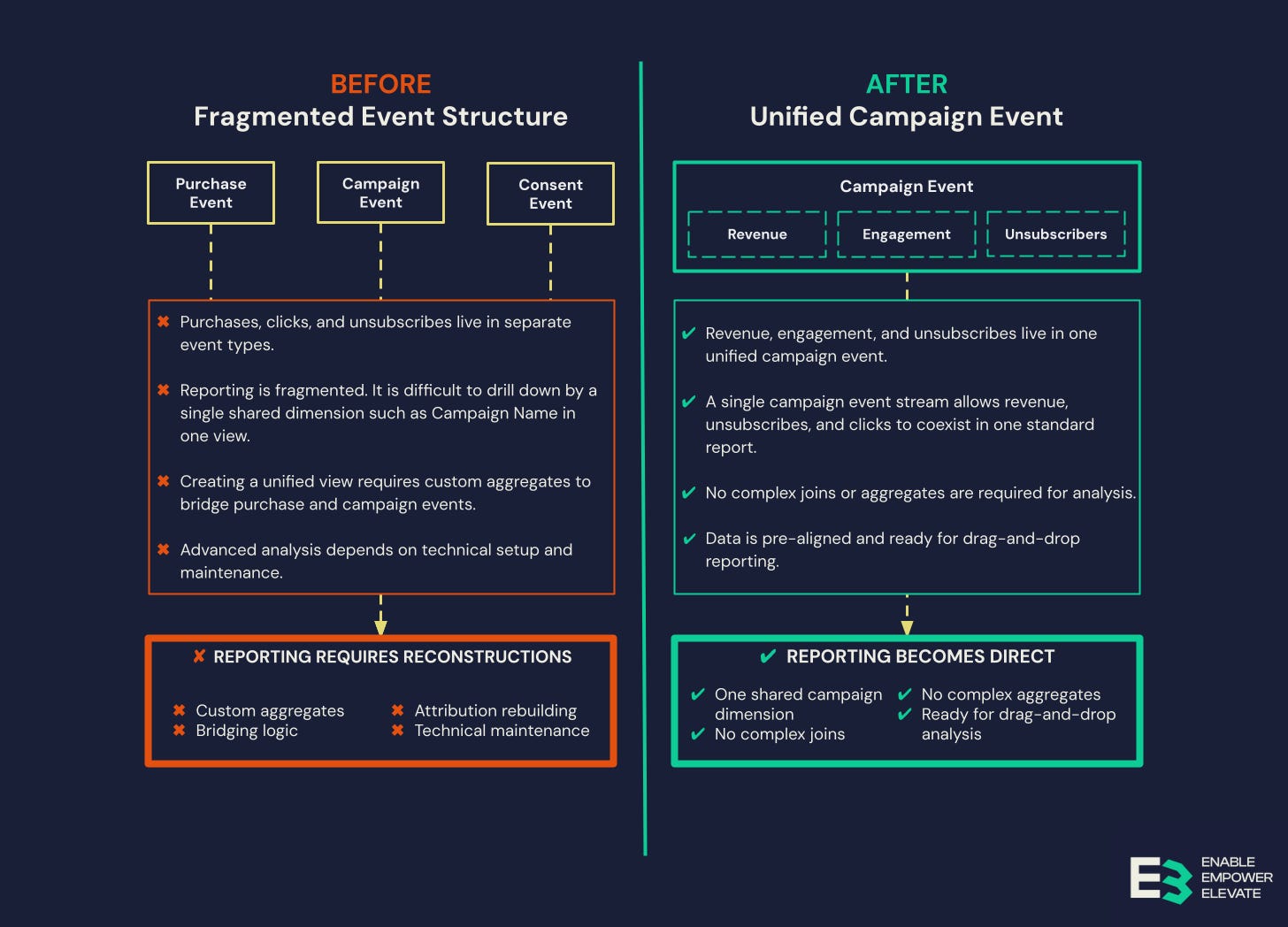
In a standard event setup:
Engagement lives in campaign events
Purchases live in purchase events
Unsubscribes live in consent revocation events
When you want a complete campaign view, you must bridge these event types.
In practice, that often means working with aggregates and running aggregates.
For example:
Using a running aggregate to identify the last qualifying click before a purchase
Deciding whether to include or exclude the triggering event itself
Applying time-window conditions inside the aggregate
Grouping by campaign attributes to reconnect conversion to campaign context
Filtering specific interaction types
These tools are powerful. Bloomreach provides detailed control over how events are counted and evaluated.
But they also introduce complexity.
Advanced reporting depends on maintaining these aggregates correctly. Attribution logic may be replicated across multiple reports. Small configuration differences can lead to inconsistent numbers if not carefully managed.
Bloomreach dashboards already handle part of this logic internally by joining engagement and purchase data to present unified views.
However, dashboards are structured environments. They are optimized for standardized drilldowns and predefined views.
When CRM teams want more flexibility, they often return to aggregates and custom logic again.
And that is where reporting once again starts to feel heavier than it should.
As CRM programs mature, reporting questions become more specific.
For example:
This campaign generated strong revenue, but which engagement segments actually drove it?
Did active users convert differently than passive ones?
Which customer segments generated the strongest response?
Did certain markets generate higher revenue per send?
How did unsubscribe rates compare across revenue-driving segments?
Where do users drop off between send, engagement, conversion, and unsubscribe?
None of these questions are exotic.
They are typical follow-up questions once basic campaign KPIs are understood.
But answering them consistently requires revenue, engagement, and unsubscribe data to be unified at the campaign level.
Otherwise, each analysis depends on bridging logic behind the scenes.
Below is an example of a campaign performance report built on a unified campaign event structure. Revenue, engagement, unsubscribe rate, and conversion metrics coexist under a single campaign dimension without additional bridging logic.
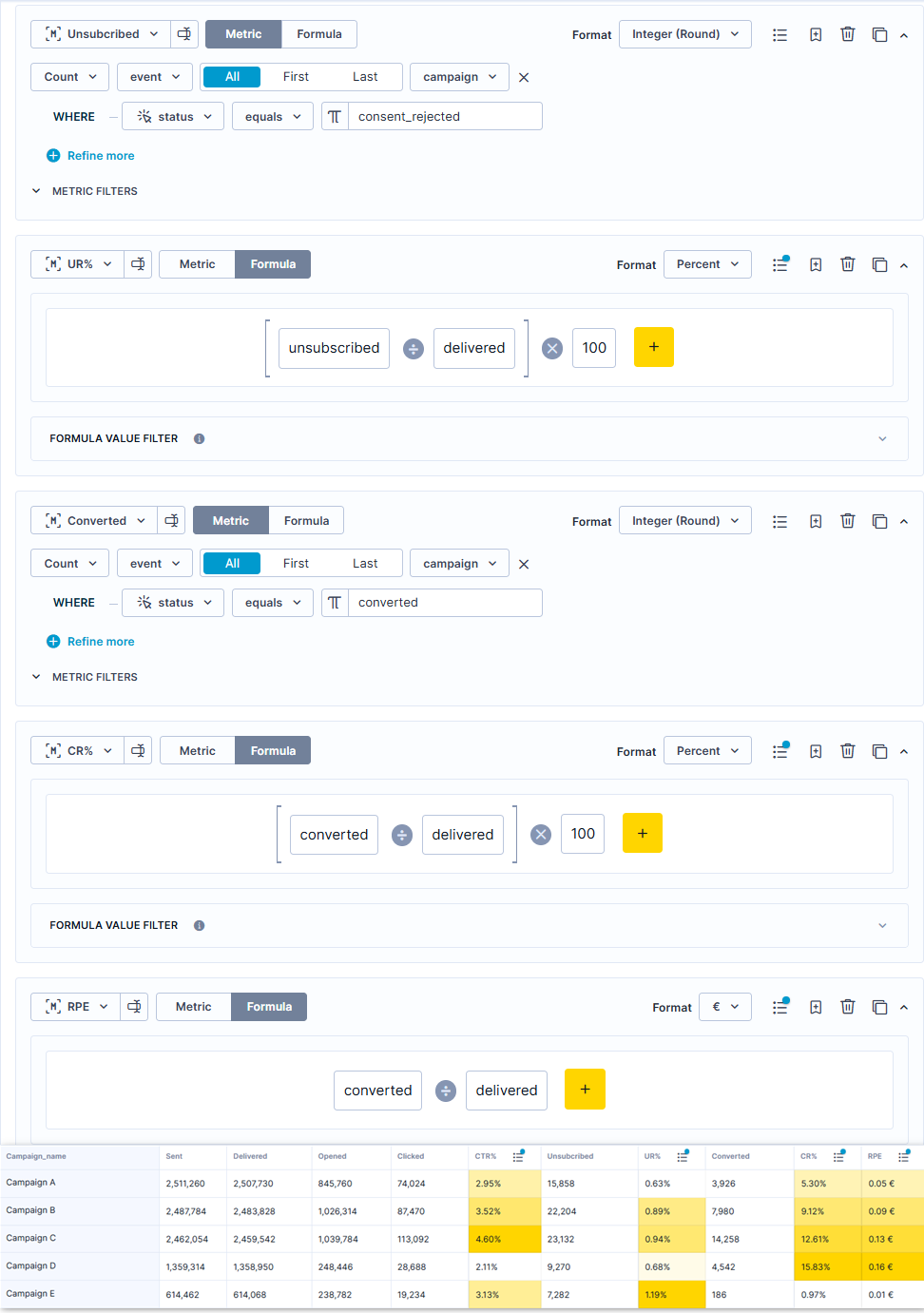
When conversions and unsubscribes are written into campaign events, reporting becomes materially simpler.
The questions raised earlier become much easier to answer.
CRM teams can:
Compare revenue and unsubscribe performance across engagement segments such as active and passive users
Evaluate which customer segments generated the strongest response within the same campaign view
Analyze campaign performance by market using a single shared campaign dimension
Review revenue and unsubscribe impact side by side without switching between event types
See where users drop off between send, engagement, conversion, and unsubscribe
This is not about introducing new metrics.
It is about removing fragmentation.
Instead of rebuilding attribution logic across multiple reports, it is defined once.
Instead of bridging purchase and consent events each time deeper analysis is required, campaign reporting already contains the necessary context.
The result is simpler, cleaner, and more consistent CRM reporting.
Bloomreach has done a strong job standardizing email reporting. The native dashboards address most operational needs and significantly reduce complexity for CRM teams.
This approach does not replace those dashboards.
It builds on them.
By simplifying the event structure behind campaign reporting, dashboards become more flexible and easier to extend.
When conversions and consent rejections are campaign-native, reporting friction decreases. CRM teams can focus on interpreting results instead of maintaining technical setup.
The biggest gain is operational clarity.
Campaign performance is evaluated through one unified dimension.
Advanced drilldowns no longer require custom builds. New insights do not depend on additional technical setup. Reporting becomes faster, cleaner, and more consistent across teams.
Simplifying campaign reporting does not require new dashboards.
It requires simplifying the event structure behind them.
And once that structure is in place, deeper evaluation becomes a natural extension of everyday reporting.
Comments
Nothing yet. Say the first thing.
Sign in to join the conversation.