
This article builds directly on Part 1 of the series.
If you haven’t read it yet, start here:
Optional audio overview (≈4 minutes)
A short architectural walkthrough of the core idea behind this article: why render-only email components work initially, and why they break down once email is treated as a send-time system.0:00
-3:25
Render-only email components are not inherently wrong.
They do exactly what they are designed to do:
receive inputs
generate HTML
render content consistently
For a long time, that was enough.
The limitation appears only once email is treated not as a static deliverable, but as a system that executes decisions at send time.
In that context, rendering stops being the primary responsibility.
A render-only component answers a narrow question:
“Given these inputs, can I produce HTML?”
In a send-time system, that question is no longer sufficient.
What matters is not whether something can be rendered, but whether it should be rendered at all, given the current context.
Render-only components do not evaluate that.
They assume the inputs are valid, intentional, and appropriate. If something is passed in, they output it.
That assumption used to hold. It no longer does.
As CRM programs mature, several changes happen simultaneously:
campaigns are reused across markets
automation replaces manual selection
personalization increases surface area
dependencies on live catalog and pricing data deepen
In this environment, correctness becomes systemic.
It no longer depends on one campaign or one marketer making the right choice. It depends on the system behaving correctly every time, across thousands of executions.
Render-only components push responsibility outward:
to campaign configuration
to QA processes
to documentation
to human vigilance
That works only while scale is limited.
The failure mode is not dramatic. Nothing crashes. Nothing errors. The email still sends.
The system simply does the wrong thing quietly.
One of the most misleading signals in email systems is a successful render.
If the HTML is valid and the preview looks correct, the campaign is considered safe.
But render success confirms only one thing:
the component displayed what it was given
It does not confirm:
that the data was still valid at send time
that constraints were respected
that edge cases were handled intentionally
In send-time systems, this gap accumulates risk silently.
The system keeps working, until someone notices the outcome.
Once email is understood as a send-time system, the architectural question becomes unavoidable:
Where should the final decision about correctness be made?
Not in:
the recommendation engine, which selects candidates
the campaign definition, which expresses intent
the editor preview, which is only a snapshot
The decision has to live at the boundary where content becomes output.
That boundary is the component.
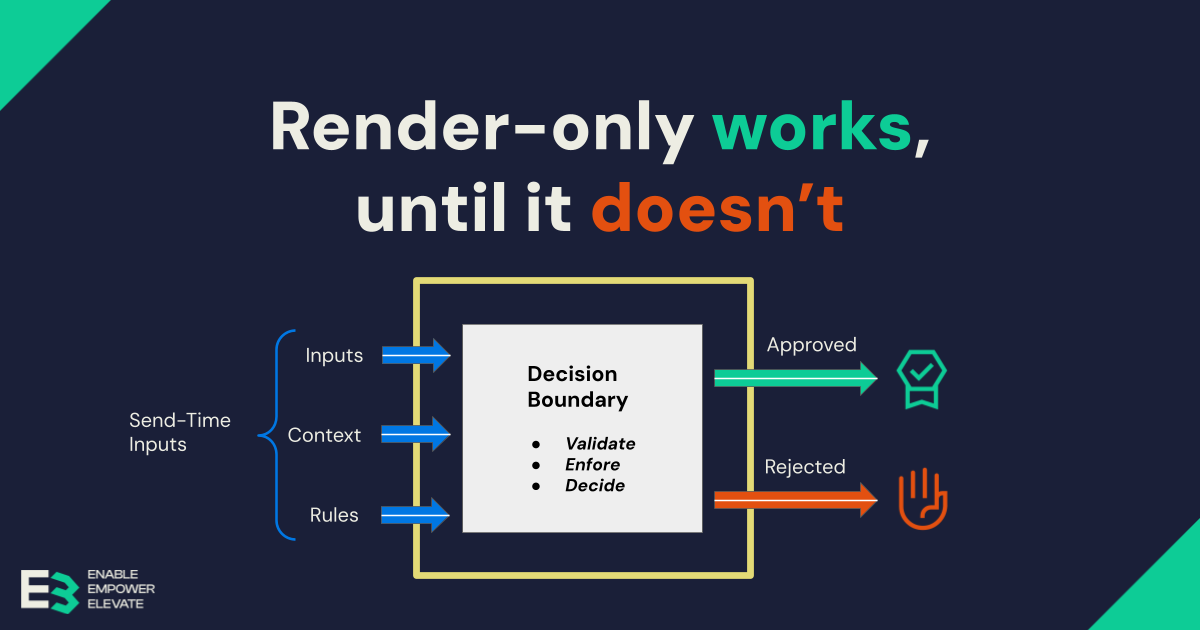
Render-only components have no authority.
They cannot:
validate inputs beyond presence
enforce campaign-level constraints
reason about context
decide that rendering would be incorrect
Their implicit contract is simple:
“If something is passed to me, I will render it.”
That contract made sense when email was static.
In send-time systems, it becomes a liability.
This is where the distinction introduced in Article 1 becomes operational.
A decision-capable module is not defined by appearance or editor behavior. It is defined by responsibility.
Such a module:
evaluates inputs at send time
applies explicit constraints
handles edge cases deliberately
can decide not to render when output would violate its contract
This is not added intelligence. It is ownership.
In render-only systems, not rendering is treated as failure.
In decision-capable systems, not rendering is a valid outcome.
It means:
constraints were enforced
correctness was preserved
the system behaved intentionally
This represents a shift in mindset:
from always producing output
to producing output only when it is correct
As CRM systems evolve, this shift is unavoidable.
Systems either:
encode responsibility where decisions occur, or
rely increasingly on human oversight to compensate
Render-only components belong to the first phase of email maturity.
Decision-capable modules belong to the next.
This article stops short of implementation on purpose.
The next step is not tooling. It is defining the contract of a decision-capable module:
what it validates
what constraints it enforces
what it is allowed to refuse
That is where the theory turns into architecture.
In the next article, we will examine what it actually takes to make a component decision-capable in practice, and why this responsibility cannot be retrofitted at the campaign level.
Comments
Nothing yet. Say the first thing.
Sign in to join the conversation.