
Author’s note: Earlier this month, I had an epiphany about the youth mental health crisis and how it connects to the distress so many of us are feeling given the state of the world. That epiphany sent me down a deep dive into analyzing the publicly available Monitoring the Future survey data on teen depression. What came out of that and the analyses that followed is the piece below: it counters the most prominent explanations for the youth mental health crisis, lays out my own nervous-system-based model for what I think is actually driving it, and includes original data figures throughout.
Enjoy!
Correction, July 23, 2026: After this piece went up, I found an error in one data point in Figure 3 (worry about race relations by political ideology and sex). A change in codebook style in 2021 caused the 2021 data point to be misread. I've traced the error, fixed it, and replaced the figure. The corrected data does not change the trend or conclusions in this piece.
Since around 2012, teen mental health in the United States has plummeted. And interestingly, this trend appears to depend (at least in part) on political alignment, with the sharpest declines seen among liberal teenagers, and especially liberal girls.
The figure below shows this trend, with depressive affect among liberal girls and liberal boys rising sharply around 2012, and conservative teens showing a slower and smaller rise.
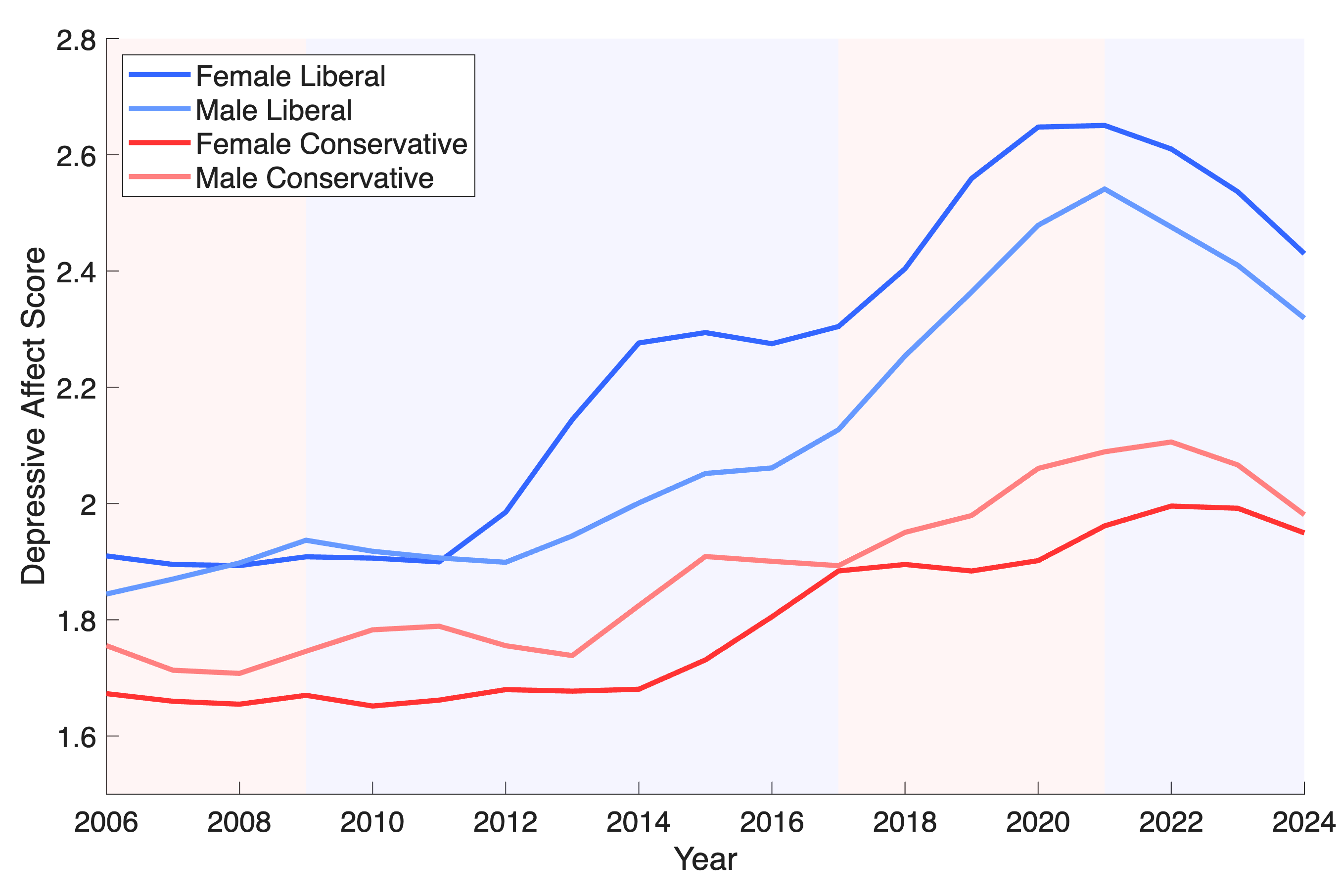
Figure 1: Depressive affect score among US 12th graders by sex and political ideology. Data source: Monitoring the Future survey. Shaded areas represent Republican (red) versus Democratic (blue) presidencies. Data analyzed using MATLAB R2026a. Note that this image is a full replication of Figure 1 from Gimbrone et al., 2022 and thus uses the same methods for depressive affect composite calculation and handling of missing data. Also note that because Gimbrone et al., 2022 did not report data pooling methods, the values reported here for 2016 and later (when depressive affect survey questions were added to multiple survey forms) may vary slightly from the original Gimbrone publication.
This finding was originally reported by Catherine Gimbrone and colleagues in 2022 and the cultural response to it was predictable. Most people, including some of the most prominent voices in the cultural discussion around teen mental health, concluded that obviously something must be wrong with liberal teens, and especially with liberal girls.
Jon Haidt (author of The Coddling of the American Mind and The Anxious Generation) is one of the clearest examples of this, broadly arguing that modern teen distress, particularly among liberal girls, is the result of smartphones that warp their brains, parents and universities that overprotect and coddle them, and progressive ideology that trains them into catastrophizing, fragility, and helplessness.
Of course, the fact that Haidt is the loudest voice in this debate does not necessarily make him correct, and many people have pushed back on his framework. One line of pushback argues that the world is genuinely hostile and that teen distress reflects that reality. Journalist Taylor Lorenz put it bluntly when she tweeted:
“People are like ‘why are kids so depressed it must be their PHONES!’ But never mention the fact that we’re living in a late stage capitalist hellscape during an ongoing deadly pandemic w record wealth inequality, 0 social safety net/job security, as climate change cooks the world”
A different line of pushback comes from researchers like Candice Odgers, who has argued that the evidence for smartphones as the root cause is far weaker than Haidt suggests, and that we should be skeptical of his strong claims.
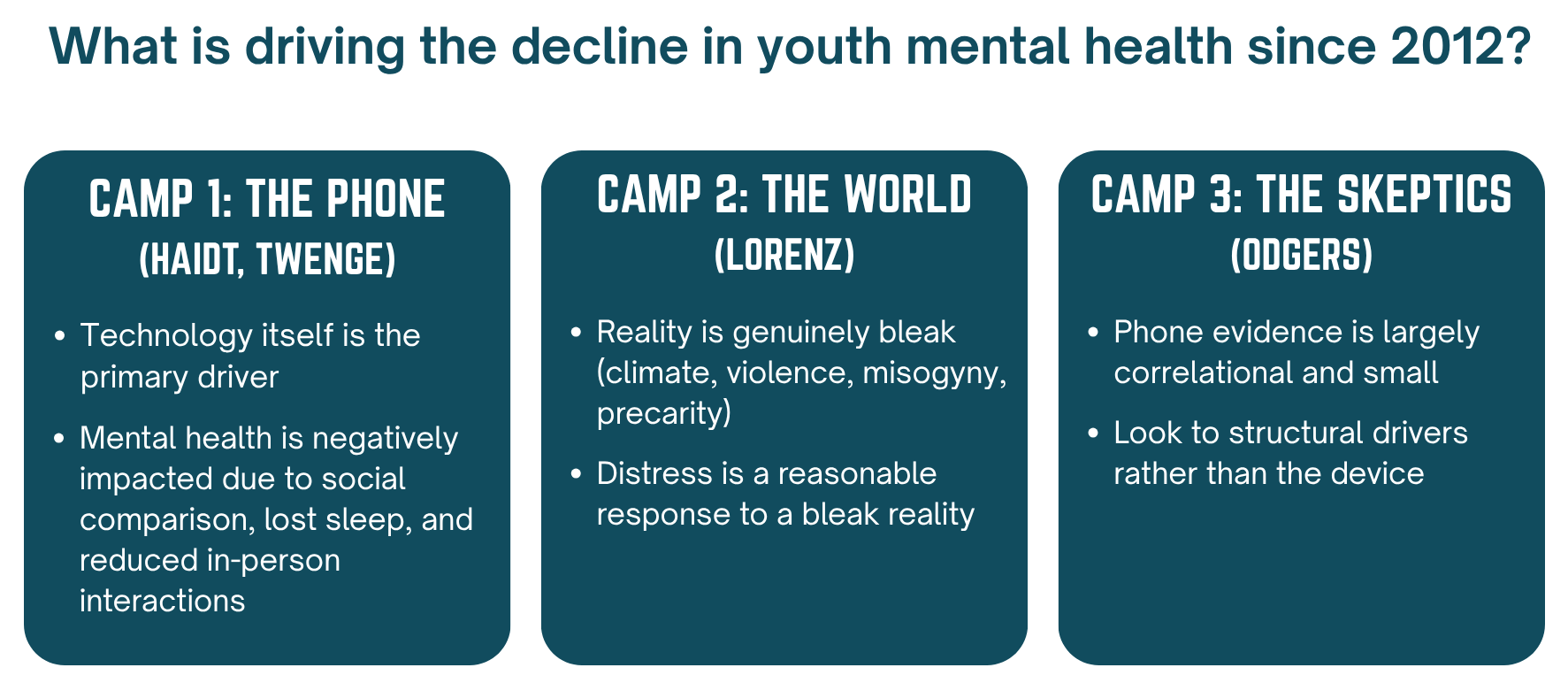
Thus, the debate surrounding the teen mental health crisis has settled into three primary camps: the Smartphone Camp, which blames the technology; the World Camp, which blames real-world conditions; and the Skeptics Camp, which doubts that the evidence supports smartphones as a primary driver.
It’s worth noting that more than three alternative explanations for the youth mental health crisis have been proposed, and Haidt (along with psychologist Jean M. Twenge) have countered many of them on Substack (here and here). I’ll spare you the nitty gritty details, but one of their arguments is particularly important for this piece. Haidt and Twenge argue that genuinely threatening real-world conditions like the COVID-19 pandemic, gun violence, climate change, capitalism, and recessions cannot explain the teen mental health crisis, because none of these things noticeably changed in 2012 when teen mental health sharply declined.
Twenge goes further, arguing that modern conditions don’t actually warrant the level of alarm we’re giving them. In her Substack post (published in 2023), she runs through a list of comparisons, including the 2020 pandemic, the 2008 financial collapse, World War II, and infant mortality rates in the early 20th century, to make the point that every generation has faced serious hardship. What separates them, she argues, is “whether the reaction to those challenges is action or nihilism [which] is more about perception and psychology.”
On its face, this objection seems somewhat reasonable (if slightly gaslighty), given that the timing of the decline in teen mental health really does line up with smartphone adoption rather than with any obvious shift in world events.
However, here is where I think Haidt and Twenge go wrong.
The relevant question isn’t whether real-world conditions changed in 2012. The question is whether the amount of threat that teens were exposed to on a daily basis increased. And the unequivocal answer to that second question is “yes”.
Because the thing about our nervous systems is that they don’t track statistics on violence, pandemics, or economies. They respond to the amount and intensity of threat cues that reach our brains. And in 2012, the rise of the smartphone meant that we were suddenly bombarded with a constant stream of threat cues about a massive number of highly distressing real-world events.
On a nearly daily basis, we view some of the most distressing content a human will ever encounter.
We watch as the limp and bloodied bodies of babies and children are pulled from rubble in Gaza.
We watch as American mothers race barefoot across pavement to determine whether their children have been killed at school.
We watch horrifying close-up footage of a man shot in the neck, a young woman stabbed to death on public transit, and Americans repeatedly killed by immigration officers.
In previous eras, images and videos like this would have been mostly confined to military contexts and war zones, or to a highly sanitized nightly news broadcast. But now, we see them, mostly uncensored, on a nearly daily basis. And most of us don’t even seek these images and videos out. They arrive on our feeds uninvited, pushed by an algorithm that cares very little about our nervous systems’ inability to process such a steady stream of threat cues or the toll it’s taking on our mental health.
Thus, I think the smartphone might be best understood as something like a telescope. Just as the telescope let us see stars and planets that already existed but had been beyond the reach of the naked eye, the smartphone let us see the full breadth of the world’s horror and dysfunction, which was largely invisible to many humans (particularly Americans) before 2012.
It’s also important to note that the invention of the smartphone didn’t just impact our exposure to threat cues. It also displaced in-person interactions. This is a critical point, because it means that at the same time that the smartphone began to drown us in threat cues, it also displaced the in-person co-regulatory conditions that would otherwise have helped buffer our bodies’ threat response system and resolve threat-driven dysregulation.
Thus, the World Camp and the Smartphone Camp are not actually in conflict. They are describing the same mechanism from opposite ends. The World Camp is right that the threats are real and that teen distress is not some sort of overreaction or cognitive distortion. The Smartphone Camp is right that the technology is central and that 2012 is the critical pivot. The Skeptics Camp is right that phones are not the root cause.
What all of the Camps are missing, however, is the thing that is driving all of it and why liberal teens are suffering the most.
To understand what the smartphone actually did, we have to look at the world it arrived in.
Countries throughout the world vary in regard to how individualist they are, meaning that they differ in how much they support (or work against) the interdependent and co-regulatory conditions humans evolved to rely on. The United States is at the extreme end of the individualism spectrum, and is what many have called a “hyperindividualist” society.
And this hyperindividualist societal design has two important consequences.
First, hyperindividualism heightens baseline threat. When a society structures itself around hyperindividualism, competition increases and economic precarity is viewed as a personal failure rather than a structural failure. At the same time, social safety nets weaken and status becomes a primary measure of worth (which means that social evaluation and comparison become a chronic source of threat).
Second, hyperindividualism erodes communal infrastructure. The same condition that demands individual self-sufficiency also dismantles the structures that once helped people process and tolerate threat collectively (via co-regulation), including close neighborhoods, religious communities, extended family networks, unions, civic organizations, and regular, ordinary in-person contact. This means that individuals are often left to process highly distressing collective problems like climate change, gun violence, and political instability alone and in isolation.
Thus, hyperindividualism produces conditions that are simultaneously more threatening and more lonely. In nervous system terms, this means that hyperindividualism chronically activates our body’s alarm system while also removing the tools we evolved to shut the alarm off.
Then, around 2012, the smartphone arrived.
The smartphone acts on both halves of the hyperindividualist condition at once. It acts as a telescope, allowing us to view an unprecedented amount of threat, while also accelerating the erosion of communal structures that support co-regulation and interdependence.
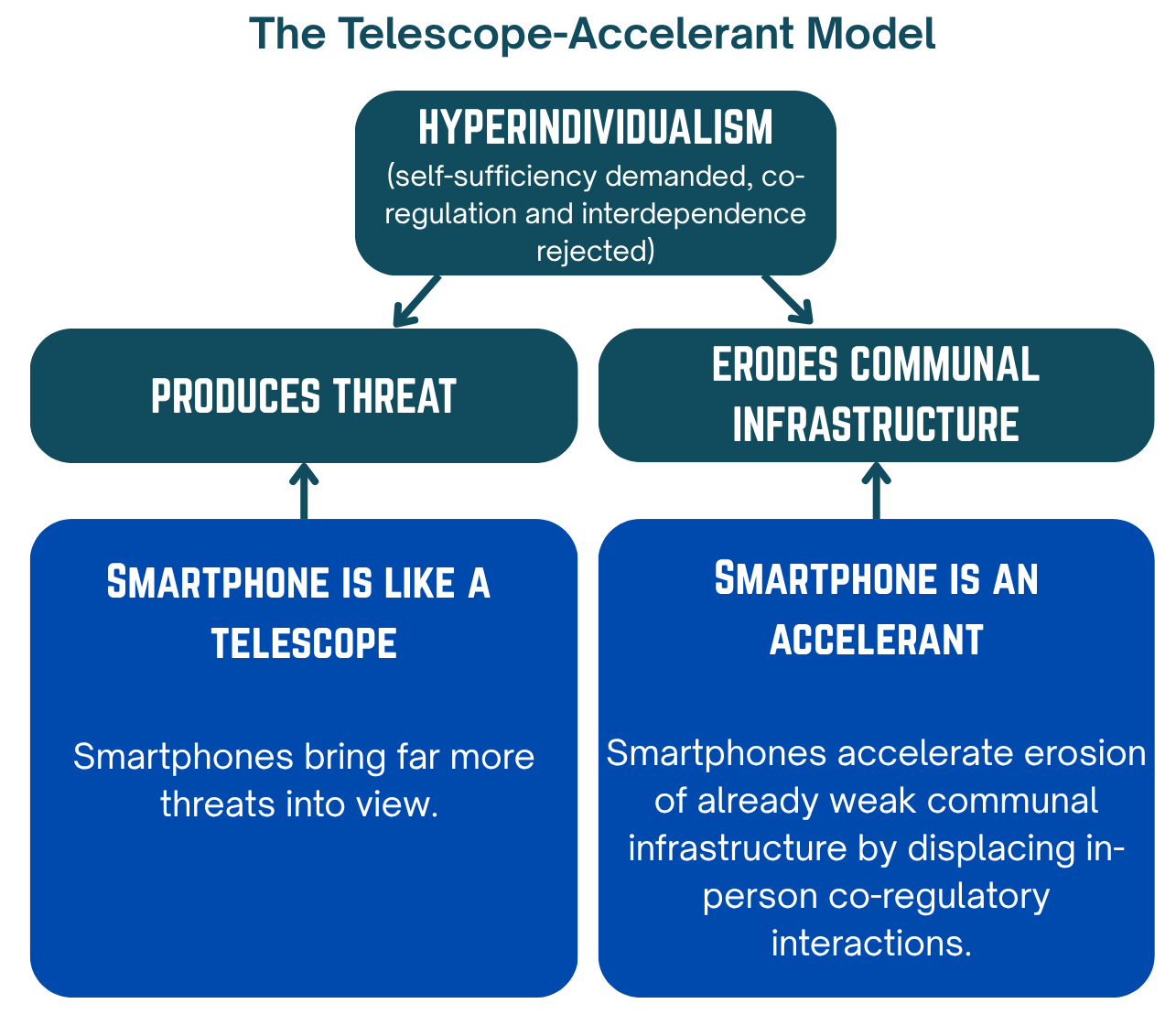
The smartphone didn’t create inequality, climate change, gun violence, economic precarity, or social comparison and status competition, but it did make those threats continuously visible, in real time.
In 2012, an algorithmically curated feed became the primary way most adolescents encountered the world. And, importantly, that feed is built to hold attention, and one thing that holds attention very well is threat. So instead of learning about global crises periodically through an evening news broadcast, adolescents began receiving a steady stream of climate catastrophe, mass shootings, political dysfunction, war, wealth inequality, reproductive rights rollbacks, anti-LGBTQ legislation, and racial injustice.
Thus, the youth mental health crisis is not a matter of progressive ideology training teens to be depressed and helpless. Smartphones are delivering an accurate picture of a chronically threat-saturated human world, and that threat-saturated environment is driving mass dysregulation and distress within all of us.
And the research supports this. Work by Roxane Cohen Silver, E. Alison Holman, and colleagues has established that encountering real-life threatening events (like bombings and shootings) through a screen produces a genuine physiological stress response that is sometimes even greater than that of direct exposure to the threats themselves.
The second half of my Telescope-Accelerant model matters just as much.
The smartphone doesn’t just deliver threat. It also displaces the thing that would otherwise buffer threat. A teenager scrolling alone in a bedroom at midnight is receiving constant threat cues while losing the in-person, face-to-face interactions that would help a distressed nervous system return to baseline.
Hyperindividualism had already been eroding communal life for decades, and the smartphone accelerated that erosion. It promises connection while displacing the relationships that actually regulate us.
This is why the model needs both halves. My model predicts that if a smartphone is introduced to a society with rich communal infrastructure, it causes less distress because it delivers threat cues to nervous systems that are buffered by a rich co-regulatory environment. In contrast, if a smartphone is introduced to a hyperindividualist society, it delivers threat to nervous systems that are not buffered by a co-regulation-rich environment.
And Haidt’s own work supports this hypothesis. In a Substack piece reviewing the international evidence, Haidt and Zach Rausch found that the decline in adolescent mental health was sharpest in the most individualistic nations.
That is exactly what my model predicts.
This is the part of the data that all of the dominant explanations of the youth mental health crisis (especially Haidt’s) handle very badly. And it’s also the part that most strongly supports my Telescope-Accelerant model.
Haidt and Greg Lukianoff interpret the steeper declines in mental health among liberal girls as evidence for what they call the “reverse Cognitive Behavioral Therapy” (reverse-CBT) hypothesis, which is the idea that progressive ideology teaches young people cognitive distortions that result in catastrophizing, fragility, and helplessness, in effect training liberal girls into depressive thinking.
However, I strongly believe that Haidt and Lukianoff are way off base with this hypothesis, and the evidence supporting my position ironically comes from Haidt’s own research.
As I’ve written about before (here and here), in 2019, Haidt co-authored the finding that adult liberals extend moral concern to broad social circles (for example, marginalized populations, people in other nations, and humanity as a whole), while conservatives focus it on narrower ones (for example, self, family, and close community).
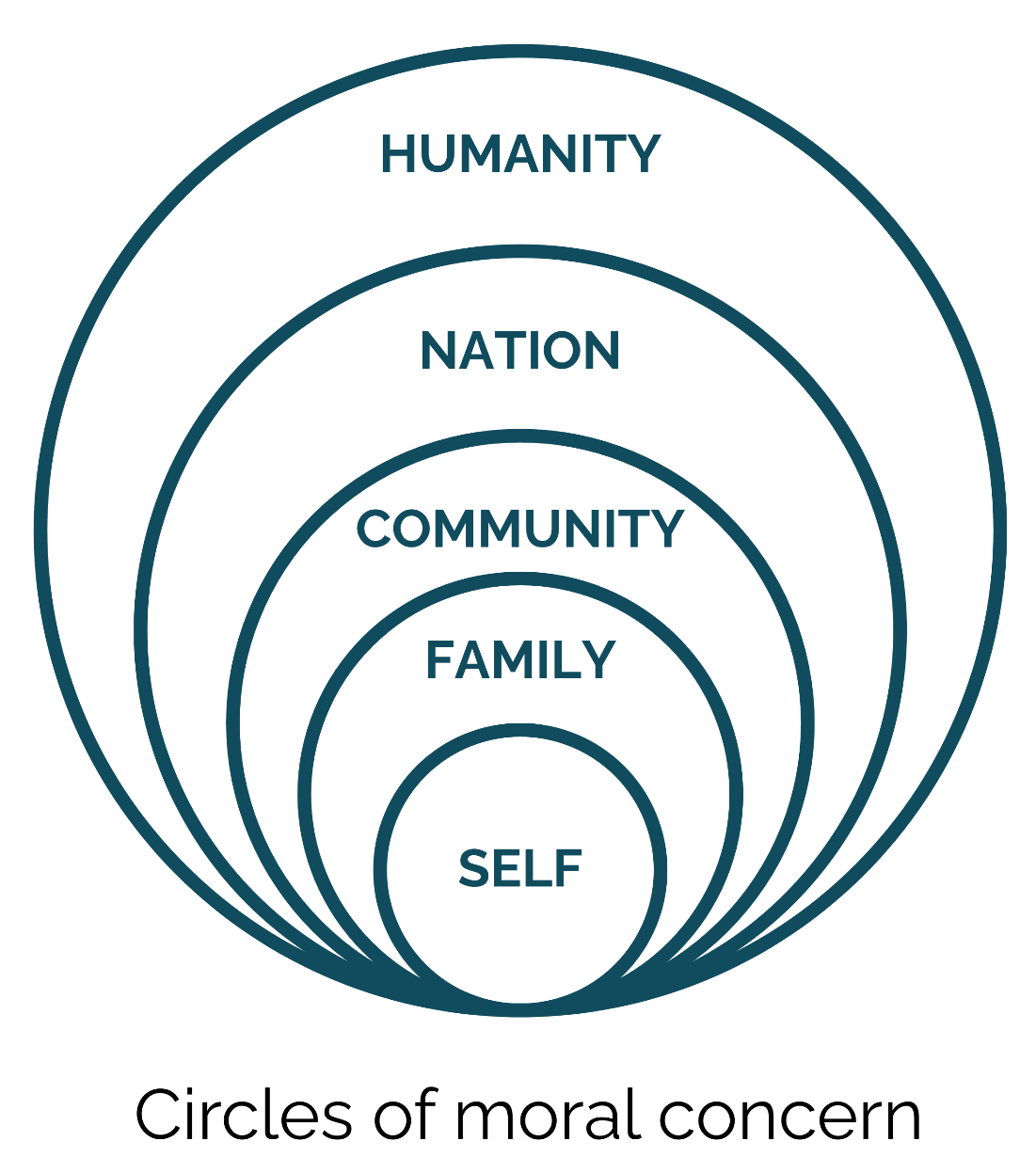
If liberal adolescents also hold wider moral circles on average (which is a reasonable extrapolation of the adult data), then an algorithm-driven media environment delivers more morally salient threat to them. Critically here, it’s important to know that liberals don’t show less concern toward the center circles (i.e., all groups show high moral concern for the inner circles of self, family, community) — liberals simply ALSO extend concern outward. This is an important distinction because it means that broader moral circles encompass a greater number of salient threat cues than narrow ones (rather than an entirely different set of threat cues).
This distinction also matters because it lets us separate two layers of threat exposure that my Telescope-Accelerant model predicts. The first layer is universal: since the rise of the smartphone in 2012, every teenager, regardless of political or moral ideology, has been exposed to the same algorithmically curated stream of threatening content, including self-harm content, violent imagery, and social comparison and status threat. This is why conservative teens’ depressive affect also rises after 2012, even though their rise is smaller and later than liberal teens’.
The smartphone functions as a threat-delivery device for everyone.
The second layer of threat depends on moral circle width. If liberal adolescents hold wider moral circles on average, then an algorithm-driven media environment delivers an additional stream of morally salient threat to them specifically, on top of that shared baseline. While a conservative teen may scroll past a post about climate change or a distant war, a liberal teen, with a wider moral circle, registers that information as a threat because it impacts people who fall within their circle of moral concern. That threat then produces more physiological activation of the body’s alarm system, and chronic activation eventually leads to dysregulation and distress.
Fortunately, the Monitoring the Future survey data also lets us test this moral circle hypothesis directly, rather than just extrapolate it from the adult data above. When you ask teens how much they worry about various national problems, liberal and conservative teens diverge sharply on some issues, but not others, and the pattern of divergence maps cleanly onto moral circle width. Worry about the economy, for instance, is similar between liberal and conservative teens across nearly two decades of data, which suggests that liberals are not simply more worried across the board.
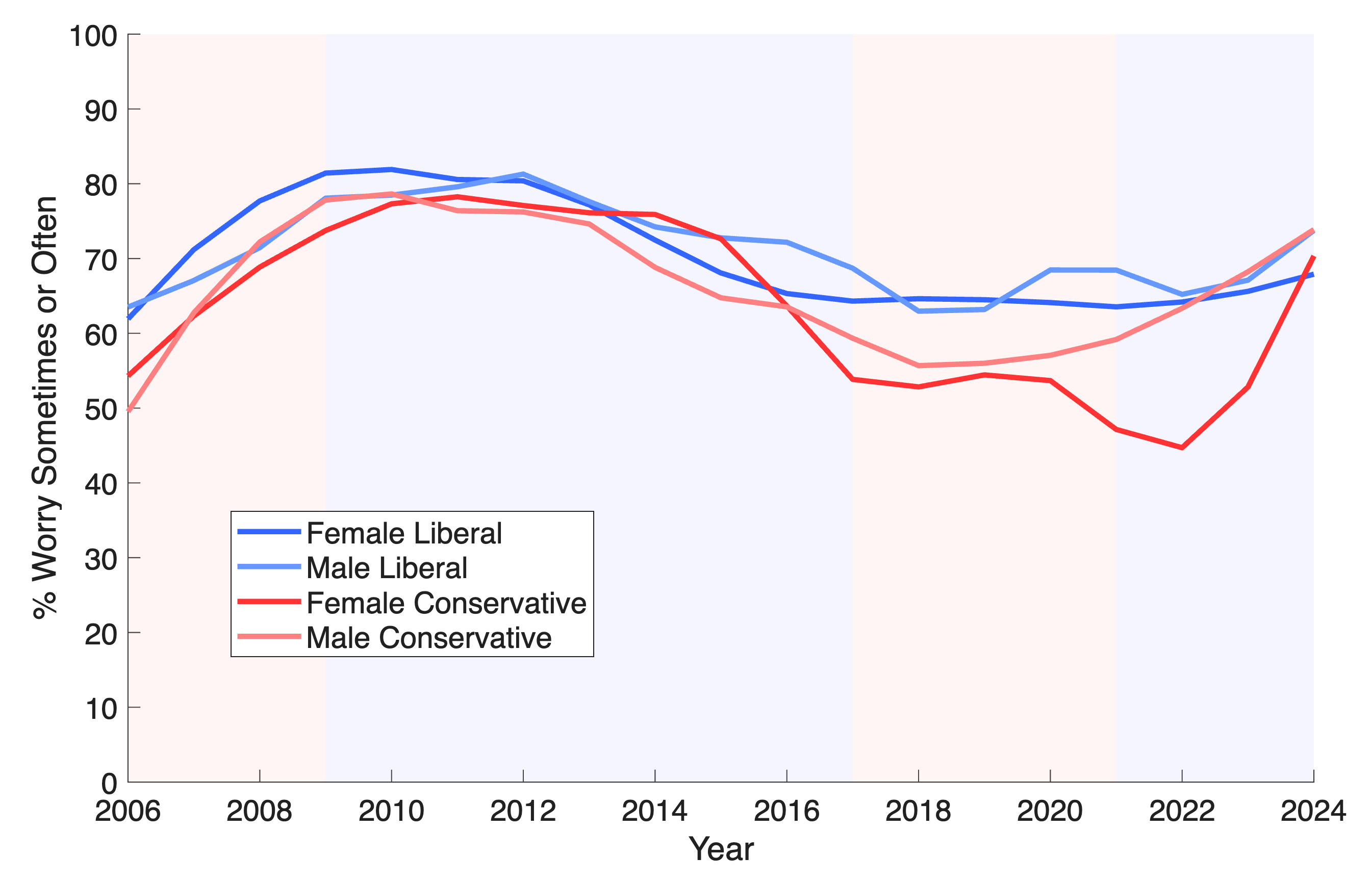
Figure 2: Percent of 12th graders who sometimes or often worry about economic problems facing the nation, by political ideology and sex. Source: Monitoring the Future.
In contrast, worry about race relations shows a large partisan gap, with liberal worry climbing sharply beginning around 2013 while conservative worry stays flat or declines. This is exactly the kind of concerns (the treatment of other groups) that a narrower circle of moral concern would filter out and a wider one would not.
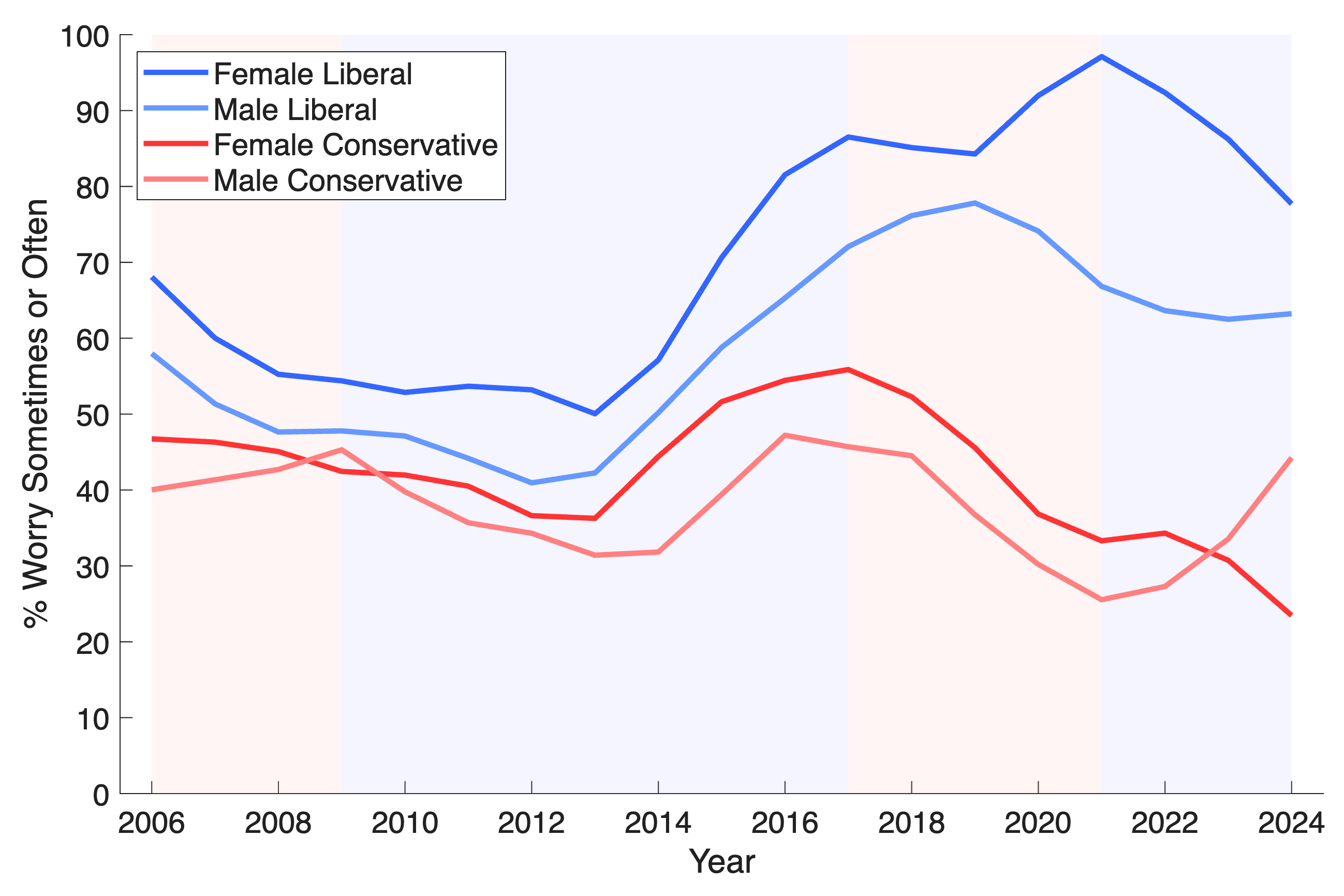
Figure 3: Percent of 12th graders who sometimes or often worry about race relations, by political ideology and sex. Source: Monitoring the Future.
So the split isn’t between liberals who worry about everything and conservatives who worry about nothing. Both groups worry about threats to themselves and their immediate circle at similar rates. But only one group is also carrying the weight of threats that fall within broader moral circles of concern.
A natural objection to this argument is that the causality runs the other way, and that liberal girls’ depression produces the perception of a dangerous world, not the reverse.
However, I think this misunderstands what the smartphone actually does.
The threats liberal girls encounter are, for the most part, real events rather than cognitive distortions. The smartphone is simply the tool that exposes them to far more of it. The telescope analogy is useful again here. Nobody would argue that the invention of the telescope caused humans to imagine more stars. It allowed people to see more of what was already there.
More importantly, the mechanism I’m describing is not a conscious cognitive appraisal that the world is dangerous, which a low mood could plausibly color. It’s repeated physiological activation of the body’s threat-response system by a steady stream of real and salient threat cues, which produces chronic activation of the body’s alarm system, leading to dysregulation and depressive symptoms. That happens regardless of what an adolescent consciously believes or what their baseline mood happens to be.
There are also several other lines of evidence that support my framework over Haidt’s. These are as follows:
1. The dominant split in the data is political, not sex-based.
Haidt argues that girls are the most depressed because they spend more time on image-based platforms, like Instagram, and thus social comparison is the primary driver of greater distress among girls relative to boys. However, the dominant split in the Monitoring the Future depression data (i.e., the first image in this article) is by political belief, not sex. Liberal girls show the sharpest rise, but liberal boys are next, well above both conservative groups, while conservative girls and boys remain lower and rise later. This fits my model well given that liberal boys have wider moral circles than conservatives, so they land exactly where my threat-exposure account predicts. A social-comparison account can’t explain why conservative girls (who use the same image-based platforms) are among the least affected while liberal boys are among the most.
2. Civic efficacy is the strongest evidence against reverse-CBT.
Haidt’s argument that bad progressive ideology is training liberals into depression (via reverse-CBT) proposes a specific mechanism called an external locus of control, which refers to the belief that outcomes lie outside one’s control. But my own analysis of the teen mental health data (and previous analyses by Twenge) shows that liberal adolescents report much higher civic efficacy than conservative adolescents, especially when asked whether citizen groups can influence policy. Most importantly, their efficacy also rose as their distress rose (while conservatives’ efficacy fell), which is directly opposite to what the reverse-CBT argument predicts. If bad progressive ideology is training liberal girls into helplessness, and the belief that outcomes lie beyond one’s control, they should become LESS convinced that action works, not MORE convinced of it. A helplessness account cannot explain distress paired with high civic efficacy.
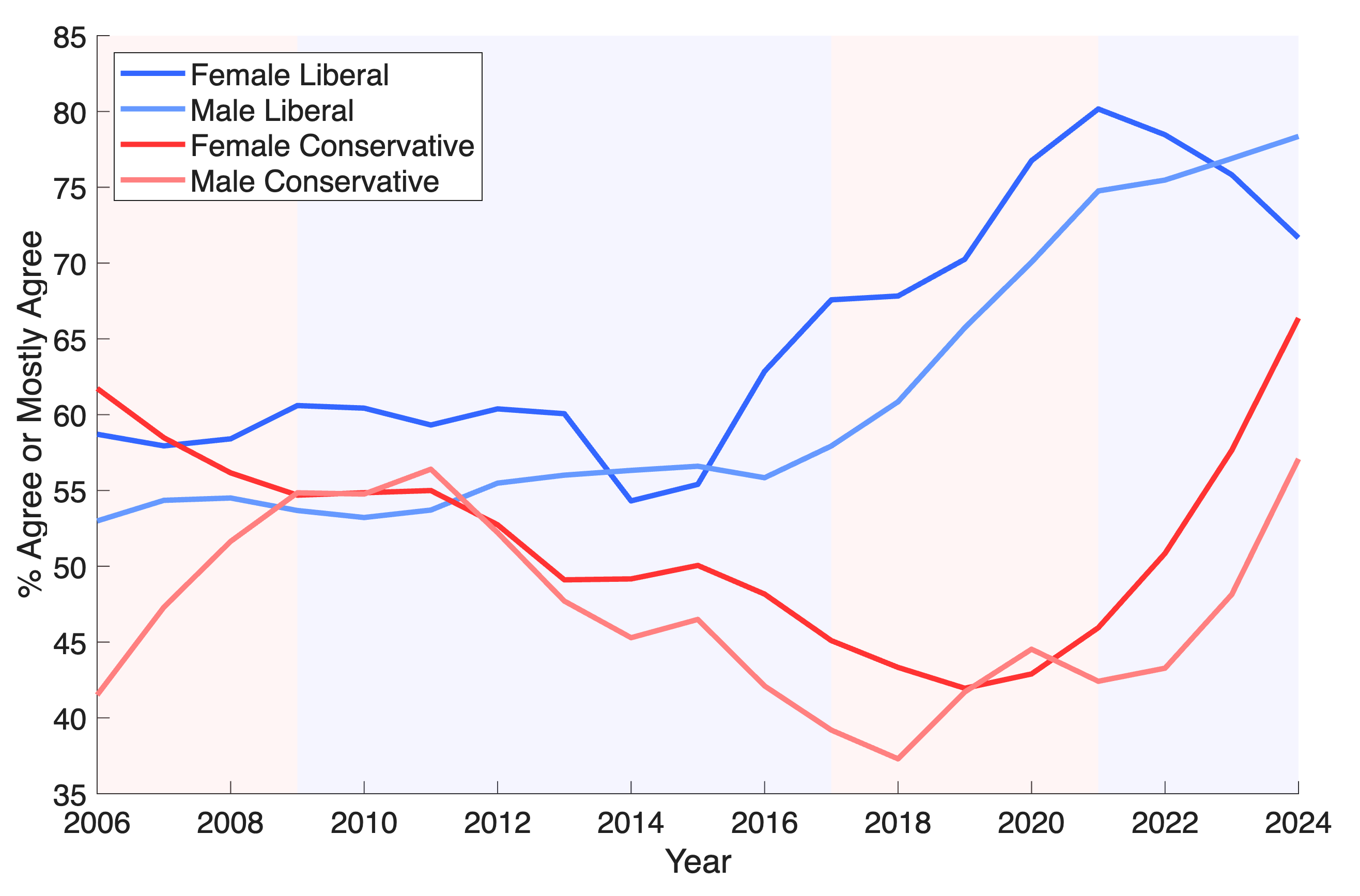
Figure 4: Percent of 12th graders who agree or mostly agree that citizen groups can influence government policies, by political ideology and sex. Source: Monitoring the Future.
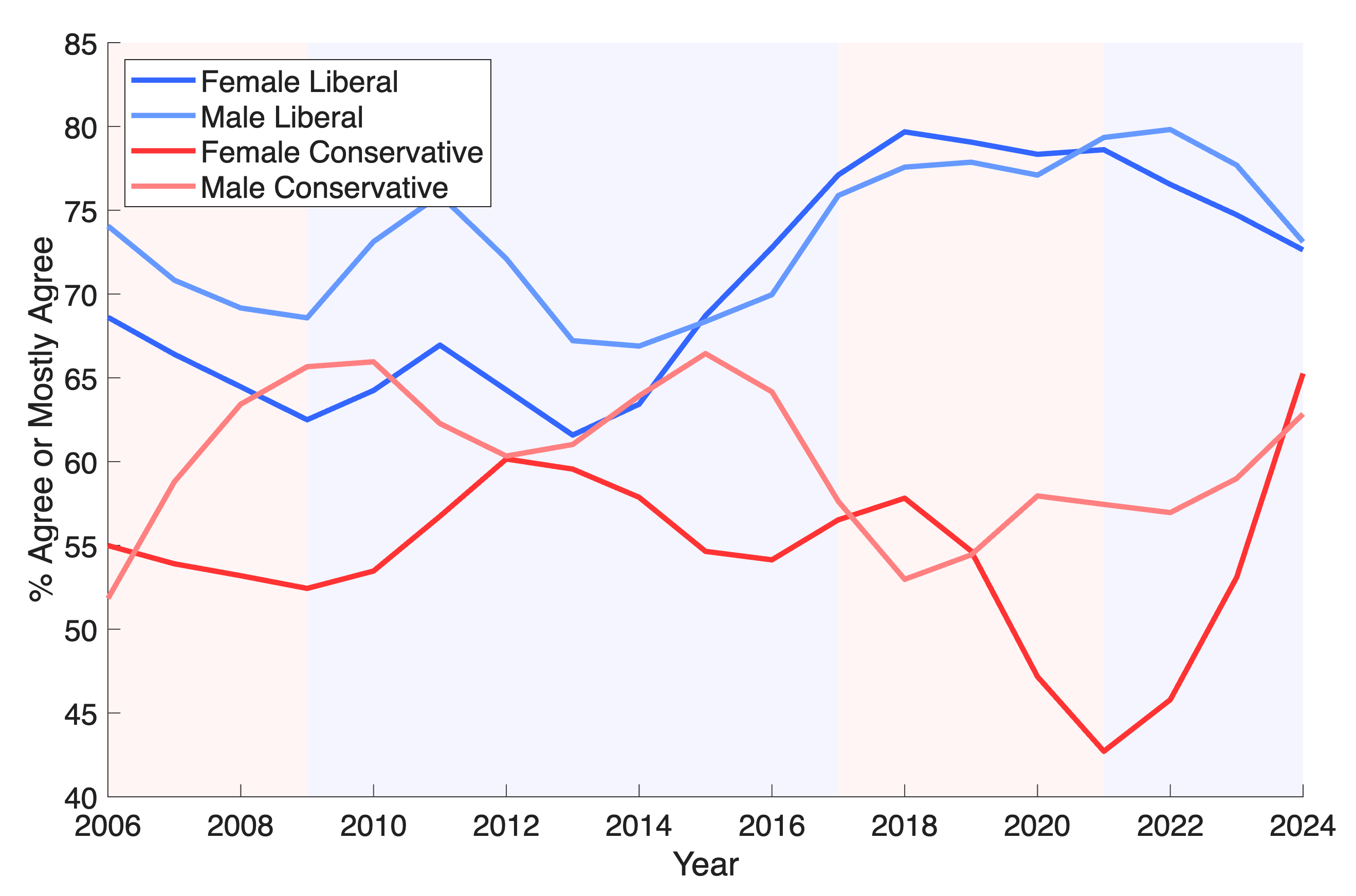
Figure 5: Percent of 12th graders who agree or mostly agree that good citizens try to change government policies they disagree with, by political ideology and sex. Source: Monitoring the Future.
3. The parental education finding.
In the Gimbrone depression data, the highest depressive scores of any subgroup belonged to liberal girls whose parents did not hold a college degree. If the mechanism were the transmission of distorted progressive ideas through elite institutions like universities (which is Haidt and Lukianoff’s primary argument), the heaviest burden should fall on the most elite families. But the data doesn’t support that.
4. Loneliness.
Liberal girls are not only more depressed, they’re also lonelier. This is well aligned with the accelerant half of my Telescope-Accelerant model. Research shows that media-driven distress drives heavier media consumption, and that heavier consumption delivers more threat and deepens distress (driving a self-reinforcing cycle of distress). Liberal girls are more likely to be pulled into this cycle due to their greater threat exposure via wider moral circles and thus end up spending more time online and less time with others. Those with narrower moral circles are less likely to be pulled into this cycle because they are exposed to fewer salient threat cues. Conservative adolescents may also be more buffered by the communal institutions that survive in their communities (e.g., religious congregations, family-centered networks, and thicker local ties).
5. The CBT paradox.
If teen distress were mainly a matter of distorted thinking, directly correcting that distortion should help. A recent Australian study tested exactly this: roughly 500 middle schoolers were taught a curriculum built around a type of CBT called DBT. Interestingly, the researchers found that the curriculum produced no meaningful improvement and actually increased depression, anxiety, and emotional dysregulation. (If you’d like to listen to an interesting conversation on this finding, journalist Derek Thompson and clinical psychologist Darby Saxbe discussed the results at length on his podcast.)
Note that I do have a theory about why some CBT methods (especially some types of cognitive reappraisal) could contribute to worse mental health (and what type of reappraisal would likely work better), but I'm holding that theory back for now since it will likely end up being a key piece of the book I'm currently writing.
Though the data I present here comes from teens, the Telescope-Accelerant Model is not specific to teenagers. We are all living with the same threat-delivering, co-regulation-eroding technology within the same threat-producing, co-regulation-eroding society. The effects are simply most visible in adolescents, whose nervous systems are still developing, who have the least control over their environments, and who have the fewest established sources of co-regulation to buffer what the phone delivers. Social-evaluative pressure also peaks in adolescence, which compounds it further.
Liberal teenagers are not distressed because they’ve been trained into catastrophizing, nihilism, or bad thinking. They’re distressed because: 1) they have wide moral circles, 2) the smartphone delivers a continuous stream of real threat into those circles, and 3) they’re facing it in a society that has systematically dismantled the communal structures that would have helped buffer that threat.
Teens are telling us that the air we’re breathing is poisoned, but instead of working to clean the air, we’re doing things like taking away their smartphones or blaming progressives and their bad ideas.
By doing so, we’re essentially telling teens that if they would just stop insisting on breathing in the poison, they’d all be just fine.
For more content like this (but in bite-sized video format), head over to my TikTok (@Dysregulation.Nation), YouTube, and Instagram (@DysregulationNation).
And, as always — stay calm, stay connected, and stay regulated.
—Brianna
No posts
Comments
Nothing yet. Say the first thing.
Sign in to join the conversation.