
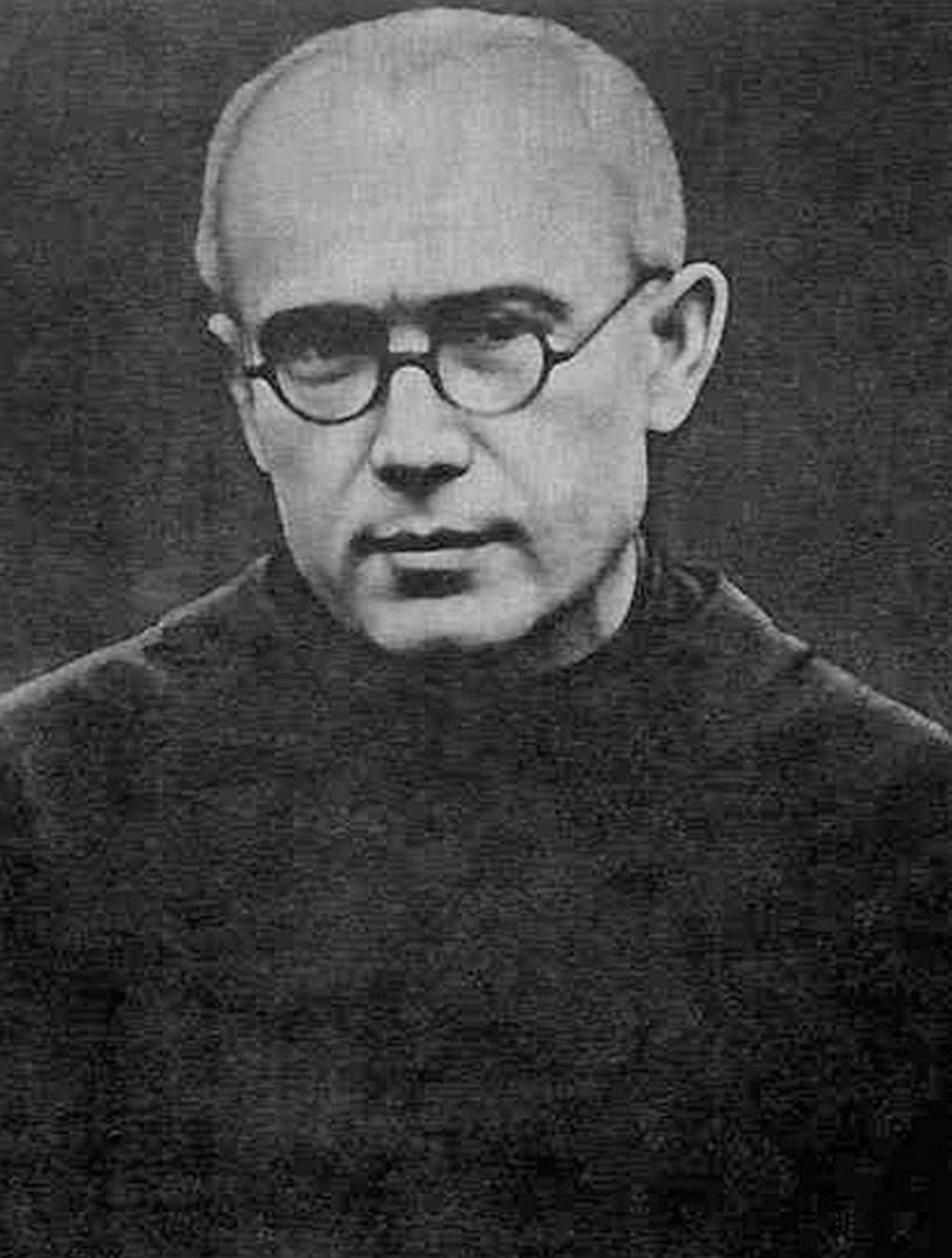
Today is the memorial of St Maximillian Kolbe and on my desk I’m looking at a collage from our parish pilgrimage to Poland ten years ago. One of the highlights for me was to celebrate Holy Mass on Kolbe’s altar at Niepokalanów—the location of his Franscican friary and now the site of the basilica in his honor. On the altar was one of the few first class relics of Kolbe. When he returned from Japan (where he went as a missionary and where he grew his magnificent beard) they shaved his beard and kept it. So although his body went into the ovens of Auschwitz there are a few relics of Kolbe.
The outline of his life is simply told and heroic. Born in Zduńska Wola (then in the Kingdom of Poland under the Russian Empire), he experienced a vision of the Virgin Mary as a child in which she offered him a white crown of purity and a red crown of martyrdom; he chose both. He entered the Conventual Franciscans as a teenager, took the name Maximilian, studied in Rome (earning doctorates in philosophy and theology), and was ordained a priest in 1918.
In 1917 he founded the Militia of the Immaculata (MI), a movement dedicated to promoting devotion to the Immaculate Conception and evangelizing the world. He established the large publishing and religious center of Niepokalanów (“City of the Immaculata”) in Poland and a mission in Japan (near Nagasaki). He used modern media—magazines, newspapers, and even plans for radio and film—to spread the faith.
During World War II he sheltered refugees, including many Jews, at Niepokalanów. Arrested by the Nazis in 1941, he was sent to Auschwitz. There he volunteered to take the place of a fellow prisoner, Franciszek Gajowniczek (a family man selected for starvation as a reprisal). Kolbe was confined in a starvation bunker, where he ministered to the others; after nearly two weeks he was killed by a lethal injection of carbolic acid on August 14, 1941.
Kolbe’s story is heroic—not only in the sacrificial manner of his death, but also in his accomplishments in life. He went through life like a hot knife through butter—accomplishing amazing things for his time all through a fiery faith in the Lord Jesus and a passionate devotion to the Immaculate Mother of God.
At the same time another Catholic was at Auschwitz. The camp commandant Rudolph Höss. Born in Baden-Baden into a strict Catholic family, Höss served in World War I as a teenager.
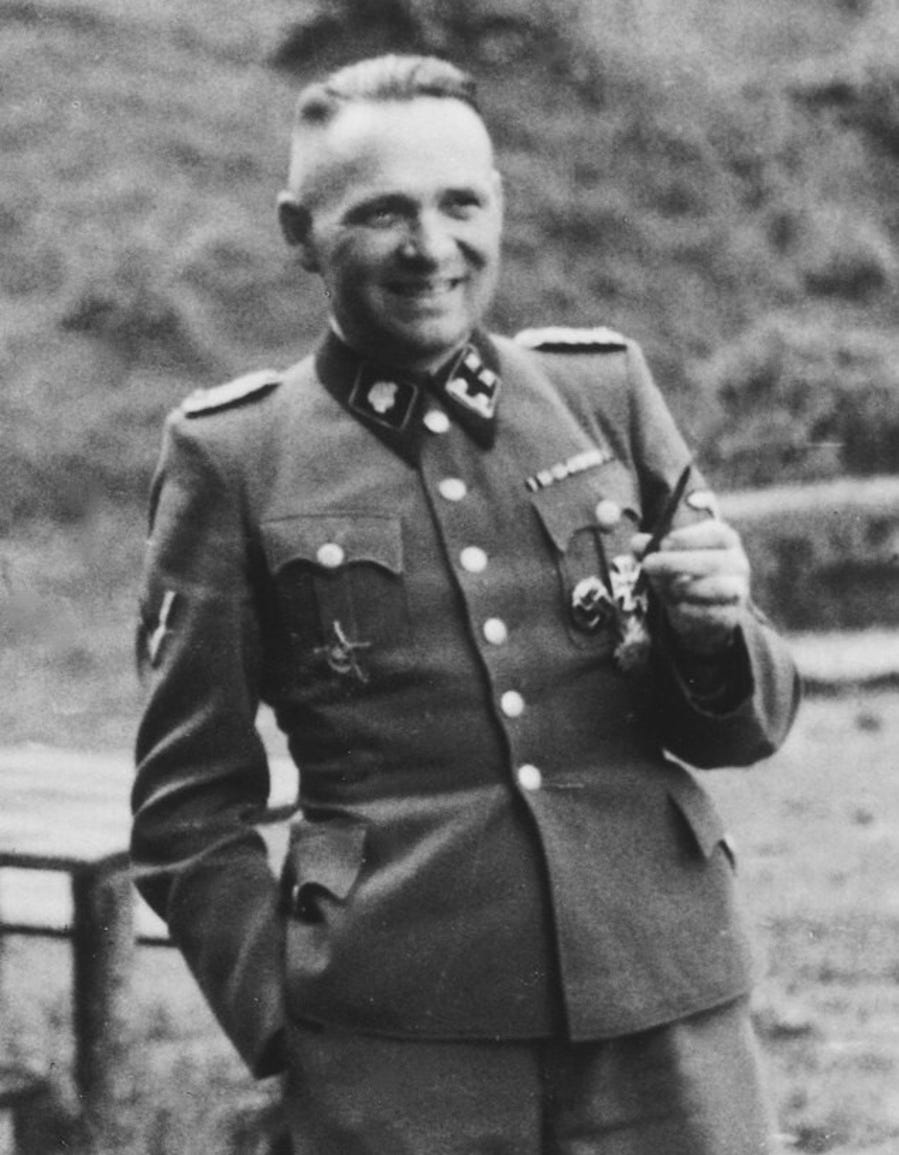
After the war Höss joined nationalist paramilitary groups, participated in a 1923 political murder, and served a prison sentence until 1928. He joined the Nazi Party in 1922 and later the SS. From 1934 he worked at Dachau and then Sachsenhausen concentration camps. In May 1940 Höss was appointed the first commandant of the newly established Auschwitz camp in occupied Poland. He oversaw its rapid expansion into the Nazis’ largest killing center, including the introduction of mass gassing with Zyklon B. He held the post until November 1943, and briefly returned in 1944 to coordinate the murder of Hungarian Jews.
Under Höss’ command, approximately 1.1 million people were murdered. After Germany’s defeat he lived under a false identity until British forces captured him in 1946. He testified at the Nuremberg trials, was extradited to Poland, tried for war crimes, and sentenced to death. While imprisoned he wrote an autobiography. Höss was hanged on 16 April 1947 on the grounds of Auschwitz.
There are a few other details about Höss worth relating. During his tenure as camp commandant a house of Polish Jesuits were incarcerated at Auschwitz. When they were arrested their superior was away on business. When he returned the Jesuit superior, having learned the fate of his brother priests turned himself in at Auschwitz saying he belonged with them. He survived, but Höss remembered him.
Once Höss was captured and put on trial the Polish Catholic guards actually treated him with dignity and respect. However, once Höss was sentenced he returned to his Catholic faith and asked for a priest to hear his confession and give him last rites. They could not find a priest to take on this notorious monster who had engineered the torture and death of millions. Höss asked for the one priest he knew would come—the Jesuit superior.
Höss duly confessed, received last rites before he was hung in the grounds of Auschwitz. If you visit the camp today (as I did ten years ago) you can see a plaque on the wall of one of the huts indicating the place Maximillian Kolbe stepped forward to offer his life for another, and about a hundred yards away is the gallows where Höss was hanged. Before his death Höss publicly acknowledged his crimes and expressed his remorse:
My conscience compels me to make the following declaration.
In the solitude of my prison cell, I have come to the bitter recognition that I have sinned gravely against humanity.
As Commandant of Auschwitz, I was responsible for carrying out part of the cruel plans of the “Third Reich” for human destruction.
In so doing I have inflicted terrible wounds on humanity.
I caused unspeakable suffering for the Polish people in particular.
I am to pay for this with my life.
May the Lord God forgive one day what I have done.
I ask the Polish people for forgiveness.
Today was our first school Mass, so before Mass I briefly told the story of Rudolph Höss to my altar servers. I said at the end he went to confession, received absolution and the last rites of the church. They were somber.
“So was he forgiven?”
“Yes, Father.” said a ten year old.
“So, did he go to heaven right away?”
“No Father. He went to Purgatory.” said a Middle School boy.
“Probably for a very long time.” said an Upper School server.
Some time ago I told the story of Höss on my blog and had a comment from a reader who was outraged and said he would never join a religion that would even dream of forgiving such a monster.
And thus, the audacity of forgiveness. We are okay with the concept of forgiveness when the offense seems small, but when faced with the enormity of the horror of the death camps we pull back. Can God forgive evil on such an inconceivable scale? How so?
My commenter’s outrage is understandable, and when you stop to consider it, forgiveness is actually an audacious concept no matter how grave or slight the offense. But what is the option?
This question is one of the main themes of my book Immortal Combat. I analyze there the human cycle of resentment, rivalry and revenge that begins in envy and fear and ends in the ovens of Auschwitz.
But when one considers the evil and then considers the options in response what can you do? The only options are revenge or forgiveness. Revenge leads to an ever spiraling nexus of hatred, rage, recrimination and violence. It never ends.
Forgiveness is the only answer, but it is the divine answer. “Who can forgive sins but God alone?” God’s mercy and justice are met together on the cross. There the Bloodshed produces the unbelievable blessing. How this works is the point of mylatest book Bloodshed and Blessing.
Catholics believe that the forgiveness is offered unconditionally, but that justice also demands that the sinner participate in the action of purification. So Höss, like most of us will receive forgiveness, but continue to work with God’s grace to a final purification and then, most audacious of all , as St Thomas More said, I believe Rudolph Höss and Maximillian Kolbe “will meet merrily in heaven” .
No posts
Comments
Nothing yet. Say the first thing.
Sign in to join the conversation.