
I missed my appointment with Substack yesterday because it was my joy to drive one hour up into the foothills of Western South Carolina to get to the— out in the boondocks— retreat center where our ninth graders were on a beginning of school year retreat.
Our Lady of the Rosary School in Greenville is enjoying a milestone year. When I went to the parish in 2010 the K5-8 parish school was struggling for enrollment. A hard working principal pulled the school back from the brink and a new Headmaster came on board and since then the school has moved forward each year. In 2018 we expanded the school to include grades 9-12 and transitioned to a classical curriculum.
There are lots of interesting stories of hard work, good ideas and God’s blessing, but now after starting the Upper School (we don’t call it a high school for reasons I will explain in the future here on Substack) with just nine students in ninth grade, last year we graduated 22 students and this year the Upper School students move into a new facility—and we have just under fifty ninth graders enrolled—almost doubling the class size.
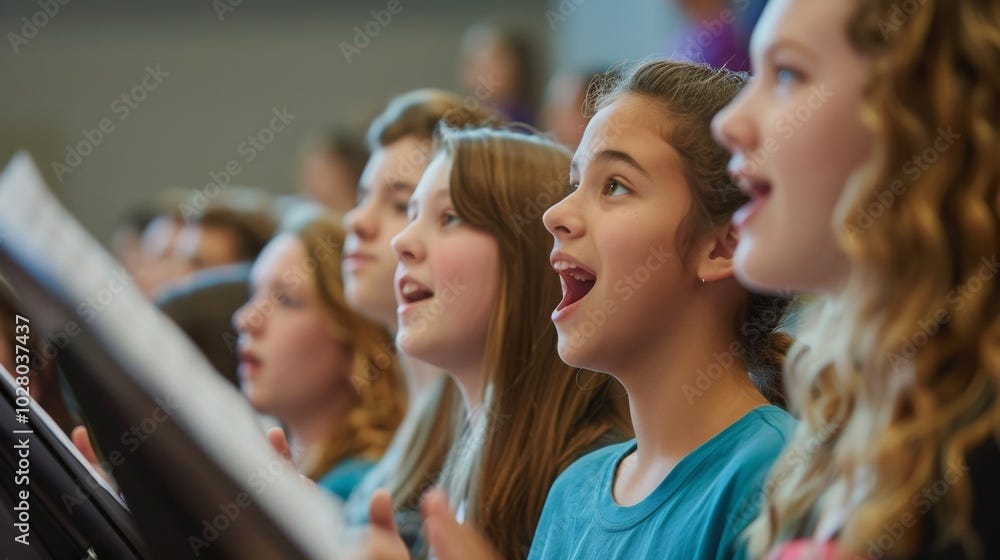
These are kids from good Catholic families who have chosen a “small is beautiful” school, so it was a joy to be with them yesterday and the one of the beautiful aspects of our Mass together was for a group of six or seven of the girls providing the music. They chose the music and prepared it beforehand and it, in addition to singing the Mass parts in Gregorian chant, they sang classic hymns, and anthems in sacred polyphony. Not a geetar to be heard.
As the Mass was celebrated in a rather bare meeting room at the formerly Baptist camp, there was no organ so the music was a cappella and all the more beautiful for that.
These were high school kids. The music wasn’t forced on them. Nobody made them sing it. They chose it. Notably they did NOT sing campfire songs, pep rally music or pop Catholic folks songs. They may have done so at the campfire that night. That’s okay. Campfire songs for campfires. Pep songs for pep rallies. Folk music for square dance nights. Sacred music for liturgy.
One of the reasons music is so important is that beauty is the language of worship and we apprehend beauty with our senses—not just through words and abstract concepts. This is one of the weaknesses of Protestant worship—it is mostly word based, full of intellectual language and discursive thought with a heavy emphasis on Bible study it misses the depth of worship all of which should actually help us to transcend language.
We apprehend beauty in ways that are beyond language and so we move into the realm of truth and goodness that is God’s presence which is beyond our linguistic limitations. What do I mean by linguistic limitations? Language is tied up with particular verbal representations, definitions and every definition is also a boundary and an exclusion. A word means THIS and not THAT. Thus language, which we must use to make sense of reality, naturally limits our expression and our thoughts. Language can only take us so far. Worship should take us beyond language.
Using a foreign language helps to do this. Here is an excerpt from my book Letters on Liturgy about the use of Latin.
Anyone who has learned a foreign language knows that as you learn the new language you also learn to see the world in a completely fresh way. Everything becomes new as you master the new way of speaking. A foreign language transcends our everyday speech and experience.
As I said, this is what the charismatics witness to. When they speak in tongues they feel they are using language to transcend language. I believe the same thing happens when we use Greek or Latin in the liturgy. We’re not all charismatics, but most of us are speaking in an unknown tongue! When we speak Greek in the Kyrie Eleison or Latin in the Agnus Dei, Sanctus, or Gloria—just a few moments in the liturgy—our language is transcending our ordinary language and showing us the world through a fresh filter. We connect with the emotional meaning of the words even if we do not connect with the literal meaning. So we are lifted into the supra-rational part of our mind, brought into that higher place where our hearts are joined in a greater language of worship.
This is one of the reasons why the Church instructs us to retain Latin in the liturgy. This is why I think Latin should be taught in Catholic schools and why I’m glad that those who are called to preserve the Latin Mass are able to do so with freedom and enthusiasm. I’m afraid I don’t see the whole Mass being in Latin as the desired norm to be used by all everywhere. Why? Because the use of English for most of the Mass—especially for the readings—continues to make the Mass intelligible for most people. This is important not only so God’s people can understand what is going on, but also for this subtle play between the linguistic level of our experience and the sub-linguistic and supra-linguistic.
What I’m getting at is this: to get to the sub-linguistic you have to go through language. The repetitious words that we understand are the gateway to that deeper realm which is below language. Likewise, it is the spoken words we understand which contrast with the Latin and Greek phrases that open our minds and hearts to the supra-linguistic level. The linguistic level is therefore the gateway to both the sub-linguistic and supra-linguistic.
This is shown even more by the other way we experience the supra-linguistic—and that is through sacred silence.
An old priest was once asked how long he prays. He said, “Two minutes, but it takes me twenty minutes to get there.” What he meant was that he spent two minutes in rapt contemplation in the beautiful silence of God’s presence. However, for the first twenty minutes he was probably praying the Divine Office and other vocal prayers. The twenty minutes in the realm of language took him to the realm beyond language.
I have written about the different aspects of traditional worship in this article about traditional worship being a compendium of culture and how it takes us beyond.
Music especially does this because music affects our emotions and touches the transcendent. Sacred music has the potential to do this. Pop/rock/folk idioms? Not really. They may spark an emotion or religious sentiment of some sort, but that is very different from the transcendence of true sacred music.
Here is another excerpt from Letters on Liturgy about music moving us beyond language.
Finally, there is one other very important key to unlocking the supra-linguistic level of our human experience: music. By its very nature music is both sub-linguistic and supra-linguistic. Someone has said that music is “emotion expressed as sound.” Music opens the sub-linguistic realm which is the realm of wordless emotion because pure music is wordless emotion. Sacred music opens the supra-linguistic realm as the music combines with words to take us beyond words. I’ll write more about that later, but for now, you might think all this is just a lot of psychological mumbo-jumbo or hogwash. You might ask what evidence I have for these theories. I’d reply that I have the evidence of being a priest for twenty five years—fifteen as an Anglican and ten as a Catholic. During that time I have experienced deep healing at that foundational level of my life, and I’ve also experienced the knowledge of the presence of God in that higher frame of mind.
The Olfactory Apprehension of Beauty
On Saturdays I post samples of my creative writing and in case you missed it, here is the indomitable Mantilla the Hon on the use of incense in worship.
It seems incense also helps to take us out of the immediate, linguistic limitations to something more primitive and sensational (in the literal sense of the word)
Thomas Cook MD—observed:
The stalks of your olfactory nerves are a direct protrusion of your neocortex, like an amoeba that blobs out. So when you smell something you’re literally touching it with your brain. It’s the most mystical form of sensation that bypasses the “inner theater of the mind” in the Cartesian sense. It is not an idea. It’s wordless and pre-verbal like an infant.
Nice. Every aspect of traditional worship, therefore combines to lift us above the quotidian, to move beyond the normal frames of reference and take us beyond this sad and dull everyday world to approach the threshold of heaven.
++++++++++++++++++++++++++++++++++++++++++
Want more content about traditional worship? Get Letters on Liturgy and if you like it share it. One priest got copies for all the priests in his diocese!
Remember my content on this Substack is free. We all hate paywalls! You can access more of my free content at my website: dwightlongenecker.com. The website is about to be updated, but you can still go there for over twenty years of archived blogging. There is more content behind a paywall there and if you want to support my writing you can do so with a paid subscription here—but no pressure!
Remember my new book Bloodshed and Blessing is just released and is available on my website. Hard copy and e-book. An audio book version is in the pipeline.
No posts
Comments
Nothing yet. Say the first thing.
Sign in to join the conversation.