
A year ago today, a federal judge in North Dakota struck down Regulation II in its entirety.
Then he stayed (delayed) his own ruling, so that nothing would actually change.
In the twelve months since, the industry has been busy trying to buy the thing he’d just called unlawful.
Capital One closed on Discover in May 2025 and started moving its debit cards onto Pulse the month after. This July, four of the largest banks in the country were reported to be circling Fiserv’s STAR network at about $15 billion.
They’re buying the same thing, and it isn’t technology.
It’s an exemption from a rule a court has already said the Fed had no authority to write.
Let me break it down.
Let’s start with the part that made sense first.
Between 1976 and 1985, American banks had a real problem. Customers wanted cash from machines, and no single bank owned enough machines to be useful. Building a national ATM footprint alone was absurd. Sharing one was the more obvious strategy.
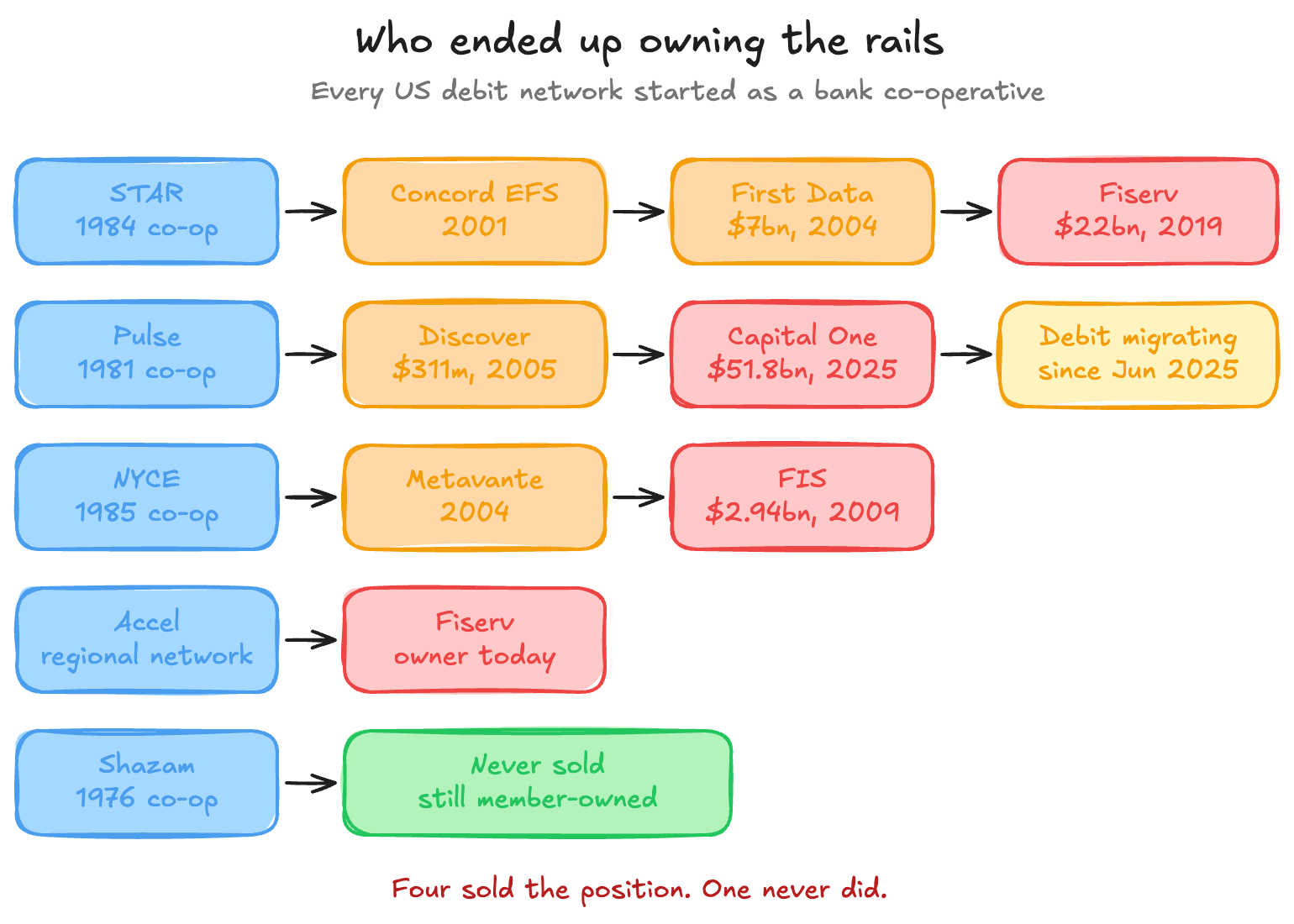
So they built co-operatives. Shazam in Johnston, Iowa in 1976. Pulse in Houston around 1981, formed by Texas banks. STAR in 1984, eleven banks and savings-and-loans pooling their machines. NYCE in the northeast in 1985. Each one owned by the institutions that used it, each one mutualizing a cost none of them wanted to carry alone.
Then the same switch proved effective at the checkout, and PIN debit was born.
For those who might not know;
A single-message (SMS) transaction is requested and settled in one go, which is what happens when a customer enters a PIN.
A dual-message (DMS) transaction authorizes first and clears later, which is what happens when they sign or tap. The domestic networks grew up on the first kind.
Visa and Mastercard grew up on the second. Almost everything that followed traces back to that split.
At the peak, there were more than a hundred of these networks. By the mid-1990s, around fifty. Today you can count the ones that matter on one hand.
Ownership went first, and the members handed it over willingly.
Concord EFS bought STAR in 2001. First Data agreed to buy Concord in April 2003 for roughly $7 billion in stock. The DOJ, eight states and DC sued that October to block it, and the parties settled on 15 December, the day trial was due to start, with First Data forced to divest its entire 64% stake in NYCE. The deal closed in February 2004.
Discover bought Pulse for $311 million, with the deal closing in January 2005. Pulse’s 4,100-plus member institutions voted it through. This was the network that had spent two decades marketing itself as the one that answered to banks and credit unions rather than Wall Street.
NYCE went to Metavante, then to FIS when it bought Metavante for $2.94 billion in 2009. Fiserv took First Data for about $22 billion in 2019, which put STAR and Accel under one roof.
Nobody was robbed here. Members got liquidity, buyers got scale, and every board could show its shareholders a number. The position was sold, not lost, and that distinction matters, because it means the networks understood what they had and priced it anyway.
Brand went second, and that one was taken.
On the other side, Visa and Mastercard owned the brands that the customer actually saw. The domestic networks became a routing decision made by a merchant, invisible to everyone else. The numbers show how far that went: single-message volume fell 2.2% between 2021 and 2022, the first absolute decline ever recorded, and by 2023 dual-message networks carried 71.4% of US debit transactions.
Then the mandate arrived, and it arrived backwards.
In 2011, Regulation II required that every debit card operate on two unaffiliated networks. Congress handed back a form of distribution that the networks had already given up commercially. They didn’t win it, they didn’t build it, and they can’t defend it. It’s a statute, and statutes move.
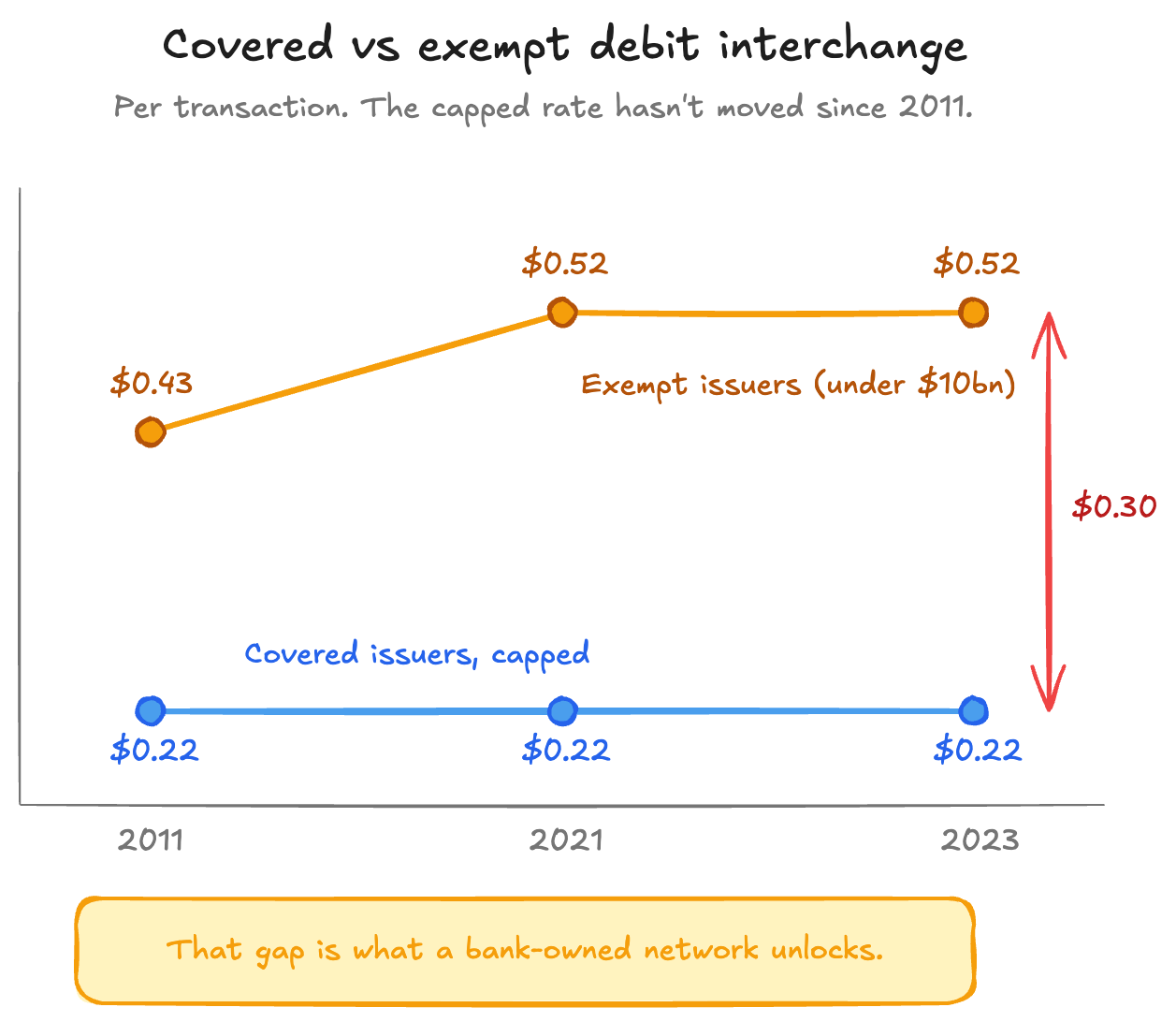
On regulated debit, interchange barely differs by network. In 2023, the covered rate was $0.22 per transaction on dual-message and $0.24 on single-message. That’s it. The cap flattened the thing merchants were supposed to be shopping for.
So the savings from routing don’t come from interchange. They come from network fees. Visa and Mastercard assessments run around 13-14 basis points, plus roughly 1 for licensing. A PINless switch fee runs around 10, often with no license fee at all.
A few basis points. That’s the arbitrage.
Now look at who pays. Total network fees came to $12.95 billion in 2023, and merchants and acquirers covered 64.9% of them, up from 44.3% in 2009. Over the past fifteen years, the networks have quietly shifted most of their fee burden onto the merchant side of the transaction.
The routing behavior follows the arithmetic. Break-even sits around a $15 ticket, because PIN networks charge less as a percentage and more as a fixed fee. Grocery, big-box and fuel route away hard. Coffee shops and drive-throughs stay exactly where they are.
CMSPI puts the total US routing opportunity at roughly $4 billion a year, rising to about $5 billion if every card were PINless-enabled, which they aren’t. As of October 2024, only 51.1% of US debit cards had PINless switched on.
Set $4 billion against $4.66 trillion of US debit value in 2023. That’s under a tenth of a percent of the money moving. It’s real money, and it is astonishingly thin, and it’s the entire commercial case for the routing mandate that keeps these networks alive.
It’s worth being clear about who is even making this choice, because it isn’t the network. The merchant sets the routing policy. The acquirer or gateway executes it. A specialist vendor usually designs the logic, and the system selects the cheapest available option for each transaction, limited to whatever the issuer has provisioned on the card.
So a domestic network competes on price, into a decision it doesn’t participate in, on a spread of a few basis points, for volume its own issuer clients can switch off. And in card-not-present, it competes with token vaults that Visa and Mastercard control, which is a constraint the domestic networks have been debating for years and haven’t resolved.
Capital One closed the Discover acquisition on 18 May 2025 for $51.8 billion in purchase consideration and told investors to expect $1.2 billion in network synergies in 2027. Migration of its debit portfolio onto Discover and Pulse began that June, card by card.
Here’s the mechanism, because it’s the hinge of everything that’s followed. Reg II caps what a covered issuer, meaning one with $10 billion or more in assets, can earn per swipe. It doesn’t cap what a network charges when the issuer and the network are effectively the same house. A bank that owns the rails its own cards run on can argue its way out of the cap, and that argument is worth a great deal of money.
Once a card moves, it leaves the cap behind.
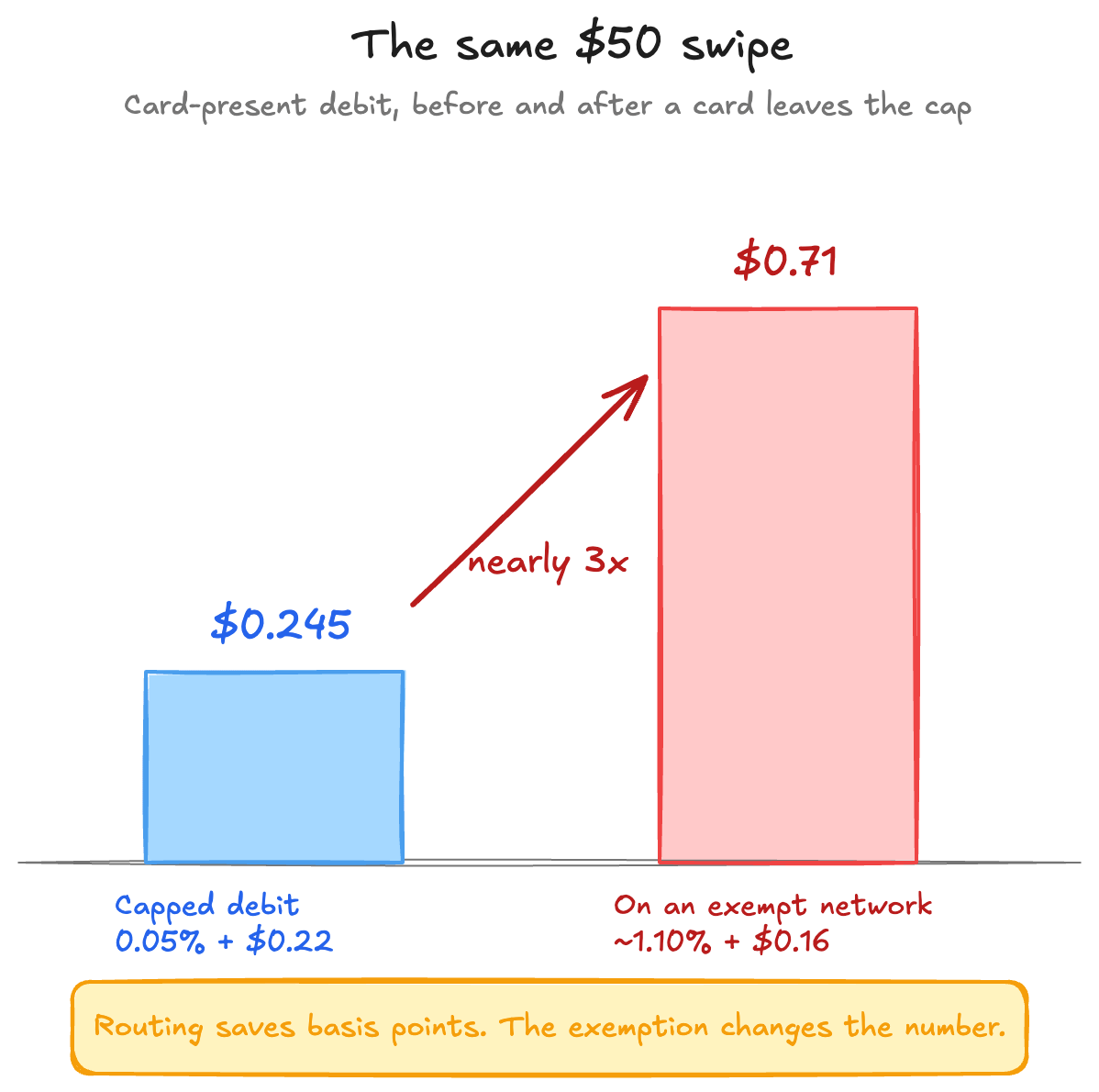
Unregulated card-present debit at roughly 1.10% plus $0.16, against the covered cap of 0.05% plus $0.22. On a $50 sale, that’s about 71 cents instead of about 24 and a half cents. Nearly three times the economics on the same swipe, the same rails, the same fraud logic.
SRM sized it at around 7 million cards and $60 billion of purchase volume, with the exemption alone worth more than $350 million a year.
Nothing about the switch got better. Capital One didn’t buy a faster network. It bought permission to charge more for the same one.
There’s a bill for that, and Pulse pays it. A network that spent 40 years selling neutrality to banks and credit unions now belongs to a top-six bank that competes with many of those banks and credit unions.
My read is that this is the real cost of the deal and the one nobody has priced yet, because no disclosure yet shows what third-party issuers are doing in response. That gap is genuine, and I’d watch it more closely than the synergy number.
On 7 July, the Wall Street Journal reported that Fiserv had held preliminary talks with JPMorgan, Bank of America, Wells Fargo and PNC about selling STAR, possibly with Accel, at a valuation of about $15 billion.
All just speculation, of course.
However, the asset underneath is real enough. STAR runs around three billion transactions a year for more than 115 million cardholders across 2,800-plus financial institutions, including 24 of the top 50 US issuers. KBW put the prize for the ten largest debit issuers at $460 million to $3.5 billion in extra gross revenue. William Blair called a deal unlikely, citing regulatory and merchant pushback and the risk of alienating Fiserv’s community bank and credit union base.
But look at the structural difference between this and the Capital One deal.
Capital One bought one company and controls it outright. It sets its own routing, migrates its own cards, and answers to no one about pricing. A consortium has to agree. Four owners, repeatedly, about how to price a network that thousands of competing institutions route through.
The precedent cuts both ways. Zelle works, and it works beautifully: more than $1.2 trillion in payments and over 150 million enrolled accounts, distributed within banks’ own apps, where the owners control the shelf. Paze is the other outcome. It auto-enrolled 200 million-plus cards and still had to sign distribution deals with Fiserv, Worldpay and Nuvei in 2025 to get accepted anywhere.
A debit network is a merchant-acceptance business. That’s the side bank consortia have historically been worst at, and I don’t see what makes this attempt different.
Then there’s the room the deal would be filed in. The DOJ is currently suing Visa for monopolizing the debit market, alleging that it handles more than 60% of US debit transactions and collects over $7 billion a year in processing fees. Handing the four largest issuers a route around the interchange cap is a difficult transaction to bring into that environment.
One more thing worth flagging plainly. Fiserv doesn’t break out STAR or Accel anywhere. They sit inside Financial Solutions with no separate revenue or margin disclosed. The $15 billion comes from deal chatter, not a filing, and no one outside the room can tie it to any official documents.
But let’s get back to North Dakota.
On 6 August 2025, Judge Traynor vacated Regulation II in full, holding that the Fed had gone beyond its statutory authority in deciding which costs the cap could recover. He then stayed his own vacatur to stop interchange becoming, in his words, a completely unregulated market.
The Fed appealed to the Eighth Circuit that October. It filed its opening brief on 30 December, Corner Post responded in February, and the Fed’s reply landed on 23 March. Briefing has closed. As far as I can tell, no oral argument date has been posted yet.
So the fork runs in three ways, and each one changes what a network is worth.
Vacatur affirmed. The cap disappears, and covered interchange rises for everyone. The exemption stops being scarce, which means the thing a buyer paid a premium for becomes the default setting. You’d have bought a privilege on the eve of it becoming ordinary.
Vacatur reversed. The cap survives, and the Fed’s November 2023 proposal to cut the base from $0.21 to $0.144 remains unfinalized and frozen. Finalize it, and the gap between capped and exempt widens. The exemption gets more valuable, not less.
Nothing happens for years. Which, given appellate timelines and a possible return trip to the Supreme Court, is the base case.
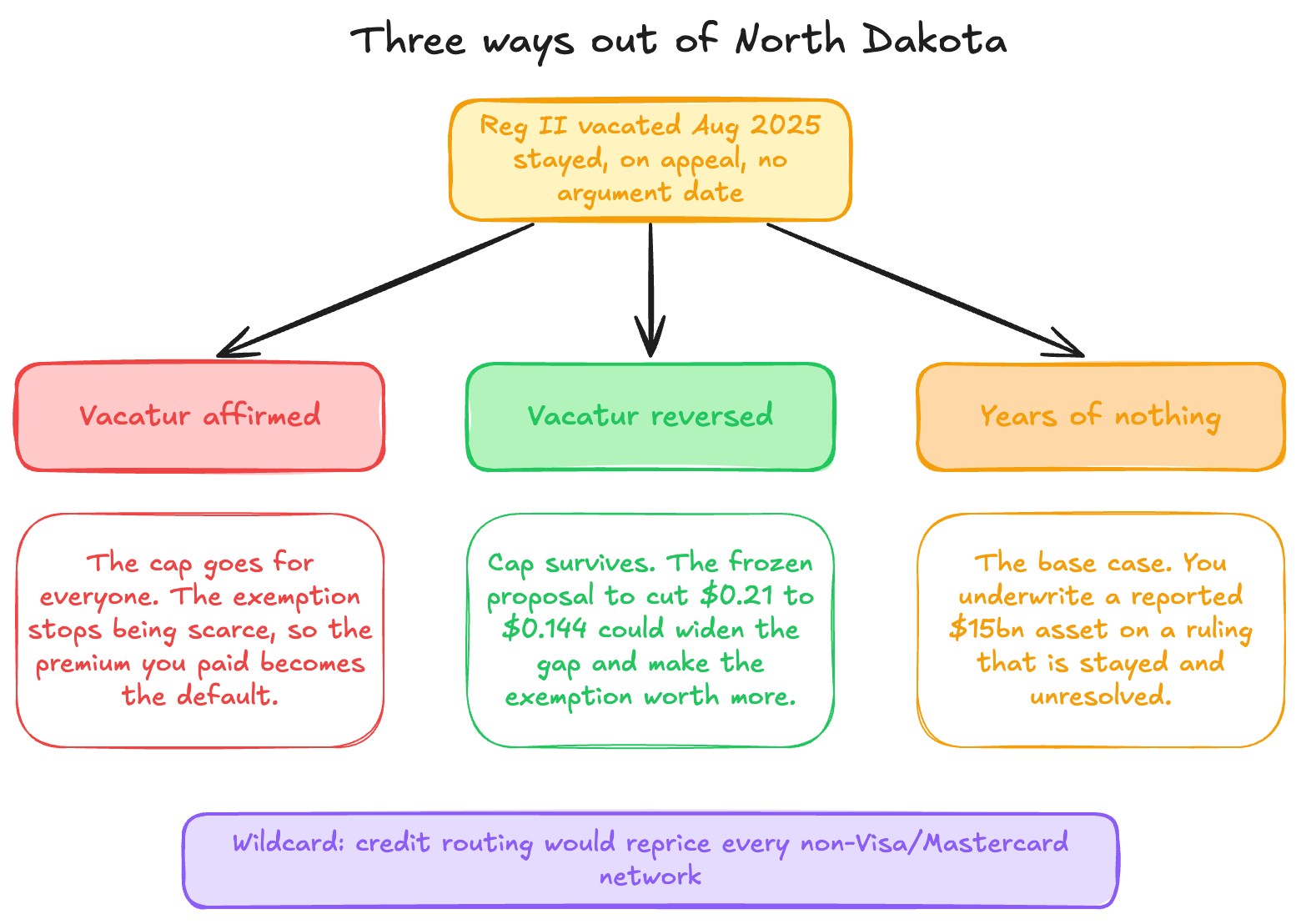
There’s a wildcard on top. The Credit Card Competition Act returned on 13 January 2026 as S.3623, with a House companion, and was endorsed by the President the same day. It’s still in committee, and an attempt to attach it to the CLARITY Act at the end of that month failed. If credit routing ever becomes law, every network that isn’t Visa or Mastercard reprices overnight.
And the Visa case has slipped since the July reporting. Under the current schedule, fact discovery now closes on 16 October 2026 with expert discovery running to April 2027, which pushes any trial into 2027 or 2028.
Add it up. Whoever buys a debit network today is underwriting an appellate panel, a frozen rulemaking and a bill in committee. None of that is a business you can operate your way out of.
Two things cut the other way, and I want to make sure I highlight them properly.
The first is that PIN debit is genuinely better plumbing. This isn’t sentiment, it’s in the Fed’s own 2023 data. Single-message transactions carried the lowest fraud losses at 6.7 basis points of value against 17.9 for dual-message transactions, and the lowest authorization, clearing, and settlement costs at $0.030 against $0.039. Cheaper and safer, measured rather than claimed. If the networks were purely a compliance artifact, that wouldn’t be true.
They’ve also moved where they were weakest. The 2022 clarification took effect in July 2023 and forced PINless routing into e-commerce. Single-message share of card-not-present volume went from 6.1% in 2021 to 6.6% in 2023, and vendor One Inc reported a 50% rise in debit routed PINless to STAR, NYCE and Pulse between February and September 2023. The direction is right; however, the slope is shallow.
The second is Shazam. Founded in Iowa in 1976, still independent, still member-owned, still not-for-profit, and it marked fifty years in 2026. It never sold, and it still serves the community banks and credit unions that the big consolidators treat as an afterthought.
That’s an existence proof: a service model can hold a position that scale can’t buy.
It’s also about $191 million of revenue, which tells you the size of the ceiling on that model. Both things are true at once, and anyone arguing this industry from one of them is only half right.
To learn what can happen, we can look at other regions. The sharpest evidence isn’t in the US at all.
Look at the domestic schemes that thrived. Interac in Canada, founded the same year as STAR. Girocard in Germany, with more than 100 million cards and around 31% of German non-cash payments in the first half of 2025. Cartes Bancaires in France, Bancontact in Belgium.
Every one of them kept three things. Member or bank ownership, so the scheme answered to its users. A mandate or default routing that regulators actively protected. And the brand on the front of the card, so the consumer knew whose rails they were on.
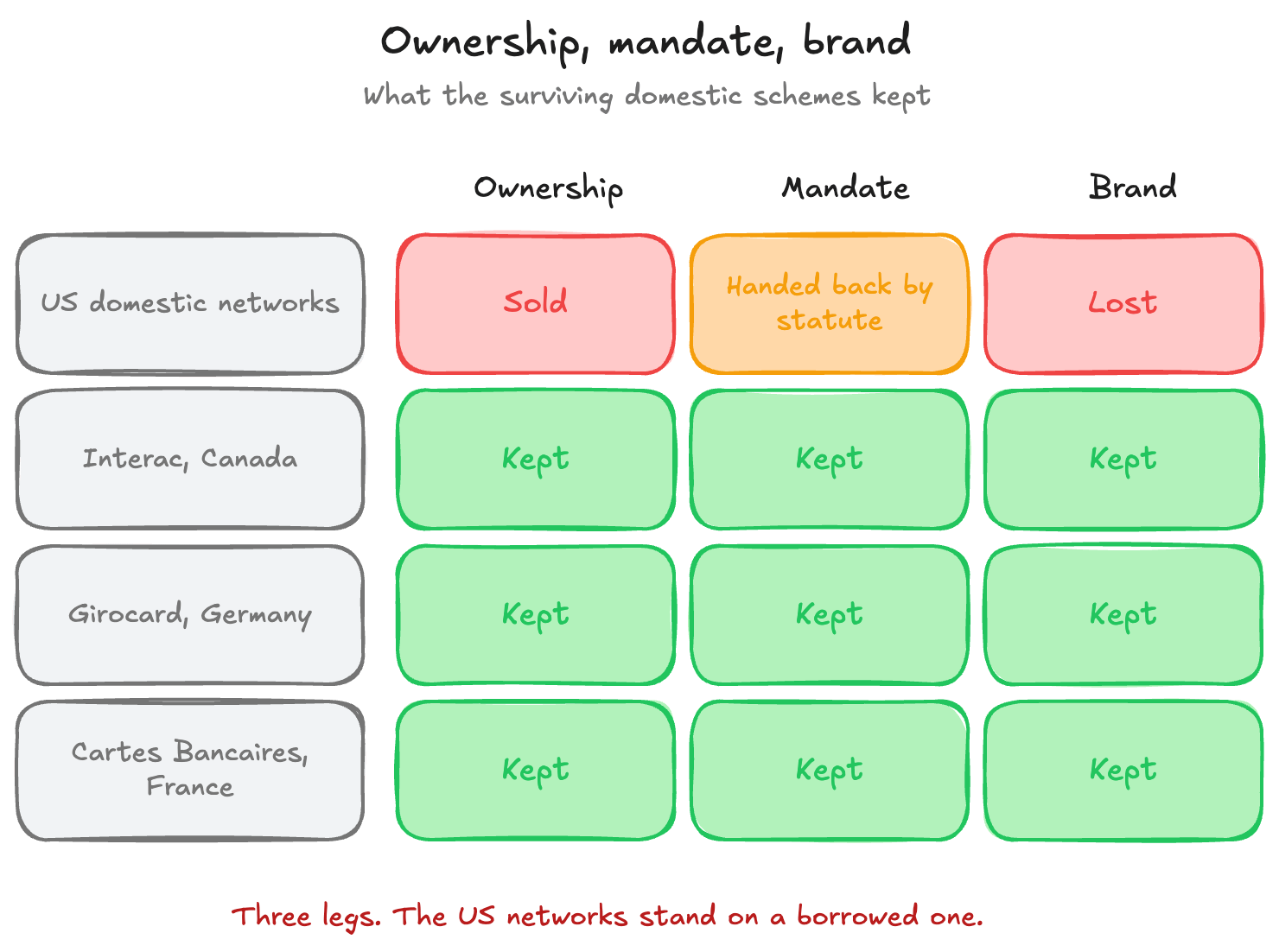
The US networks kept none of the three. They sold ownership, lost the brand to Visa and Mastercard, and then received a routing rule from Congress that they neither built nor control.
Even holding all three isn’t permanent, and it’s worth being honest about that. Nilson’s 2024 Canadian data shows Interac’s share of purchase transactions falling 191 basis points to 37.63%, with Visa at 36.50%, and its 2025 reporting has Visa edging ahead. The strongest domestic scheme in the world is losing ground too. It’s just losing it from a position it actually owns.
Brazil and India went further, skipping the argument entirely. Pix and UPI are rails the regulator built, and adoption followed the mandate rather than the marketing.
Ownership, mandate, brand. Three legs, and the American networks are standing on a borrowed one.
When a business earns from what it does, you can make it better. Invest, price, ship, compete.
When it earns from what it’s allowed to do, there’s nothing to improve. You can only wait, and hope the permission holds.
That’s the trade on the table right now. Capital One made it and is collecting on it today, which is a perfectly good reason to have made it. The banks reportedly looking at STAR would be copying a deal whose main input is a rule that a district court has already vacated and an appellate court hasn’t yet ruled on.
Fiserv, for its part, would be selling infrastructure at the exact moment its own market value sits near $29 billion, roughly 70% below where it stood in March 2025. That’s not the behavior of a seller with options.
These networks solved a genuine problem in 1984 and got properly paid for it. Everything since has been an argument about who gets to hold the permission that replaced the advantage.
A loophole isn’t infrastructure. It’s a lease, and somebody else writes the terms.
Thank you for reading.
P.S. If you’re reading this and are looking for the insights to help you improve your own strategy, that’s exactly what I help payments companies figure out.
20+ years in payments data and strategy. From being the First Data Scientist at Adyen, to being the First VP of Data Science & Analytics at Checkout.com, to helping over 50 of the top 150 acquirers and issuers globally through my consultancy.
For Advisory. Speaking. Consultancy. Email me or DM me to set up a call.
Or, if you just want to keep fueling these breakdowns and deep dives, buy me a coffee.
No posts
Comments
Nothing yet. Say the first thing.
Sign in to join the conversation.