
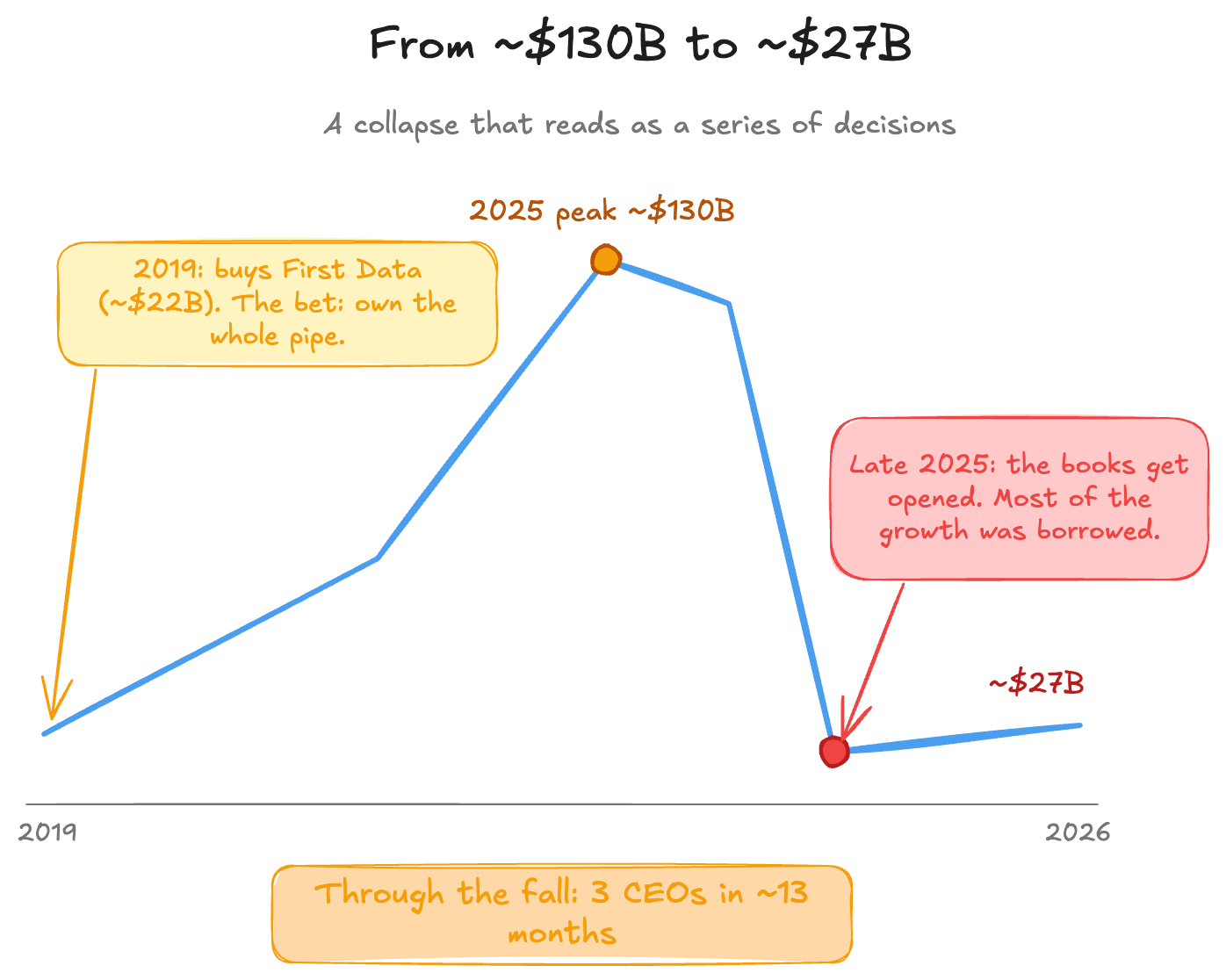
Fiserv was worth about $130 billion.
Today it’s worth a fraction of that, down close to 70% in the past year alone. In roughly the same window, it burned through three CEOs and lost its president less than twelve months after she took the job.
The easy read is financial. A bad quarter, a guidance cut, a market that soured on an old-line processor.
That read is wrong. It isn’t even close.
Fiserv didn’t fall apart because the market repriced it. The market repriced it because it had already fallen apart. The stock was the last thing to break, not the first.
What broke first was the strategy. Or the fact that, under all the growth, there wasn’t much of one.
So this isn’t a piece about earnings. It’s about what happens when a company mistakes momentum for direction, and keeps sprinting on the first long after the second is gone.
Let me break it down.
Start with the ambition, because the ambition made sense.
In 2019, Fiserv bought First Data for about $22 billion, one of the biggest deals payments had ever seen. The logic was clean. Bolt the largest US merchant-acquiring business onto one of the largest bank-technology businesses, and own the whole pipe.
Fiserv already sat inside thousands of banks. Now it would sit inside millions of merchants too. Money moving on one side, the tools to move it on the other, and a fee clipped at every step.
The prize inside First Data was Clover: the point-of-sale and business-management system for small merchants. Picture the tablet and card reader on the counter at your local cafe, plus the software that runs the shop behind it. Clover became the growth story.
So Fiserv wasn’t sold to investors as a sleepy utility. It was sold as a compounder. Boring plumbing on the outside, double-digit growth on the inside, the kind of stock you buy and forget for ten years.
That’s a great pitch. Own the most rails, move the most volume, and somehow grow faster than everyone while you do it.
Here’s the catch, and it’s the whole piece in one line. Owning the most rails is a position. It is not a strategy.
A goal is not a strategy. “Grow double digits” is a goal. “Be the biggest processor” is a goal. A real strategy is the harder thing underneath. An honest read of your actual problem, a clear choice about how you’ll deal with it, and a set of actions that all point the same way.
Fiserv had the goals. It had the scale to chase them. What it slowly lost was the choice about what to actually be.
And once that choice goes missing, something still has to feed the growth number every quarter. That’s where the trouble starts.
The first test of a real strategy is whether you’ve honestly named your problem. Most bad strategy fails right here. It skips the diagnosis, because the diagnosis is a hard pill to swallow.
Fiserv’s hard pill was simple. Strip out a few things that couldn’t last, and the core business grew at low-to-mid single digits, like the infrastructure utility it actually is.
Look at what was holding the headline number up.
Argentina. Fiserv ran a business there that paid merchants early, before their card money cleared, and charged for it. In a country with runaway inflation and sky-high rates, that spread is enormous. It’s a license to print, right up until the economy calms down.
How big was it? By the company’s own account, Argentina alone contributed 10 of the 16 points of organic growth in 2024. Most of the growth the whole company was celebrating came from one inflation-soaked market.
That’s not a franchise. That’s carry, the kind a trading desk books, not the kind a software platform earns. When Argentine inflation cooled, the growth cooled with it, and what was left underneath was ordinary.
Argentina wasn’t the only prop. A few others were quietly doing the work:
Tech investment deferred for years to protect margins. That flatters today’s profit and starves tomorrow’s product. It’s borrowing from your own future and calling it discipline.
Pricing pushed above what the market would bear, then pulled back when it wouldn’t hold.
Merchants moved onto Clover from older Fiserv systems in ways that lifted volume, and that the company is now defending in a shareholder lawsuit. More on that shortly.
The moment of truth came in late October 2025. New leadership opened the books, cut the outlook, and reset organic growth guidance from around 10% toward 3.5–4%. The stock fell about 44% in a single day, its worst ever, erasing roughly $30 billion. Analysts who cover the sector called it, more or less, unrecognizable.
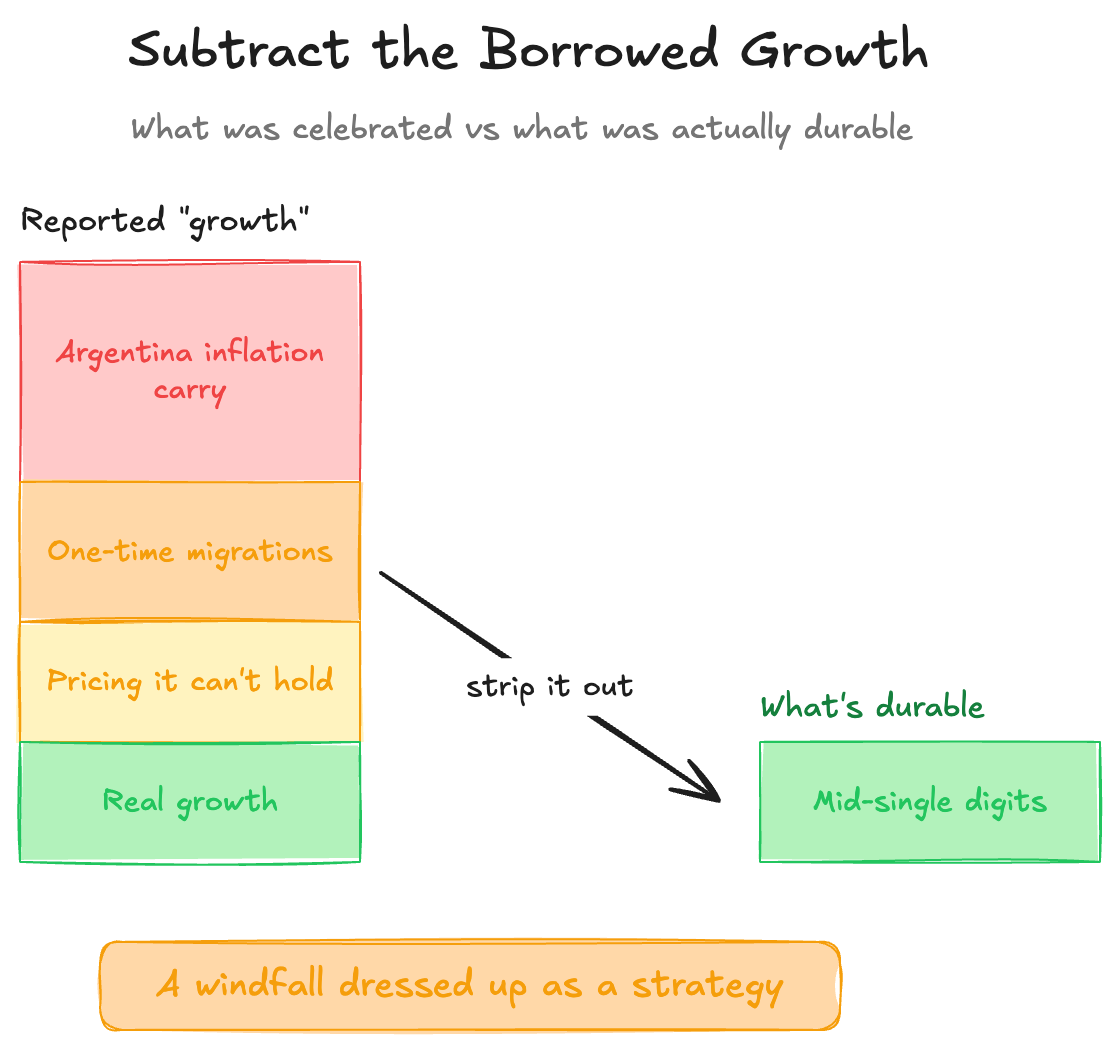
But the crash was the symptom. Here’s the diagnosis Fiserv hadn’t said out loud for years. The growth wasn’t the output of a strategy. It was a substitute for one.
That is textbook bad strategy. Not the absence of a plan, but the refusal to face the real problem, papered over with a number that looked like success.
You can usually spot a strategy vacuum before it hits the financials. Look at who’s running the place.
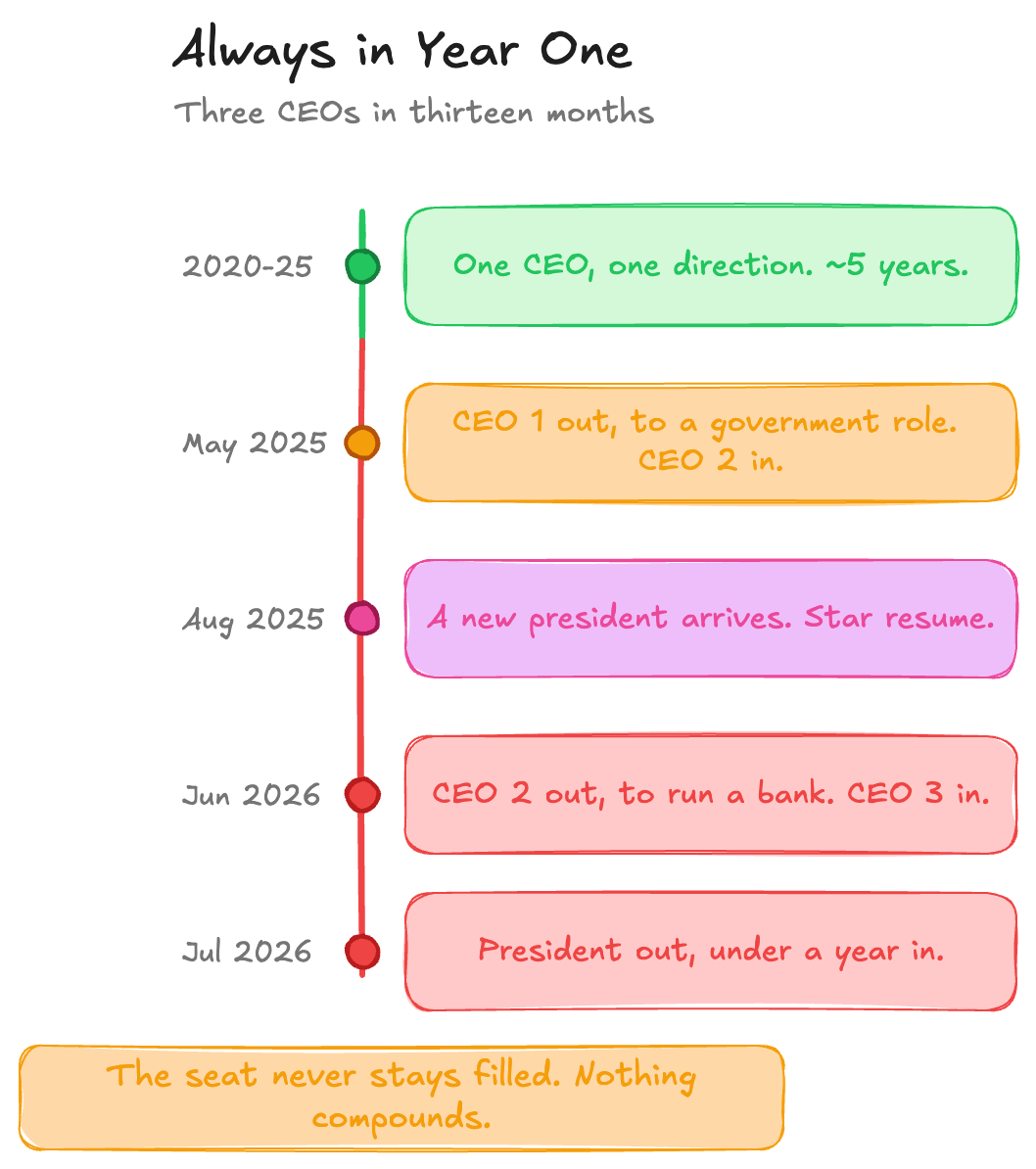
In a little over a year, Fiserv’s top job changed hands three times. The long-serving CEO who built the era left to run a government agency. His successor lasted about thirteen months, then left to run a bank. A third stepped in. Around the same time, a new president, hired with a resume most boards would fight over, walked out less than a year after arriving.
Three CEOs in roughly thirteen months. It’s tempting to make this about the individuals. Don’t. The people aren’t the story. The pattern is.
Good people leave when there’s nothing solid to hold. A real strategy keeps them, because there’s an obvious thing worth staying to finish. Take that away, and every new leader has to start by working out what the company even is.
That re-diagnosis is expensive and invisible. A new CEO spends the first couple of quarters learning which of the old assumptions were real and which were wishful. By the time they set a direction, half their runway is gone. If they leave before it proves out, the next arrival starts the same clock at zero.
So nothing compounds. The company lives in a permanent year one.
The people in the middle learn the obvious lesson: don’t commit to this plan, wait for the next one. That’s how ambition drains out of a company that still, on paper, has everything.
Scale is supposed to protect you from this. Fiserv is enormous. It processes for a huge slice of the US economy, and its rails aren’t going anywhere. But scale only buys time. It doesn’t buy direction. Spend that time arguing with yourself about what you are, and the size stops being a moat and starts being weight.
If you want the sharpest picture of a company that’s lost the plot, look at what it was reportedly willing to sell.
Reports this year said Fiserv had quietly shopped one of its debit networks, STAR, to some of the biggest US banks. A debit network isn’t a side asset. STAR routes debit, ATM, and online payments for more than 115 million cardholders across 2,800-plus financial institutions. It’s real infrastructure.
The company hasn’t confirmed the talks, and plenty of analysts think nothing happens. Forget whether it closes. The reason it even came up is the tell.
Ask why a mega-bank would want a debit network. Not because the technology is magic, and not because they couldn’t build one. The pull comes down to a single rule from 2010.
Under the Durbin Amendment, big banks face a cap on the debit interchange they can earn per swipe. If a bank owns the network the payment runs on, it can argue its way around that cap. Analysts at KBW put the prize at somewhere between $460 million and $3.5 billion in extra gross revenue for the largest issuers.
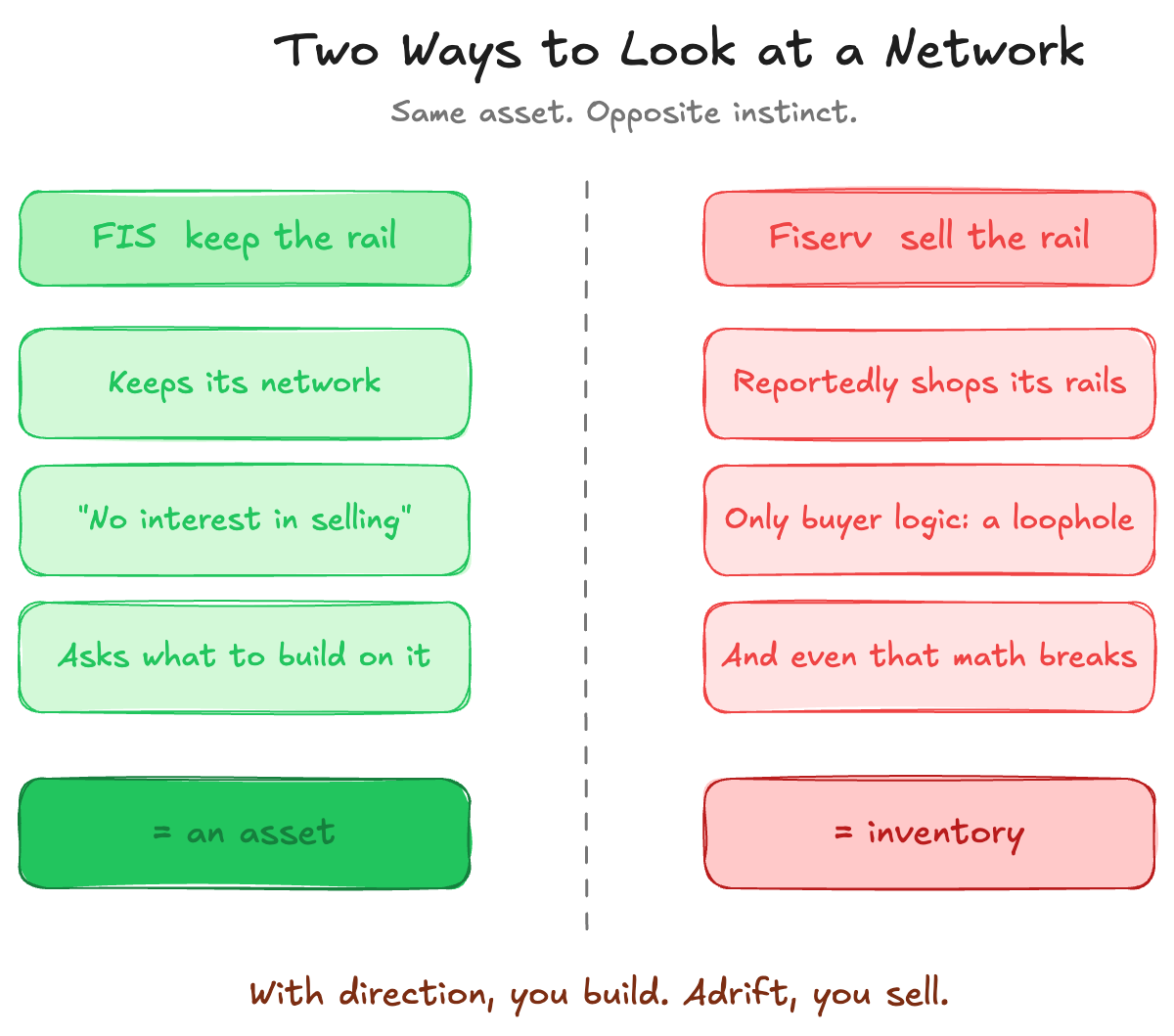
So read what that means. The rails aren’t wanted as rails. They’re wanted as a loophole.
When the only reason anyone wants your core infrastructure is a regulatory workaround, the market is telling you what those rails are worth in your hands. Not much.
And even that thin logic tends to fall apart. Route your debit onto a network you just bought, and the card giants can pull the volume discounts they give you across all your other cards. Retailers push back. Regulators circle. Some banks reportedly ran the numbers and walked.
Here’s the strategic point, and it isn’t about debit at all. A company that knows what it is looks at an asset like STAR and asks what it can build on it. A company adrift looks at the same asset and asks what it can get for it. One treats its infrastructure as a foundation. The other treats it as inventory.
For contrast, a rival in the same seat took the opposite view. Asked about her own debit network, the CEO of FIS said flatly that she has no interest in selling it, and that there are interesting things she wants to do with it. Same kind of asset. Opposite instinct. That instinct is the whole difference between having a strategy and not.
Now to Clover, the engine that was supposed to make the whole thesis true.
For years, Clover’s growth was the proof that Fiserv wasn’t just a commodity processor but a real software platform. And to be fair, Clover is a real product. In 2025, it did about $3.3 billion in revenue, up 23%. Merchants use it and like it.
But look at how some of that growth got made. A chunk of it came from moving merchants onto Clover from Fiserv’s older systems. Those migrations lifted the numbers. They now sit at the center of a shareholder lawsuit that claims the company pushed as many as 200,000 merchants onto the platform to inflate its growth, then stayed quiet as many of them churned back off.
I’m not here to try the case. The strategic point holds either way.
As the one-time boosts faded, Clover’s underlying growth slowed. By management’s own comparison, its US payment volume in one recent quarter grew about 7.5%, landing, in their words, between Visa’s and Mastercard’s growth rates.
Think about that. A platform sold as a share-taker had settled into growing at roughly the speed of the card networks it runs on. That’s the quiet death of a growth story. Not a crash, just a convergence. The engine keeps running. It simply stops pulling ahead of the pack it was meant to leave behind.
The lesson isn’t really about Clover. If your growth engine’s growth was partly manufactured, you didn’t build a franchise. You bought time. And time without a direction runs out quietly, which is the dangerous way, because you don’t hear it go.
So is Fiserv finished? No. And that’s what makes it a case study rather than an obituary.
The assets are real. Millions of merchants. Thousands of banks. A genuine software platform in Clover. Rails that half the industry’s disruptors would love to own. Fiserv didn’t lose the pieces. It lost the plan for them.
Turning this around isn’t about another acquisition or another leader. It’s about doing the three things Fiserv skipped. Richard Rumelt, author of Good Strategy/Bad Strategy, calls them diagnosis, guiding policy, and coherent action. In plainer terms: say what’s actually wrong, decide what you’re going to be, then make every move serve that decision.
First, an honest diagnosis. Say it out loud. The core is an infrastructure utility that grows in the low-to-mid single digits, and the double-digit years were borrowed. That sounds like surrender. It’s the opposite. You can’t fix a problem you’re still dressing up. To their credit, current leadership has started this, resetting growth guidance toward 3.5–4% and unwinding the pricing tricks. Painful, and correct.
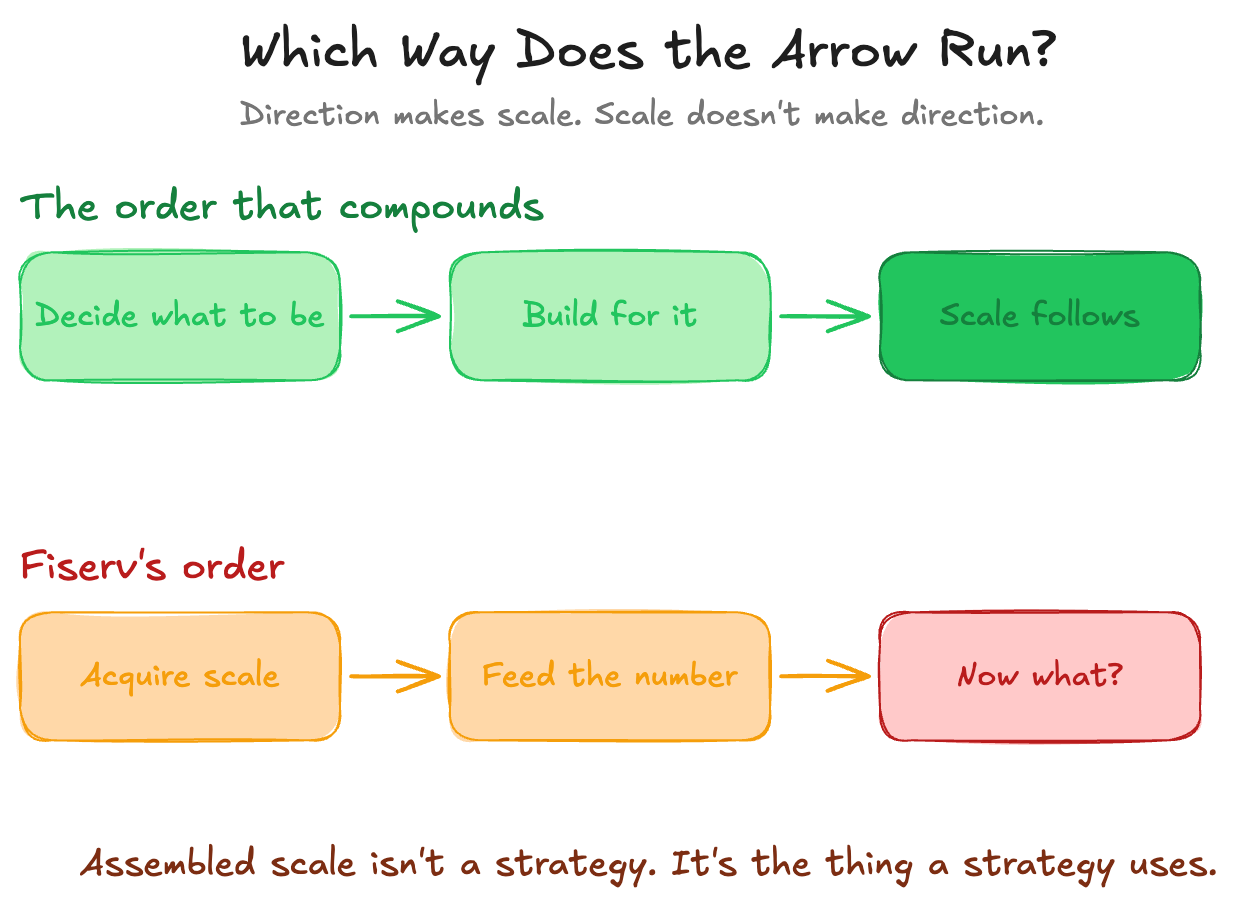
Second, a guiding policy, which means a choice. This is the one Fiserv has dodged for years. Is it a software company or a processing utility? Those are different companies, with different owners, different margins, and different reasons to exist.
If Clover is the future, then Clover gets the money, the engineers, and the roadmap, and it wins on product depth, not by migrating captive merchants onto it. The test is whether it can take share again on its own merits.
If the rails are the future, then own that. Be the most reliable, best-priced infrastructure in the market, keep networks like STAR and build services on top of them, and stop apologizing for being a utility. Utilities are excellent businesses when they’re run and priced like utilities.
What Fiserv can’t be is both-and-vague, which is exactly what it’s been.
Third, coherent action, where every move serves the choice.
Reinvest the tech spend that was starved to flatter margins. The bill for deferral has come due.
Decide the debit network on strategy, not desperation. Keep it and build, or sell it cleanly to fund the chosen direction. Just don’t shop it around because you’re unsure what it’s for.
Stabilize the top. A strategy needs someone to hold it for more than a year. The single most valuable thing the board can do now is let one direction run long enough to compound.
Reset expectations honestly, so the company is measured against a real base instead of a fantasy. A durable mid-single-digit grower that knows what it is beats a fake double-digit grower that doesn’t.
None of that is glamorous. All of it is a decision. And the decision, not the market, is what’s been missing.
Fiserv’s fall reads like bad luck if you only watch the stock. Watch the decisions, and it reads like something more ordinary, and more avoidable.
A company with every advantage in payments- the scale, the rails, the merchants, a real platform- spent years chasing growth numbers instead of choosing what to be. The numbers came from places that couldn’t last. When they ran out, there was no strategy underneath to catch the company, and the people at the top left rather than build one.
The good news is that the thing Fiserv is missing is also the one thing it can still choose. It can’t buy it, and it can’t reorganize its way into it. It has to decide.
Scale was never the strategy. It was just the part that came easy.
Thank you for reading.
P.S. If you’re reading this and are looking for the insights to help you improve your own strategy, that’s exactly what I help payments companies figure out.
20+ years in payments data and strategy. From being the First Data Scientist at Adyen, to being the First VP of Data Science & Analytics at Checkout.com, to helping over 50 of the top 150 acquirers and issuers globally through my consultancy.
For Advisory. Speaking. Consultancy. Email me or DM me to set up a call.
Or, if you just want to keep fueling these breakdowns and deep dives, buy me a coffee.
No posts
Comments
Nothing yet. Say the first thing.
Sign in to join the conversation.