
Hey Dwarfers,
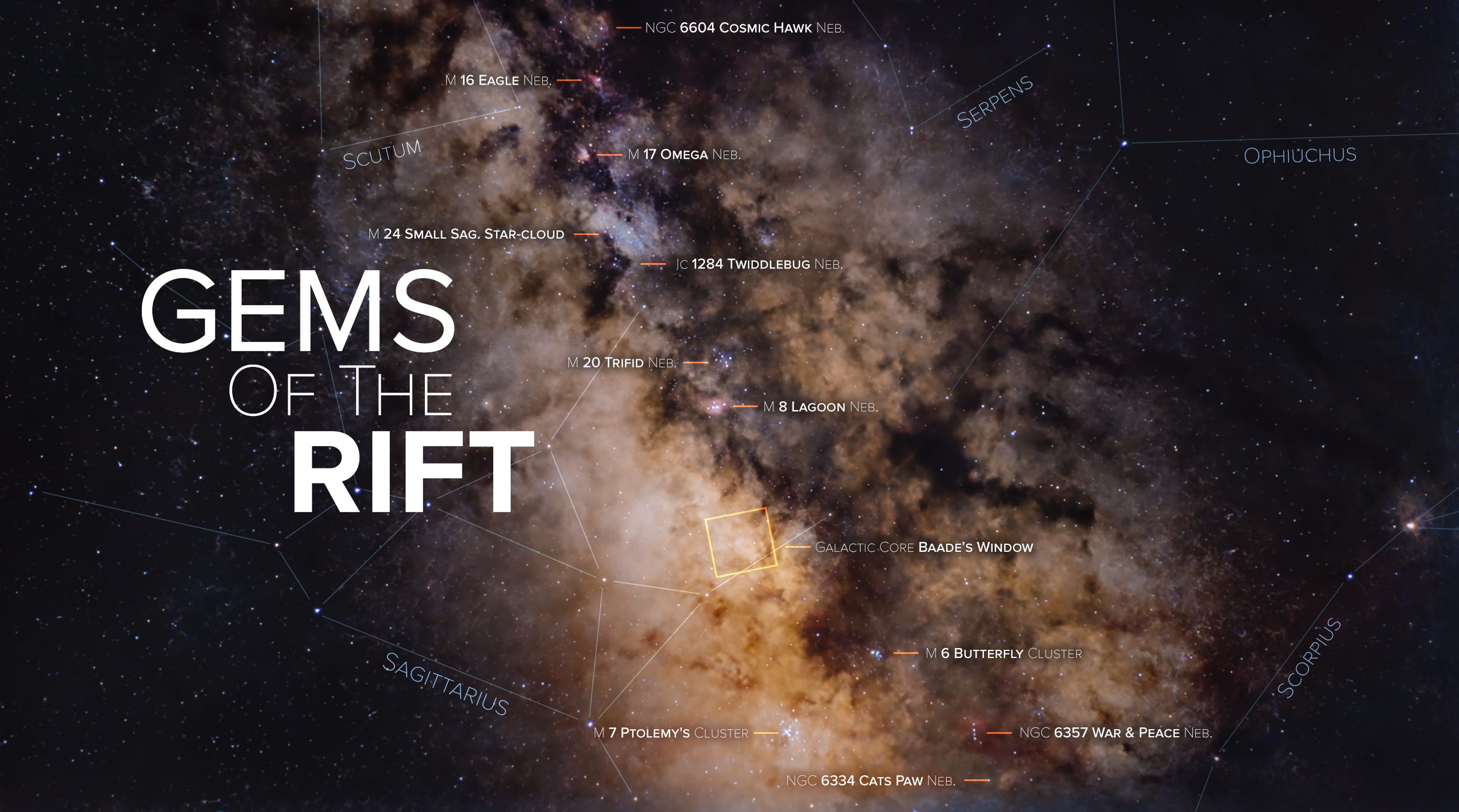
In our last post, we looked at how to capture the sprawling, wide-angle grandeur of the Milky Way core. If you followed our guide, hopefully you have a spectacular, star-studded panorama sitting on your hard drive, posted to Insta, or hanging on your wall, just like our cover shot!
Don’t miss a newsletter post—subscribe with your email to get our DSO deep dives, Dwarf Astroprocessing tips, early access to challenges and contests, plus so much more, directly to your inbox!
But what happens when we swap out the wide-angle mode on our Dwarf Smart Scope and switch the mode to “Deep Sky”, and zoom straight into that glowing core of our Galaxy?
Yes, it’s clear from your Milky Way shot that a dark, serpentine rift splits the Milky Way in two; on either side are stunning starfields, including the Great Sagittarius Star Cloud, with an unbroken 5-degree-wide, star-studded window to the very core of the galaxy called “Baade’s Window.” To find it in your DWARF, just center on NGC 6520, the “Dead Man’s Chest Cluster”.
The Euclid Space Telescope just made the sharpest capture ever through this star-studded window, a 5-square-degree patch of sky equivalent to 25 full moons, where 60 million stars abide:
While Baade’s Window gives us a clear peek through the dust, the Great Rift itself hides some of the most radiant, chaotic, and beautiful stellar nurseries in the known universe.
The Great Rift isn’t actually an empty void or a lack of stars; it is a colossal, continuous chain of thick, freezing molecular dust clouds. Sitting right inside our galaxy’s local spiral arms, this massive expanse of interstellar dark nebulae acts like a heavy cosmic curtain. It physically blocks out the visible light coming from the billions of stars crowded directly behind it in the galactic core.
When you look at it through your smart scope, you are seeing structural cosmic dust so dense and cold that it absorbs all background starlight, leaving behind that dramatic, ink-black silhouette splitting the glowing center of the Milky Way in two.
Tonight, we are going hunting for the southernmost jewels of the rift.
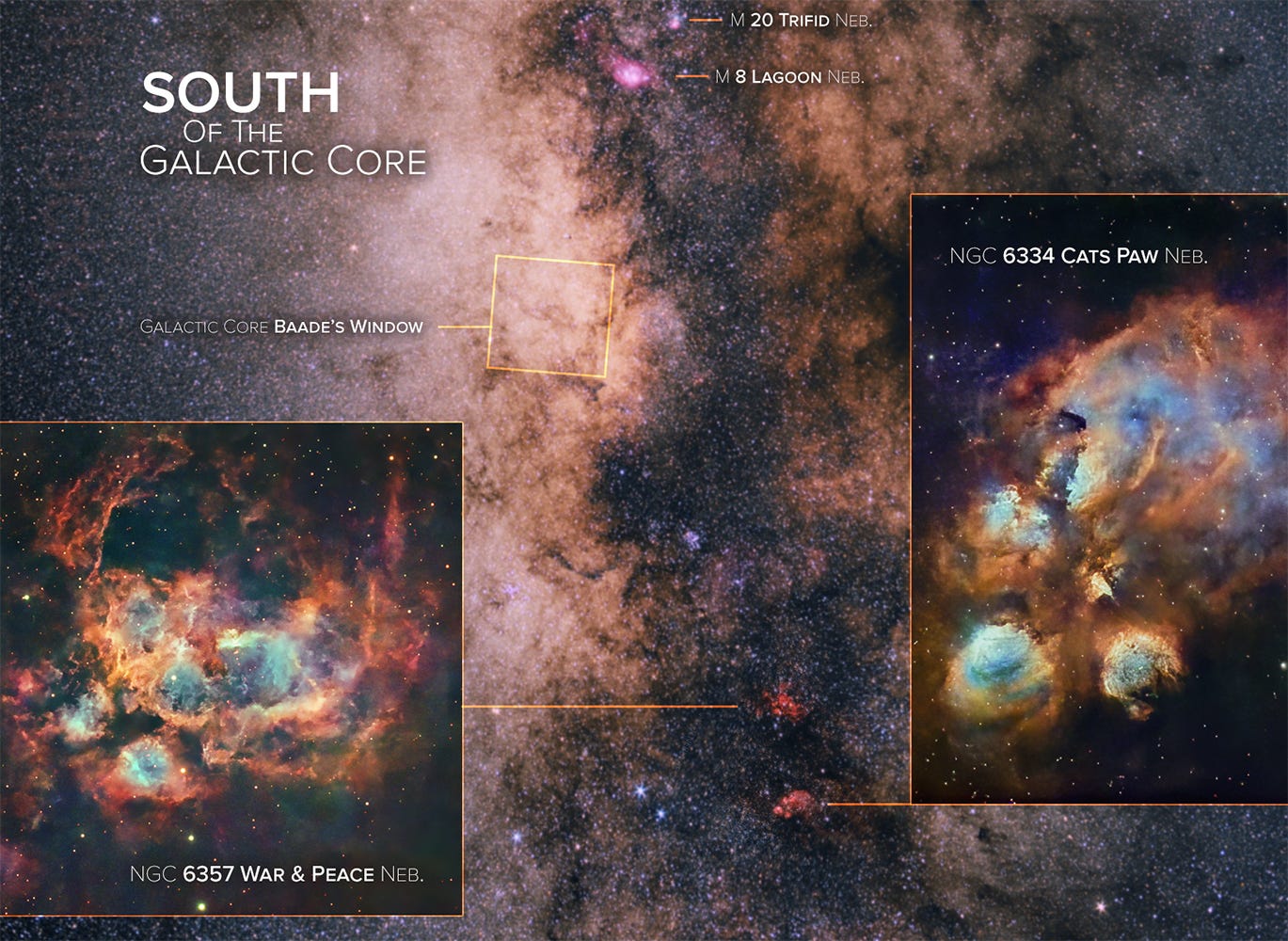
Before we dive into the targets, we need to talk about location. If you are shooting in the Southern Hemisphere, you have the absolute shot advantage right now. From July through September, these targets are blazing directly overhead at the zenith. You get to shoot through the thinnest part of the atmosphere, meaning your Dwarf scope can pull in breathtaking, high-contrast details with ease.
For my Northern Hemisphere shooters, you have a challenge ahead. Because these targets sit so far south along the galactic plane, our window to capture them is closing fast, and you are fighting the thick atmospheric “soup” near the horizon. By mid-August, depending on how north you are, they may be lost entirely. If you have clear skies near the end of July on into August, these need to be at the very top of your “rift” list
Situated roughly midway in the rift, you will find the Cat’s Paw.
If you are trying to understand where this is visually, look for the famous “teapot” asterism in Sagittarius. Starting from Phi Sagittarii (the “handle” star), trace a line through Kaus Australis and Ascella (the “spout” stars), continuing through the bright Milky Way straight toward the center of the dark rift. Or follow the line of three “stinger” stars of Scorpio; these point right to the location of both Nebulae.
What awaits you is a massive emission nebula that genuinely looks like the glowing red paw print of a cosmic feline.
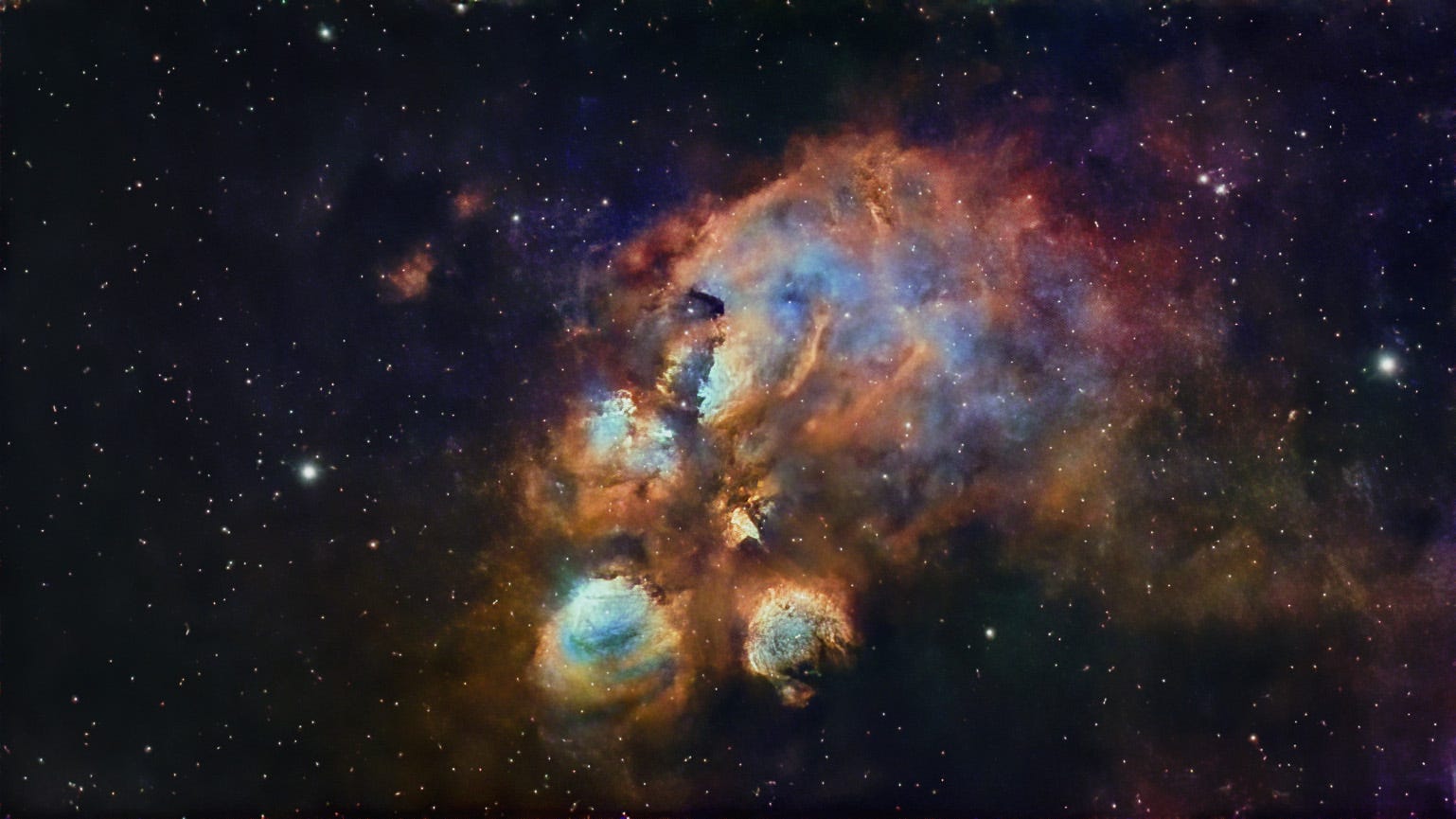
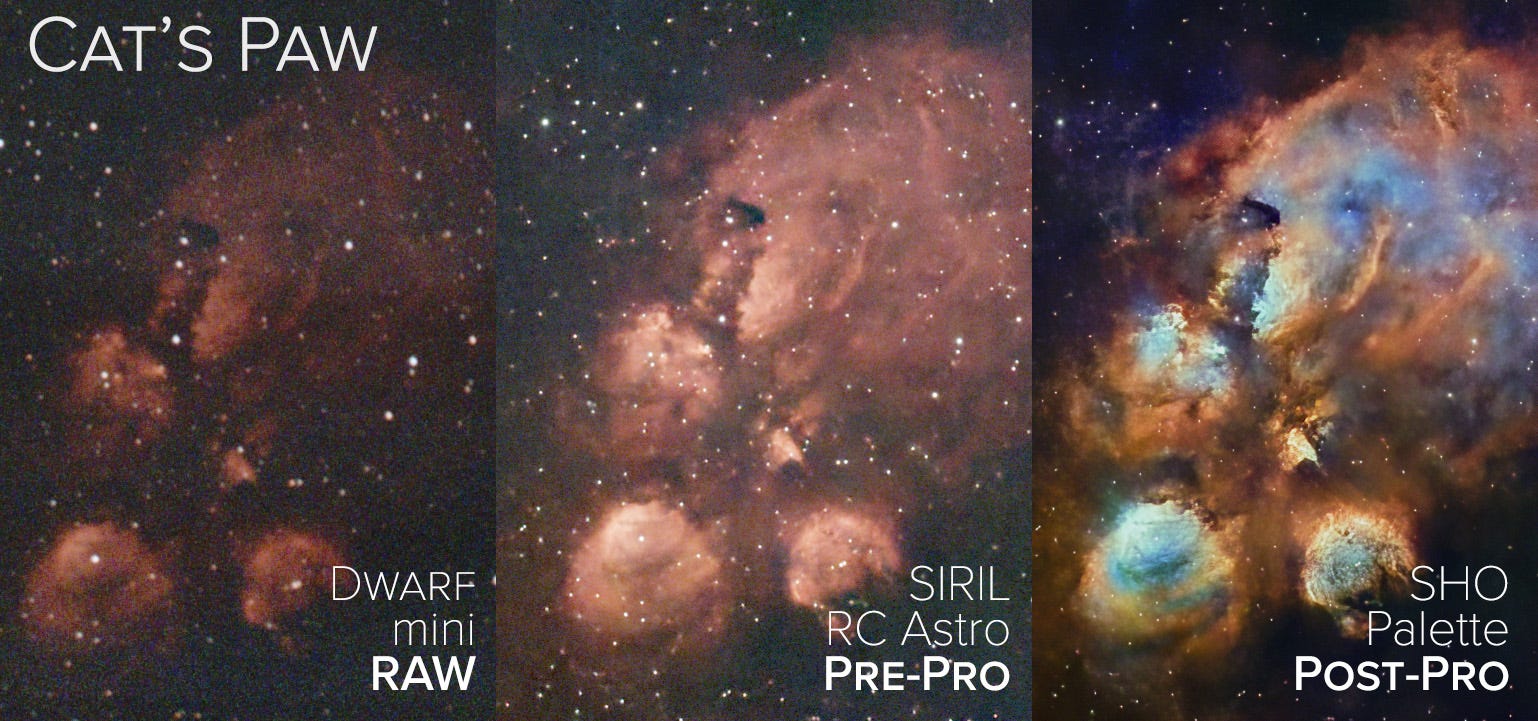
NGC 6334, creatively called the Cat’s Paw, has a highly distinct bean-pod appearance from intense, localized bubble expansions around young stars or star clusters. These young O- and B-type stars are almost completely buried within thick dust clouds of the Nebula. Yet, these hidden stars unleash blistering stellar winds and radiation that “hollow out” localized cavities (or “toe-beans”), creating expanding bubble shells that slam into the surrounding dark, freezing molecular material, the “veins” between the toes.
Just north and slightly east of the Paw sits its chaotic neighbor.
While it is commonly called the “Lobster Nebula” in the DwarfLab App, its alternative title—the “War & Peace” Nebula—tells a much better story. This evocative name originated with the Midcourse Space Experiment (MSX) team. When they looked at this nebula, they noticed a striking duality: the bright, highly ionized regions appeared chaotic and tumultuous, representing “war,” while the dark, serene dust lanes stood in stark, tranquil contrast, representing “peace”.
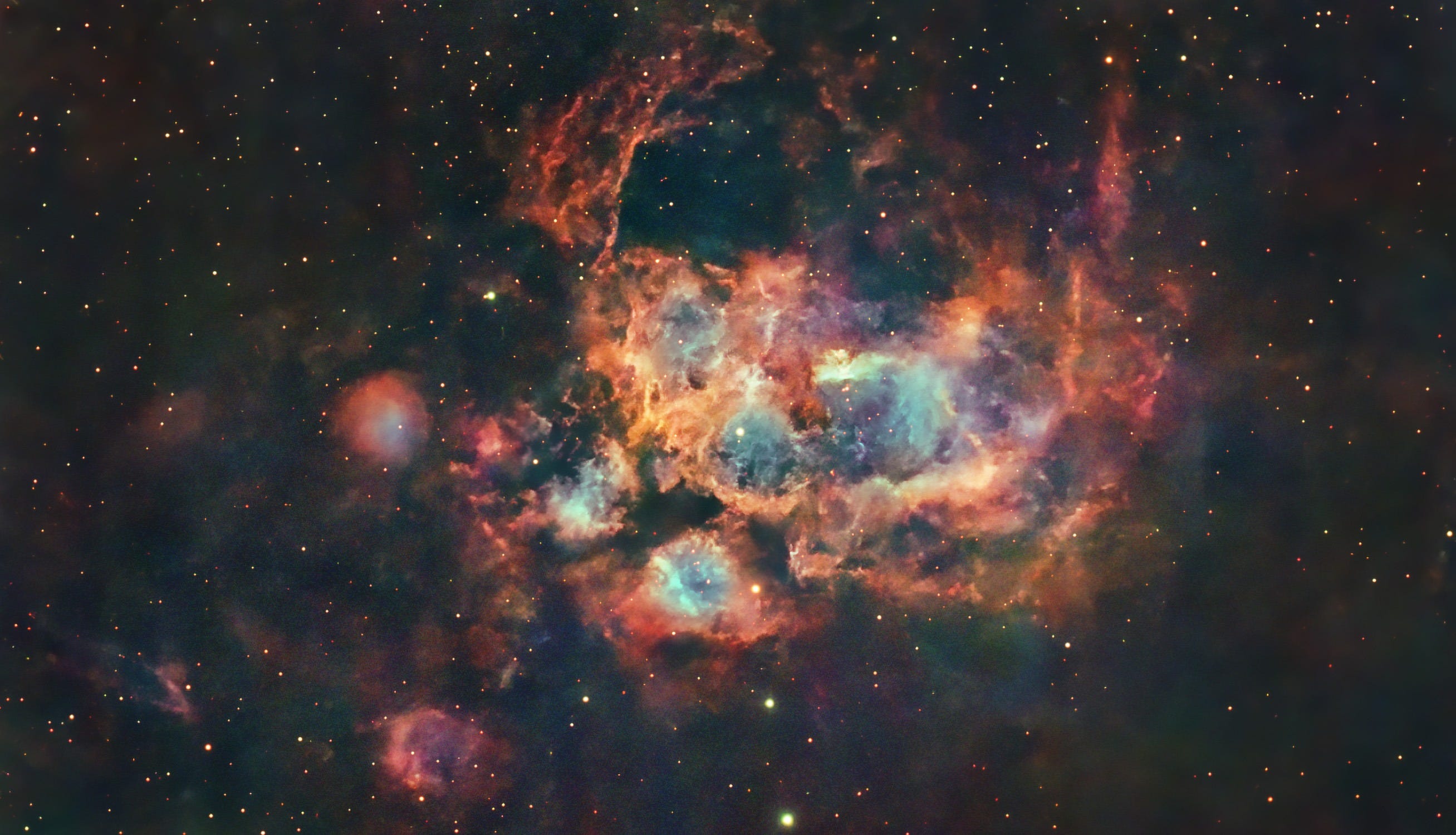
The Duality of the tumultuous, blue-hued "war" regions is powered by a massive, hidden cluster of ultra-hot O-type stars, which unleash blistering stellar winds and intense ultraviolet radiation that rip through the nebula, ionizing the surrounding hydrogen and creating expanding, high-pressure shock bubbles that glow intensely in OIII blues, yellows, and H-alpha oranges. Conversely, the serene "peace" zones comprise highly concentrated, cold molecular dust lanes that act as thick cosmic shields, absorbing the violent radiation and remaining almost completely invisible. For the astrophotographer, this intense structural clash creates an incredible palette of high-contrast hues, where the chaotic, glowing gas fronts slam violently against ink-black, tranquil dust silhouettes to reveal the complex, layered texture across the nebula.
If you're ready to begin capturing and processing these gems, consider upgrading your membership today. Download this PRO GUIDE, plus get immediate access to our growing library of PRO GUIDEs for DWARFERS!
Already a member of our CREW? Scroll down to download this CAPTURE & PROCESSING ProGuide on these GEMs of the RIFT and take your skills to the next level.
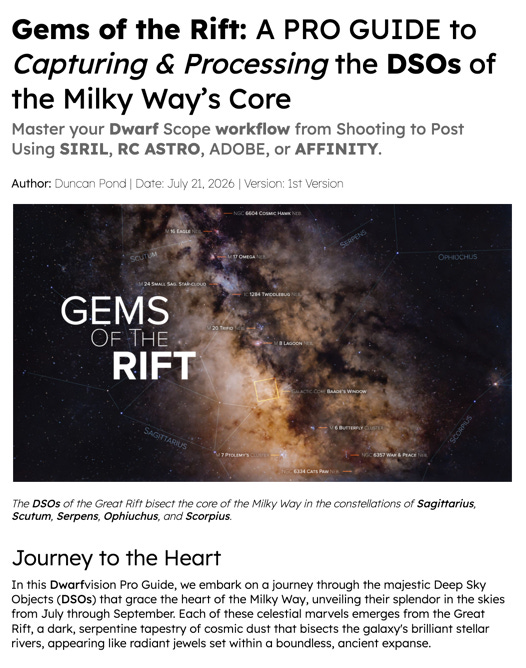
The guide contents at a glance:
Target Selection: A guide to locating iconic nebulae within the Great Rift, including the Cat’s Paw, War & Peace (Lobster), Lagoon, Trifid, Omega, and Eagle nebulae.
Our Astro-Photography Workflow: Learn our complete A to Z pipeline for imaging celestial marvels, covering session capture settings, stacking in SIRIL, and using AI-driven tools like RC Astro’s (BlurXTerminator, NoiseXTerminator) to refine your images.
Software How-Tos: Detailed advice on using a mix of free and subscription tools, including SIRIL, Affinity Studio (with JR’s Macros), and Adobe Photoshop (with SyQon’s Prism Deep), to achieve professional, “Hubble-like” SHO palette results.
Technical Tips for DSOs: Practical steps for achieving high-quality images with your Dwarf Scope(s), including specific EQ mode alignment, exposure settings for dark skies, and advanced color balancing techniques to isolate narrow-band signals like OIII.
Coming up in Part TWO, we explore the iconic Lagoon and Triffid Nebulae plus a few surprises, so stay tuned. For the CREW, we will drop all our files and data on these Gems of the Rift!
Clear Skies, and Happy DSO Hunting Dwarfies!
Duncan
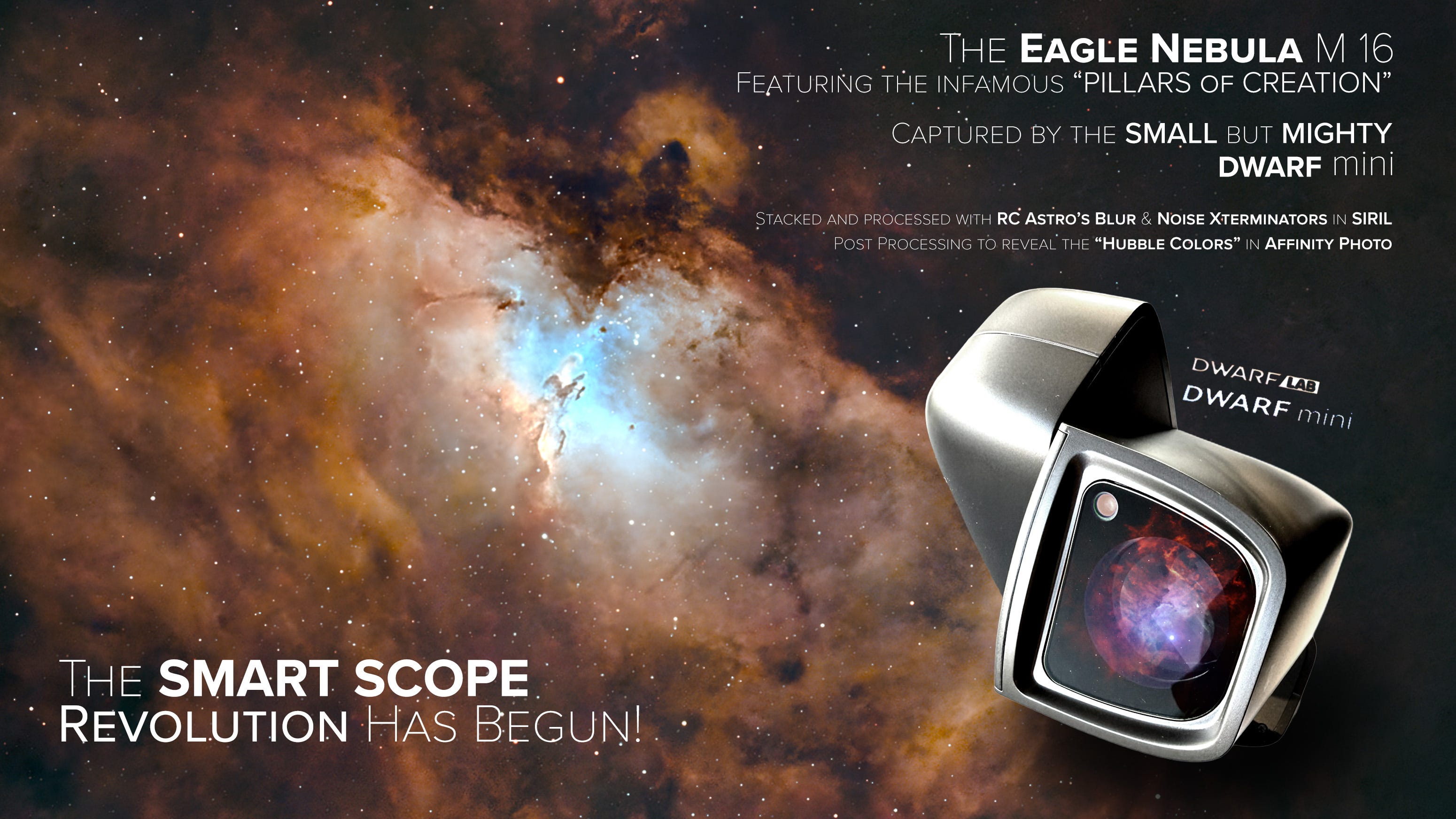
The tiny marvel that took our shots in this post was the DWARF mini SMART SCOPE. Seriously, it’s not a smaller D3 companion; it’s an upgrade! Order your mini today with our Affiliate link:
Comments
Nothing yet. Say the first thing.
Sign in to join the conversation.