
Two words that would set an almost impossible target for the greatest military force the world has ever known – “Unconditional Surrender.”
As of the writing of this short essay, threats to begin disabling civilian infrastructure in Iran remain in place. In fact, Donald Trump himself has come out with a statement that is Trumpy even by Trump standards:
A whole civilization will die tonight, never to be brought back again. I don’t want that to happen, but it probably will. However, …, maybe something revolutionarily wonderful can happen, WHO KNOWS? We will find out tonight, …
Trumpy Trumpissimo!
I am no better situated than anyone to opine imperiously about what is or what is not going on, but my sense is that the deadline of “tonight” marks a threat to start nibbling away at electrical grids and other infrastructure. But, to what ultimate effect?
The fairytale result contemplates the 39-day war ending with the eventual collapse of the regime and the rise of a new polity and new leadership. The new leadership would replace the Chiliastic aims of the current regime with something that enables the country to prosper without threatening the prosperity of other nations.
Recall what the Chiliastic aims of the current regime officially include. From the preamble to the constitution of the Islamic Republic of Iran: to develop military capacity …
… not only for safeguarding the borders, but also for accomplishing an ideological mission, that is, the Jihad for the sake of Allah, as well as for struggling to open the way for the sovereignty of the Word of Allah throughout the world.
Collapse might yet deviate from the fairytale in that it itself likely contemplates the defection of some number of regime insiders… Indeed, results short of collapse would also likely involve the defection of regime insiders. We could end up replacing Regime-Classic with something like Nuke-free Regime-Lite. But, Nuke-free is still nuke-free, although a nuke-free regime could still yet require costly adult supervision for some time.
How disabling civilian infrastructure facilitates the collapse of the regime or the transition of the regime to regime-lite is not entirely obvious. Disabling the capacity of the regime to commercialize oil might be effective insofar as oil revenues comprise the regime’s principal source of revenues. Disabling the distribution or generation of electricity might also disrupt revenue-generating activity, but it could also impose immediate hardships on the general population. If I were Iranian, I would feel blessed to find myself occupied with herding sheep out in the country where I might have access to well water and to the produce of my own field. City folk might have a harder time taking care of themselves were public services to be disrupted.
One might yet wonder why the United States has not already disabled the capacity of the regime to commercialize oil. One reason would be that allowing the Iranians to sell oil helps contain the rise in global oil prices. Some observers note that the United States procures a small volume of oil from the Persian Gulf whereas the Chinese procure a large volume from the Gulf. “Closing the Strait of Hormuz” should therefore amount to a larger problem for the Chinese than the Americans, right? But restricting the volume coming out of the Gulf—whether it’s Saudi oil, or Kuwaiti oil, or Iraqi oil or Iranian oil—merely amounts to restricting the global supply of oil. Restricting global supply amounts to imposing upward pressure on global prices. Even the United States will have to deal with higher prices, and that amounts to a politically sensitive matter.
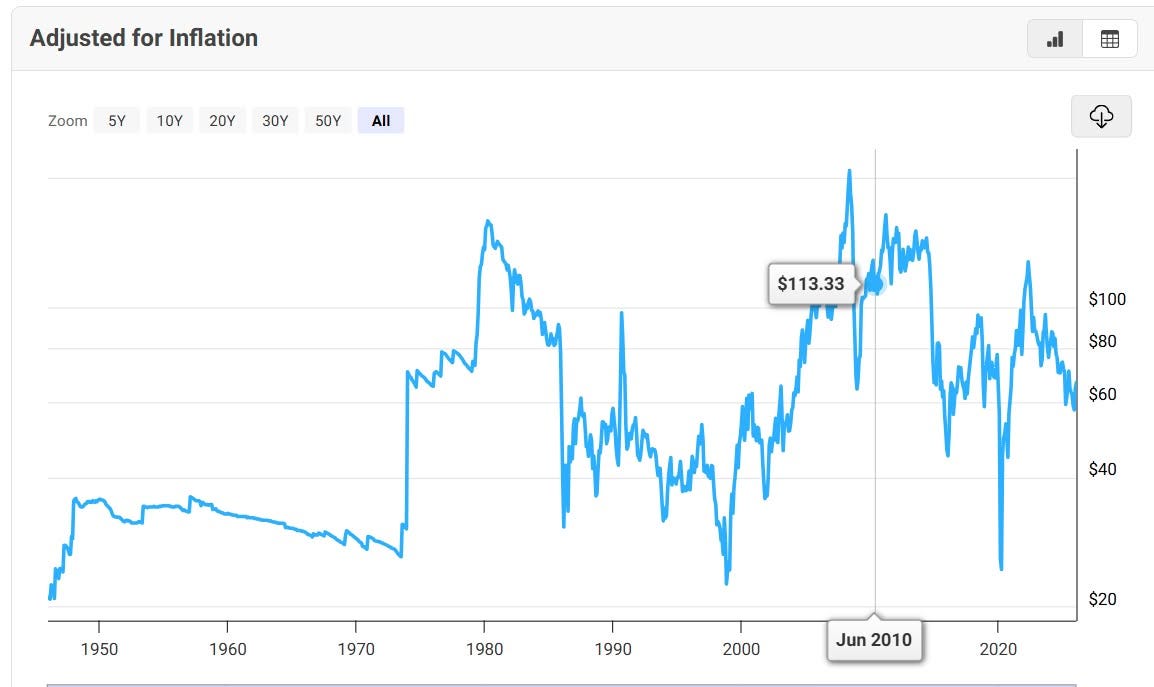
As of right now, West Texas Intermediate crude oil (WTI) is selling for about $113 per barrel. The following graph features WTI prices adjusted for inflation going back to 1946. What it shows is that WTI had been selling for about $68 at the end of February. At the current price of $113, it yet remains lower than what it had been in 1979-1981, 2007-2014 and 2022... No one complained in 2007-2014?
Another reason, of course, that the United States has not yet destroyed the capacity of the regime to commercialize oil is that it hopes to preserve that capacity for the regime that would succeed the current regime. It hopes to preserve the capacity of Iran to finance the rebuilding of its own country after the war wraps up. But, will the Trump administration decide that it really does have to inflict more damage in order to effect something approaching regime-change?
Inflicting damage was a much easier matter to justify during the Second World War. Franklin Roosevelt met with Winston Churchill in Casablanca in 1943 not long after the United States landed troops in North Africa. The Americans were pressing down on Rommel’s Afrika Korps from the West. The British were pressing in from the East. American and British forces would soon meet up in Tunisia.
It was at that conference that Roosevelt publicly committed to the “Unconditional Surrender” of Germany and Japan.
Note what committing to unconditional surrender both entailed and did not entail. First, it involved to committing to a hard bargaining position and taking away from the Germans and Japanese some capacity to cut deals that would preserve their respective regimes. The leadership of each country would have more incentive to commit their armed forces to fighting to the bitter end. Note, for example, that the end of the war in Europe included the Battle of Berlin. The Soviets lost more than 80,000 men fighting block-to-block. The Germans lost at least as many combatants as well as another 125,000 civilians. I am not sure whether to count German pre-teens among the civilians or the combatants:
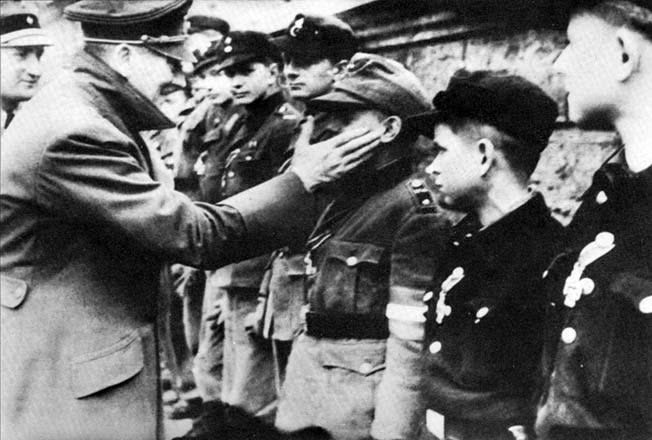
Would cutting deals well short of unconditional surrender have obviated the Battle of Berlin or, say, the battle for Okinawa? Would deals have obviated the atomic bombings of Hiroshima or Nagasaki?
Second, unconditional surrender did not entirely involve replacing all regime personnel with new personnel. Indeed, some observers complained that post-war German government included many of the same people who had managed the administrative apparatus of the war-time government. But, why not, for it was these people who were already well situated to help turn things around in the immediate aftermath of war. The same thing in the Japanese experience: The British, for example, needed to impose some order in the Southeast Asia. But, the Japanese military, still intact, was still there. Britain’s agent, Lord Louis Mountbatten cut a deal with the Japanese by which the Japanese military would continue to provide security until local authorities or the British themselves could build up capacity. Meanwhile, back in Japan itself, the Americans worked with many of the Japanese who had been running the old system in making the transition to the new system.
So, what is going to happen in Iran? The Trump administration seems committed to definitively ending the Iranian nuclear program. That program includes both the development of nuclear warheads as well as the development of the ballistic missiles that could deliver those warheads. The Americans and the Israelis now seem committed to starting a campaign of whittling away at civilian infrastructure. This kind of thing made for a much less politically-fraught business during the Second World War. Back then, the political will built up not merely to destroy infrastructure that could support continued war efforts but also to raze German and Japanese cities. The West has since operated under increasingly strict political constraints. The East, not so much. Islamic-inspired violence looks much like it did through the course of the Mahdist State in the Sudan (1881-1898) or the Seventh Century: Unconstrained.
No posts
Comments
Nothing yet. Say the first thing.
Sign in to join the conversation.