
This essay features a lot of images and, so, may be too long for an email. Click on the title to load the essay up in your browser.
* * *
I had been disappointed that Norway had not qualified for the 2022 World Cup in Qatar, because I had wanted to see Norwegian phenom Erling Haaland. But, in the just-concluded 2026 World Cup, many casual viewers got a chance to enjoy the Viking Row (1, 2) and to see some crisp matches, some featuring Norway with yet others featuring the top competitors. And then there was … Cape Verde? Where did those guys come from?
For the most part, these matches seemed crisper than most, even by World Cup standards. The World Cup featured the usual controversies that attend futbol—I myself think Egypt was robbed of a beautiful counterattack and goal against Argentina—but I will credit the governance of this edition of the tournament with containing the usual volume of game-stopping flip-flopping and hysterics. Which brings to mind a sport that reaches into an ancient tradition that affirmatively discourages flip-flopping and hysterics, and, rather, elevates, an ethos of stoic sportsmanship. And that, my friends, would be Sumo. The Shinto kami (spirits) do not like flip-flopping and hysterics.
Admittedly, like football/soccer, Sumo can impose demands on the viewer. Equipping oneself to appreciate its finer points can require a nontrivial investment of time and concentrated attention on the part of the viewer. But, I am going to suggest that there is something to it. At first sight (to me), a Sumo match is a short battle between a pair of big, fat, strong fellows with the result determined by a coin flip. But, really, a match usually amounts to a short battle between a pair of big, fat, strong fellows that features interesting technique. Add to that a lot of Shinto ritual and quietly colorful crowd participation. That crowd participation will include some number of younger and older ladies in their kimono taking up prime seats in direct view of the television cameras. Some of these people are professional viewers who make a quiet business of being part of the spectacle. It’s fun.
Then there is the motivation for this essay, the matter of the governance of Sumo tournaments. The governance of tournaments stands in (in my mind) as a metaphor for governance in Japan itself in that it features a blend of ritual, hierarchy and seemingly inviolable rules with subtle rule-bending discretion. Rules are inviolable on pain of death until they’re not. Who decides and how?
* * *
The title of this essay is a play on The Master of Go (Kawabata, 1951), a book I periodically cite. The subtitle is a play on In Praise of Shadows (Tanizaki, 1933; PDF), an entertaining essay about keeping it real, not being blinded by glitz and appreciating the small things.
The Master of Go uses the governance of Go tournaments before and after the War as a metaphor for the shift from more traditional ways of governing society—ways that had depended more on deference to age and rank—to (dare I say it?) “rules-based,” technocratic governance that, by virtue of operating out of rules, was ostensibly more democratic. The former mode of governance permitted more scope for discretion in what we might recognize as the rules-versus-discretion tradeoff. The latter mode assigned more weight to rules in the rules-versus-discretion tradeoff. And, one point of the book was that there are tradeoffs: something might be gained in moving away from one pole towards the other, but something is also lost. And the second point elaborates on the first: rules-based, ostensibly democratic governance is susceptible to manipulation and, so, may not be as democratic as presented. It can be quite anti-democratic.
Sound familiar?
In Praise of Shadows is a meandering essay in which Tanizaki recounts his transition from a young man who had been taken with the brassy, glassy glitz of the Westernized metropolis to an older man who had ventured out from a clean, well-lighted place to one in which an organic, Zen wabi-sabi aesthetic had been permitted to reestablish itself.
I have attended Sumo tournaments on three occasions. By “attend,” I mean that I showed up for one day of matches in each of three different tournaments. The Japan Sumo Association sponsors six tournaments each year. The Association puts on two tournaments in Tokyo, two in Osaka, one in Fukuoka, and one in Nagoya. Each tournament runs for 15 straight days with each wrestler competing once in each of those days.
The 2026 July tournament in Nagoya just wrapped up. The winner of the tournament was determined on the last day. Three wrestlers (rikishi) finished the tournament with 12-3 records, and, so, there was a three-way play-off. That made for an exciting finish.
In speaking of tournaments, I am concentrating attention on the top “Makuuchi Division.” Sometimes competitors in Makuuchi succumb to injuries and drop out during the course of a tournament. The Association might then elevate a wrestler from the junior “Juryo Division” right in the middle of the tournament.
Forty-two wrestlers populate the Makuuchi Division, and, on a given day of a tournament, those wrestlers will participate in 21 matches. (Towards the end of this last tournament, the Association cut the number of matches to 20 in order to accommodate withdrawals due to injury.) The Association will then do something very East Asian: It will assign each wrestler a rank that he will maintain through the course of the tournament. The Association updates rankings after each tournament.
Note that 21 matches a day over 15 days amounts to 315 matches. Three-hundred-fifteen matches is well below the 42*41/2 = 861 matches the Association would require were 42 wrestlers to participate in a round-robin. (In a round-robin, each of 42 wrestlers would eventually be matched up with each of the 41 other wrestlers. That makes for 861 matches.) So, how does the Association distribute 315 matches across as many of 861 distinct pairings?
A lot of discretion goes into this, surely, and, in fact, the Association does not commit to a fixed, 15-day assignment of matches at the start of the tournament. Instead, the Association crafts a schedule for the next day right after conclusion of a given day’s matches.
The Association does make a point of pairing all of the most-highly ranked wrestlers at some point (usually late) in the tournament. Wrestlers trolling a lower stratum will do just that: troll that lower stratum, unless they start doing very well or very poorly in that lower stratum. The Association seems to get around to pairing a wrestler that has been dominating a lower stratum with wrestlers occupying higher strata. Less successful wrestlers will end up trolling the lowest stratum, and the Association might even relegate them to the lower Juryo Division in the succeeding tournament. Successful competitors in Juryo may yet be elevated to Makuuchi.
The Association divides the 42 wrestlers into two sides, “East” and “West.” Most matches pair a wrestler from one side with a wrestler from the other side, but the Association will pair-up wrestlers from the same side when it comes time to pair the highest-ranked wrestlers in the most consequential, potential match-ups.
The highest rank a wrestler can secure is Yokozuna, and I get the sense that the Association prefers to have one Yokozuna on each side. Right below the Yokozuna are, in descending order, the Ozeki followed by the Sekiwake and Komusubi. Below those top ranks are the Maegashira.
The Association tries to balance the distribution of wrestlers on each side. In a symmetrical distribution, each side could feature one Yokozuna, one Ozeki, one Sekiwake, one Komusubi followed by a cadre of Maegashira ranked from 1 to 17. But, in any given tournament, the roster may deviate from this distribution and may deviate from pure symmetry. One side or the other may feature more than one wrestler in a given top rank. Going into the just-concluded Nagoya tournament, the Makuuchi Division was symmetrical but featured two “East Sekiwake” and two “West Sekiwake.”
A given wrestler may end up rising and falling and rising again in the rankings over the course of a few seasons. Some number of Maegashira will have occupied the rank of Ozeki at some point before falling back into the lower ranks and even falling out of the Makuuchi Division … before making it back into the Makuuchi Division and making another run for higher rank. The highest rank of Yokozuna is exceptional not merely for being highest but also for indicating an absorbing state. A Yokozuna can’t be demoted.
So, how does the Association determine promotions and demotions? And what does the Association do about an aging Yokozuna who is no longer capable of beating most competitors?
Good questions, and I do not have much insight into this, but a lot discretion seems to be a work. Consider, specifically, this business of elevating a wrestler to Yokozuna status. There are tradeoffs, and a given wrestler might not be too keen to (yet) be elevated. Demotion might afford a wrestler an opportunity to recover from a disappointing streak of performances. A Yokozuna going through a bad stretch might, in contrast, end up facing rising demands from the back office to retire.
So, what would the optimal trajectory of a Sumo career at the highest ranks look like? Should one aspire to reach the rank of Ozeki early in one’s career and then to troll the highest ranks for many years before being elevated to Yokozuna? But, in those years, might injury take its toll, and would one’s prospect of ever rising to Yokozuna diminish? Alternatively, should the optimal program involve just going for it and endeavoring to secure the status of Yokozuna as early as possible?
My understanding is that the Association found itself short of Yokozuna and made a point of expediting the elevation of the wrestler Hoshoryu to “East Yokozuna” . (“Hoshoryu” is the “Ring Name” of the wrestler Sugarragchaa Byambasuren from Mongolia. As I understand it, “Hoshoryu” means something like “Rising Dragon.”)
Hoshoryu is 27 years old and has won two non-consecutive tournaments. My understanding is that it is customary to consider the candidacy to Yokozuna status of a wrestler who had managed the great feat of winning two consecutive tournaments. But, custom was a little strained in this case.
Meanwhile, 22-year-old Danylo Yavhusishyn (“Aonishiki”) has just won the Nagoya tournament in a three-way playoff—very exciting!—and will return to the rank of Ozeki after having fallen out of that rank earlier this year.
Aonishiki’s has now won three tournaments, and Hoshoryu has yet to win a tournament since being elevated to Yokozuna last year. Chatter about elevating Aonishiki to Yokozuna will surely start picking up again, but would Aonishiki really aspire to Yokozuna status at such a young age? Meanwhile, Hoshoryu, who is an excellent, exciting wrestler, must be feeling increasing pressure to finally win another tournament post-elevation to Yokozuna. He is not an old man, either, but will having been elevated prove to be more of a burden than an honor? What does the Association think of this?
The old man in this last tournament was “Takayasu,” whose real name, it turns out, is “Takayasu!” He is 36 and entered the Nagoya tournament as a Maegashira #7, having fallen far from the rank of Sekiwake, a rank he had occupied two tournaments ago. He had a very good tournament in Nagoya, finishing 11-4. He has never won a tournament but has often threatened to do just that. He just can’t seem to get that one or two extra wins over the top wrestlers that winning a tournament would require.
I myself assign names to the rikishi. I call Takayasu “Hairy Bear,” because he is a bear of a man, and he is the most hirsute of the bunch. It’s no contest. I call Hoshoryu “Mean Cat,” and I call the Ozeki Kotozakura “Fat Cat.” Hoshoryu really is kind of mean. He likes to stare down his opponents at the start of a match, and his pre-match ritual includes staring into—or rather, through—the television camera and making his hissing, mean face. That may be his game face, but it’s genuine. Hence Mean Cat. Kotozakura, meanwhile, has his own pre-match ritual: roll one shoulder; pause while staring impassively through the camera; roll the other shoulder; reach down for a big, heaping handful of salt; rise up, stare through the camera, roll both shoulders simultaneously and make his mean face before turning around tossing the salt into the ring (the dohyo) with a whip of the wrist. These rituals make for entertaining, comfortably predictable performances.
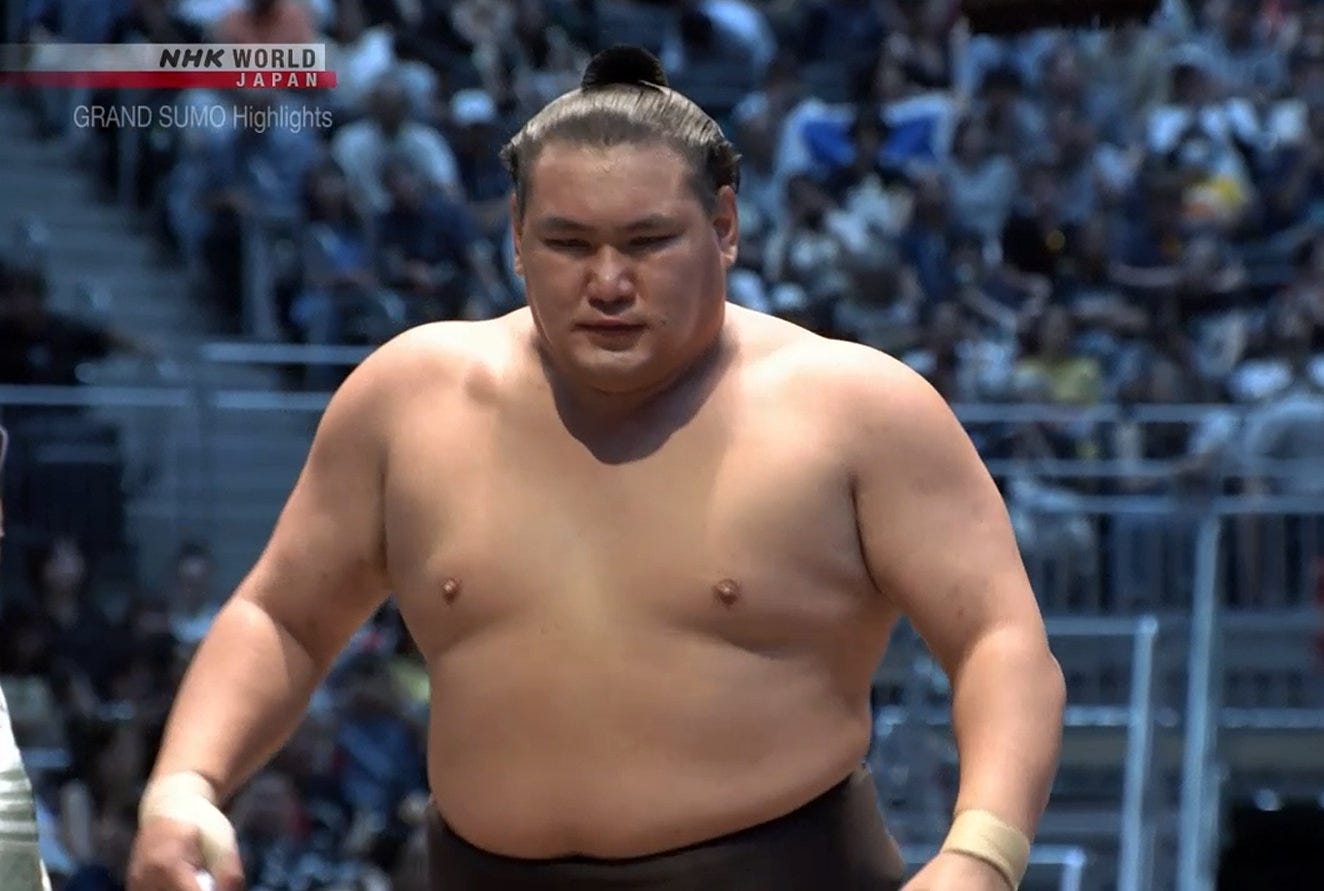
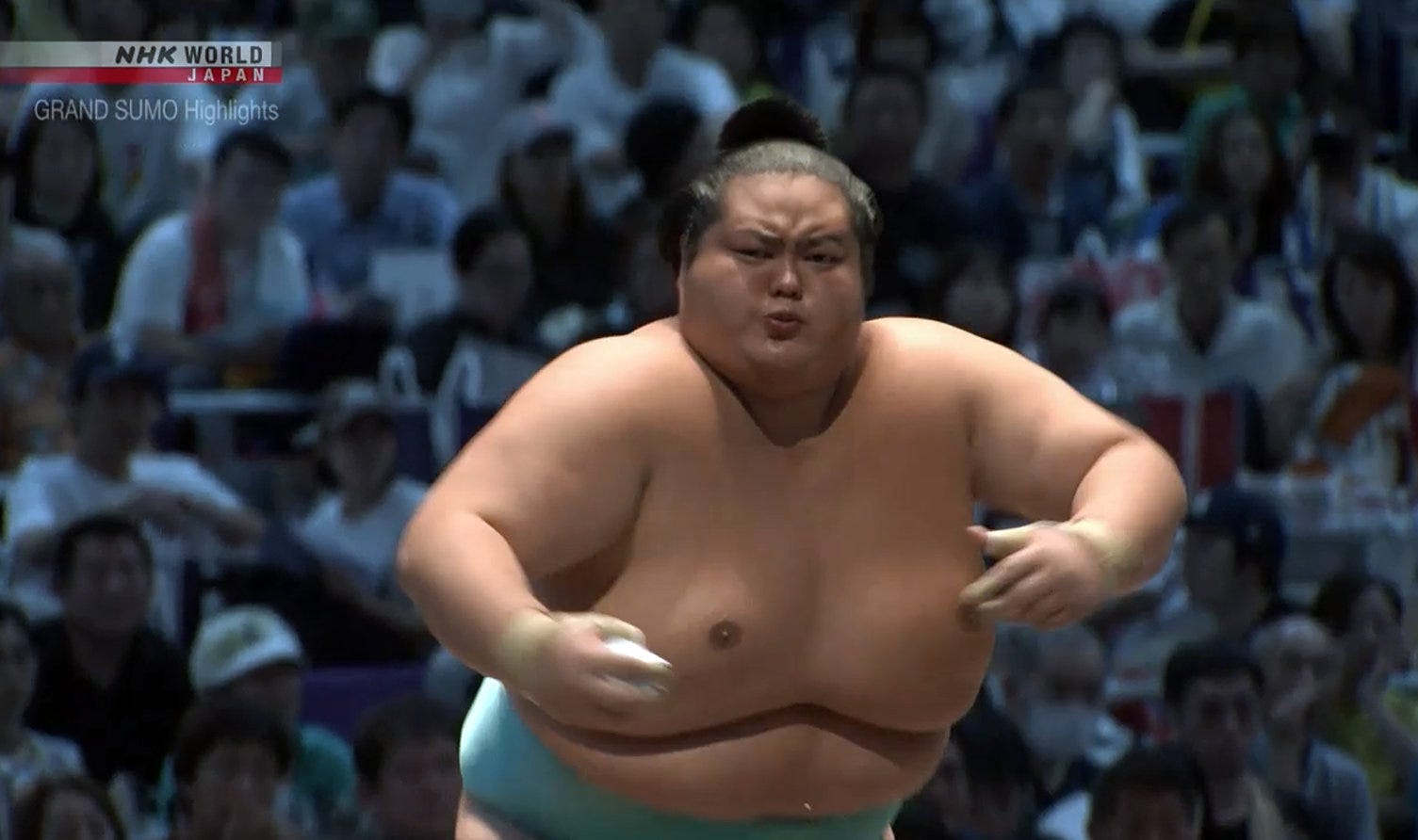
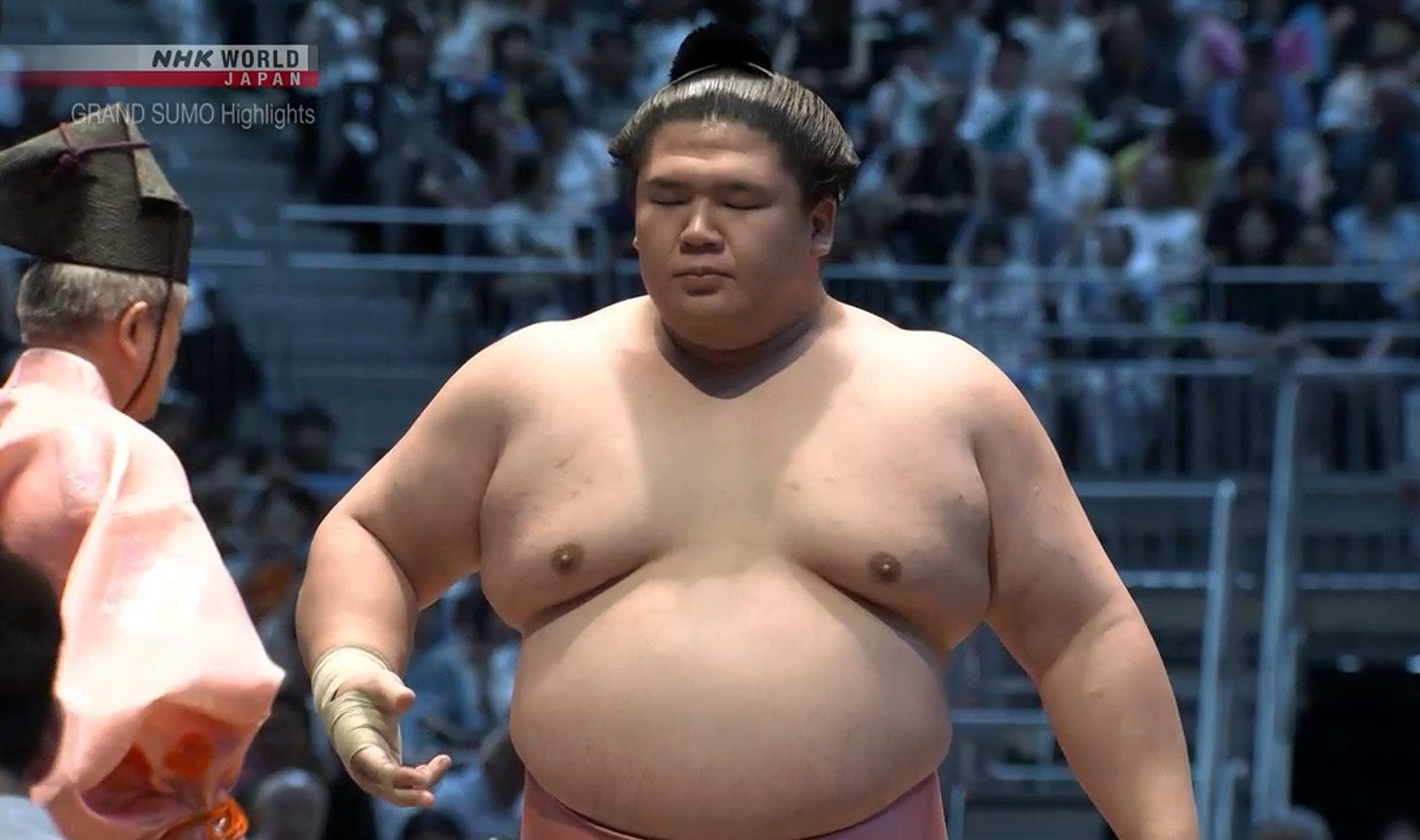
Now, what is this business of tossing salt into the dohyo before each engagement? “Shinto purification ritual” would seem to encompass much of what goes on in the lead up to a match as well as at the opening and closing of the day’s proceedings. Dispelling evil spirits is also part of the opening and closing programs.
An interesting thing is that each match involves a sequence of salt throwing: The wrestlers step up to the raised competition surface, the clay dohyo. They go through a sequence of the Sumo foot stomps and hand clapping before retiring to their respective corners and gathering up some salt. At the direction of the gyoji (the referee), they will toss the salt into the ring before facing each other and assuming their starting positions. Along the way they will very ostentatiously slap their belts (mawashi) as a way of signaling (I am guessing) to opponents that they do not hide any salt residues on their hands. (These days, the belt slapping is mostly just for show, surely, and Takayasu makes belt slapping a big part of his warm up ritual even before he has taken up any salt. He just likes the percussive sound of slapping his belt.) The wrestlers will rise up from their starting positions after some amount of staring each other down and go through the salt-throwing exercise again. They may do this like four times.
The gyoji will finally direct his “war fan” (a wooden paddle) toward the center of the ring, signaling that it is time for business. No more salt throwing. Business starts once both wrestlers touch the surface of the dohyo with both hands.
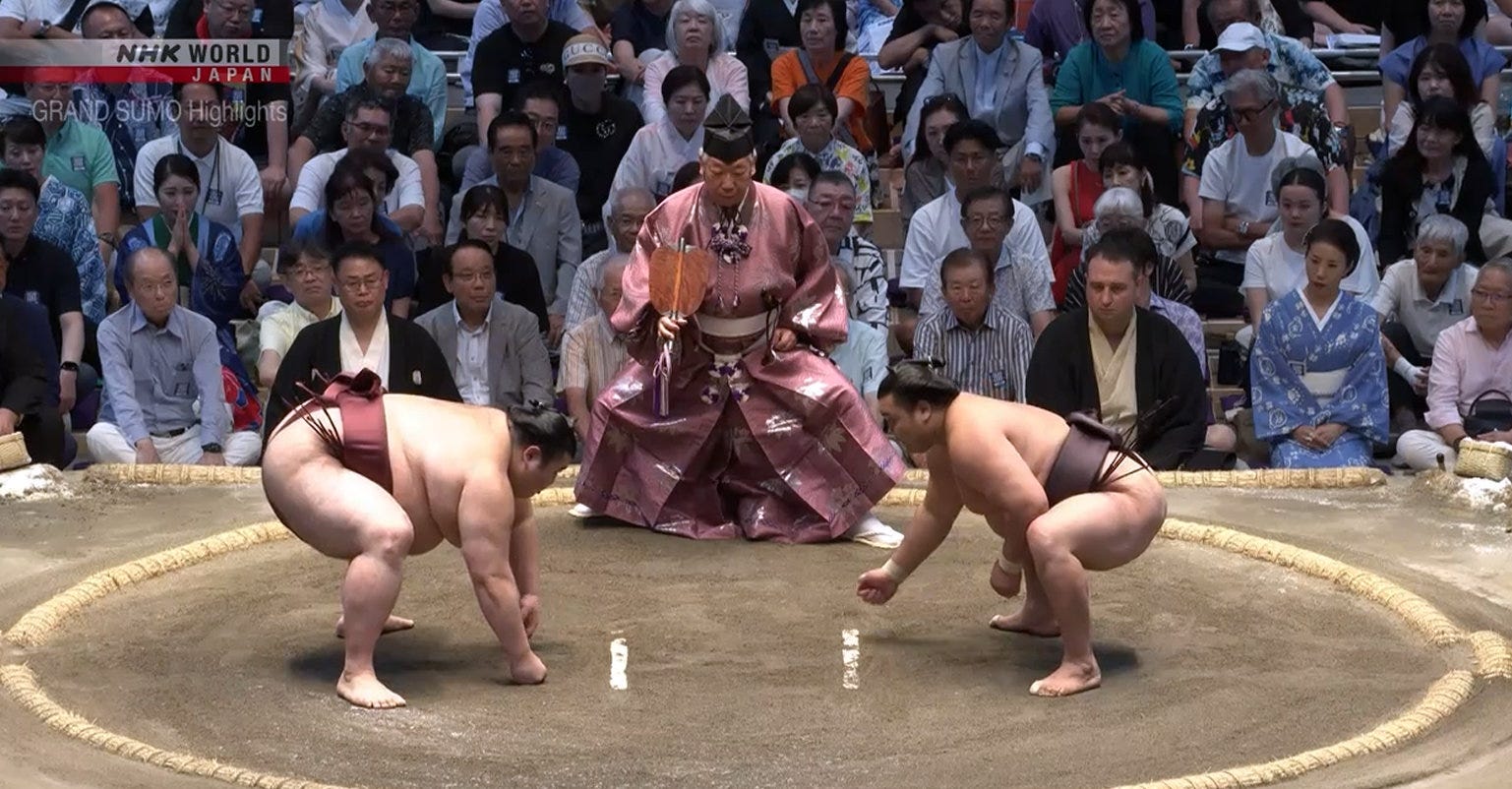
The Tachiai is the initial contact, and there is some expectation that the wrestlers will not avoid a violent tachiai by, say, side-stepping a charging opponent. Although, wrestlers will sometimes do that, especially smaller wrestlers.
The smallest wrestler in the last several tournaments has been Fujinokawa (East Maegashira #1) who weighs in at 123 kg (271 lbs). He looks small compared to other wrestlers, but still, 123 kg!
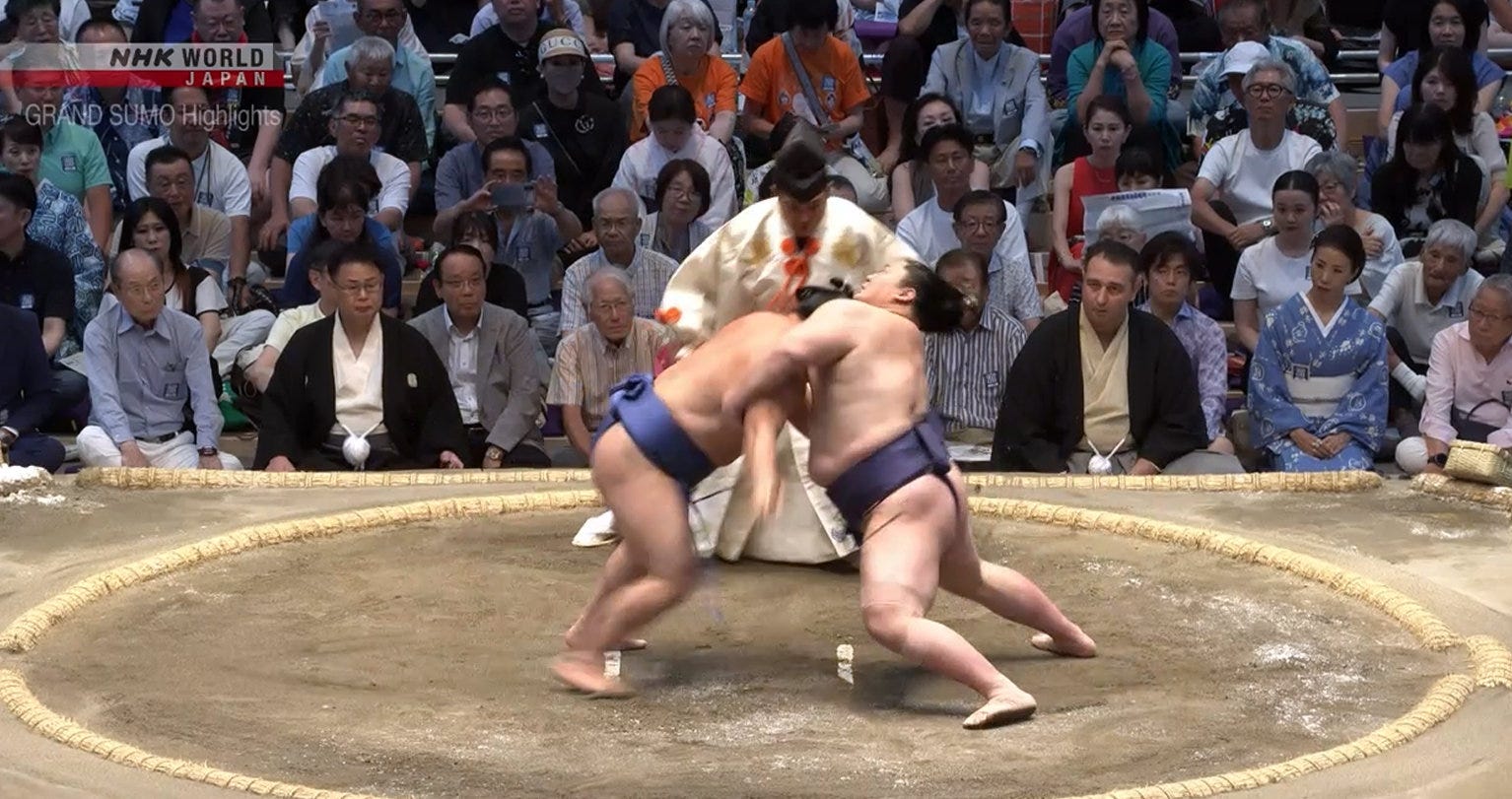
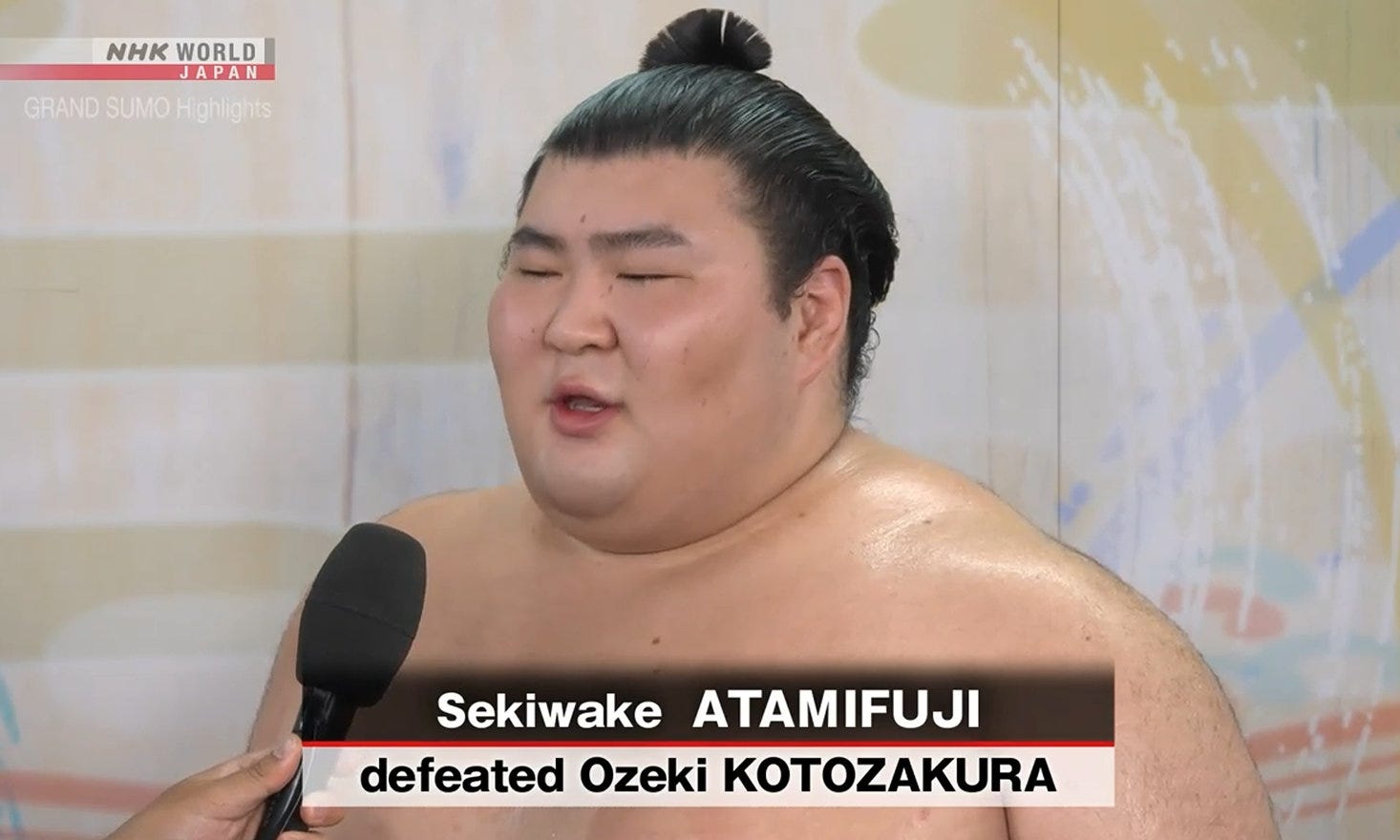
In this last tournament, the biggest wrestler was newcomer Kazuma (West Maegashira #15) who weighed in at 205 kg (451 lbs). He had a disappointing debut in the Makuuchi Division, which is interesting, because just being a big load is not good enough to have success in the dohyo. Meanwhile, the other biggest rikishi is a young fellow Atamifuji (East Sekiwake) who weighs in at a 197 kg (433 lbs.). My name for him is “Atomic Fuji.”
Atamfuji has had some success and has been climbing up the ranks, and he was within inches of winning the January tournament. Both Atamifuji and Aonishiki were tied at the end 15 days of competition, so the competition went to a playoff. Atamifuji absorbed the tachiai and started advancing steadily like Godzilla, but, at the edge of the ring, Aonishiki threw a headlock in desperation, and somehow this caused Atamifuji to lose his balance. The big guy fell to the side, and Aonishiki ended up winning his second tournament.
Aonishiki and Atomic Fuji met on the last day of the Nagoya tournament, and Atamifuji managed to avoid losing his balance. He methodically pushed Aonishiki out of the ring, and this mattered, because now Aonishiki and Atamifuji would again go to a playoff, but, this time, they would be joined by the Mongolian Kirishima. Aonishiki masterfully won both his matches in the three-match playoff.
So, how did Aonishiki manage to prevail over Atomic Fuji in their second meeting of the day? At the tachiai, he managed to get a good grip with his left hand on Atamifuji’s belt (the mawashi). And then he stepped to his left, wheeled away from the edge of the ring and started to get Atamifuji turning. The big guy just could not recover and start mounting offense of his own. He ended up wheeling around and then stepping out of the ring. If you can’t knock ‘em down or win a straight-on pushing contest, then get them on the defensive and wheel them around in circles. Maybe throw in a trip.
The result of a given match can look like a coin-flip, but the most successful wrestlers do include (it seems to me), some measure of finesse in their game. There can be, for example, a lot of uncertainty at the tachiai: What will the opponent do? Will the opponent go for an inside grip of the mawashi with the left or right hand? Alternatively, will the opponent merely smash into oneself and avoid committing to a grip? Might an opponent step sideways after the tachiai or step sideways even before initial contact?
The very top rikishi like Hoshoryu, Aonishiki and Kirishima can do it all. They can take advantage of strong grips on the mawashi, but they can be a little elusive and outflank an opponent. The commentators, meanwhile, will distinguish between wrestlers who tend to be “pusher-thrusters” from those who prefer exploiting grips on the mawashi. “So-and-so is a mawashi man. He prefers the inside grip with the left hand…” Or, “This match features a pair of pusher-thrusters …”
Gonoyama is a fellow in mid-career who had a very good experience in the March 2026 tournament, but, as the commentator Murray Johnson observed, “This man only knows one thing: How to bash into his opponent!” And, so, Gonoyama started his March tournament dominating everyone in the lower Maegashira ranks. The Association then started to match him up with top-ranked wrestlers in the second week of the tournament, and while he made a gamely effort, his predictable (and usually potent) technique, was not enough to win against the best wrestlers. In his match with the big guy Atomic Fuji, he launched himself and bashed away. Atamifuji slowly retreated to the very edge of the ring, and, in fact, Gonoyama came within an inch of forcing Atamifuji to make contact with the exterior of the ring with the heel of his foot. Gonoyama would have won the match had Atamifuji made external contact, but it wasn’t enough. Atamifuji managed (just barely) to absorb the tachiai and the successive round of bashing. He recovered his balance, centered himself and started to mount his own offense. He mechanically advanced, ultimately pushing Gonoyama out of the ring. Gonoyama could stand for a little more finesse in his game.
Aonishiki, meanwhile, continues to develop his repertoire of tricks, and, he has had to do that, because other wrestlers had started to figure out how to counter his most winning technique. That winning technique had involved assuming a lower stance than most wrestlers. So, at the tachiai, Aonishiki would go in low and endeavor to secure a good grip, preferably with both hands, on the opponent’s mawashi. Aonishiki would then mechanically advance and secure a very straight-forward win by something like yorikiri (“frontal force out”) or oshidashi (“frontal push out”). This is interesting, because assuming a very low stance makes a wrestler vulnerable to hatakikomi (“slap down”) and falling on his belly. But not Aonishiki. He’s got a very strong core, and getting a good grip on the opponent’s mawashi enables him, like a cantilevered bridge, to avoid collapsing in on himself.
So, how do opposing wrestlers counter this? They have to stand Aonishiki up; keep him from getting (or staying low). It was in the March 2026 tournament or so that the Yokozuna Onosato managed to masterfully do just this. In that match, Onosato launched himself into the tachiai with a secret weapon: Instead of, say, putting his right arm up in order to protect himself from initial contact, he brought his big right hand up like an open-handed upper-cut and managed to stand Aonishiki up. He then grabbed Aonishiki’s mawashi with both hands and tossed him sideways out of the ring like a rag doll. It made for a decisive win and a short match. Aonishiki has since made a point of putting on a little more weight—not an easy thing to do!—and to be less predictable at the tachiai.
That said, Aonishiki still manages to deploy his favorite, winning technique with some regularity. In the Nagoya tournament, he managed to pull it off against the big guy Kotozakura. At the tachiai, Aonishiki managed to get on the inside of Kotozakura’s reach and to press his forehead straight into Kotozakura’s sternum. He failed, however, to get a grip with either hand on Kotozakura’s mawashi. But, he effectively managed to stand Kotozakura up, and Kotozakura could not mount effective offense of his own. He tried to back up and shake Aonishiki off (much less effect a “slap down”), but Aonishiki steadily advanced, and Kotozakura ended up stepping out the ring. The victory went to Aonishiki.
Note this business of formally assigning labels to modes of winning matches. That’s a very Japanese thing. The culture loves taxonomies! It loves labeling everything. One will see this, for example, in samurai films: “So-and-so is an adherent of the Such-and-such School of Swordsmanship… So-and-so is an expert in the This-and-that technique.” In Sword of Desperation (2010), the protagonist perfects his winning technique, “the sword of desperation!” In The Twilight Samurai (2002), the protagonist is an expert of a particular short sword technique, which comes in handy when he gets stuck with the job of rousting a master swordsman out of a confined space.
Sumo recognizes something like 82 winning techniques. “Frontal Force Out” and “Frontal Push Out” may be the most common, but then there is yoritaoshi, “Frontal Crush Out”. Then there are mawashi-centric techniques like uwatenage (“over arm throw”), or uwatedashinage (“pulling over arm throw”). Hoshoryu is a dangerous practitioner of any number of arm throws.
Most of these techniques are just that: techniques. Others, however seem (to me) to be a given technique blended with incidental effects of no making of one’s own. And, sometimes, of course, there can be uncertainty about how to categorize a given, winning result. Was that a win by oshidashi or yoritaoshi? That was a wicked sukuinage (“beltless arm throw”)! Or was it more of a kotenage (“armlock throw”)? And was that guy “pushed out,” “forced out,” or “crushed out?” It can be a bit of a mystery. But, these things must be labelled and filed away!
Note the kinds of techniques one does not see in Sumo. Wrestlers can’t touch the surface of the dohyo with anything other than their feet once the match begins, so wrestlers will not be wearing knee-pads and will thus not sweep in low, brushing a knee along the clay of the dohyo, in an effort to execute a take-down of the sort one would expect to see in collegiate wrestling. Also, Sumo does not sort wrestlers by weight classes. Finally, the ring is not so big that a smaller opponent could spend his time running a larger opponent around the ring indefinitely like, say, the small fellow thrust into gladiatorial combat in that scene from Monty Python’s Life of Brian (1976). Rather, the rules of the game really do favor the biggest men. (Would a larger dohyo favor smaller opponents?) Force equals mass times acceleration, and fat counts as competitive mass. Some fat might also cushion the impact from the tachiai.
That said, I have already noted that mass alone does not strictly dominate. Fujinokawa has made a career of bringing more acceleration into the formula. Famously, in the 1990’s, the relatively small wrestler Mainoumi (about 220 pounds) made a career of sometimes prevailing over much larger opponents like Konishiki by combining speed and a wide range of techniques. If he could keep his opponents from centering themselves and mounting their own offense, he could win. These days, Mainoumi often provides ring-side commentary in the big tournaments.
Konishiki was exceptional for being the first non-Japanese rikishi to secure the status of Ozeki. He also may have been the biggest rikishi to compete in the Makuuchi Division—or any division—in that he weighed over 500 pounds and even maxed out, at some point, well in excess of 600 pounds. At the same time, however, he never secured the rank of Yokozuna, and, while I have not studied the matter, the matter did seem to inspire some controversy. Then, as the 1990’s wore on, the demands of all that mass must have wore him down. He retired and, one would guess, made a point of losing some weight and relieving the stress on his joints.
I have already noted that Hoshoryu’s elevation to Yokozuna seemed to depend on a flexible interpretation of custom. Hoshoryu had a disappointing tournament in Nagoya. He looked good, but he dropped a few matches here and there and then faded from contention in the Yusho race (the race to secure the best record in the 15-day tournament). In fact, he even dropped out of the last two days of the tournament in Nagoya, and that comes after having retired after only one match in the May tournament in Osaka.
The Osaka tournament was unusual in that both Yokozuna ended up retiring early. The Yokozuna Onosato had not even participated in the preceding March tournament, and one can imagine that this kind of thing gives the Sumo Association heartburn. How should the Association manage these apparently under-performing Yokozuna? Should the Association mask under-performance by blaming injuries? Or have injuries been a real concern that themselves require management? Or are injuries a reflection of long-term wear-and-tear, in which case one or the other Yokozuna should start contemplating the prospect of retirement?
Onosato had a slow start in the Nagoya tournament but ultimately secured a winning record. That must have given the Association some relief.
All that said, part of the ethos of Sumo is to win and lose with dignity and stoicism. No complaining. No hotdogging. No excuses. No big talk. Leave it to the Association to manage the business of making excuses and assigning some blame to injuries.
It is really kind of refreshing. This is not futbol … or NBA basketball, WNBA basketball, or a matter ripe for adjudication according to the long-standing tradition we know as “Monday morning quarterbacking.”
At the end of a match, both rikishi will return to the ring. (One or both of them may have gone flying out of the ring, and the ring is elevated. One can imagine that rikishi can get badly injured merely by falling off of the platform.) The rikishi will bow to each other, and the loser will march out impassively, head up, from the arena. The winner will remain in the ring, assume a low stance, and make what in my mind looks almost like the sign of the cross before accepting from the gyoji some number of envelopes, each of which contains 70,000 yen from a corporate sponsor. (Ten-thousand yen from each sponsorship goes to the Association.) Hoshoryu routinely walks out with what looks like two bricks of sponsorships. He will accept them with two hands and make a slight but earnest bow before retiring. Most winning rikishi retire with more like three sponsorships.
The Association seems to informally manage the business of reporting injuries. I am not aware of formal announcements. Rather, an understanding that So-and-so has been dealing with a nagging back issue or another rikishi has been dealing with some other nagging injury seems to just become common knowledge. In fact, extracting information directly from anyone seems impossible. I would even suggest that the worst job would be to be tasked with interviewing a rikishi after one of them has won an important bout. The rikishi say all the right things: “I was pleased with the result today; I just want to perform my brand of Sumo; I am not thinking about the Yusho race. I am just concentrating on each match in succession. We are only half-way through the tournament …” The rikishi do a good job of presenting themselves with modesty.
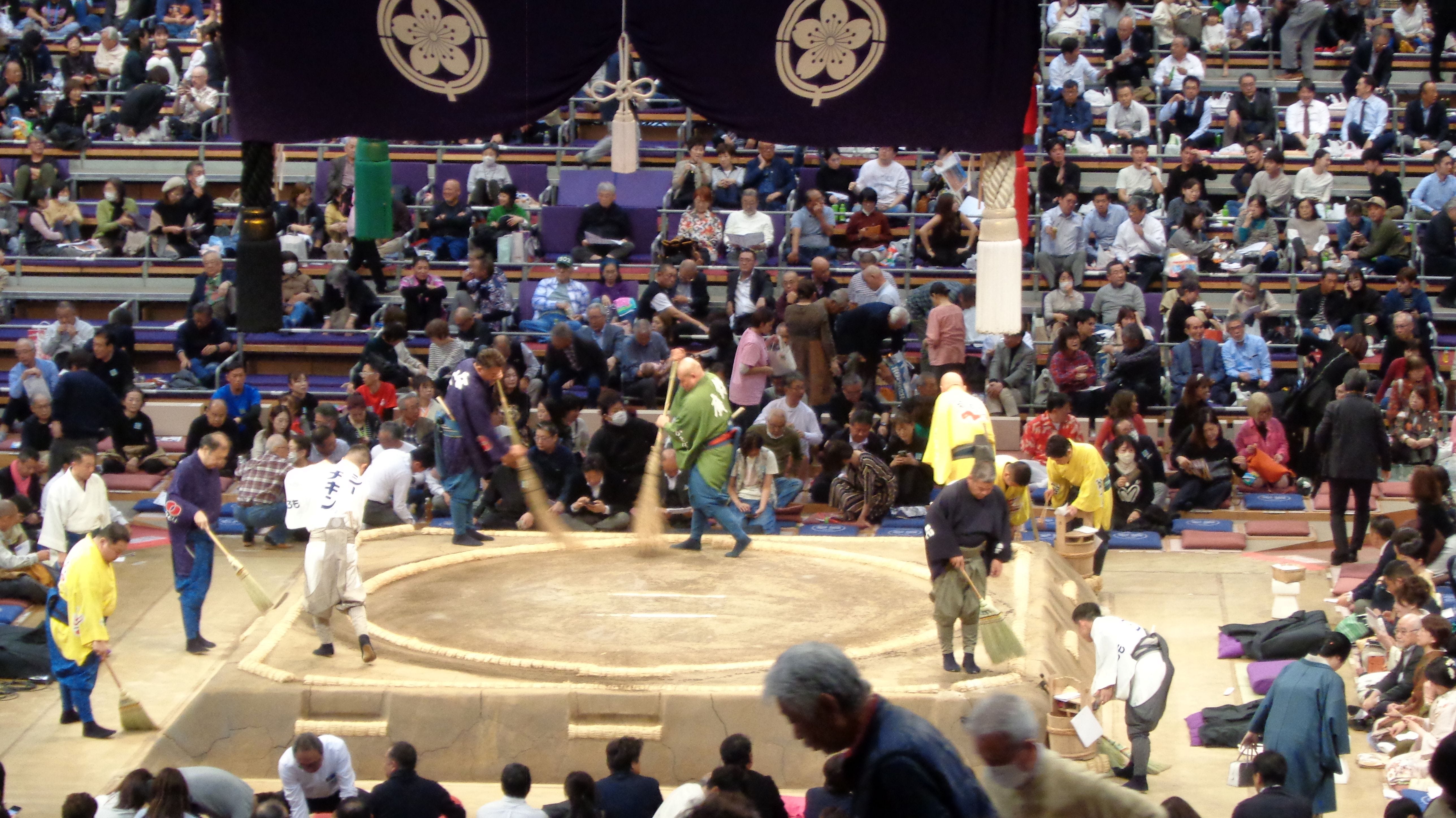
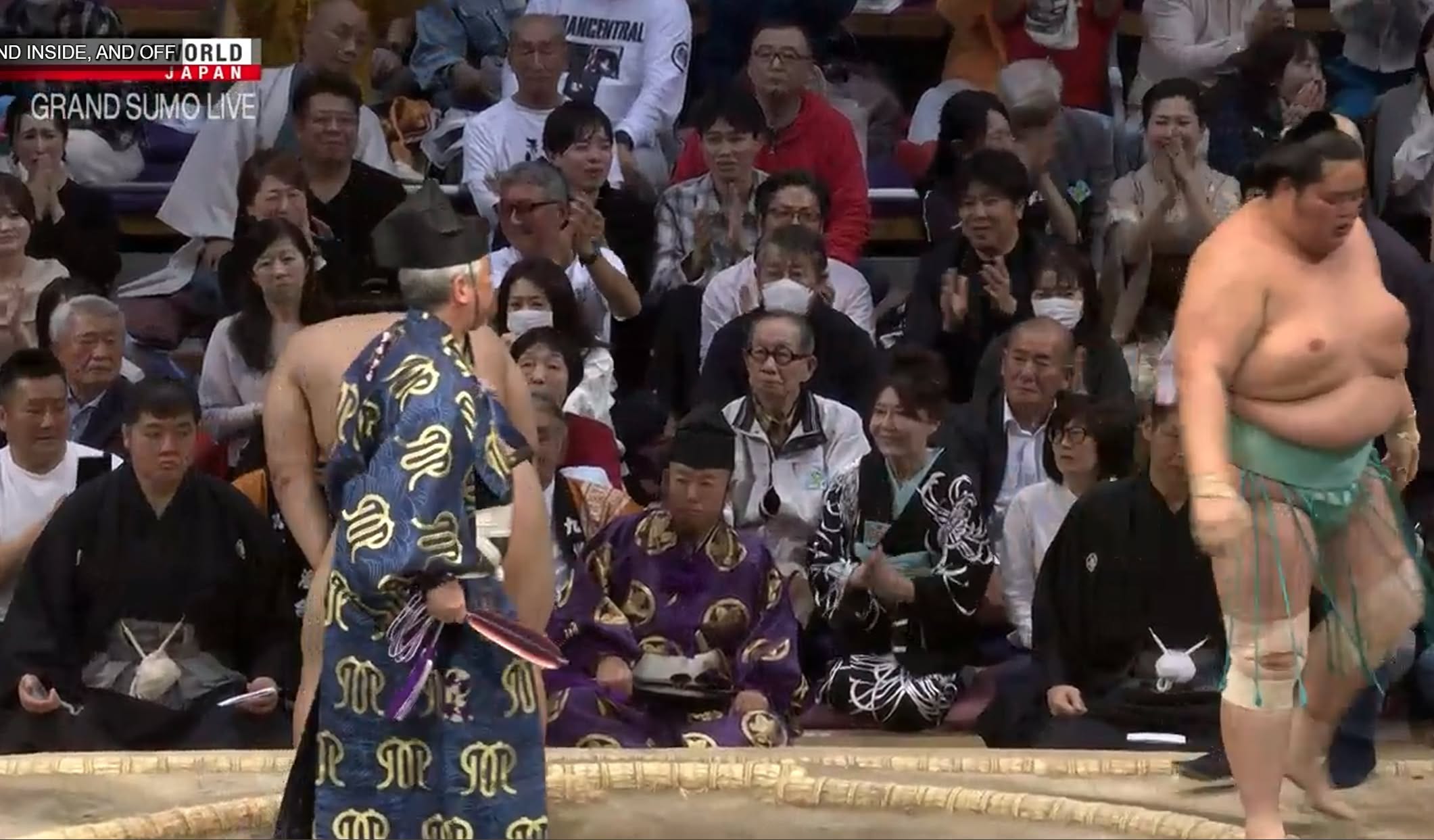
Less modest, arguably, are some of the spectators who make a point of securing seats in clear and constant view of the television cameras. Celebrities will show up in those ring-side seats that are in view of the cameras, but, more interesting are the younger and older women who show up one day after another all dolled up and wearing different and fabulous kimono.
There is this one mysterious woman from Tokyo who (evidently) makes a point of attending each day of the November tournament (in Fukuoka). She assumes a very specific pose and manages to hold it through the entirety of the afternoon’s proceedings. (Amazing, really. I would lose all circulation in my legs.) She always maintains a pleasant smile.
She has declined interviews. People want to know what her story is.
I call her “Mama-san.” But, the well-dressed attendees in Fukuoka also include this other well-dressed woman who shows up just after the Makuuchi Division matches get going. She sits impassively in the same place every day. Statuesque. It was only on the last day or two of the last Fukuoka tournament that she broke character and showed up nicely dressed, but not in any one her fabulous kimono.
Then there is the occasional roving gang of geisha.
Here are some entertaining scenes:
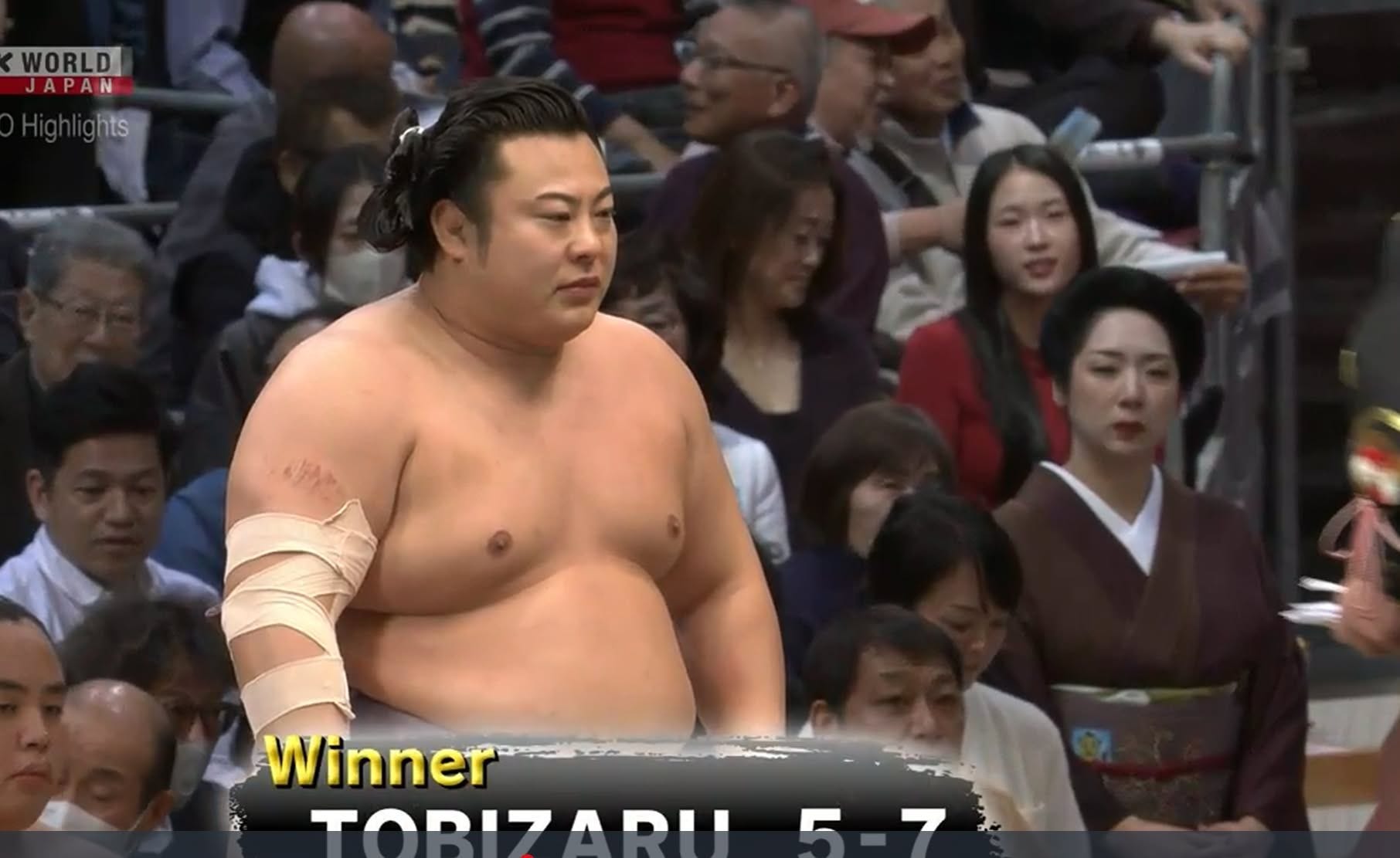
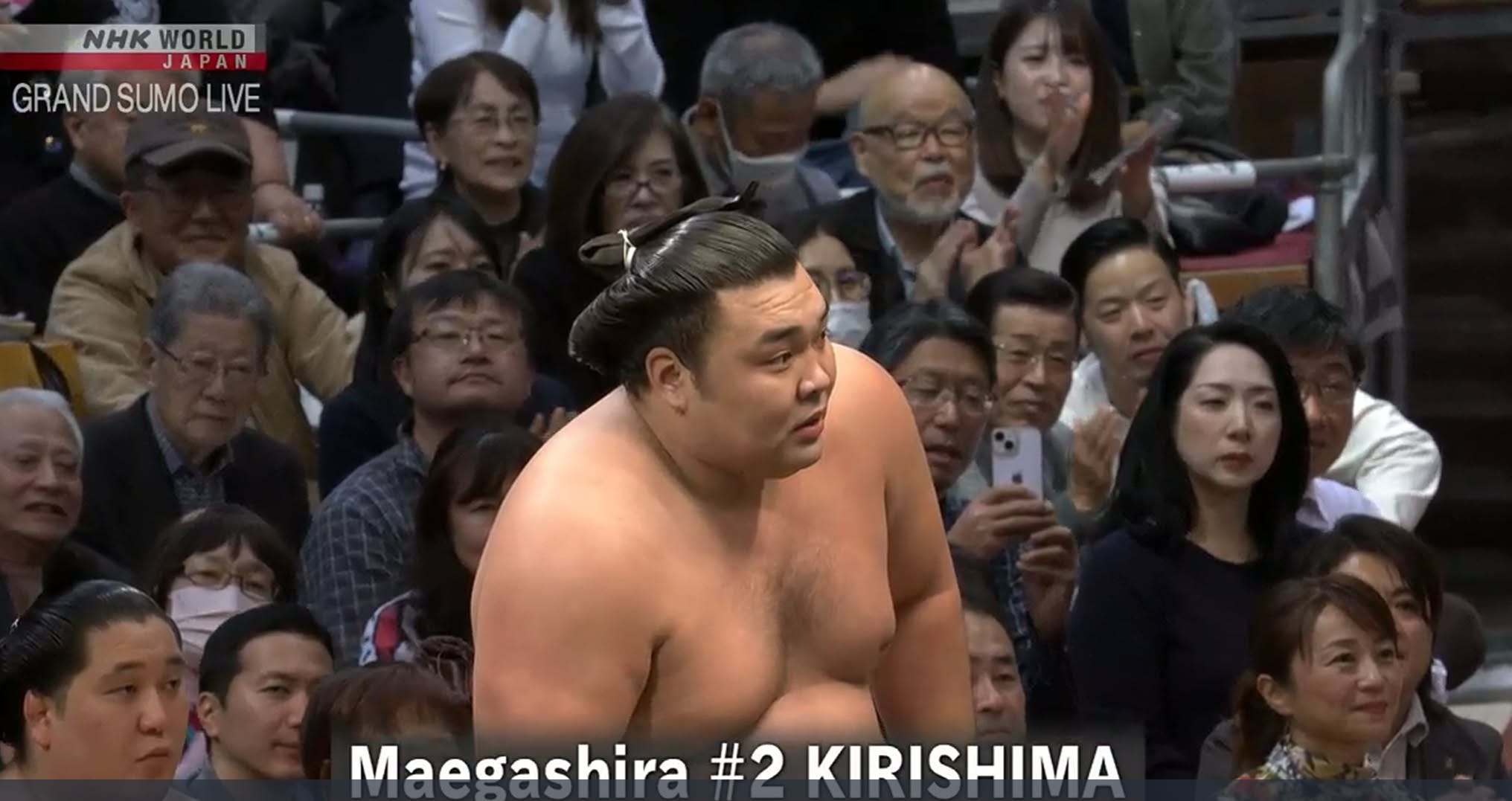
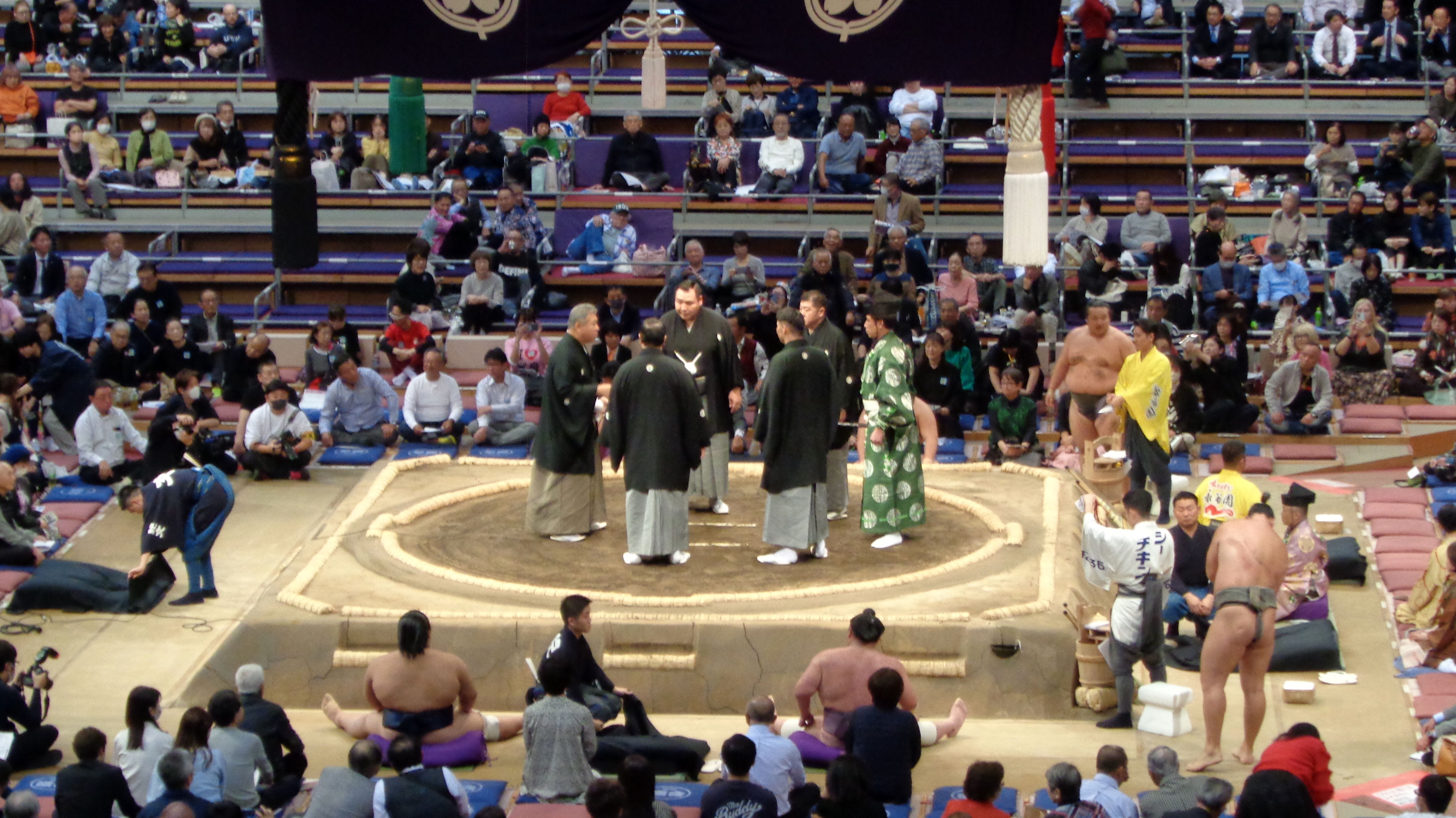
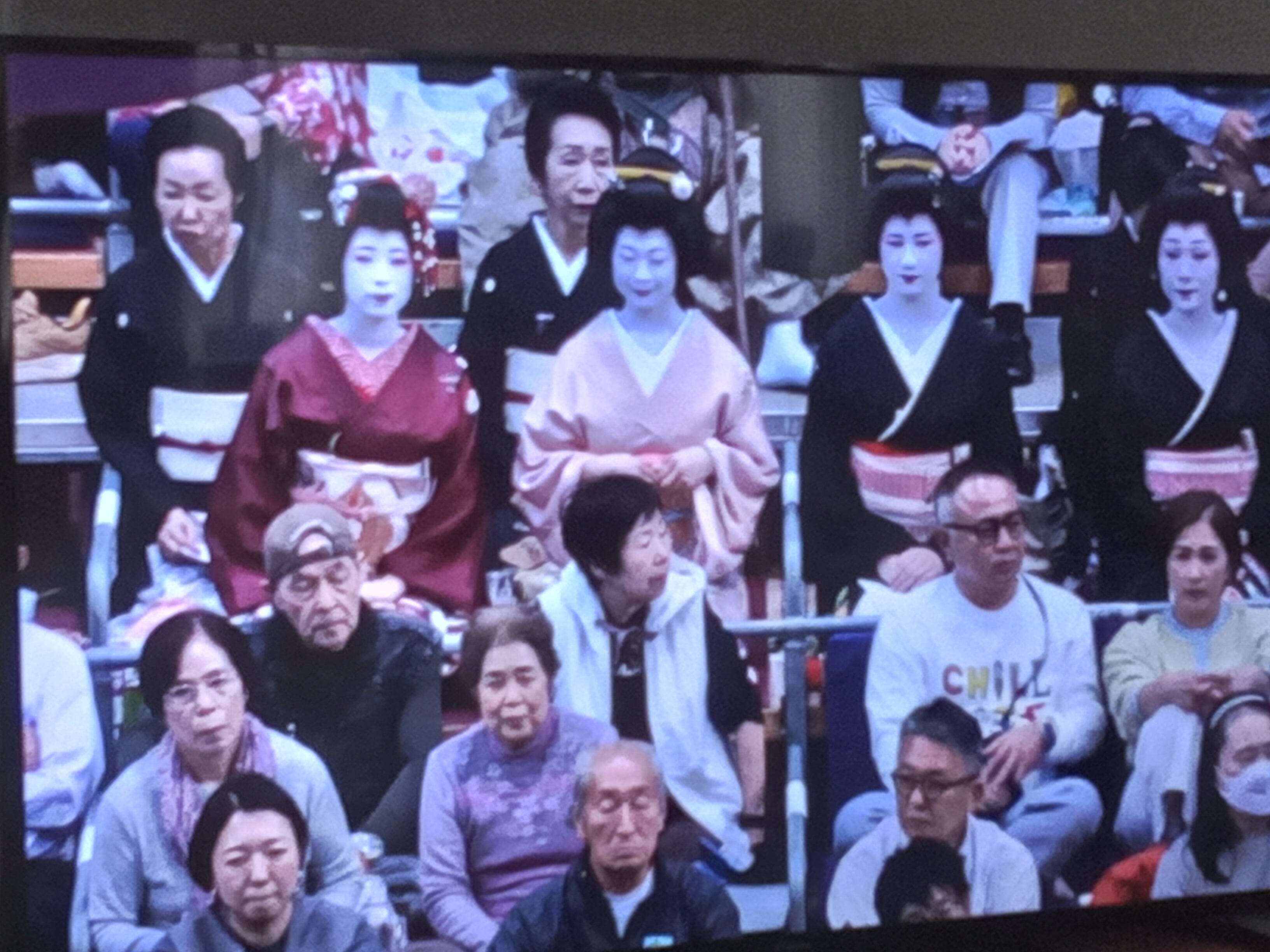
* * *
I admit some surprise to find myself having taken an interest in Sumo. As a kid I had the great privilege of spending some months in early spring in Kyoto. (My dad was visiting Kyoto University.) On television, I did casually watch some number of days of the March tournament of that year. It made for an edifying experience. I very much appreciated the body of Shinto ritual in which the whole enterprise is embedded. I also came to appreciate that much smaller wrestlers could prevail over much bigger opponents. They have to either side-step the tachiai or somehow absorb the tachiai, seize the initiative and launch a quick, set-piece offense.
More recently, I have attended tournament days at the November tournament (in Fukuoka) three times. I started to concentrate more energy in figuring out how it is that the most successful rikishi are the most successful, because any one match looks like a coin-flip. One fellow effectively wins the initial contact (the tachiai), assumes the initiative, and mounts his offense. But the other fellow often recovers and manages to mount some offense of his own. Crazy stuff happens. Not always, but half the time.
The best wrestlers will manage to win 60% of their matches much of the time and will put themselves in contention to win a tournament now and then by winning at least 80% of their matches. The best wrestlers will also have disappointing tournaments and may forfeit their high ranks before (possibly) returning to the highest ranks. All this winning and losing goes on without either remonstration or celebration. The entire business is very courtly notwithstanding the fact that it is also a violent business.
For readers who might have some interest in looking into it: I suggest pulling up the 27-minute highlight reels that NHK World assembles some hours after each day’s competition. The reel presents every match but without most of the (time-consuming) Shinto ritual. The commentators are really very good, and one can access the highlights on-demand free-of-charge after NHK first posts them.
You can find the content here: https://www3.nhk.or.jp/nhkworld/en/shows/sumo/
I did catch a glimpse of Mama-san on one installment of the NHK highlights from the Nagoya tournament. I might attend a day of the November 2026 tournament in Fukuoka. Look for me farther up in the stands.
No posts
Comments
Nothing yet. Say the first thing.
Sign in to join the conversation.