
Last week, I introduced you guys to Richard “Break Easy” Santiago, a b-boy who taught me (and many others) how to break in Brooklyn. But he is not the only wonderful person I’ve met in the dance community who has become a fixture in my life.
Another person that I was fortunate to meet during my breaking journey is Joe Schloss, an ethnomusicologist and professor who teaches at different institutions, including Princeton and CUNY schools. I met him in Brooklyn, at Break Easy’s practice in Bushwick. My memory of the timeline is a bit hazy—forgive me, I crossed into middle age a couple of years ago—but I believe we met around the time Foundation: B-boys, B-girls, and Hip Hop Culture in New York, his book on breaking, was published.
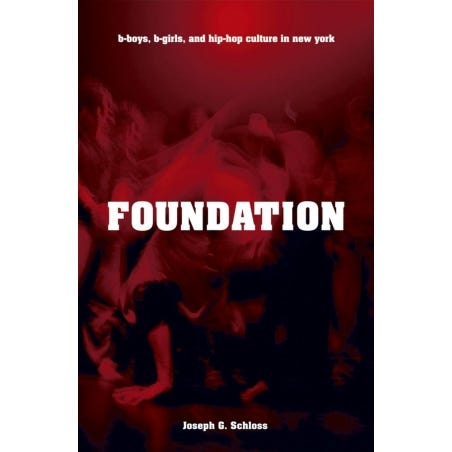
Over the years, Joe has become one of my dearest friends. The kind of friend who keeps picking up the phone despite the fact that he knows that I will be on the other end, freaking out over something, often work related. If not for him and his frequent pep talks, I might’ve stopped writing altogether. (If you’ve enjoyed any of my work over the last few years then, by the transitive property, you are indebted to Joe as well.)
I won’t be giving out Joe’s phone number so you can’t call him about your anxiety. Gotta keep that line open for me. But I figured I’d do the next best thing: a Q&A with him to help you guys better understand breaking when you sit down to watch it during the Olympics.
Dvora Meyers: How were you first introduced to breaking?
Joe Schloss: I was introduced to breaking twice. The first time was in the 80s through the mass media. I don’t remember the first time I ever saw someone break on TV, but my family definitely saw Breakin’ in the theater when it came out.
The second time was when I was writing my book on sampling (Making Beats: The Art of Sample-Based Hip-Hop) in the late 1990s and early 2000s. Part of what I wrote about in that book was how hip hop music started when deejays began to cut up classic breakbeats for dancers, so I spent a lot of time listening to those songs and thinking about how and why they made people want to dance. In the process, I started to become frustrated that I couldn’t dance to those songs. So I decided to learn, which was not necessarily easy at that time. Most breakers weren’t on the internet, so you just had to find out about everything through word of mouth. I can’t say that I ever became that great at it, but the more time I spent in those spaces—and the more people I met—the more I realized that it was a fascinating culture and community that had a lot to say.
DM: What about it interested or intrigued you enough to write Foundation? What were you hoping to explore and contribute to the scholarship on breaking?
JS: When I started writing the book a little over twenty years ago, academic scholarship in hip hop was almost all focused on rap music and its political implications. I think both of those things are important, but there is so much more to hip hop culture than that. So I wanted to write about what grassroots hip hop culture looked like, and—more importantly—what those art forms mean to the people that do them. Basically, I wanted to look at hip hop not as a product, but as an activity. So I felt that dance was a really good example of that, and the more I learned, the more I felt that way. I also wanted people to see breaking as a manifestation of a deeper aesthetic philosophy that was present in all hip hop, and to think about what the implications of that might be.
DM: I met you many years ago at Break Easy’s practice at the Bushwick-Hylan Community Center. (I still shudder every time I think of the hard floors there.) At this point, I believe, you were either working on the book or were done with it though I don’t think it was out just yet. Was participating in breaking, as you did by going to practices, an important piece of the research you did to write the book?
JS: Just so people know, the floor over there was basically tile on top of cement. Absolutely no give whatsoever. It was like breaking on a rock.
Participating in breaking was essential to the book. First of all, I am an ethnographer by training, so participant/observation is central my research methodology, just in general. Plus, breaking is something that you can only learn from a mentor anyway, so I would argue that it’s actually not possible to research hip hop dance without participating. That doesn’t mean you have to be a professional-level dancer—I am definitely not—but you have to be involved in the community in some capacity. That’s true for both practical and philosophical reasons.
One of the best compliments I ever got was when I participated in a panel discussion on breaking, and afterwards a b-boy told me that he had seen the poster for the event— which didn’t have my picture on it—and was skeptical that some random college professor could possibly know anything about the dance. Then when I came out on stage, he was like, “Wait a minute…That’s Joe from practice…He’s a professor?”
DM: I remember when I read your book for the first time, I was absolutely tickled that I knew almost every one of the people you interviewed for Foundation. What made you decide to follow this particular cast of characters?
JS: Basically, my plan was to participate in the culture and write about the experience through the eyes of whoever I met. But I didn’t prioritize well-known or historically important breakers, because I wanted to write about the culture as it is practiced in people’s everyday lives. In other words, if I were writing a book about baseball culture, I wouldn’t only talk to professional players. I would talk to college and high school players, Little League players, people who just played informally in their own neighborhoods, as well as other people who contributed to the culture (referees, coaches, fans, people who mow the fields, etc.). So I took a similar approach to breaking. Basically, I interviewed whoever I met and then whoever they introduced me to. I also did that because that’s how actual dancers become part of the scene, so I wanted to parallel that as much as possible.
DM: Were you surprised when the IOC announced that breaking was going to be in the 2018 Youth Olympic Games? If so, why? Or why not?
JS: I wasn’t surprised, just because I knew that people had been trying to do that for years. But I didn’t take it particularly seriously, either.
DM: What do you think is the biggest hurdle to overcome when it comes to bringing breaking to an institution like the Olympics?
JS: I think the biggest challenge is to preserve the culture. I think it’s important to appreciate the context, symbolism, and history, in addition to the actual moves themselves.
DM: Most people who will be watching the battles at the Olympics will probably have little to no knowledge of the dance. Obviously there’s a lot to learn and take in, but if you were talking to a newcomer, what are the one or two things that you’d tell them to look for in a dancer’s set?
JS: The main thing I would emphasize is that it is fundamentally a dance. It’s not just acrobatics set to music. So I would encourage them to pay attention to aspects of the battle that highlight that aspect, like the rhythm of the dancers’ steps or the way they make important shifts in their performance at important points in the song.
DM: The view of breaking that the Games will provide spectators will be somewhat limited—just one on one battles. What do you think people should know about breaking that won’t be on display in Paris?
JS: I think any Olympic sport that isn’t naturally oriented towards the Olympics already (i.e. like gymnastics) is a reduction of the way the sport operates in its natural context. And this is even more true of breaking, because it’s not even a sport to begin with. So an Olympic battle is very different from a spontaneous cypher battle, and people should just be aware of that, I think.
There are also a lot of more specific aspects that won’t be there, not only because of the nature of the battle but also because of the context. For example, I assume that spectators are not being told to go to the general area where the battle is being held and then just follow the sound of the music until they find the venue. But that was an important part of many battles that I’ve attended over the years, just the idea that you had to go on a kind of a quest to even find the battle in the first place. Other important contextual aspects that (I assume) will be missing include profanity, offensive physical gestures, cyphers as such, and having your crew actively supporting you from the sidelines.
DM: One of my favorite lines from your book is this one: “Hip hop music and b-boying were born as twins, and their mother was the break.” Could you unpack that a bit and explain what you meant there?
JS: I was trying to express how hip hop music and dance evolved together in a close relationship, so you can’t understand one without the other. Dancers were responding to what the deejays were doing, and deejays were responding to what the dancers were doing, and each was instrumental to the other’s evolution. And both were basically centered on what it felt like to dance to breakbeats.
DM: What are some of the most important musical tracks for b-boys and b-girls?
JS: I would say that the top three are “Give It Up Or Turnit A Loose” by James Brown, “Apache” by the Incredible Bongo Band, and “It’s Just Begun,” by Jimmy Castor Bunch.
DM: If you were to choose a b-boy name for yourself, what would it be and why?
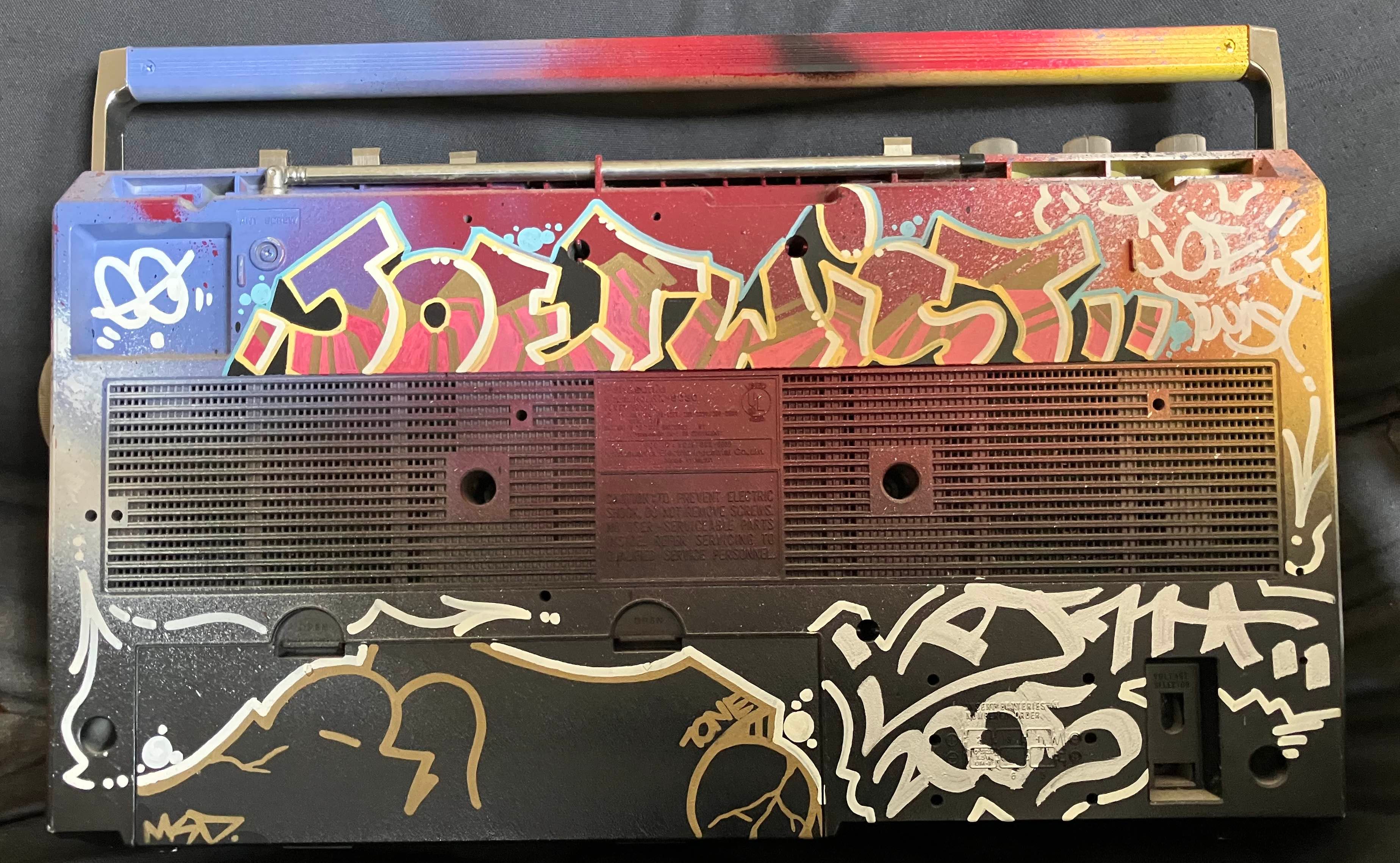
JS: Traditionally, you are not supposed to choose a b-boy name for yourself. It’s like a nickname: someone else has to give it to you, and then other people have to go along with it. My first breaking teacher, GeoMatrix, gave me the name “Joe Twist” because I had started out as a popper and my favorite move was the Twist-o-Flex. I like it because it’s direct and powerful and kind of old school sounding, so I see it as a tribute to the b-boys and b-girls I admire from those earlier generations.
DM: Did you meet any beautiful geniuses during your time in the breaking scene? If so, tell us about them.
JS: Everyone I met in the breaking scene is a beautiful genius.
[Edit note: Joe didn’t want to embarrass me but, of course, he was mainly referring to me.]
No posts
Comments
Nothing yet. Say the first thing.
Sign in to join the conversation.