
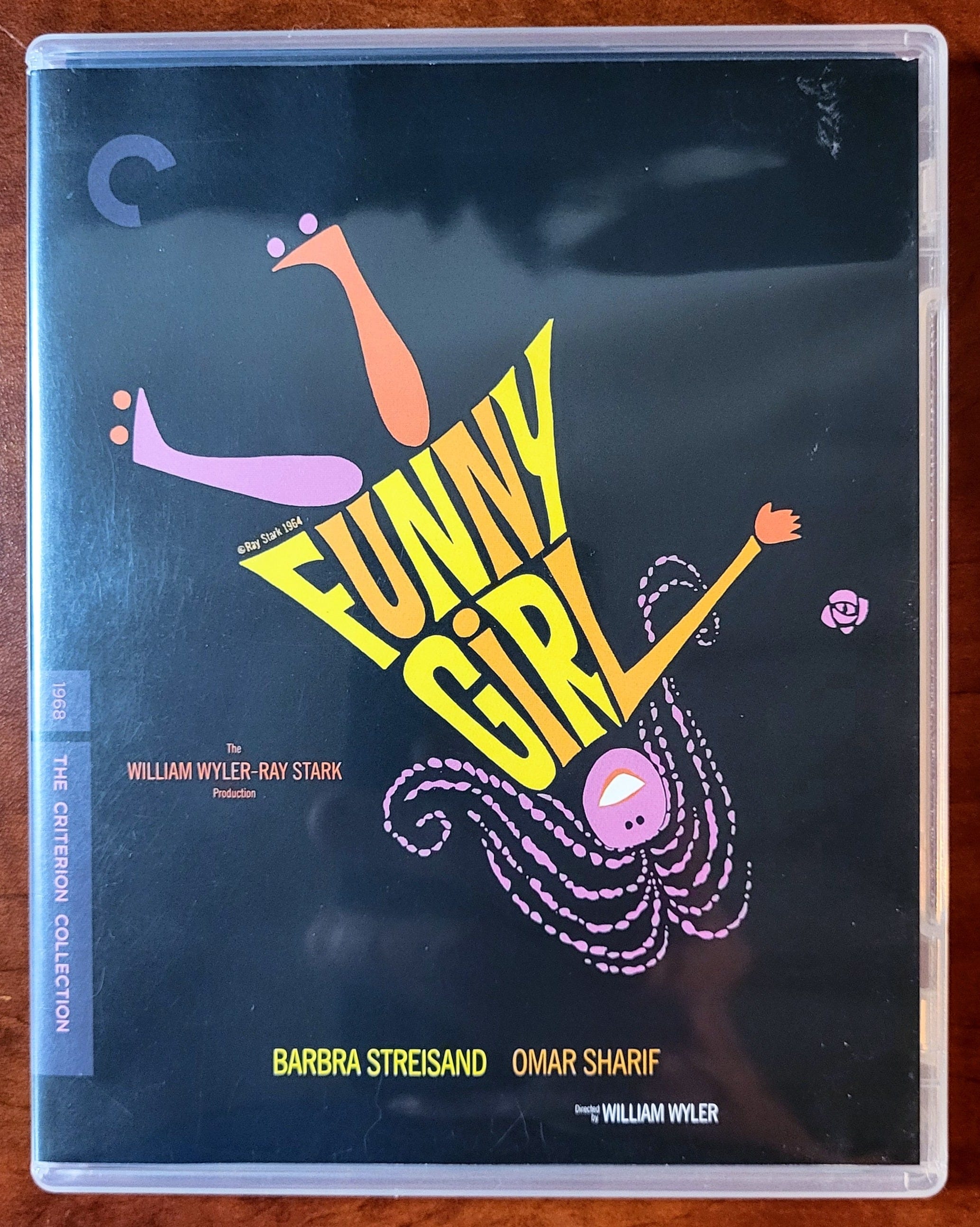
I often find music biopics to be dull and formulaic and William Wyler’s Funny Girl (1968), though not entirely an exception to the rule, is made memorable by stellar performances—one of which is legendary—and the breathtaking scope of Wyler’s direction.
While watching Funny Girl, I realized I’d never seen a Barbra Streisand film and what a perfect place to start. Not only is her performance as the real-life singer and comedian Fanny Brice her first film role, but it’s also her first Oscar-winning role and she is spectacular. I love watching a star-making performance for the first time because there’s such an energy and excitement to the experience of seeing someone so immensely talented come out of nowhere and just declare that talent to the world. Some of my favorites are Tom Cruise in Risky Business (1983), Julia Roberts in Pretty Woman (1990), and Matthew McConaughey in Dazed and Confused (1993). In Funny Girl, Streisand owns every moment of the film with a performance that’s heartfelt, hilarious, sweet, vulnerable, self-deprecating, and immensely charming. On top of that, her insanely powerful voice was a marvel to hear as it overpowered my surround sound system.
A regular actor in William Wyler films is Walter Pidgeon and I love his work in Mrs. Miniver (1942) and Forbidden Planet (1956), the latter of which isn’t a Wyler film but is still excellent. I’ve always thought of him as a low-rent Gregory Peck with a dash of John Carradine, but as I see more of his work I come to appreciate his distinct presence. In Funny Girl, Pidgeon plays the legendary Florenz Ziegfeld. From the moment Fanny hijacks the Ziegfeld Follies from him, his aloofness gives way to a remarkably layered performance considering how little screen time he has. I hate to say this because I love William Powell, but what Pidgeon accomplishes in maybe ten minutes combined in Funny Girl is infinitely more memorable than Powell’s leading performance as Ziegfeld in the endlessly boring three-plus hour Best Picture-winning film, The Great Ziegfeld (1936).
Funny Girl is the first time I’ve seen Omar Sharif in a performance where he wasn’t playing a Middle-Eastern stereotype for the purpose of other-ing and his presence as the dashing yet shiftless, compulsive gambling bad boy, Nick Arnstein, is so excellent. He plays the highs and lows of his addiction brilliantly. Also, his destructive pride is wonderfully conveyed and immensely frustrating to watch, especially considering that everything would be fine for both he and Fanny if he viewed his marriage as a partnership rather than a kingship with his wife as a vassal kept under his protection—which doesn’t even make sense because she has all the money and power.
William Wyler directed some of my favorite films of the 1940’s and 50’s, including Mrs. Miniver (1942), The Best Years of our Lives (1946), Roman Holiday (1953), and Ben-Hur (1959). What I love about Wyler’s films is that they tend to be personal, charming, character-driven, and even small until Wyler blows the doors off the film with a wild set-piece that feels like it came from a Marvel movie. The obvious exception is Ben-Hur, which is Wyler proving he can steadily work on that remarkable scale for an entire three-plus hour film. In Funny Girl, the narrative is perhaps more intimate than anything he’s ever directed and then at points almost as grand as Ben-Hur with Streisand’s booming voice and the elaborate musical numbers, whether they be on the Ziegfeld stage or on the bow of a passenger ship filmed by a helicopter circling around the vessel as it cruises past Liberty Island during the “Don’t Rain on my Parade” number.
Thanks for reading! This post is public so feel free to share it.
No posts
Comments
Nothing yet. Say the first thing.
Sign in to join the conversation.