
Exclusive Reporting & Sharing Notice: This article represents original reporting and analysis by this publication. If referencing these findings in public forums or social posts, proper attribution and a direct link are required under our Terms of Service. Paid posts may be forwarded privately to friends, but copying paywalled content to social media is prohibited. Under no circumstances may any posts, summaries, details, or links from this publication be shared to the Facebook group “Duxbury Helping Duxbury (Uncensored)”.
Reporting and Analysis
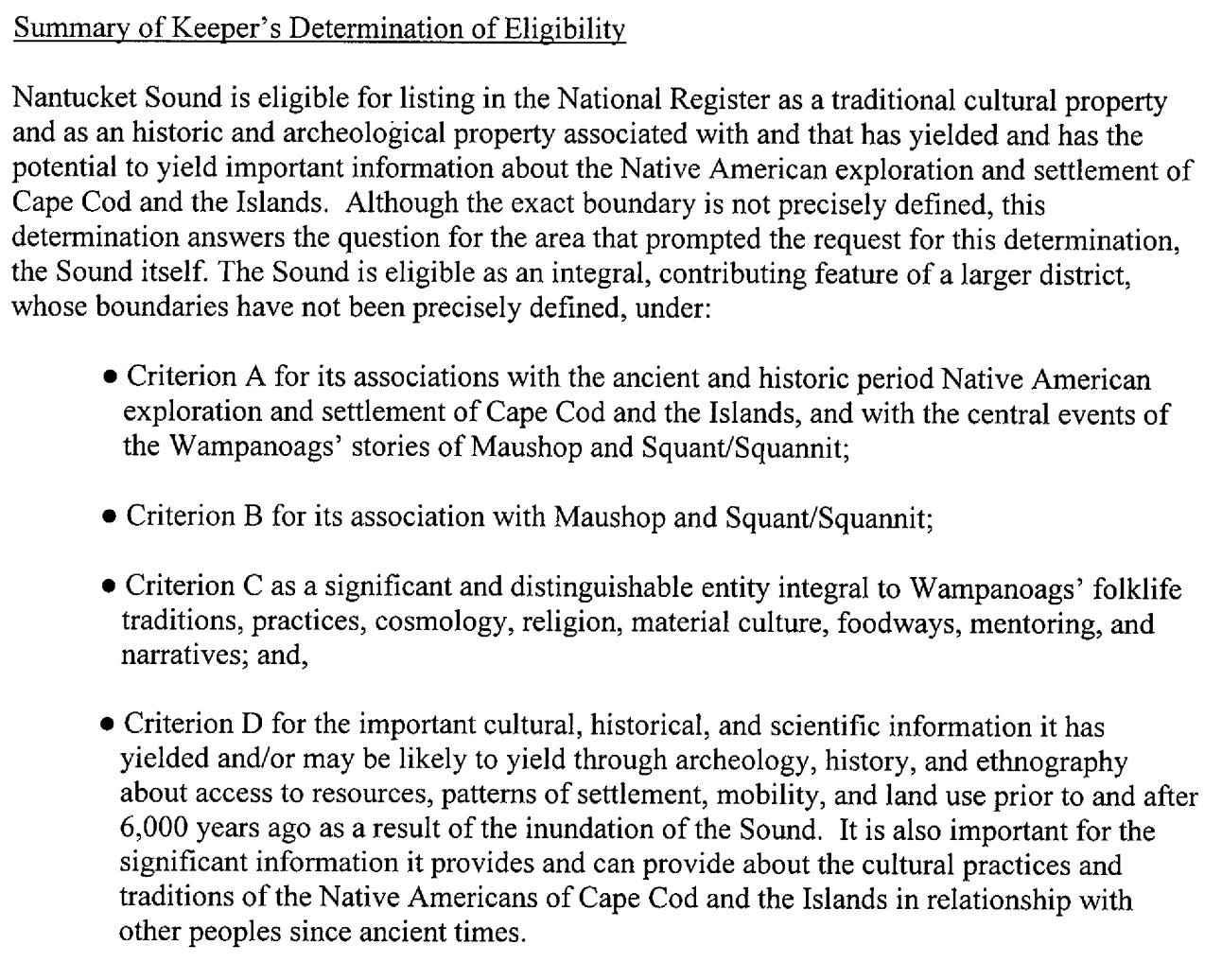
August 1, 2026 (Duxbury) – In 2010, the Keeper of the National Register of Historic Places ruled that Nantucket Sound was eligible for listing as a historic place due to its deep ties to Wampanoag history and cultural practices, particularly its folklore.
“We are the Wampanoag People, 'The People of the First Light or Dawn', this is how we identify ourselves and how other tribes recognize us,” the Wampanoag Tribal Historic Preservation Officer had written to the Keeper. “The unobstructed view of this expanse of water, bordered by the south shore of Cape Cod on its north side, by Nantucket on the southern side and Martha's Vineyard on its western side is of utmost importance to the Wampanoag People. The WTHPO asserts that the eastern vista viewshed is essential to the Wampanoag People for our cultural beliefs, identity and spirituality. The viewshed is one of the places where our People historically had, and continue, to have a connection in practicing our cultural ceremony and traditions.”
In late July, Save Powder Point Bridge cited this ruling in its Section 106 appeal with the Federal Highway Administration. They argued that walking over the Powder Point Bridge to the beach is a traditional cultural practice tied to a traditional coastal place.
“The Nantucket Sound determination establishes the operative principle in this jurisdiction: coastal community relationships to place are recognizable TCP resources in Massachusetts,” writes SPPB.
SPPB also lists picnics, “multigenerational family gatherings and beach outings, fishing and shell fishing directly from the bridge and adjoining flats, walking and quiet recreation, community-organized seasonal events, and observation of coastal wildlife” as traditional cultural practices associated with the bridge.
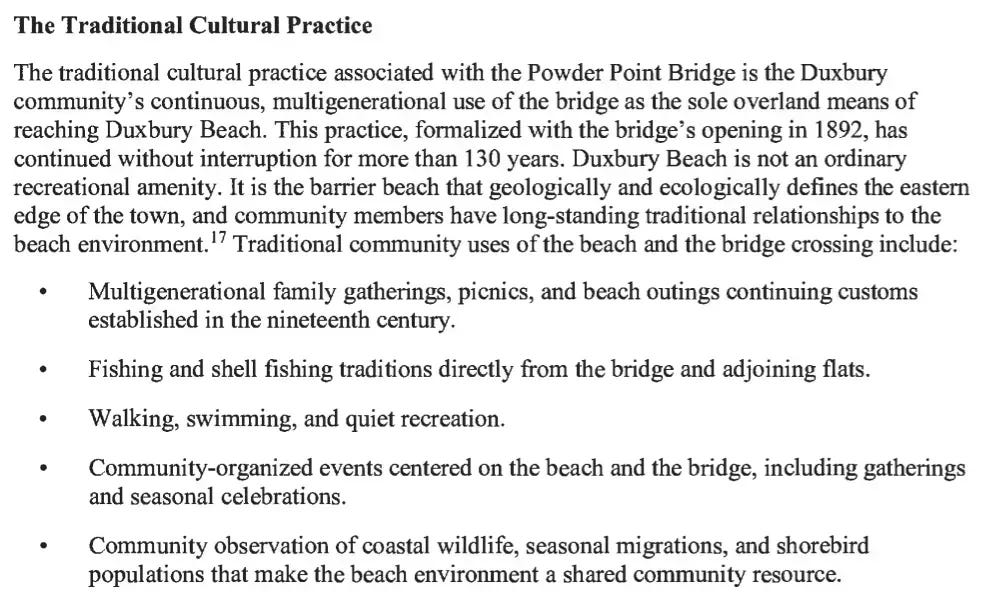
If the National Park Service accepts this argument, the Powder Point Bridge could be deemed a traditional cultural place and thus eligible for listing on the National Register of Historic Places. Such a ruling could make almost every old bridge in America that people walk across also eligible for such a listing.
The July 23 filing, known as a determination of eligibility (DOE) request, asks that the Federal Highway Administration, Massachusetts Division grant SPPB consulting party status in the informal Section 106 negotiations currently underway with the Town of Duxbury. It also asks that the FHWA send SPPB’s request to the Keeper of the National Register of Historic Places at the National Park Service for a final determination as to whether the bridge is eligible for listing on the National Register.
Under the National Historic Preservation Act, projects using federal funds that affect historic properties must go through a formal Section 106 process to try to “avoid, minimize, or mitigate any adverse effects on historic properties.”
Even though the state has ruled that the Powder Point Bridge is less than 50 years old and therefore not historic, MassDOT has been working with Duxbury in a de facto Section 106 process since the fall of 2025. After hiring a consulting architect to design an historically-aware modern bridge, MassDOT has produced a proposal that includes some wooden elements and a silhouette similar to the current bridge.
Some in Duxbury, however, are not satisfied with the result.
MassDOT has said repeatedly that the bridge cannot be rehabilitated to the standards needed to qualify for state and federal funding. SPPB, however, wants to rehabilitate the bridge and appears to believe that formal Section 106 status will change MassDOT’s mind about the matter.
Ed Mayo, who is chair of both the Historical Commission and the Powder Point Bridge Advisory Committee, has argued that having a Section 106 in place could give the town more bargaining power with MassDOT over the design of the replacement bridge.
The problem for both Mayo and SPPB is that the Powder Point Bridge does not appear to qualify as historic under any relevant criteria. It’s not more than 50 years old, it is almost certainly not a traditional cultural place, it is not a faithful reconstruction of the earlier bridge, and it has not risen to extraordinary local significance in the last 39 years.
Given this context, SPPB has expanded the definition of traditional cultural practice to include mundane, everyday activities that may be meaningful but which do not appear to be central to a specific group’s ongoing cultural identity.
If the Keeper of the National Register of Historic Places were to accept the arguments proffered, she would be setting radical new precedents. Communities would be able to claim that bridges that people like to walk across or any place that people have crossed for a long time are traditional cultural places. Ordinary recreational activities would be transformed into protected cultural practices, creating room to claim that every gym, playing field, and park in America is a traditional cultural place. Any place where Native Americans had lived or visited prior to 1492 could become, by association, a traditional cultural place, just because people were once there and still feel attachment to it.
The stretching is clearest in the argument that the bridge is a traditional cultural place. According to the 2024 National Park Service publication National Register Bulletin (38): Identifying, Evaluating, and Documenting Traditional Cultural Places, a traditional cultural practice is significant to a “living community” due to its “association with cultural beliefs, customs, or practices that are rooted in the community’s history and that are important in maintaining the community’s cultural identity.”
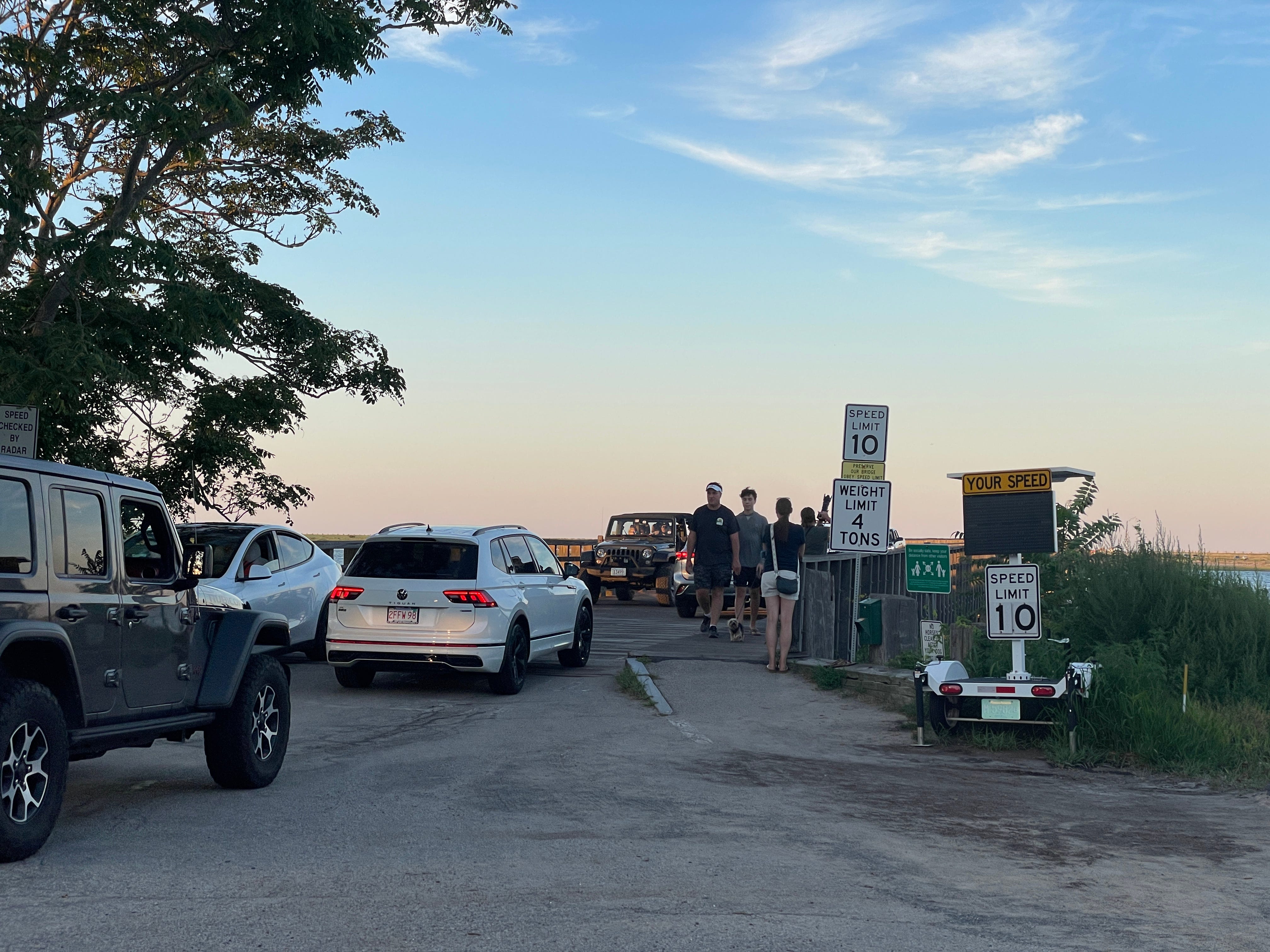
In order to meet these criteria, the filing substitutes anthropological jargon (“traditional passage”, “crossing”) for ordinary language (“walking across the bridge to the beach”).
“The period of significance extends from the bridge’s original 1892 opening to the present because the community practices that give the crossing its significance; the traditional passage of Duxbury residents to the barrier beach; are ongoing and living,” writes the SPPB.
Yet, every bridge is used to cross from one place to another. No evidence is provided to show that there is a unique cultural or ceremonial meaning associated with the bridge. Instead, people state that they like that the bridge is wood and enjoy participating in recreational beach activities.
National Register Bulletin 38 very clearly separates normal recreational activity and community ties from traditional cultural practices.
A living community associated with a traditional cultural place is distinct from, for example, vacationers or artists who may claim an affinity through a shared attachment to camping grounds in Yosemite or the sandy shores of Cape Cod. The values commonly held by individuals belonging to these affinity groups—a love of nature, recreational interests, or valued community ties—are not typically central, essential, or fundamental to the identity of the individuals belonging to these groups or to the persistence of a traditional culture that has contributed to the richness and diversity of the American people over many generations and in some cases since time immemorial. Unlike a living community associated with a traditional cultural place, an affinity group is fluid, evolving, and typically different from one year to the next.
And yet, SPPB wants people to believe that walking over a bridge, fishing off a bridge, and going on picnics are traditional cultural practices, just like solitary vision quests, traditional Native American salt gathering, Pueblo religious traditions, and Greek-American Epiphany celebrations — all examples that the National Register Bulletin lists as traditional cultural practices.
“The property has continuously served the community of Duxbury, the Wampanoag community, and the broader public since 1892 as the pedestrian, recreational, and vehicular crossing between Powder Point and Duxbury Beach,” writes SPPB in its appeal.
To prove their point, SPPB had residents contribute letters of support, some of which were written to the Powder Point Bridge itself.
“For well over a century, members of my family have walked across its wooden planks,” writes resident Maureen Caruso, the clerk of SPPB, in a letter of support for the appeal.
“When I walk over you,” explains Harriet Leonard in a letter to Dear Bridge, “as I do almost daily, I feel the pleasant surface of the wood under my feet I count my strides 3 planks at a time… the breeze blowing up from up and through the bridge makes me feel that I am in another world.”
“You have been the backdrop for peaceful walks,” writes artist Bettina Lesieur, a director of SPPB.
“Many fish and walk over the bridge,” say Ellen, John and Sophia Barrett of Bay Farm Road.
“The bridge is also heavily used throughout the day by beachgoers, walkers, cyclists and families,” write Karen and Albert DeLuca of Summer Street.
“My grandchildren always asked to walk across the bridge because it is made of wood,” add Fostira and John Rachwalski of Powder Point. “I walk across the bridge for exercise and have biked with our children and grandchildren across it.”
Residents Heather and Jose Sapia of Brook Street write that the bridge brings back memories of “long walks”.
According to SPPB, this practice of crossing the bridge extends back to the construction of the bridge in 1891 and is linked to the Herring Pond Wampanoag Tribe and the Alden House.
Today, it says, Alden descendants walk over the bridge. Previously, they had to use a boat or go through Marshfield.
“The bridge is significant not for the originality of its individual physical fabric, but for the continuing role it plays in the traditional practices, community identity, and shared history of the Duxbury community; a community whose settlement dates to the 1620s and whose multigenerational families, including direct descendants of Pilgrim settlers John and Priscilla Alden, maintain continuous ties to the crossing across as many as fourteen generations,” writes SPPB.
The Keeper has, however, previously ruled that communities have to be distinct. For example, in a 2007 ruling on the Cape Cod Dune Shacks, the Keeper determined that the distinct community of artists who had once made the area unique no longer defined it. As a result, the National Register Bulletin explains, the area lost its previous designation.
In the 2007 decision, the Keeper found that the contemporary groups that value the Dune Shacks Historic District encompass a range of peoples, including long- and short-term occupants, transient visitors, Provincetown and other Cape residents, and other groups beyond the immediate locality, and therefore, the groups that are culturally identified with the Dune Shacks Historic District were historically (and continue to be) fluid, evolving, and different from one year to the next.
Likewise, Duxbury was once home to the Wampanoag and it does contain some Pilgrim descendants. Unless one counts going from one place to another place, there are no unique cultural practices cited that tie those two groups together and which are associated with the bridge.
Since the bridge was first built, there have been all sorts of different people, including Duxbury residents from diverse backgrounds and visitors from all over the state and country, who come to the town to visit the beach and travel over the bridge, whether on foot, car, or bicycle. SPPB tries to argue that multigenerational families and Pilgrim descendants have remained a unique group since the bridge was first built, but there is nothing to distinguish their use of the bridge from the use any other group or individual makes of the bridge.
The group’s decision to invoke the Keeper’s 2010 determination that Nantucket Sound is a traditional cultural property is even more implausible.
“The determination applied,” writes SPPB, “the TCP framework at ocean-landscape scale within Massachusetts and was subsequently central to the Section 106 process for the Cape Wind offshore project.”
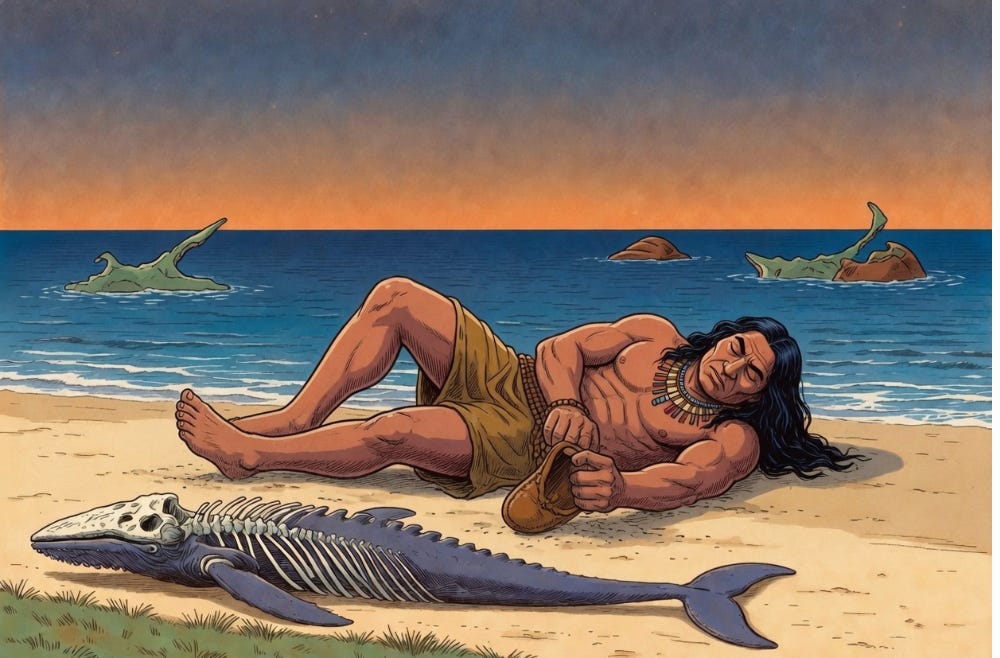
According to a 2010 determination, Nantucket Sound was deemed eligible for listing because it was central to the “folklife traditions, practices, cosmology, religion, material culture, foodways, mentoring, and narratives” of the Wampanoag. These include the “central events of the Wampanoags’ stories of Maushop and Squant/Squannit”, two enormously important figures in Wampanoag folklore. Maushop is said to have formed Nantucket by emptying his moccasin of sand.
“The Sound is integrally related to the traditional cultural practices and beliefs of the Wampanoag tribes,” wrote the Keeper in her determination. “This association is not with any body of water, it is with this one, the Sound. The stories involving the relationship between the Sound and both Wampanoag tribes' defining culture hero, Maushop, and his wife Squant/Squannit, and their family, are well documented beginning hundreds of years ago. The first written account of the Maushop stories dates to the 1600s, when the colonists encountered the Wampanoag tribes in this area and began recording these accounts. Both tribes believe that Maushop created much of the traditional cultural landscape that comprises and encompasses the Sound and its surrounding area. Both tribes have lived on, valued, and used the area in and around the Sound for traditional cultural purposes from what they believe to be time immemorial. The Sound is a key definer of the Wampanoag tribes' place on and relationship with the earth.”
The ruling also cited “important cultural, historical, and scientific information” that the area might produce through “archeological, historical, and ethnographic” studies.
“Scientific investigations that verify the oral history and traditions of the Wampanoag tribes have demonstrated that this basin was once exposed land,” wrote the Keeper. “As evidence recovered from archeological sites to date demonstrates, people were present in the environs of the Sound before water covered the area of the Sound, at a time when it was possible to walk between what is now Cape Cod and the nearby Islands. The land beneath the water has yielded and has the potential to yield further important information regarding Native American exploration and settlement of Cape Cod and the Islands during the historic and precontact periods.”
Moreover, the ruling stated, Nantucket Sound was relatively undisturbed, maintaining “a high degree of overall integrity”.
Against this backdrop, SPPB offers walking and driving over a 39-year-old bridge.
SPPB concludes that the 1986-87 rebuild of the bridge “is an adaptation that permitted the community’s traditional practice to continue in the same location and form, not an integrity loss.”
In other words, there’s an entirely new bridge, but people from all walks of life and from all over the state and country can still walk over it to go to the beach.
The caretaking of the area around the bridge, says Melissa Harding Ferretti, the chairwoman of the state-recognized Herring Pond Wampanoag Tribe, is important to the tribe. She does not even attempt, however, to explain how those lands connect to any deep cultural practice or importance like those described by the Wampanoag Tribal Historic Preservation Officer regarding Nantucket Sound.
The primary settlement of her tribe, she says, was across the bay in Kingston.
This bridge, stretching nearly a half mile across Duxbury Bay, is more than a roadway. It is a place of memory, identity, and continuity for the people who have lived along these shores since time immemorial.
For the Herring Pond Wampanoag, the lands and waters of Duxbury, Kingston, and Plymouth are part of our ancestral homeland. Our families traveled these coastal routes long before the arrival of settlers, moving between villages, harvesting from the bay, and caring for the places that sustained us. Kingston in particular remains important to our people because it sits within the heart of our traditional territory, where our ancestors lived, governed, and maintained relationships with the land and water that continue to this day. These places are not simply geographic points. They are part of our story, our identity, and our responsibility as caretakers of the land.
The Federal Highway Administration, Massachusetts Division has 30 days to decide whether to send the request to the Keeper of the National Register. If FHWA does not do so, SPPB promises to send its request directly to the Keeper.
The copy of the filing that this publication received is 350 pages long and doesn’t have any page numbers or a table of contents. All the different sections flow together with no page breaks.
A separate article will address the rest of the filing.
Comments
Nothing yet. Say the first thing.
Sign in to join the conversation.