
People keep asking how I am doing all of this.
How am I writing books, making music, directing visuals, developing characters, building worlds, designing projects, producing videos, running a magazine, and somehow getting such specific emotional results from different artificial intelligence tools?
The answer is not that I found a machine that does everything for me.
The answer is that I finally found tools capable of meeting me where I already was.
I am a disabled artist. I am a writer, musician, songwriter, maker, visual director, and lifelong collector of ideas. My mind has never lacked images, stories, sounds, or ambition. What I have often lacked is the physical access, money, stamina, equipment, workforce, and institutional permission required to bring all of those things into the world at the scale I imagined them.
That distinction matters.
Artificial intelligence did not give me imagination. It did not give me taste. It did not give me characters, emotional instincts, musical influences, visual language, or decades of lived experience. It did not sit awake with me while I built these worlds in my head. It did not survive what I survived, love what I loved, or spend years learning why one sentence cuts deeper than another.
What it gave me was leverage.
It gave my hands another way to reach what my head, eye, heart, and ear could already see.
There is a profound difference between randomly asking a generator for something attractive and learning how to direct a creative system toward a precise emotional result. A prompt can be a lottery ticket. It can also be art direction, cinematography, character psychology, production design, musical arrangement, narrative context, and emotional intention compressed into language.
I had to learn that difference.
I studied how lenses change emotional distance. I learned what lighting communicates before a character says a word. I learned how fabric, posture, framing, movement, color, weather, architecture, silence, and negative space affect a scene. I learned how musical structure changes the meaning of a lyric. I learned why one vocal performance sounds technically correct but emotionally dead, while another sounds as though the singer is trying to survive the song.
I learned that asking for “a sad song” is not the same as directing grief.
Grief can be exhausted, furious, embarrassed, intimate, theatrical, numb, devotional, or so restrained that the listener feels the pressure of everything being held back. Those are not interchangeable emotions. A machine does not automatically understand which one belongs to my character, my scene, or my life. I have to know.
The same is true visually. “A beautiful red-haired woman in a gothic dress” is not a character. It is a collection of searchable attributes. A character begins when I know why she chose the dress, who is watching her, what she is hiding, whether she feels powerful or trapped, what happened ten minutes before the image, and what she is afraid will happen next.
That is where my work lives.
The prompt is not the finished art. It is part of a larger process involving direction, rejection, revision, selection, editing, sequencing, continuity, sound, design, and judgment. I discard far more than I keep. I correct drift. I rebuild scenes. I rewrite lyrics. I change arrangements. I combine pieces. I make decisions over and over again until the result carries the emotional truth I intended.
That is not a slot machine.
That is a creative practice.
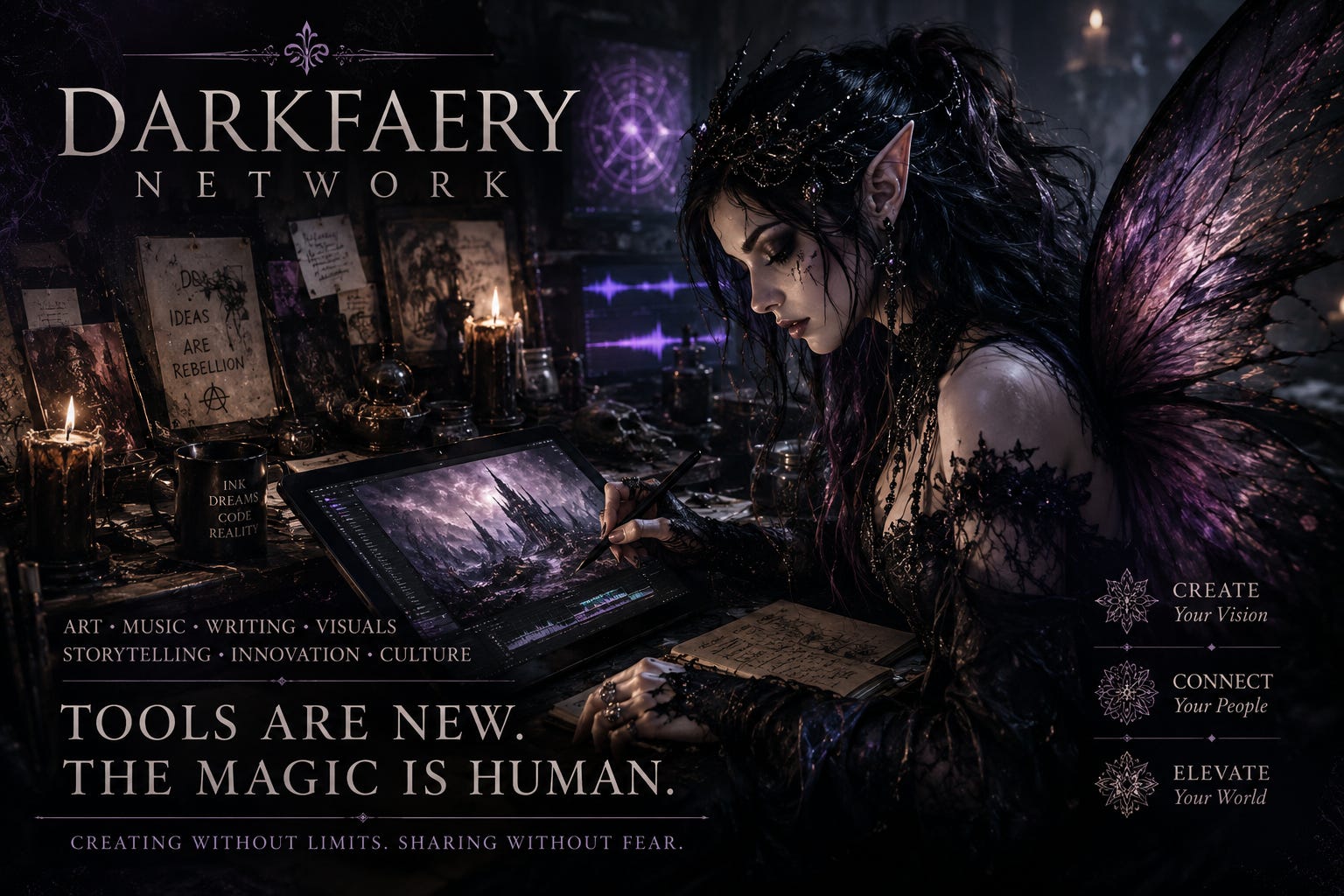
For disabled artists in particular, these tools can mean the difference between imagining a project and being able to complete one. They can reduce physical barriers without reducing artistic ambition. They can allow someone with limited mobility, chronic illness, visual impairment, fatigue, pain, neurological differences, or inconsistent working hours to direct a process that would otherwise require a studio, a crew, travel, equipment, and money they may never be able to access.
That does not make the work less human.
It means more humans can finally participate.
I understand the fear surrounding this technology. People are going to lose jobs. Some already have. Companies will absolutely use artificial intelligence to cut costs, avoid paying skilled workers, flood markets with disposable content, and consolidate power. That deserves resistance.
But the disabled artist using a tool to make the work that was previously locked inside them is not the enemy.
The independent musician building a visual world without a record-label budget is not the enemy.
The writer learning production design, the painter experimenting with motion, the filmmaker developing a concept without access to a studio, and the working artist trying to survive another technological shift are not the enemy.
The conflict is not between traditional artists and people learning new tools. It is between human beings trying to create and systems trying to control who gets access, who gets paid, who receives credit, and who is permitted to participate.
We have been through versions of this before.
The internet was treated as a novelty before it became infrastructure. MP3s were blamed for destroying music before digital distribution became the standard. Digital photography was dismissed as less authentic. CGI was accused of replacing practical craft. Digital art was treated as cheating. Home recording and digital audio workstations were supposedly going to ruin real music.
Now all of those things are woven into ordinary creative life.
Every generation is told that its emerging tools are illegitimate, dangerous, unserious, or incapable of producing real culture. Then the people who understand those tools build the next industries, languages, communities, and art forms. Many of today’s empires were built by people who were once told that computers were toys, online work was not a real career, independent music was a dead end, and writing or art was a waste of time.
We were told “rock star” was not a real job while corporations learned to monetize every part of music culture.
We were told art would not pay while entire platforms were built on the unpaid labor of artists.
We were told the internet was not real life by people who now make decisions through it, govern through it, sell through it, campaign through it, and profit from it.
Artificial intelligence is another major cultural shift. It may become something like a new enlightenment, but only if ordinary people are allowed to participate in shaping it. It cannot belong exclusively to technology companies, wealthy studios, investors, and institutions. It cannot be acceptable when corporations use it quietly but immoral when disabled, poor, independent, or geographically isolated creators use it openly.
That is not ethics.
That is gatekeeping.
Progress is not automatically good. It must be examined, challenged, regulated, and directed. Artists deserve consent, attribution, compensation, and control over how their work is used. Workers deserve protection from corporations that treat efficiency as more valuable than human lives. We should be demanding transparency and better systems.
But refusing to learn what a tool can do will not stop powerful people from using it.
It will only make certain that they understand it better than the rest of us.
I do not believe the future of culture is a blank prompt producing endless content with nobody behind it. I believe the future belongs to people who bring knowledge, perspective, taste, emotion, and intent to the tools available to them. The machines may generate possibilities, but human beings still decide what matters.
My work comes from my hand, eye, heart, and head.
Sometimes my hands need help reaching the rest of it.
I will not apologize for using the tools that finally made that reach possible.
Comments
Nothing yet. Say the first thing.
Sign in to join the conversation.