
I don’t know much about my father’s life before I was born.
I’ve learned more about his failures than his successes. I know that he was a three-sport athlete in Talladega, Alabama, who could’ve gotten a baseball scholarship had his football coach not convinced him to quit. I know that he could’ve earned a degree at Jacksonville State if his first wife hadn’t convinced him to drop out after a few semesters so they could have a second child. And I know that his first wife wound up having an affair anyway, leaving him a divorced father of three before he’d even turned 40.
But there’s one story I’ve always liked to tell about my father. When he was in his 20s, he and his family were living near Durham, North Carolina, where he was making ends meet as a salesman.1 And as the breadwinner of the family, he liked to let loose when he had the time and the energy.
One of his favorite beers was Coors. But he lived on the East Coast, and this was the 1960s, back when Coors wasn’t distributed east of the Mississippi River. Luckily for him, he had a friend in Colorado who was willing to illegally ship him a few cases of “the Banquet Beer” from time to time. And whenever those packages arrived, my father would excitedly call his friends to let them know that they’d all be partying at his house that weekend—because he just got a fresh shipment of Golden’s finest. I believe he may have even earned himself the nickname “Coors Man.”
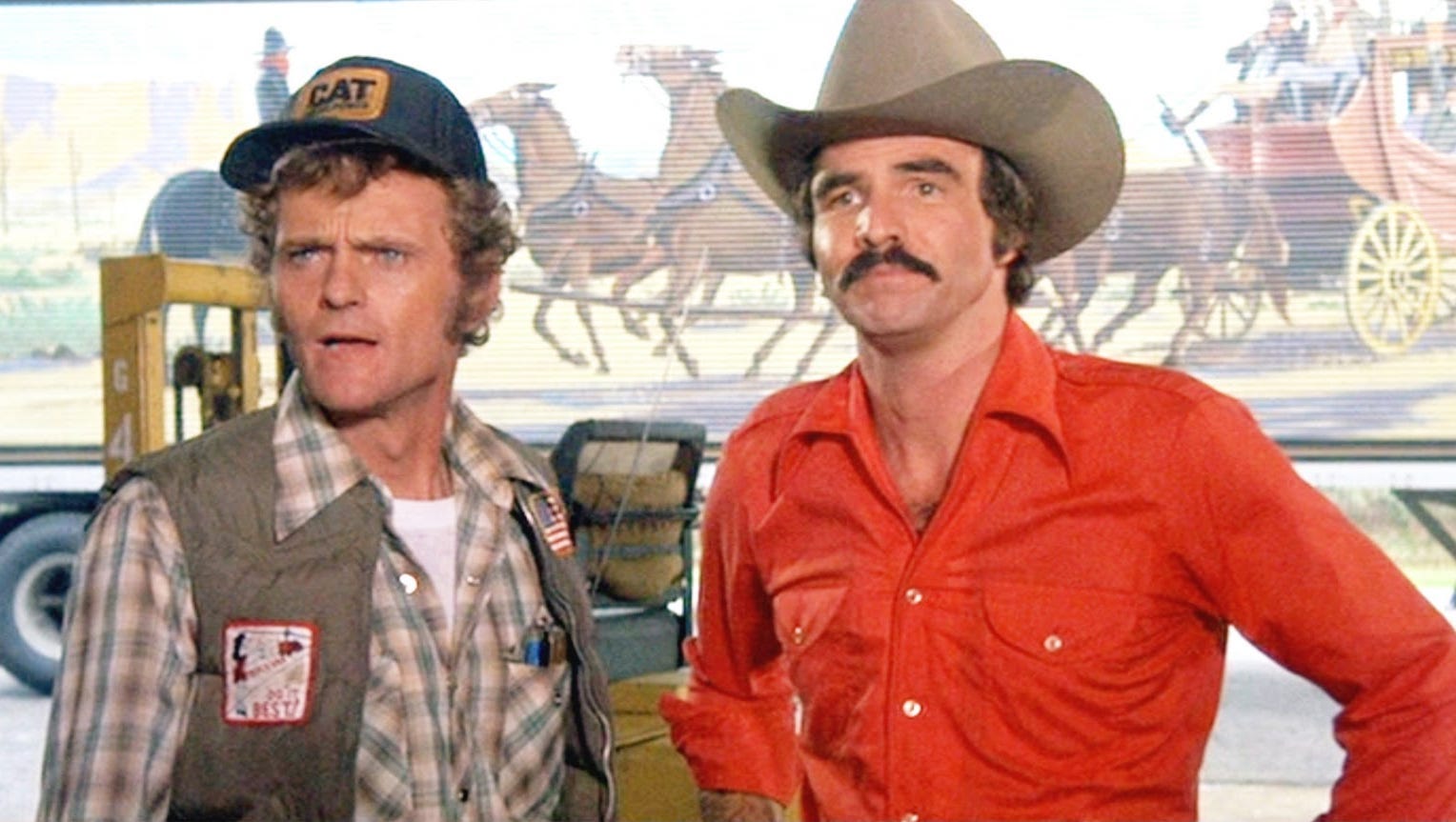
I told that story countless times growing up so that my friends and I could marvel at the notion that one of the cheapest beers on the market used to be liquid gold.2 I didn’t realize until years later that I was basically describing the plot of Smokey and the Bandit.
For whatever reason, that film didn’t seem very important to my father—important enough to sit me down and have me watch it with him, at least. So I didn’t catch up with it until the fall of 2019, when my hometown’s newly opened indie cinema ran it as one of their first retrospective screenings.
My curiosity had been piqued just a few months earlier when I covered the Chattanooga Film Festival for Modern Horrors and witnessed genre film critic and horror host Joe Bob Briggs deliver a keynote lecture called “How Rednecks Saved Hollywood.” As I wrote back then, it was “135 minutes of cinematic scholarship stretching all the way back to the Scots-Irish origins of the term ‘redneck’ and cataloguing every bit of hicksploitation that Hollywood has leaned into ever since.” In other words, it was right up my alley.
Joe Bob spent a significant amount of time hailing Smokey and the Bandit as the greatest film ever made simply because it has everything you could ever want in a Southern saga: a handsome rebel and a pretty girl, a Pontiac Firebird and an 18-wheeler, and of course a sniveling police officer getting outsmarted left and right while trying to stop the pettiest of crimes (illegal beer trafficking). If that’s your criteria for a fun time at the movies, I think Joe Bob makes a pretty good case.3
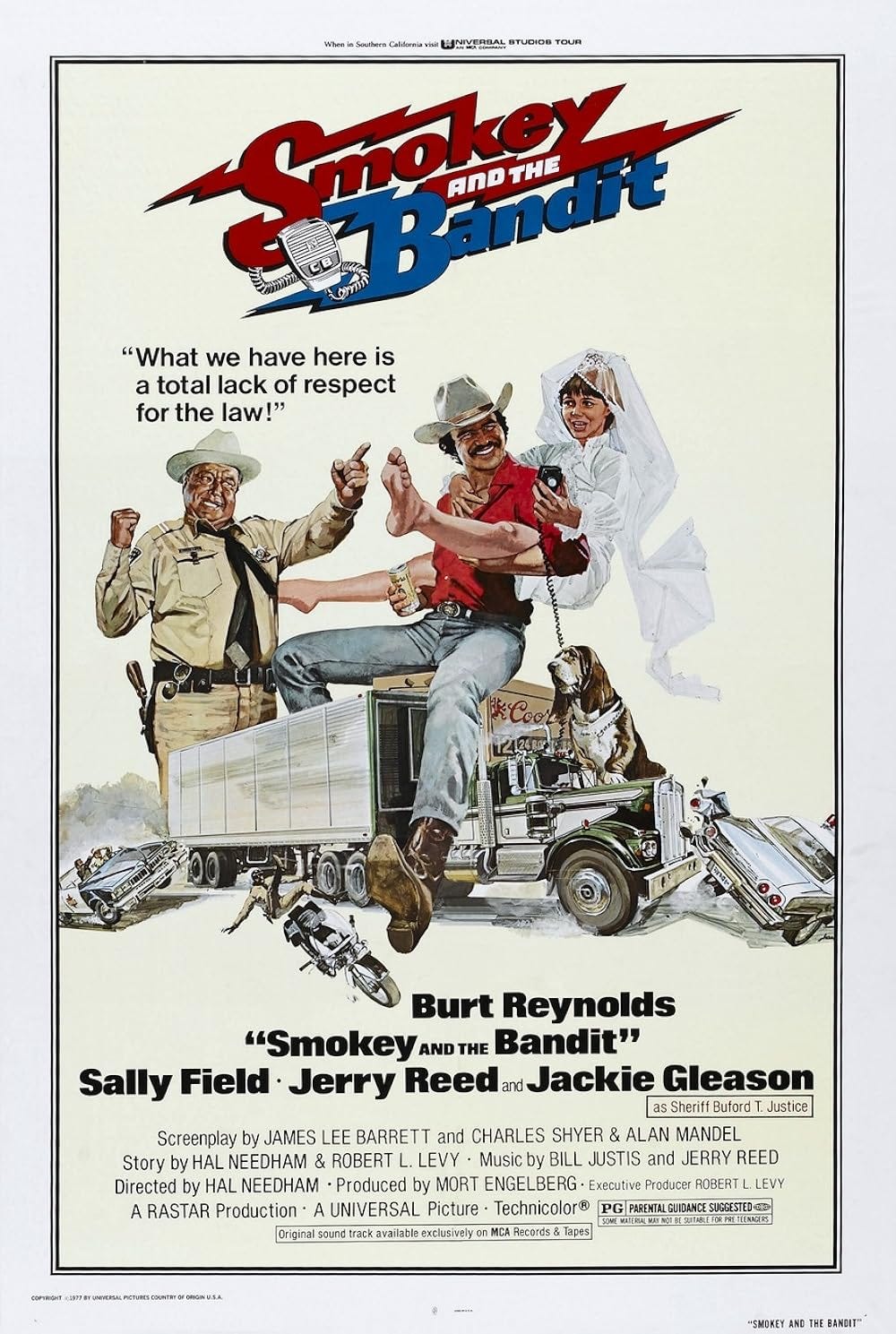
Even the origin story of Smokey and the Bandit is as pure as it gets (i.e. accidental). Director Hal Needham, a Memphis man who grew up in Arkansas and Missouri, was working as a stuntman and 2nd unit director on Gator, which was shooting in Savannah, Georgia. As the story goes, someone left a supply of Coors in his trailer as a gift. Needham wasn’t much of a beer drinker, but after he noticed his stash was mysteriously dwindling, he discovered that his maid was swiping two bottles a day. Realizing how much Southeasterners coveted the stuff, he turned this regional demand into a screenplay and convinced his good buddy Burt Reynolds to star in his directorial debut.4
Smokey and the Bandit is all about simplicity. It’s a simple origin story for a simple concept that became a huge hit with simple folks like my father.5 It was the second-highest-grossing film of 1977 behind Star Wars, and Reynolds said later in life that it was the most fun he had making a film. They didn’t overthink it, they just made something that felt authentic to the Southern experience, and it resonated well beyond the region.
Life was simpler back then—at least for white Southern men like my father—and Smokey and the Bandit was a snapshot of that era. But then Coors expanded its distribution to the East Coast in 1986—the same year I was born. The cheap thrills of beer bootlegging were gone, and my father now had five children (and four grandkids). Life wasn’t so simple anymore.
Looking back on my adolescence, I’m not sure why we never watched Smokey and the Bandit. Maybe he and my mother were afraid it would encourage me to drink at an early age. Maybe he actually did offer to show it to me but I wasn’t interested. Feels like a failed opportunity to bond over a favorite story, but again, failure wasn’t a stranger to my father.
This will technically be my first Father’s Day without him. He passed away this past August. But he left my mother (and, ostensibly, my sister and I) 15 years earlier. He did write me a few letters after that, but I had no interest in writing back when it became clear that he was more concerned with getting back his records and other belongings that he’d left behind.6 He was still clinging to that simpler time, I suppose.
But my own life’s not so simple anymore either. In fact, this will be my first Father’s Day as a (step)father myself. My girls never met my father, but when they’re old enough to ask about him, I don’t think I’ll begin with the end. They don’t need to know about how he walked out of my life when I was 24 and made minimal efforts to repair the damage. They don’t need to know how bitter I was that he was cashing checks for years that my mother was forced to write him after their divorce settlement. And they don’t need to know about all of those earlier failures either. At least not yet.
I think I’ll tell them that my father was an outlaw beer-runner who brought canned contraband to the foothills of North Carolina in the 60s. He was the Coors Man. In fact, they kinda made a movie about him.7
Smokey and the Bandit is now streaming on Netflix, and it is available to rent elsewhere.
I’m not quite sure what he was selling back then, but he sold clothing and jewelry during my youth, so I assume it was something similar.
I actually have my own version of this story. Back before the craft beer boom of the early 2010s, I spent two years in Louisville, Kentucky, for graduate school. One night, when I was partying with some of my buddies who lived across the river in Indiana, they told me that a friend of theirs was bringing this amazing beer from Pennsylvania—a beer you couldn’t buy in Indiana or Kentucky. Turns out it was just Yuengling, a beer that was readily available in gas stations and grocery stores across Alabama at the time, for whatever reason. (I do still enjoy a good Yuengling, though.)
It looks like Joe Bob is still doing his traveling “How Rednecks Saved Hollywood” show. If you care at all about Southern films and he comes to your neck of the woods, don’t miss it. I’d watch it again if I could.
In case you’ve forgotten, Hal Needham’s friendship with Burt Reynolds was the inspiration for the Cliff Booth and Rick Dalton characters in Once Upon a Time in Hollywood.
I don’t say “simple” to mean “unintelligent” here. I say it like Lynyrd Skynyrd said it: a “simple kind of man.” Something you love and understand.
Yes, I kept those records. In fact, I played several of them last time I spun records for a Friday happy hour at one of my favorite local bars. He had just about every Willie Nelson album, so I have to give him credit for good taste.
And after they watch that movie with me, they’ll understand why my mother’s cats are named Smokey and Bandit. (She let me pick the names, of course.)
No posts
Comments
Nothing yet. Say the first thing.
Sign in to join the conversation.