
Today’s issue of Dust On The VCR is a subscriber request! This film was brought to you by Hayes Killian, a fellow local film fanatic and a self-proclaimed longtime Matt Dillon fan. Hayes is one of the people I’ve connected with through the Sidewalk Cinema here in Birmingham—which he asked me to promote in this introduction, so maybe you should check out the Sidewalk Film Festival lineup that just dropped and buy yourself a pass, then you can hang out with both of us in August. I should mention too that Hayes is a big supporter of dog rescues, especially those that take in senior dogs, so maybe you should adopt a good boy or a good girl sometime soon, yeah? (Start with the Sidewalk pass first, though; it’s a much cheaper investment.)
Wanna request a film for a future issue of Dust On The VCR? Subscribe to the paid version!
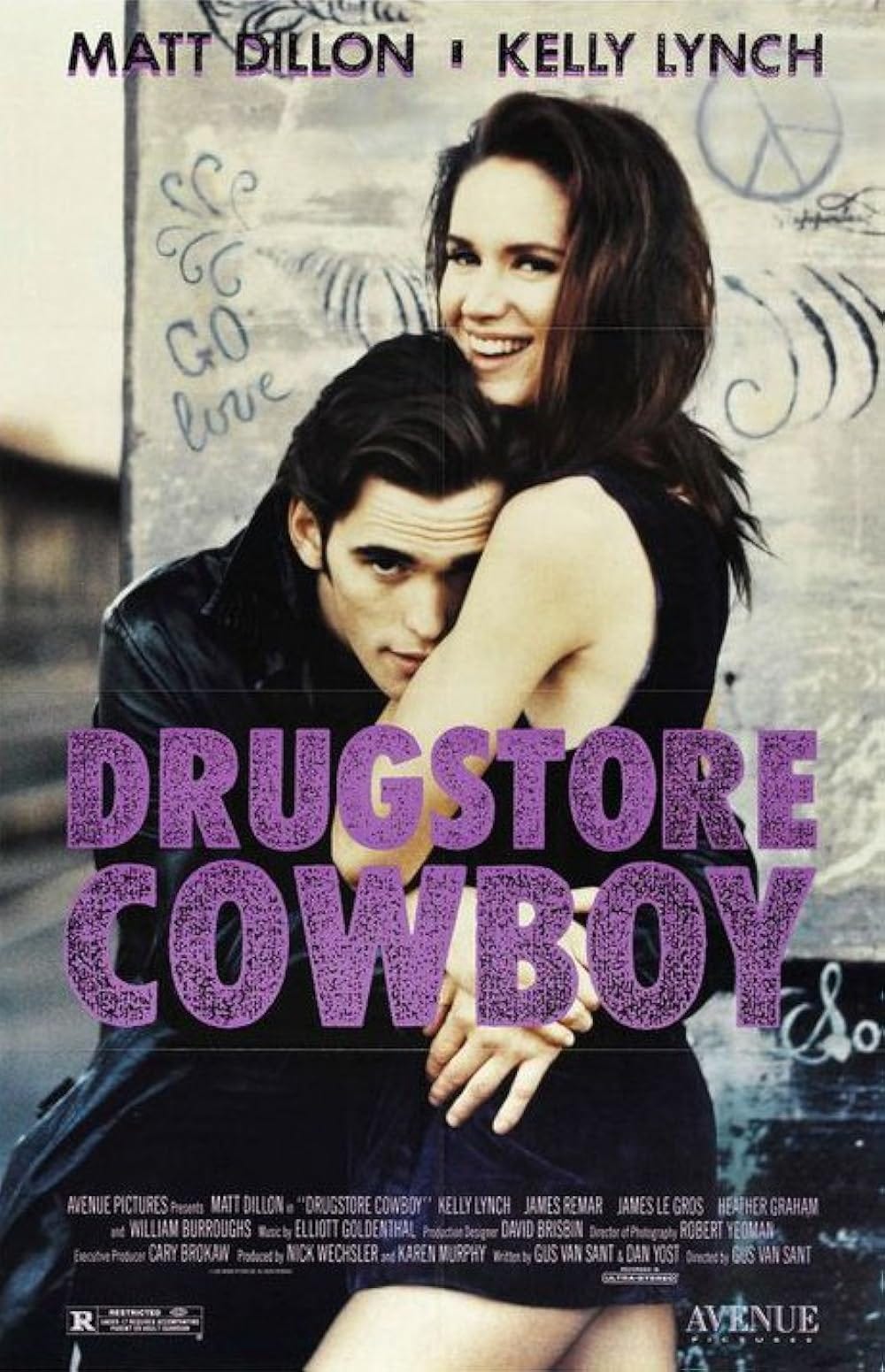
Drugstore Cowboy isn’t exactly plotless, but it is pretty straightforward. It follows a small group of drug addicts as they cruise around Oregon robbing hospitals and pharmacies.1 Sometimes they sell what they find, sometimes they shoot it. As such, much of the narrative is crafted around these four junkies as they hunt for their next score and try to keep the cops off their tails.
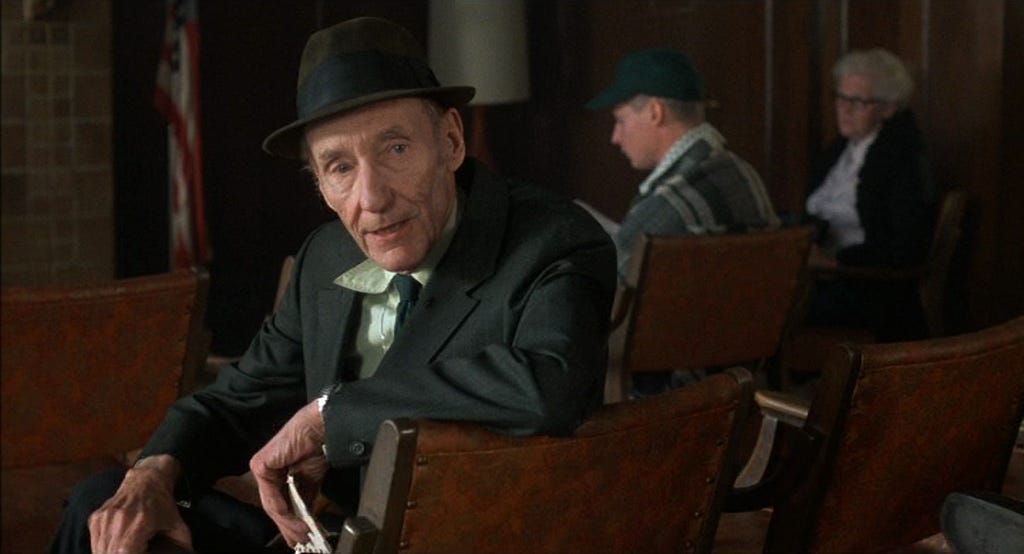
Then things take a turn in the third act. The gang splits up when their leader Bob (played well by Matt Dillon) decides to get clean. He moves back to Portland. He checks himself into a methadone treatment program. And then in walks legendary author William S. Burroughs.
Stunt casting can be a gift or a curse. If the wrong public figure shows up, it can derail the story or become a distraction for the viewer. A bad celebrity cameo can really take you out of a film you’ve otherwise been enjoying. But when employed smartly and strategically, it can add new narrative and even thematic layers.2 Such is the case with Gus Van Sant’s expertly employed Burroughs appearance in Drugstore Cowboy.
It’s a bit of a flex, to be sure. Van Sant had just made waves on the film festival circuit with his debut feature Mala Noche, and suddenly he was drawing interest from Hollywood. But when Universal Studios declined both of his pitches, he decided to move back to Portland—where he’d spent time in his youth—and use his newly earned clout to level up on his sophomore feature. Which became Drugstore Cowboy, of course.3 And given that he had the opportunity to do so, why shouldn’t he cast an artist that he (presumably) had admired for many years?
Stunt casting can go one of two ways. The celebrity might show up and merely play themselves, or a version of themselves, often to add humor or levity to the situation. Usually this works best when it’s not an actor but another sort of public figure that doesn’t grace the silver screen very often.
And then there’s the more effective version of stunt casting, I believe, which is to have a “nonactor” play a part alongside the professional actors, as Van Sant does here. But that’s one of the things I love most about these cameos: Even when the visiting luminary isn’t playing themselves, they’re always kinda sorta playing themselves. A smart director like Van Sant understands that it’s difficult for most viewers to separate the public image from the character being presented—it’s over as soon as your brain says “Hey, that’s the guy from Shark Tank,” for example—and so they lean into it.4
Burroughs is an interesting choice here for a lot of reasons. For one, he was primarily an author and a visual artist, which means that many audience members won’t clock the man playing Father Tom Murphy as an icon of the Beat Generation. Those in the know may recognize him, and many others (like myself) have have learned in advance that he played a role in the film. But I think there’s still merit to finding out you were watching someone out of the ordinary after the fact. I love a good “Wait, that’s who that was?” moment. Makes you want to watch the film again; it might even increase your estimation of the film.
Van Sant knew that Burroughs would add a metatextual layer to the film as well, of course. We’re talking about the man whose first published novel was a mostly autobiographical saga titled Junkie: Confessions of an Unredeemed Drug Addict. Burroughs would’ve instantly recognized the characters in Drugstore Cowboy from the first few pages of the script, so it’s no wonder that he believed he could bring something to the project.
Thankfully, Van Sant gave him the perfect part to play. Tom isn’t merely an Irish Catholic priest—he’s a recovering drug addict just like Bob. Burroughs makes a subtle but intentional entrance in the film, and Bob recognizes him with the same sort of affection that a bookish viewer might’ve held in 1989. Bob had been Father Murphy’s altar boy, and Father Murphy had been Bob’s gateway to the drug scene. It’s more than a chance encounter.
The two men have a handful of conversations throughout the third act, and Bob quickly learns that Tom is still more interested in his next score than his rehabilitation. He’s the “unredeemed drug addict” who forces Bob to really reckon with his path to redemption. Roger Ebert noted in his review that Burroughs’ cameo is “a guest appearance by Death,” but I believe there’s more to it than that. Case in point: After Tom goes on a rant about how right-wing politicians are using the war on drugs to justify turning the world into a police state, Bob smiles and responds politely: “You know, Tom, you might have missed your calling. You should have been a philosopher.” And then Tom’s response is one of the best lines in the whole film: “In another life, perhaps. In another life.”
Burroughs’ appearance is more than a stunt. He shows up and adds a new level of gravity to Drugstore Cowboy, grounding the third act as the strongest portion of the film and helping wrap it up in a profound way. And just like his writing does, his performance leaves you with plenty to think about.
Drugstore Cowboy is now streaming on Kanopy, Hoopla, Tubi, and Fandango, and it is available to rent elsewhere.
The credits note that the film was shot in “beautiful Portland, Oregon,” and I love Gus Van Sant for that. All of our hometowns are beautiful.
I’m not a Travis Scott fan, so I didn’t even recognize him in The Odyssey. But I appreciate what Nolan was going for with Scott’s small role. It kinda signals to the viewer that they’re about to witness something classical but modernized.
The other pitch that Universal declined became My Own Private Idaho. How embarrassing for them.
Marty Supreme was littered with amazing stunt casting, and Josh Safdie somehow made all of the roles feel organic to the story. I still can’t believe Kemba Walker was in the film for about five seconds.
No posts
Comments
Nothing yet. Say the first thing.
Sign in to join the conversation.