
Hello,
In June, I was invited to teach at the lovely Juniper Institute at UMass Amherst. It’s such a beautiful, strange part of the country—remote, but also home to many of my idols. Kamila Shamsie studied there. Agha Shahid Ali, I can’t believe I had forgotten this, is buried in nearby Northampton. My new friend, Shastri Akella, who I just met while at Amherst, and whose book The Sea Elephants you must read, went there. That’s something about America that continues to surprise me. Unlike the metropolitan bias of so many other places in the world, where the city is the only place for opportunity and fame, this country can keep world-famous writers in the woods.
While at Juniper, I taught a craft class on writing history into fiction, using examples from the works of Elena Ferrante. As part of my preparation for the course, I read through all of Frantumaglia, a collection of Ferrante’s letters and interviews that is accurately described as Ferrante’s writing workshop. The book is as luminous as it sounds. My copy is now dog-eared every few pages, with several marginalia consisting only of inelegant “!!!”s
There is one point where, describing the interdependence of the Naples neighborhood she grew up in, Ferrante writes:
“To gather oneself, so to speak, was physically impossible. One learned very early to have the greatest concentration amid the greatest disruption. The idea that every “I” is largely made up of others and by the other wasn’t theoretical; it was a reality…The dead were brought into quarrels; people weren’t content to attack and insult the living…And then there was the dialect and there was Italian. The two languages referred to different communities, both jam-packed. What was normal in one wasn’t normal in the other. The bonds that you established in one language never had the same substance as those in the other. Customs varied, the rules of behavior, the traditions. And if you sought a middle ground, you would assume a false dialect that was a sort of trivialized Italian.”
The effect Ferrante has on me is hard to explain. It has been tremendous, at points stifling. I’m currently reading The Lost Daughter and find it unbearable—quite literally, I can hardly bear to go on, the psychological landscape of the narrator and the descriptions of her relationship with her daughters too sharp, too resonant. One of the ways in which I relate to her work is described in the paragraph above. I’ve always held that anyone who writes in a language other than their childhood tongue writes in translation. For that reason, I’ve often envied writers who have the audience / ability / means to write well in their childhood language, and then have someone else, i.e. a professional translator, take on the task of turning it into English. But as the passage above makes clear, despite being Italian, Ferrante doesn’t write in her childhood language either. Neapolitan is different enough from Italian to be almost unintelligible to Italian speakers. Further along in the same passage, Ferrante writes:
“Nothing has faded, everything is here in the present. Of course, today I have small quiet places where I can gather myself—but I still feel that the idea is slightly ridiculous. I’ve described women at moments they are absolutely alone. But in their heads there is never silence or even focus. The most absolute solitude, at least in my experience, and not just as a narrator, is always, to paraphrase the title of a very good book by Hrabal, too loud. To the writer, no person is ever definitively relegated to silence, even if we long ago broke off relations with that person—out of anger, by chance, or because the person died. I can’t even think without the voices of others, much less write.”
All of Ferrante’s main characters are from Naples. Writing their thoughts down, and in particular writing down the echoes of the other Neapolitans within them (often the mothers; Ferrante says she sometimes feels she hasn’t written about anything other than mothers and daughters) is an act of translation.
Anyway, I don’t wish to dissect her work too much. Selfishly, as a writer, I do end up reading her for tips and tricks all the time. This summer, in fact, is my summer of no new books, where I’m re-reading the Neapolitan Quartet in its entirety. As a reader, I am convinced that she is a witch, and can simply do magic.
**
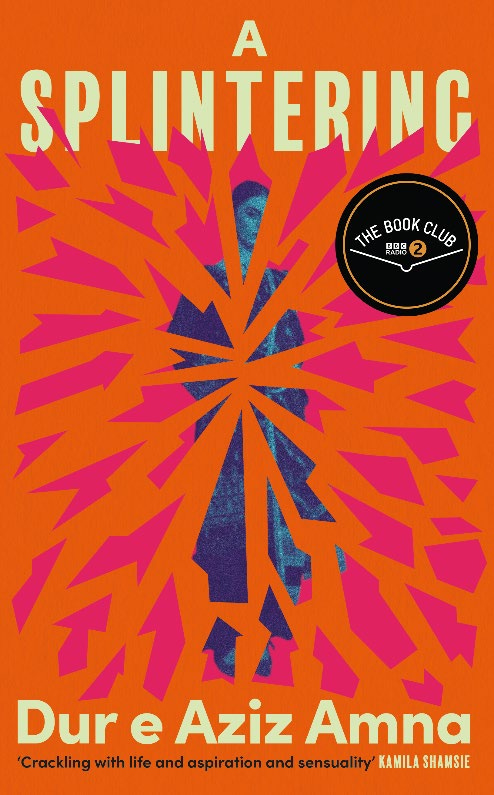
A Splintering has been chosen for the BBC Radio 2 Book Club! In September, I will be in the UK for the BBC interview and other events. Deepti Kapoor, whose book Age of Vice I inhaled earlier this year, says of A Splintering, 'I am constantly amazed by how relentless this is. When you think it's gone too far it goes further. And I love it for that.' I found Age of Vice as relentless as it gets, so I’m quite pleased with this endorsement.
If you wish to pre-order the book, you can do it here or here (free international shipping). Below is the cover, with the snazzy new book club sticker.
Stay well.
Dure
No posts
Comments
Nothing yet. Say the first thing.
Sign in to join the conversation.