
Hey fam and welcome back to dumb rich! I should have a totally epic intro now that we’re a month out from tax season, but I don’t. I’ve been on an unlucky streak lately and I am debating hiring an Etsy witch. So, that’s how life is going for me. I know my luck will turn (pleaseeeeeeeeeeeeeeee).
So today, I’m just here to drop some knowledge instead of giving you a lengthy intro. As a CPA, my clients are always curious about S-Corporations and when to make the switch. Is there a certain revenue number or a perfect time when this can be justified? What even is an S-Corp? So, let’s just get right into it with real numbers and everything so we can pick the entity that will save you the most money.

Life as a Single Member LLC
Most people switching to an S-Corp are coming from a Single-Member LLC (SMLLC). SMLLC life sounds great and simple — no additional tax filings, no extra admin, you and your entity are one, plus all the legal protection. What could be better? Well, as an SMLLC you are considered self-employed, which means you get to pay self-employment tax in addition to your regular federal and state taxes. Those taxes are:
15.3% SE tax on the first ~$176,100 of net profit (12.4% Social Security + 2.9% Medicare)
2.9% Medicare tax on everything above that threshold
So when you think of your federal tax bracket, perhaps 25%? Make sure you’re adding on this extra 15%+. YAY.
What Changes with an S-Corp
So, why doesn’t everyone switch to an S-Corp? Well, now there is a bit more of an administrative burden to take on. First, you need to split your income into two buckets:
Reasonable officer salary: You become an employee of your company! Cool, kind of?! Now you’re back in the world of receiving a W2 without having an annoying boss. This income is subject to payroll taxes which are essentially the same as the SE tax mentioned above.
Officer distributions: These are distributions that you make to yourself from your company and are NOT subject to the payroll taxes. Not totally free money, but feels like it.
Paying yourself an officer salary does come with some compliance requirements that I think are worth noting:
Separate annual corporate income tax return (1120-S) - no longer just an added schedule on your personal 1040
Quarterly payroll filings related to the officer salary that you pay yourself
W-2 issuance to yourself as an officer
Determining the “reasonable compensation” you are paying yourself based on the IRS rules
Many of my clients are reluctant to make the switch because the administrative burden of these extra filings feels overwhelming. Understandable. You aren’t a CPA and it can be intimidating!
How to Actually do this Without being Totally Overwhelmed
One word: Gusto. I am obsessed with Gusto as a payroll platform for my clients. I even use it for my own business. They completely automate the payroll compliance side of running an S-Corp. Am I a Gusto fangirl? Very much yes. It started with one client and then became a no-brainer for the rest.
Even without a CPA to help, many can use Gusto on their own. Here are all of the things it automatically does for me and my clients so I can sleep at night (yay, technology!):
Runs officer salary (and employee) payroll on a set schedule automatically. No missed paydays.
Automatically calculates, withholds, and remits federal + state payroll taxes
Files quarterly 941s and state returns automatically
Issues your W-2 at year end
It couldn't be more user-friendly. Clients go from dreading payroll to being completely hands-off. Payroll mistakes are expensive, and I've seen wild situations, even with larger payroll providers, where clients ended up in collections over a missed filing. I've never had a single issue with Gusto.
Gusto is one of my favorite partners because they’re proactive. The dashboard has a to-do list to keep you organized, and it even finds tax credits you may not have known about. Now that I think about it... is Gusto coming for my job? LOL.
Now, the Numbers…
So, we’ve discussed the S-Corp vs. SMLLC in theory, but let’s get to the good part. The numbers. Nerd alert.
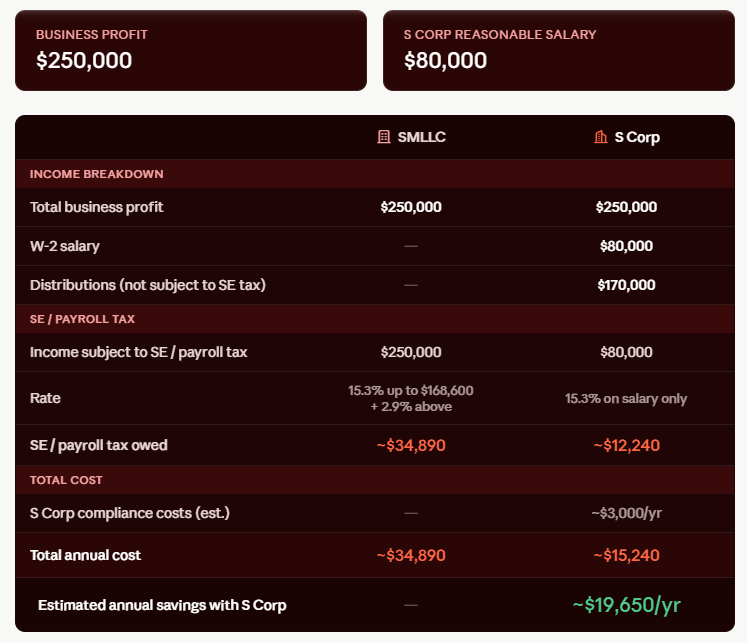
So yes, with nearly $20,000 in savings you can justify that Chanel bag, right? Okay, okay, investing back into your business or letting compound interest work its magic is the smarter move. But still.
A few footnotes because it’s not always this cut and dry:
Many states and cities (I’m looking at you NYC!) charge their own S-Corp tax, which can greatly eat into the federal tax savings. This is absolutely worth considering before making the switch.
Your “reasonable salary” as defined by the IRS may exceed the $168k Social Security threshold, which reduces your savings. That said, you’ll still save the extra 2.9% Medicare tax, which can add up.
If you remain an SMLLC, 50% of your self-employment tax is deductible on your personal return. This table only reflects SE/payroll taxes — not your total tax picture.
When Should you Switch?
I always tell my clients that it’s worth switching once they have profit that is consistent and substantial. These are serious processes to put in place — not worth the overhead for just one big year! There’s no universal number. It’s a conversation worth having with your CPA as it depends on your industry, location, and your specific situation.
If you’re ready, I couldn’t recommend Gusto enough. You can get your first month free here and join the 500,000 businesses using Gusto!
This letter is in partnership with Gusto!
No posts
Comments
Nothing yet. Say the first thing.
Sign in to join the conversation.