
“I’m on the wrong path.”
“My career has stalled.”
“I’m trying to find my way.”
“I’m looking forward to the next chapter.”
We say these things to one another, and to ourselves, dozens of times a week. We hear them repeated back to us, and we nod along. We almost never stop to notice that they aren’t descriptions. They’re maps. And the map is not the terrain, though we forget that constantly. We steer by the map as if it were the literal ground under our feet.
This is the part of language we rarely notice. Beneath almost every sentence we use to describe our own growth, a metaphor is quietly doing the work. It decides which moves are visible and which stay hidden. It decides which kind of life it can name, and which kind it cannot. It shapes not only how we describe our development, but how that development is allowed to happen at all.
The figures of speech a culture lives by determine what its people can become. That isn’t a literary observation. It’s a structural one. The image we reach for shapes our thinking, and it quietly narrows our options before we’ve consciously chosen anything.
We’ve inherited a small set of images that illustrate what it means to be a developing human being. They have served us well and held meaning across many generations. They are also, right now, our single greatest limiting factor.
That’s a large claim, and it deserves scrutiny. We tend to read this cultural moment as a crisis of meaning, or politics, or technology. Some of it is. But underneath those familiar diagnoses sits something stranger and harder to see: the way we think about the problem is bound up in mental models that have quietly stopped working. Let’s start there.
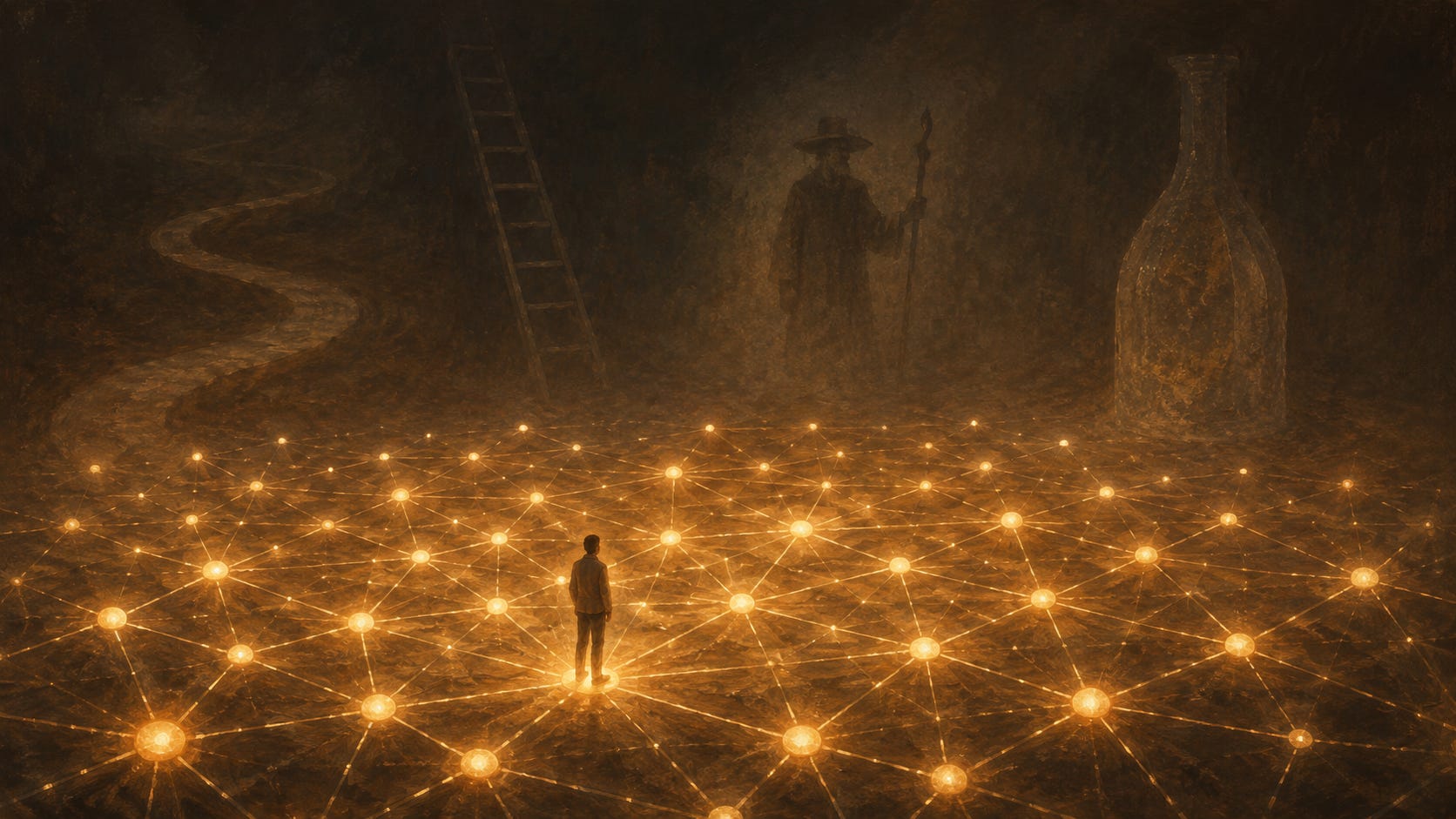
Four metaphors drive the way our culture talks about personal growth. On the surface, they look unrelated. Underneath, they share a single skeleton.
The Journey. Linear movement toward a destination. Homer’s Odyssey. Bunyan’s Pilgrim’s Progress. In 1949, Joseph Campbell published The Hero with a Thousand Faces and handed the twentieth century a vocabulary it has never put down. We talk about our paths, our journeys, our chapters. We say we’re arriving, or that we’re stuck. The arc is everywhere.
The Ladder. A vertical climb. The career ladder. Maslow’s hierarchy. The medieval Scala Paradisi, the ladder to paradise that mystics climbed by stages. Status as a single vertical axis, and the good life measured by how high you’ve gone.
The Container. The self as a bounded vessel. The authentic self, sealed inside the social shell. The instructions that follow are familiar: find yourself, know yourself, be yourself. They all rest on one assumption, that there is an essential core, separable from context, and that becoming a person means locating it and bringing it out.
The Pilgrimage. A sacred journey to a sacred place. Mecca, Compostela, Jerusalem. The soul’s inner travel toward God. It is a close cousin of the journey, with deeper roots and a richer texture, but it shares the same underlying shape. You leave. You travel. You arrive. The traveling changes you.
These are four images, with four different surfaces, but they share a skeleton:
A singular subject. Always one person, alone, doing the work.
Sequential time. One thing after another, a before and an after.
A spatial direction. Forward. Up. In. Toward.
A destination. You are headed somewhere, and the somewhere is the point.
A linear arc that ends, and the ending is where the meaning lives.
None of this is wrong. These four have held meaning for thousands of years. They shaped great novels, great traditions, great lives, and gave us our language for courage, sacrifice, vocation, and conversion. They are not dispensable. They are partial.
What they cannot hold is the part of a life that refuses to fit on a single line. Growth happens across many areas at once. Relationships do not simply enrich you. They help make you who you are. Coherence emerges from the whole rather than waiting at the end, and life moves in many directions at once.
Consider an ordinary week. A woman leads a team at work, parents two teenagers, helps care for her aging mother, and quietly wonders whether the faith she was raised in still describes her inner life. Those are not four separate journeys she takes one at a time. They are all happening at once, each one pulling on the others in real time. The line cannot draw that. It was never built to.
The metaphors built for a single line cannot describe a self that is made of many. The people who gave us these images were not wrong about their world. They simply had a different kind of life to describe. It is not the life most of us are living now.
The conditions that produced these images no longer match the terrain we actually live on.
The journey worked when a life had a single arc. Village to village. Vocation to vocation. One identity holding steady across one trajectory. You were born into a place, took up a role, served it, and died inside the same frame you had started in. The arc had a shape, and the shape was the story.
The ladder worked when status was vertical and singular. There was a guild, a court, an army, a clergy, a corporation, and inside each one, you either climbed or you stayed put. The vertical axis was it. Questions of status were measurable, comparable, and cleanly ordered.
The container worked when a person could be treated as a unit, separable from context. The Enlightenment leaned hard on this. Inside sat a rational, sovereign individual with rights and goals; outside lay the social world that individual moved through. The container held its shape, and thinkers could examine it, repair it, expand it, and claim to know it.
The pilgrimage worked when the sacred and the secular were genuinely separate worlds with a road between them. You lived in the secular for a stretch, traveled into the sacred for a stretch, and came back changed. The two were distinct, and the crossing was the whole point.
We don’t live there anymore.
We hold several roles at the same time. Our identities are not bounded. Our development is not linear. Work, relationships, community, and our sense of meaning are all in motion at once, each one bending the others as it moves. The executive who is also a parent. The parent who is also a daughter caring for a fading mother. The worker whose job has quietly stopped meaning what it used to. The believer whose tradition no longer matches what is happening inside. None of that maps onto a single journey, a single ladder, a single container, or a single pilgrimage.
And then there is AI.
Large language models are pouring a new kind of intelligence into ordinary life, and they are changing the very things these models were built to track, including knowledge, identity, and meaning. They also let a person live in many places, hold many roles, and carry many conversations at once, which is the networked condition the single line was never built to draw. Trying to navigate the world emerging from AI with the journey metaphor is like handing someone Lewis and Clark’s map and asking them to find an address in downtown Kansas City in 2026. The map isn’t bad. It’s drawn for different ground.
The unease so many thoughtful people feel about their own development is not a personal failing. It is what happens when a networked life is forced onto a single line. The life won’t fit, and the line won’t stretch. We experience the mismatch as confusion, or restlessness, or the nagging sense of being behind, but it is none of those things. It is a good life straining against a map too small to hold it.
Listen to the words people reach for when they describe the trouble. Lost. Stuck. Behind. Those are journey words. They diagnose the speaker as a traveler who has lost their way, and they point toward solutions for the journey. Find the path, catch up, push on. But what if the trouble is a different shape entirely? Words like "fragmented" or "incoherent" name something other than a traveler off course. They name a life whose parts have fallen out of integration with one another. They describe a different problem, and they invite a different kind of work. The words we choose decide what we think is wrong with us.
When I was building the framework I now call Infinite Coherence, I had the whole architecture on the page before I had the image to hold it. I knew it rested on three domains: 1) identity, 2) relationships, and 3) community. I knew what it was claiming about how a person actually becomes themselves. What I didn’t yet have was an answer to the deeper question beneath it. What picture of the human person was this work grounded in?
Here is the move that took me the longest to see, and it is the heart of this essay. The old images each give you a shape and a destination, such as a line to walk, a ladder to climb, a vessel to fill. What none of them give you is any other way to measure a life going well. In each one, the measure is arrival. You are doing well to the degree that you are getting there.
The network changes both halves at once. It gives life a different shape. Not a line but a web. Not a traveler moving alone but a node held within a living set of relationships. It also gives life a different measure. The point is no longer the arrival. The point is coherence, whether the parts of a life hold together.
That is the distinction worth keeping straight, because it blurs easily. The network is the picture. Coherence is what the picture is for, the thing that takes the place of arrival once you stop walking a line.
I tried the old images first, the way you reach for a familiar tool, and each one broke against the same claim. The journey insists on a single subject moving along a single track, but the framework was saying you are a node in a network, not a soloist on a road. The ladder insists on a single vertical axis, but the framework treats identity, relationships, and community as three distinct dimensions, with no “up” to climb. The container insists on a sovereign self, sealed off from its relationships, but the framework’s founding claim is that you do not exist apart from them. The image I had grown up inside, and the two beside it, could not carry what the work was trying to say.
I stopped forcing it, and the network opened up everything the older pictures had been hiding.
Coherence, in this sense, is not a destination. It is a property of any system whose parts work together. A body has coherence when its organs cooperate. A piece of music has coherence when its parts hold across time. A life has coherence when identity, relationships, and community integrate rather than fragment within the same person. And here is the part that the older images cannot reach. A culture has coherence in the same way. Its individuals, its relationships, and its shared institutions hold together as a living whole rather than drifting apart.
That last step is the one I care about most. The same picture describes a person and a culture, at the same time, in the same language. The journey could only ever follow one traveler. The network lets us see the formation of a single human being and the formation of a whole society as the same kind of work, happening at different scales. That is the whole reason for changing the picture.
Coherence is not the absence of difference. It is the integration of differences into a working whole. A person and a community do not merge into one another, yet they still hold together.
The network challenges a belief hidden within the other four. The journey, the ladder, the container, and the pilgrimage each place one person, alone, at the heart of the story. The network starts from a relationship instead. It treats the ties between people not as decoration on a self that exists without them, but as the very thing the self is made of.
None of this was a stylistic decision. It was a structural one. The picture decided what the framework could see, and what the framework could see decided what it could eventually build. You cannot build with an image what the image cannot hold.
The images a culture chooses do not merely describe its reality. Over time, they decide what reality is even available to them.
The medieval pilgrimage produced one kind of person. The Enlightenment journey produced another. The twentieth-century ladder produced a third. Each began as an invention. Each, in its time, came to feel self-evident. It seemed to describe the world as it truly was. And each eventually reached the end of what it could carry.
We are entering a new era shaped by AI, cultural fragmentation, the loss of a shared frame of reference, and a growing sense of disorientation. We often describe these as problems of meaning, politics, or technology. Beneath them lies something more fundamental. The pictures we use to understand ourselves and our life together no longer fit the world we inhabit. We are trying to navigate a networked world with images designed for linear lives moving toward a destination. The strain is visible everywhere. We have simply given it different names.
Expanding our repertoire of images is not something we do after the real work is finished. It is the real work. It is the cultural foundation that enables new forms of growth and development.
A culture that learns to see itself as a network of coherent individuals, coherent relationships, and coherent communities is a culture that can hold together under the pressure of this era. A culture that keeps reaching for the journey, the ladder, the container, and the pilgrimage will keep producing people who feel lost, behind, alone, and incomplete. Those are the places those older images leave us when life refuses to follow their script.
The era we are entering does not need better individuals working harder on their personal journeys. It needs a richer sense of what coherence is, and the language to pursue it together.
A culture working from the network stops asking individuals where they are going and starts asking whether the layers of their lives hold together. It stops asking institutions how high they have climbed and starts asking whether they hold the people, relationships, and communities that make them up. It stops asking communities to perform unity and starts asking whether they actually cohere across the people and networks from which they are built. The questions change. The kinds of progress we can see change. And so the work changes.
This is not the province of philosophers and theologians alone. It belongs to anyone willing to pay honest attention to the conditions of their own life, and to describe those conditions in language the conditions actually deserve.
The images of formation we inherited were once new. Somebody chose them. They served their time. And they have reached the end of what they can do.
New images do not wait to be discovered, the way a continent waits on a map. They wait to be chosen. They wait for a generation willing to describe the lives it is actually living, in the language those lives require.
That work is yours too, and it can start small. For one week, notice the figures of speech you reach for. When you catch yourself saying “I’m on the wrong path,” or “I need to climb the ladder,” or “I need to find myself,” stop and ask whether that picture still fits the conditions you are actually inside. If it fits, keep it. If it doesn’t, try another. Try the network. Try coherence. Try picturing three domains of your life in motion at once, each seeking integration rather than a finish line. Notice what shifts when you describe your life in language large enough to hold it.
The images we live by are the architecture of the world we then live in. Choose them on purpose.
No posts
Comments
Nothing yet. Say the first thing.
Sign in to join the conversation.