
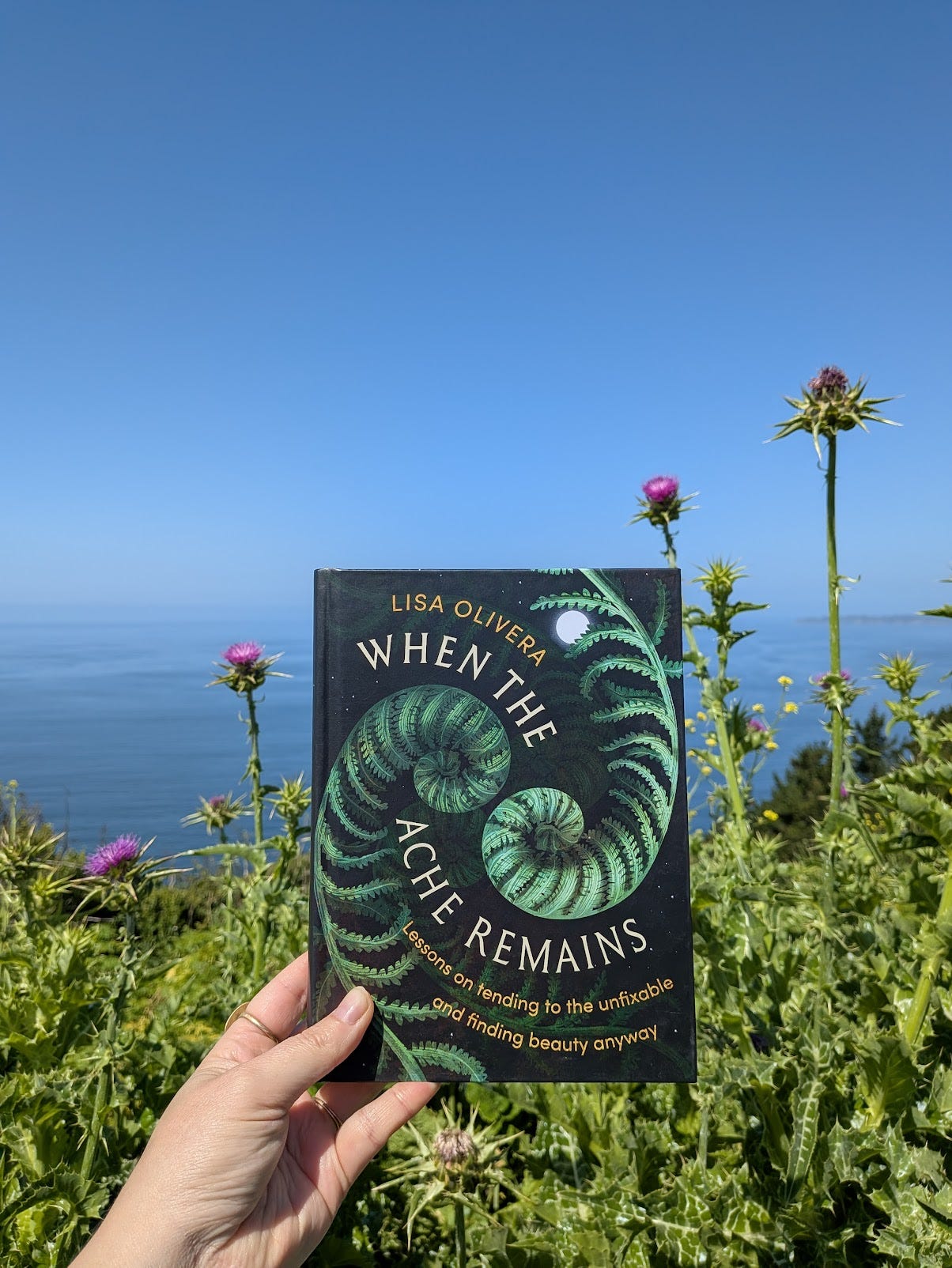
This week, I was fortunate to receive an early copy of Lisa Olivera’s new book ‘When the Ache Remains: Lessons on tending to the unfixable and finding beauty anyway’. Lisa is a writer and therapist I have followed and admired since my first days on Substack. Her words speak directly to my heart and soul, with a clarity and wisdom that emerges from having walked her talk and tended to her own healing work.
Lisa’s book addresses a theme very close to my heart—how we can come into relationship with the long-standing hurts, wounds, and aches that accompany us on our journey.
The longer I’ve worked in the field of psychology, and the longer I’ve navigated the minefield of being human, the more I’ve moved away from the idea that we need to ‘fix’ our hurt parts, and the more I’ve moved towards the idea of learning how to relate to those struggles as companions on the road. Meeting ourselves with gentleness, care, curiosity, exploration, and acceptance feels much more possible and fruitful than trying to eradicate the painful parts of life.
Life has taught me that we will continue to circle back to issues and struggles we thought we had dealt with, we will continue to grieve losses that we believed we had let go of, and we will continue to meet ourselves in our full humanity at all the different junctures and developmental stages of our lives.
This is what Lisa speaks of so beautifully in her book, with her signature thoughtful, poetic, and insightful style, and she generously agreed to respond to some questions about it.
Lisa, can you tell us who you wrote this book for, and what you hope they will take from it?
I initially wrote this book for myself, feeling connected to a familiar sensation of needing to pour out what I had been holding inside. Through the writing process, I slowly knew it was meant to reach more than just me—that it felt like this tether to the aches in others, to the pain I know I’m not alone in tending to, to the human experience of multitudes and duality we are each living through in our own ways. I hope readers feel seen and met in the places they often hide from people. I hope they recognize themselves in some of my words, creating a sense of unaloneness. I hope they cultivate more curiosity and love toward the achiest parts of themselves. I hope it encourages readers to continue making room for beauty, pleasure, joy, and deep care alongside all else. I hope they allow their full humanity to be welcomed, nurtured, and companioned. And I hope the book offers an outreached hand, a reminder that we are never the only ones, and a map back toward the wholeness each of us inherently contains, even alongside all that still hurts.
In your book, you share the raw and moving story of being abandoned in a field as a newborn baby, and how you have carried a deep, unresolvable grief from this time. I’m curious how it feels for you to share this tender story publicly?
I’ve shared small bits of this story publicly over the course of my life, so it doesn’t quite feel like a secret or a grand reveal… but sharing more intimate details, as well as being more open about the impact it has had on my sense of self, has been quite tender. I’ve noticed a deepening of courage activated within me as I’ve chosen to write honestly about some of my experiences, and I also feel my infant self being held and nourished as she gets to be seen and known in new ways, too. I’ve done so much inner work around these pieces and layers of me, so sharing them comes from a place of wanting to be of service and offer a mirror to anyone who holds similar grief, whether closely related to my own or entirely unique to them. It feels like a gift to get to offer my heart in this way, and with the gift comes a continued turning inward and exploring how I might stay bolstered and connected to my center as I keep sharing and offering parts of myself in this book. There are so many parts of myself and my life I keep private, but this particular thread of my story and experience has felt healing to share, not only for others who struggle with the depth of lifelong, often misunderstood grief, but also for the versions of me who felt they weren’t allowed to be honest about it all. There’s a real sense of pride in being able to name it all out loud now.
For someone who is reading this and carrying a heavy burden of grief and pain, and who feels like turning towards their pain is an enormous ask, where would you suggest for them to begin?
I write often in the book about smallness being everything at times. We often think we must figure it all out or get to the bottom of things right away, but meeting our pain and our tender places can be exquisitely subtle and quiet. It can be as simple as noticing sensations and feeling what it’s like to be in the practice of noticing them. It can be offering gentle touch to the face, shoulders, or jaw when sadness arises. It can be not doing it alone, which has been integral in my own path—seeking out support and connection as I face parts of myself more fully. It can be moving between the pain and something pleasurable or beautiful, moving toward the grief, noticing when it feels like too much, and moving back out toward a tree, or a beloved poem, or a soft blanket to curl up with. It can be staying with one sensation, one feeling, and one piece at a time, trusting there will be plenty of time for all that has yet been tended to. And holding this as a lifelong practice, one you can stray from and return to again, rather than something to complete or finish in one fell swoop, can bring relief and a pace that is supportive, rather than overwhelming. Honoring the choice to be in this practice at all feels like a profound gift to oneself.
You have also shared a very painful crisis point, at age 14, when you wanted to end your life. If you could go back in time and speak to that 14-year-old you, what would you want to say to her?
Goodness, I find myself thinking of her often. Especially lately. She’d be so thrilled, so very proud to know she made it through the parts she wasn’t sure she could survive. If I could go back and speak to her, I’d tell her she has an untouchable source of wholeness within her that I promise she’ll discover and feel again. I’d remind her how okay it is to be in pain, how understandable her hurt is, how deeply I see and witness her grief. I’d hold her and let her know she wasn’t alone, that she wasn’t a burden, that she had so much love to give, that her very life was a gift, without needing to prove or earn it. And I’d tell her she can move through her pain as slowly as she needs, at her own pace. That it’s okay to let goodness and beauty in, even though so much still aches. That there is room for all of it. That I promise so much light is on its way, not the kind that will completely remove the dark but the kind that will widen her aliveness within all of it, which is all she ever wanted, I think.
I love how you describe not ever being truly alone, because we are held by nature. As humans, we often seem to forget this. Do you have any thoughts on how to move this from an intellectual idea to an embodied knowing?
I find this to be so simple, often in ways my mind wants to complicate. It can be as simple as noticing the way our bodies interact with nature, because we are nature: noticing the sensation of wind dancing on our face. Noticing the texture of earth below our feet, how it is quite literally holding us up along with our own bones. Noticing what the natural world around us might be noticing about us—how that connection can go both ways. And being willing to slow down enough to let this intimacy in, which can be quite tender for some. I find it so comforting to remember we inherently have an embodied knowing of our connection to nature, because it is one of the most natural parts of being alive—and yet our culture and society often pulls us away from that embodied knowing. So the process isn’t about learning or figuring it out, but is instead a practice of remembrance, of returning, and of allowing. And it needn’t be anything we get perfect or “right”, but simply something we are willing to stay tethered to.
In your book, you describe psychedelic-assisted therapy as part of your healing journey. I’m curious what you feel the plant medicine adds to more traditional therapy approaches, and what it has shown you?
Psychedelic-assisted therapy, which in my case really means doing psychedelic journeywork with a therapist as a guide, can be incredibly profound in supporting clients in accessing themselves beyond the places of fear and protection, reaching layers underneath that can be deeply challenging to access. I’ve found in my own experiences that because my learned modes of protection, defense, and fear have been so deepened since I was in the womb, accessing certain parts of me without the support of either a psychedelic experience or deep somatic work has been hard. Moving through psychedelic-assisted therapy work with my ongoing therapist over the last few years has been truly life-altering for me, and has shown me the true essence of myself I couldn’t ever quite reach before. It has widened my lens of who I am and what it means to be in this world, while also tethering me so much more deeply to reality and to staying with What Is. I could speak about this forever, but I’m so grateful for my experiences and also note that psychedelics are not a panacea and aren’t for everyone! For the right fit, though, they can be profoundly meaningful and support healing in new, more embodied ways.
Lisa, thank you so much for your time and thoughtfulness. In a world full of quick fixes and 10-point plans, I believe your book is so deeply needed. It’s a book that deserves to be savoured and revisited many times, as a gentle companion in moments of need.
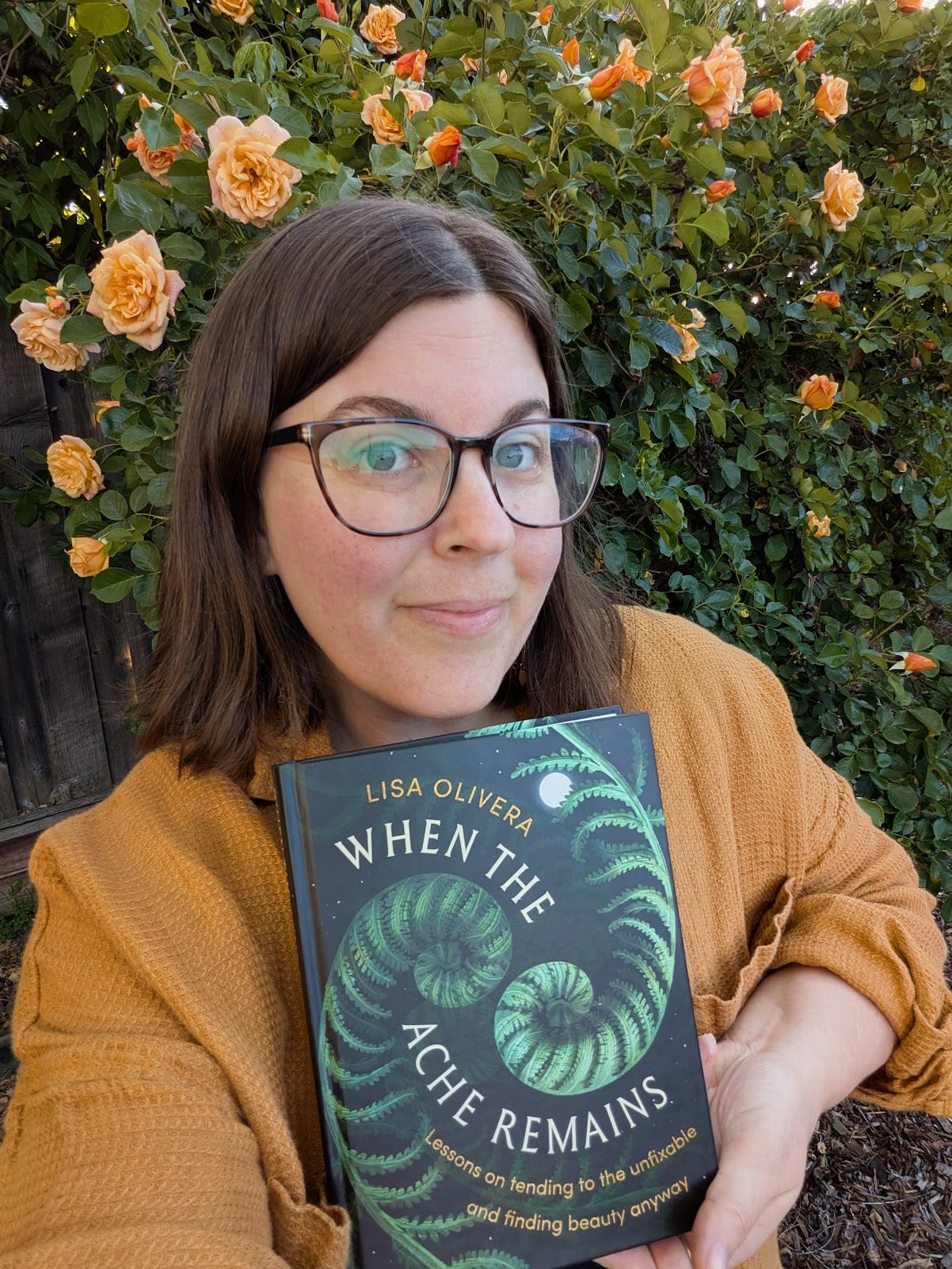
‘When the Ache Remains’ is available now for order.
And you can follow Lisa’s writing at her Substack newsletter, Human Stuff.
Thank you so much for reading. I’d love to hear your thoughts and responses to Lisa’s words. What is your relationship to the deep wounds that continue to circle back in life? And how do you support yourself through the inevitable grief and pain of being human?
If you value what you read here, you can support my writing by liking and sharing this post, and by becoming a free or paid subscriber to The Therapy Room.
Disclaimer - Content is intended for educational and entertainment purposes only and is not a substitute for individualised mental health treatment or advice.
Comments
Nothing yet. Say the first thing.
Sign in to join the conversation.