
There is perhaps no more brilliant example of Soviet animation than our adaptation of Rudyard Kipling’s The Jungle Book. Created in episodes between 1967 and 1971, and then edited into a feature-length movie released in 1973, Маугли (or Mowgli) is the most violent cartoon you will never watch.
Unlike the 1967 Disney adaptation, this cartoon closely follows much of both Kipling’s original and The Second Jungle Book. You will find no cutesy Baloo, no silly Kaa, no made-up monkey king. No, this cartoon is not only faithful to the story, but to the violence inherent to Kipling’s portrayal of the “Law of the Jungle." There are no musical numbers here. Instead, you will see death and blood. You will see Mowgli living in an unforgiving, violent jungle that’s teeming with a wildlife that lives by its own code. Mowgli must learn the Law of the Jungle in order to survive.
(Note: This post is long, so if you don’t want to read the whole thing, I recommend skimming it to look at the clips from the cartoon I’ve integrated into the article.)
We are introduced to Mowgli following the tiger Shere Khan’s attempted attack on a human village. He is barely a toddler, clumsily falling over roots, stirring up sleeping and waking animals as he stumbles through a nigh-darkened jungle. He climbs into a wolf’s den, and is greeted by a family—mother, father, and three pups—and is immediately followed by Shere Khan, who demands his prey back. Raksha, the she-wolf, is instinctively protective of the human child in a way only mother can be, and threatens Shere Kahn to drive him away. As he backs away, he says “We’ll see what the Pack says,” and his obedient servant Tabaqui quips “We’ll see what the Jungle says!” As the two parents watch the boy tussle and play with their own children, they call him “frogling,” which is where he gets the name Mowgli.
Tabaqui the jackal scampers through the Jungle trying to incite opposition to the wolf family’s adoptee. “Can you imagine?!” he cries, “A human child! Among the wolves! Disgrace!” This concept of the Jungle as a realm with its own laws—laws that forbid and allow only certain behavior in order to sustain a delicate balance within the ecosystem—will continue to reappear throughout the film. Politics is another key element of the story. The wolf pack follows a leader, Akela. His rule, as with any good leader, is dependent on a combination of physical dominance and peace-keeping. A consensus must be reached on Mowgli’s future. Akela cannot make the call by himself.
Through Tabaqui’s scheming, we are introduced to major characters in the story: agile Bagheera, wise Balu, and dangerous Kaa, who is ever-watchful as he digests his prey. The argument to the pack is simple: the human does not belong. At Council Rock, Akela sits majestically as his council gathers below him. Raksha brings forth her pups, Mowgli in tow, and they perform a dance-like ritual to display their potential hunting prowess.
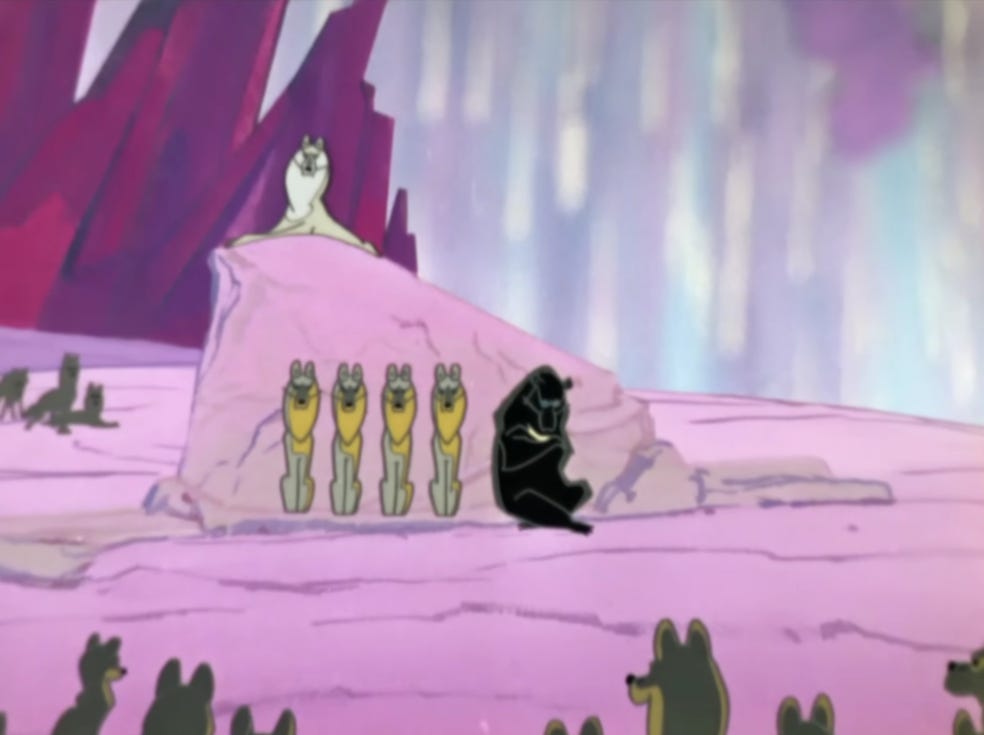
As the council watches, they are divided. When Tabaqui tries to intimidate Mowgli, the boy roughly grabs his nose, evoking a pitiful squeal and immediately wins the support of the Council. This display of violence from Mowgli—the need to prove his abilities and establish himself as a creature not to be taken lightly—will be a core component of his future rise to prominence in the Pack.
“Who else will speak of the child?” Akela asks. Shere Khan pounces into the arena. Immediately the wolves scamper behind him; tails tucked, ears lowered. Again Akela prompts the crowd, and Raksha, seeing the Council sway in opposition, jumps in to boldly proclaim “He will live! May this be my last battle, but he will live!”
Balu slowly stands, and deliberates that Mowgli will benefit the Pack, promising to teach the boy himself. But the bear alone cannot outweigh the other Council members. Only then does Bagheera arrive. She lands in a puddle in the middle of the square, moving like liquid onyx, and charismatically purrs to the wolves who are creeping in behind Shere Khan, eager to kill Mowgli. “The Law of the Jungle says,” Bagheera says with a care-free smirk, taking the time to lick her long legs. “That the life of the child can be bought. To my words I add a bull, recently killed by me,” she lazily finishes her declaration, stretching out on the ground.
The Council is swayed by the fresh kill and the invocation of the Law. As the wolves carefully leave Shere Khan’s side, even loyal Tabaqui cannot help but follow them “just to see.” Mowgli survives because Bagheera is willing to kill on his behalf. One life traded for another.
Bagheera’s depiction in this cartoon is possibly the most gorgeous representation of a feline in animation. Beautiful, sleek, agile—and violent. First look at how gracefully she moves when we first see her. She flows like a liquid as she plays with the butterflies, gentle and playful.
Now compare to how visibly agitated she gets when Shere Khan shows up. Notice the quick transitions from calm and playful to threatening. No words are necessary to convey her intent. You can see it in the moments when she suddenly snaps from sleek to murderous.
Mowgli is older now, but still a child. Balu is leading the instruction for him and his three wolf brothers, and pretends to be a deer they are hunting. Mowgli considers himself a wolf—he shakes himself off like a canine and tries to run on all fours—but cannot help but trip over his human limbs, and runs on two legs, passes his brothers, and successfully tackles Balu. The bear spanks him to reprimand the boy for running on two paws when he has four, but is reprimanded in turn by Bagheera, who laughs “Easy, steel paw.” Mowgli says that it’s easier for him that way. “Of course it is, you’re human,” she answers. “I’m a wolf!” he proudly proclaims, “Of the Free Pack!”
It is Bagheera’s turn to instruct Mowgli on how to climb trees like a panther. He chases her through the branches as she teases him, gliding away weightlessly. They dance through the canopy in gravity-defying leaps before he finally lands on top of Balu. It is Bagheera’s turn to spank him for disrespecting his elders, and Balu’s turn to quip “Easy, steel paw. He’s only human.” This tension between Mowgli’s human nature and his attempts to fit into the Jungle as one of its own is a core component of his journey. At every turn he is forced to confront his origins, find ways to be both animal and man, in order to keep up and to surpass the other creatures.
Mowgli’s human nature immediately proves useful when an elephant calf—son of the wise Hathi—falls into a pit intended to trap Shere Khan. Mowgli does what a wolf cannot: he gathers vines from the trees, ties them up around the calf, and with the help of the other elephants who were helplessly tugging on the child’s trunk in hopes of getting him out, lifts the calf out of the hole. This earns the respect of the elephants, who do not forget such deeds. “Good hunting!” Mowgli offers the elephants a wolf’s traditional goodbye. “But we don’t hunt,” the calf kissed him on the cheek, “Good hunting to you.”
The Law of the Jungle demands certain phrases that indicate respect for other creatures, even when those creatures exist to kill one another. Balu asks the pups what they need to say before diving in to a lake. Only Mowgli knows the all-important phrase: We are of one blood, you and I. Taken directly from Kipling’s books, this phrase is intended to communicate mutual respect between all the creatures in the Jungle. It offers safe passage and conveys the recognition of each other’s rights. The Jungle is harsh, but it is not chaotic. In order to keep its balance, every animal must obey the moral law.
What happens next can be seen in the Disney version of The Jungle Book. The Bandar-Log monkeys see that Mowgli is like them—he can climb, he has arms, only he is naked—snatch him away from Balu and Bagheera while the three are napping. The two attempt to give chase, but cannot keep up with the primate mob rushing through the trees. As they berate themselves for losing their pupil, they realize that the way to get him back is to recruit the Bandar-Log’s most dangerous enemy: the python Kaa.
This is perhaps the most blatant departure from the books that the Disney adaptation makes. In that version, Kaa is a comic villain put in for comedic purposes. In this version, Kaa is the most dangerous of all Jungle creatures. He moves and speaks slowly, taking his time like an Ent from Lord of the Rings, but possesses the ability to strike quickly and suddenly. “They called you a worm!” Bagheera lies to incite rage in the snake, and it works. But where to find the Bandar-Log? Above them the kite Chil—a bird of prey that constantly hovers over the Jungle, keeping a watchful eye—calls to them where he saw the boy. “He said the covenant words: We are of one blood, you and I,” he tells them.
While the monkeys foolishly harass Mowgli in the ruins of a Buddhist temple, their death is slithering through the Jungle. Bagheera and Balu show up first, but are overwhelmed by the monkey horde. That is when Kaa strikes and scatters the Bandar-Log, who are too terrified of him to fight or flee. “So you are Mowgli,” the snake says. “You look like one of a Bandar-Log.” Mowgli proudly retorts, “I am wolf of the Free Pack! My prey will be your prey.” “A brave heart!” Kaa commends him, “And a courteous speech.”
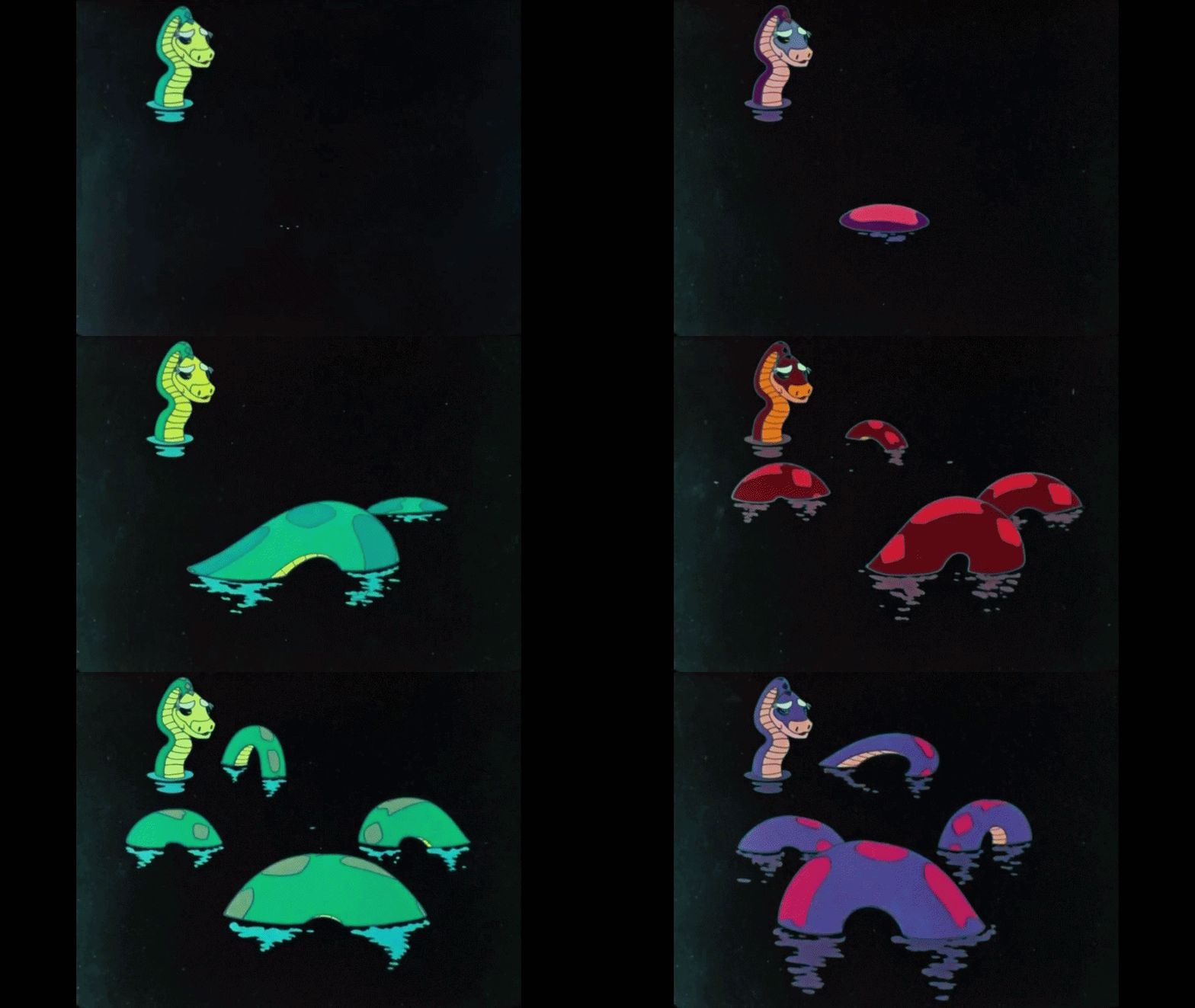
There are no colorful swirls in the snake’s eyes as he hypnotizes the monkeys. Only death. He performs a physically impossible dance in front of them, contorting his snake body into impossible shapes, becoming more psychedelic as the movements progress. He orders them closer in his slow, quiet whisper—and they walk towards their demise. Bagheera and Balu cannot help but be entranced, and also step towards Kaa. Only Mowgli can resist the hypnosis, and he will remain the only creature who has a relationship with Kaa that comes close to peer in the entire Jungle.
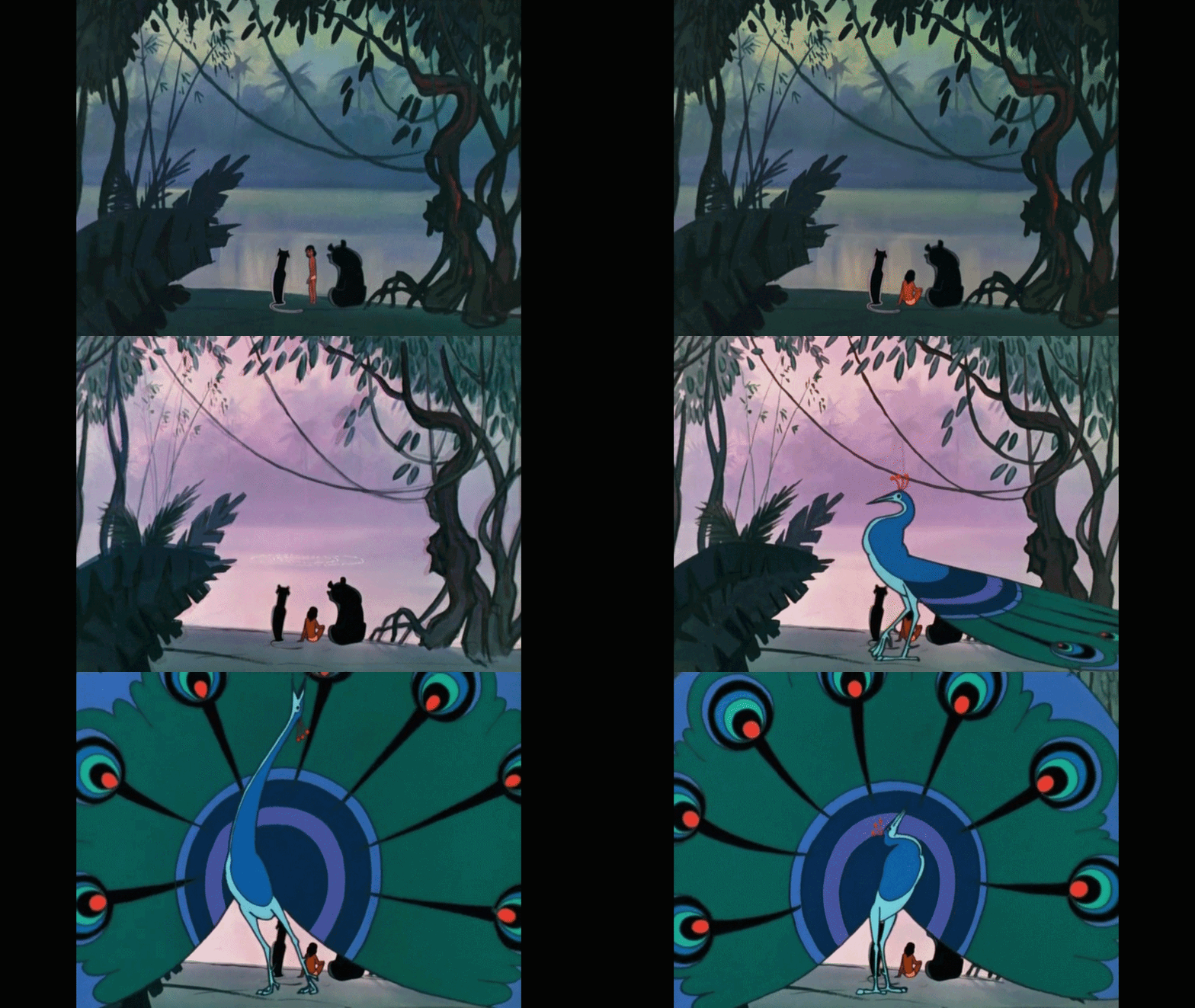
This is not a fast-paced cartoon. The animators took time to depict the jungle as it exists outside of Mowgli’s story, and it seems truly alive as a result. Flowers bloom, bees buzz, and all sorts of animals go about their lives. The color most prominent in the film is not foliage green or blood red—it is purple. Everything from the shadows to the tree trunks have a purple hue to them that makes the Jungle look psychedelic. The peacock, whose nacreous plumage begins and ends each episode, changes color while you’re looking at him, like pearl shell in sunlight.
Shere Khan has a plan. Having killed a bull and offered it to the wolves, much like Bagheera once did, he pushes them as they happily gnaw on bones; full and satisfied. “How does such a proud Pack,” he asks them, “Allow themselves to be led by such a weak leader? I hear that you don’t even dare look him in the eye at Council Rock!”
Meanwhile, teenage Mowgli is spending time with Kaa, who has taken an interest in the human. After a swim, the snake demonstrates his awesome strength when the boy tries to challenge him. “You’ve grown,” he remarks, “You’re agile and smart, but that is not enough.” “I’m strong!” protests Mowgli. “No! You have weak claws and teeth. You need an Iron Tooth!”
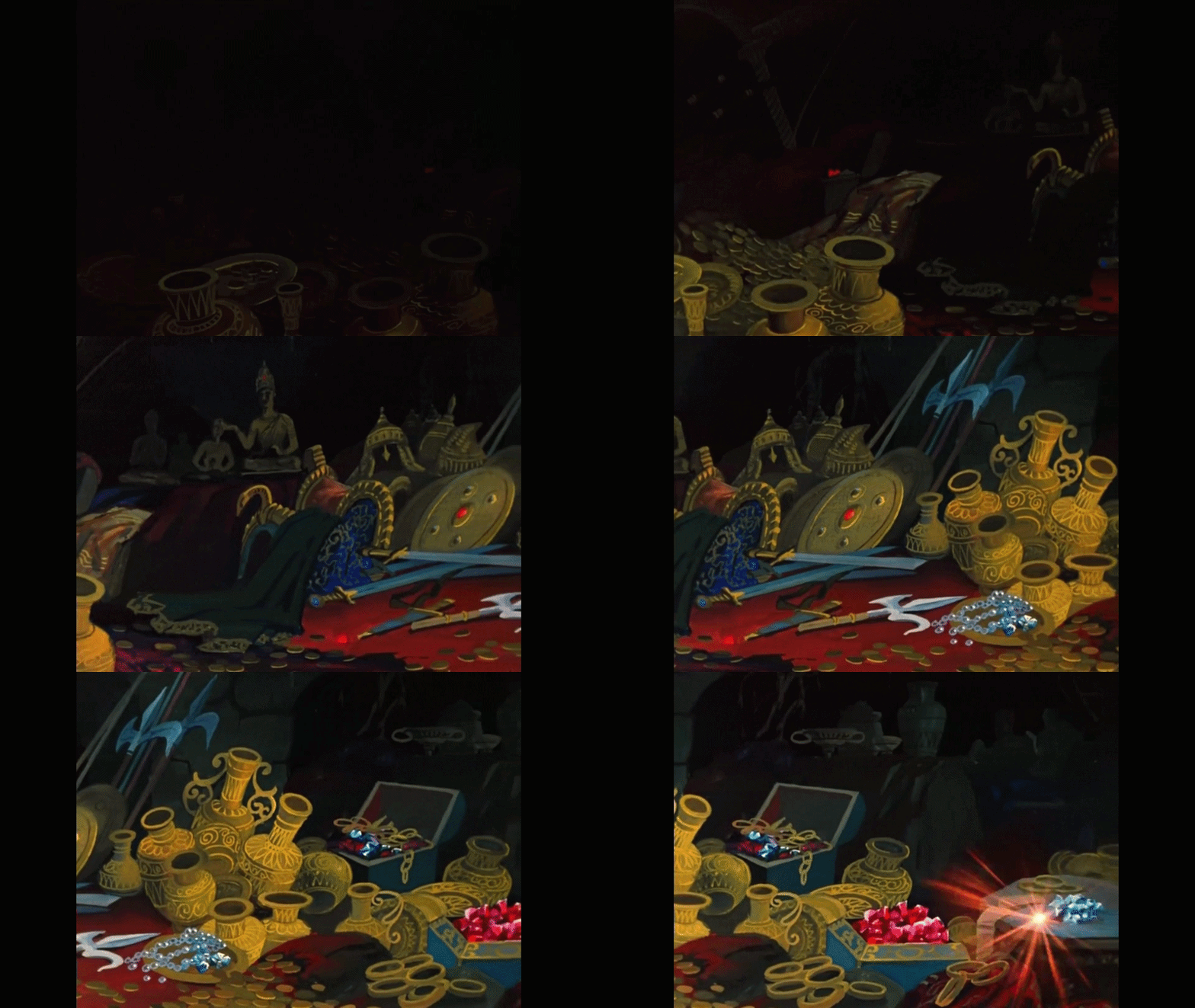
Kaa leads Mowgli to the ruins of a once-great city, and into the treasure lair of the White Cobra. This ancient creature sits upon the piles of gold and jewels scattered around her like a dragon. Skulls litter the lair—the remains of many men who came to take the treasure for themselves. “What news is there from the city above?” she asks, and is reminded by Kaa that the city has been in ruin since the time of his grandfather.
Mowgli asks the White Cobra if he can take a jeweled dagger—the Iron Tooth—and tries to use the covenant phrase, but she is uninterested. She does not dwell in the Jungle, the Law does not apply to her. Once again, Mowgli must use violence of his own to survive and defeats the cobra, leaving her in agony. “I am ashamed!” she cried, “Kill me!” She is no longer worthy to do her duty. In her defense, it was no normal man who took that dagger. Iron Tooth in hand, Mowgli celebrates and quickly discovers the violent power of this new tool when he slices open the paw of one of his brothers.
The wolves are on a hunt. Akela leads the pack towards prey, but Bagheera and Balu beg him to leave Mowgli behind with them. As the teenager shows off his new weapon, Bagheera informs him that there is another, even more dangerous tool for a human to use—the Red Flower. All Jungle creatures are afraid of it, they tell him, even Kaa and Shere Khan. Bagheera purrs to Mowgli as he falls asleep that the Red Flower can be small and timid like a moth, but if you feed it, it becomes taller than the trees, and then there is no safety from it.
Wake up, Mowgli! Shere Khan laid a trap for Akela during the hunt, and when the old wolf was going in for the killing blow, the tiger caused him to miss. The Law is clear: Akela is a dead wolf walking. The Pack needs a new leader, one that is strong, one who does not miss. The Jungle is unforgiving in this sense. Honor and integrity, ability and strength—these are the only things that matter in this dangerous realm. Bagheera hurries Mowgli off to fetch the Red Flower, the only thing that can prevent total catastrophe for him.
Mowgli and his brothers run to a village, and for the first time in his life he confronts another human; a teenage girl carrying a pot, the Red Flower inside it. Mowgli scares her and she drops the pot, but laughs from behind a tree when the boy foolishly tries to reach his hand in to grab the flower and burns himself. “We are of one blood,” he whispers to the coals inside, “You and I.” This will not be the last time the Jungle-raised human must face civilization and learn painful lessons.
It is a tense moment at Council Rock. All are gathered there before Akela, who knows the Law better than anyone. “For twelve years I have led you on hunts. Now, I have missed. Who among you will make the killing blow against this lone wolf?” Shere Khan interrupts, “Who cares about the old wolf? Give me the human child!”
“He is our brother!” Akela sternly reminds them, “He brought us prey!” Bagheera and Balu see the writing on the wall—there is nothing left for them to do but fight. Akela’s death means Mowgli’s death. “He is my brother!” Balu steps in. “He is my brother!” Bagheera joins him. That is when help arrives.
“Is Shere Khan the leader of the Pack? Or are you jackals to grovel in front of him? You insisted for so long that I am a human. Now I’ve finally accepted it myself. Here, let this help you see! You kept repeating that you would kill me. Stand when a human is talking to you!”
The confrontation at Council Rock means that Akela remains the leader of the Pack, and it also means that Mowgli has finally accepted his true nature. Mowgli convinces the wolves that Akela missed because of Shere Khan. But it is clear that there is a new force in the Pack. One capable of both influence and violence. One that can stand up to Shere Khan and successfully face him down. One who now possesses weapons greater than tooth and claw. A human.
The Red Dogs are coming. The Jungle is anxious and scared, its creatures scurry about seeking shelter. Monkeys holler, hooves beat the ground, Bagheera gingerly takes her kittens and hides them away in a tree on an island. This is not a threat to Mowgli’s life, it is a threat to the entire Jungle. The Red Dogs are foreigners, they are wild, they do not obey the Law. Allowing them to sweep in would destroy the realm. The Pack gathers at Council Rock.
“Are there many?” Akela asks the watchful Chil hovering in the sky. “They flow like a boundless red river!” the kite answers. Akela addresses the Pack: “The Red Dogs come! Each of them is weaker than a wolf, but there are too many of them. Even Hathi himself avoids the fight… But it is better to die in battle than to die running away! This will be a glorious hunt, though for many, it will be their last.” Each member of the Pack must publicly proclaim that they accept the fight. Mowgli, now a young man, is the first to accept.
As a child, this was my favorite part of the cartoon. As an adult, I recognize that what makes the battle particularly worthwhile is the wait. Most of the episode is spent building up tension before the fight. The anxiety of fleeing the coming threat fades, and Mowgli quietly spends time with Kaa as the old snake thinks. The Red Dogs are coming, but they are not yet here, so the first part of the battle must be fought—the waiting. Shere Khan and Tabaqui flee north following their own interpretation of the Law—everyone for themselves—the selfish alternative.
Kaa leads Mowgli to a waterfall swarming with wild bees. A plan is hatched. As Mowgli runs forward to meet the coming enemy, he jumps on to a branch to see a red tide. The ground is covered in Red Dogs as far as the eye can see. This is not an army, it is a swarm. Mowgli calls them to him from the tree and starts delaying. He dangles his foot from the branch and calls them names. Then he catches their leader by the scruff of his neck and cuts off his tail with the Iron Tooth, tossing the remnant to the crowd as a distraction.
The Red Dogs are led by Mowgli off the waterfall and into the waiting angered bees below. Stung and bruised, they float down the river—only to be met by Bagheera, who is defending the island where she has hidden her kittens. Finally, wet and exhausted, the Red Dogs climb out of the water to meet the Free Pack in battle.
The battle is over, but not without casualties. The old Akela is gravely injured, having served bravely as the leader of the Pack. As Mowgli gently holds him, he sings his last song into the morning sky. A new leader must now be selected, and there is only one obvious choice: the man who led the Free Pack to victory.
A great drought has struck the Jungle, and the mighty Hathi has trumpeted a Water Truce. The Law declares that during this time no predator may attack a prey, and so the deer and the lion both come to drink what little water remains in a trickling stream that was once a mighty river. But something is amiss—there is blood in the water. Who else but Shere Khan could have done this?
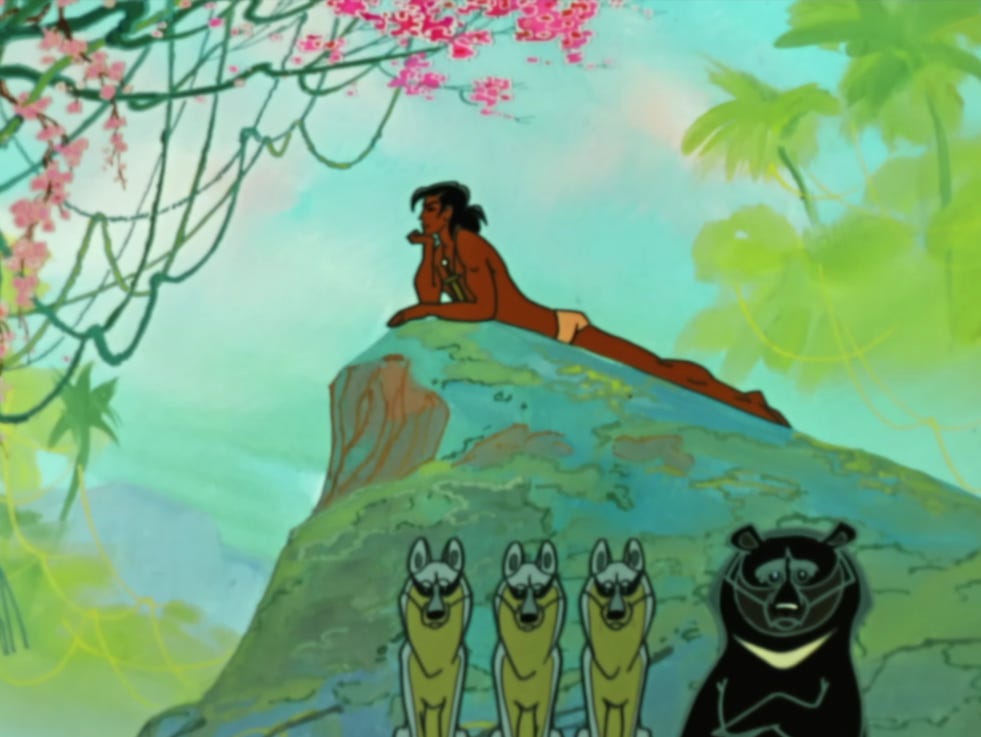
Mowgli is a man now—tall, lean, muscular. His body has been shaped by years of chasing prey with the Pack, years of swinging through the trees with Bagheera, years of wrestling his brother wolves. His back is wide, his chest is broad, his thighs are toned, and his face is sharp and angular. He is the leader of the Free Pack. Like Akela before him, he lays on top of Council Rock and the wolves gather below.
After the monsoon, Mowgli must punish the tiger for committing such sacrilege, and finally face his fate. His brothers have tracked Shere Khan and Tabaqui to a ravine. Mowgli orders them to chase a herd of water buffalo down one end while he jumps onto the back of the herd’s leader and commands him to obey with the covenant words—We are of one blood, you and I.
Shere Khan is trapped! Mowgli chases him from one end and the tiger runs into the second half of the herd at the other. As the water buffalo violently clash into one another in the ravine, both Shere Khan and Mowgli jump to a ledge above where they face off in final battle. As they fight, Mowgli loses the Iron Tooth. “Well, frogling?” taunts Shere Khan, “Now is the right time to remember the Red Flower.” Instead, Mowgli tosses the scabbard off his chest and wrestles with the tiger—and tears his jaws open with his bare, bloodied hands.
It is Spring in the Jungle, and nature is procreating. Flowers bloom and release their intoxicating pollen. In that pollen, butterflies float around each other, birds circle through the air in a mating ritual. On the ground, deer cross antlers for access to a doe in heat, panthers leap, wolves play, bunnies hop—the whole world is engaged in a natural, erotic ritual in which Mowgli cannot partake.
As a child, this was my least favorite part. As an adult, I recognize that this is by far the most violent part of the film. Mowgli has experienced no romantic touch for his entire life. He has been the sole representative of a species that does not belong. His animal friends cannot offer a companionship that a grown man like him craves deep in his bones. Seeing, hearing, and smelling the reproductive partnering of every living thing around him, he is overwhelmed by his very soul breaking inside him—and so he runs.
He sees a woman collecting water from a stream. When she spots him, she is terrified. He looks wild, barely recognizable as a man. Mowgli is faced with an impossible choice: remain in the Jungle, being torn from the inside, or leave everything he’s ever known behind. He has earned the love of his mentors, the respect of the Pack, the acceptance of the Jungle, but all his valorous achievements cannot fill the hole in his chest. He is still alone. Violence is impotent here. No number of victories can give him what he craves: someone like himself.
He seeks comfort with his old teacher Balu, who tells him “Though my eyes no longer see trees when they are up close, they see further. Go! Live where your birth Pack lives.” Mowgli’s entire life has been spent balancing his humanity and his adopted Pack. It is time to accept what is true—he cannot run away from these urges. He must accept that which he has been coming to terms with the entire time. He must accept his humanity. The Jungle’s residents bid him farewell. If he needs it, the Jungle is his: sharp eyes, sharp fangs, sharp claws, and wise words. They are of one blood, they and him.
No posts
Comments
Nothing yet. Say the first thing.
Sign in to join the conversation.