
I still have room in my course on Shakespeare’s Late Romances, if you are interested. It will be fun! Everything you need to know is right here.
In a recent interview about my latest book, Surely Some Revelation Is at Hand: Poetry, Magic Imagination, I was asked if “magic” isn’t a scary word that some Catholics (and Christians in general) might find threatening or troubling in some way. That is more than a valid concern, but, as I told my Catholic interviewer, “It depends on who you ask. Even though most Catholics would never think of the Sacraments as ‘magic,’ certainly a lot of Protestants would suggest that the way Catholics think of the Sacraments—not to mention sacramentals like holy water, relics, holy sites, and the like—is nothing but magic.” So what we have here at issue is a matter of semantics.
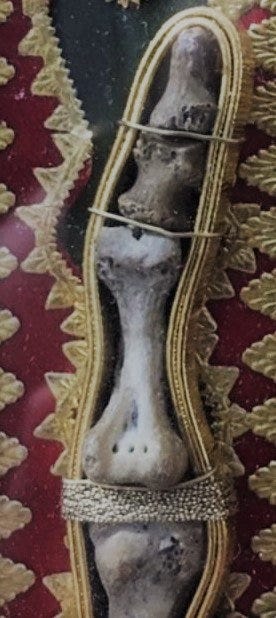
Relic (an entire digit) of St. Joseph of Arimathea. Sacred Heart Byzantine Catholic Church. Livonia, Michigan:
People talk a lot about “re-enchantment” these days, as if our world had lost all touch with the magical, the numinous, and all of those things that for most of history human beings have take for granted as properties of the world as it actually is. Not all that long ago, belief in faeries (or similar beings), for example, was widespread across what used to be called “Western Civilization.” That belief has seen a revival of sorts lately, as has the practice of astrology. But these beliefs never went entirely away. And they never went away because the Spirit can never be entirely legislated out of existence, no matter the power of the magic that demands its destruction (for all propaganda is a type of magic).
So here’s the thing: We are already under enchantment, and a very dark one at that. As I argue in my book, we are under an enchantment directed by expert magicians and propagandists and many of us have surrendered our wills to their deceptive power, much like Théoden at the beginning of LOTR. What is needed, then, is a swift and decisive disenchantment. In truth, what people call “re-enchantment” should more properly be called “a proper orientation to reality.”
So, for the sake of argument, let’s say that the Sacraments are magical operations. Because, let’s face it, if you didn’t know anything about Christianity and someone told you he could call down the Creator of All Things into bread and wine and that, by eating those substances, we can take part in divine reality—if you didn’t think he was completely mad—you would definitely think he was some kind of magician. That this even needs to be said strikes me as very strange, indeed—and those readers who have just closed their laptops and phones to go consult with their spiritual fathers in a fit of anxiety are proving me right. Valentin Tomberg was absolutely right to assert that “Each phrase of the Roman Catholic Mass or Greek Orthodox Liturgy… is a formula of divine sacred magic. There is nothing astonishing about this, since the Mass and the Liturgy consist only of the prayers of prophets, saints and Jesus Christ himself.”
Likewise, the French writer, impresario, and Catholic magician Joséphin Péladan (1858-1918), who called the Holy Spirit “the rector of the magical realm,” in his book Amphitheatre des Sciences Mortes, argues that
“The goal of true Magic is charity— the imitation of Our Lord Jesus Christ; and why, then, seek a vague and nebulous henosis when the Eucharist is present—an assimilable essence of the Invisible par excellence, since God dwells therein, and a sign of universality, since humanity is contained within it?
“The Catholic Church practices practical magic in an incomparable way.”
To which he later adds:
“Redemption changed everything in the religious order, because it brought about humanity’s great magical work. It permanently effected the union of the creature with the Creator, and thereby fulfilled all that was legitimate in Eros.
“The Eucharist is the whole of Christianity; and through it, Christianity has become living magic.
“Since Jesus, there are still sorcerers; there are no more magi.”
I’m sure, at this point, not a few readers—and especially Protestant readers—are saying, “You see! I knew it! It’s all magic!”—and not in a good way.
But their point is well taken. There is danger in realizing the potential for danger in a magical understanding of the world (is not that the message of “The Sorcerer’s Apprentice”?). But, I would argue, there is just as much danger—and probably much more—in not realizing the potential for danger in an understanding of the world that ignores its magical underpinnings. As I have argued before here in The Druid Stares Back, the Archons may not want you to think magic (or astrology, for that matter) works, but you better believe they know it does.
For years now, as we have seen in the recent MK-Ultra hearings on Capitol Hill, dark forces have been doing their best to implement what the late Romanian scholar Ioan Couliano called “the magician state.” As Couliano describes it in his book Eros and Magic in the Renaissance,
“The conclusion is ineluctable: it is that the magician State exhausts its intelligence in creating internal changes, showing itself incapable of working out a long-term magic to neutralize the hypnosis induced by the advancing cohorts of police. Yet the future seems to belong to it anyway, and the provisional victory of the police State would leave no doubt concerning the point: coercion by the law of force will have to yield to the subtle processes of magic, science of the past, of the present and of the future.”
This is certainly the trajectory upon which the Archons have been travelling for at least the past generation, and we witnessed how powerful their magical prowess had grown when they instituted the most successful magical operation the world has ever witnessed during Covid. It was so powerful, most of its unwitting victims are still under its spell. As another perceptive soul once wrote in the last sentence of his prophetic novel, “He loved Big Brother.” And now they love the Archons.
These thoughts from Couliano are never far from my awareness, and through every news cycle. But recently they altered somewhat to cause me to consider the possibility of a Magician Church. This was painfully obvious to me at Pope Leo XIV’s excommunication of the entire Society of Saint Pius X (SSPX).
For what is an excommunication but a show of power—but what kind of power? The decree claims that marriages and confessions performed in the SSPX are invalid. Though I have friends (and a daughter occasionally) who attend an SSPX parish, I have never been to one, nor do I plan on it. But I couldn’t help but be annoyed by the outright cruelty many American bishops have treated the Latin Mass and those who love it—even outside of the auspices of the SSPX. And, as the always wryly perceptive
Yoshi Matsumoto recently observed:
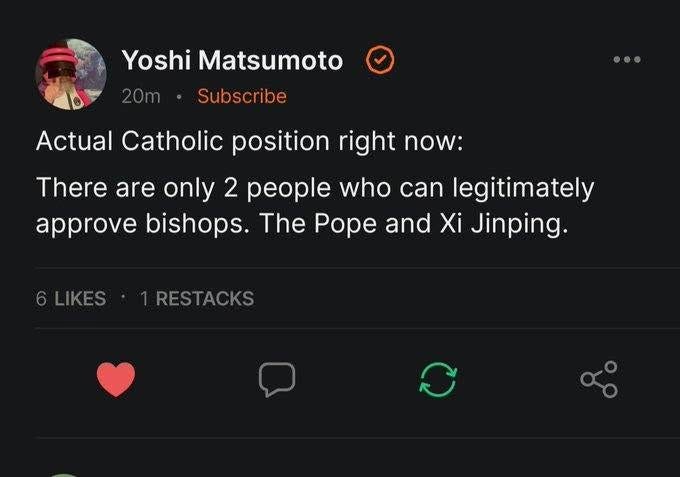
OUCH.
This all brought me back to the Covid days, when the Catholic hierarchy followed the orders of the Archons, abolishing the Sunday obligation, feast days (including Christmas), and even cancelling the feast of feasts, Easter itself. (I recall reading a Substack about a prophecy saying that when Easter would be cancelled it marked the impending end of the Church—I don’t know if that’s true and I haven’t been able to run that quote down. If you know anything about it, let me know.) I remember seeing images of signs on the doors of Catholic parishes (I think in Australia) saying “The fully vaccinated may be admitted to the Sacrament of Reconciliation.” This is the epitome of the Magician Church: Do what I say, or the Sacraments will be taken from you. I thought of all of the divorced, faithful Catholics forbidden from remarrying: the rules were never bent for them (“Offer it up”), but when the Archons whistle the rules get bent in a New York minute. And to add insult to this injury, we had Pope Francis insist that getting the Covid vaccine was “an act of love” and the Vatican issuing a Covid vaccine memorial coin. If those weren’t magical operations, nothing is. And they were by no means under the rubric of what Tomberg calls “sacred magic.” They were sorcery.
So, in the light of this, can the Sacraments be taken away from the SSPX just because a Pope labels them “invalid”? I think not. He seems to get on pretty well with the abortion-supporting Archbishopress of Canterbury enough to pray with her at Catholic headquarters—and he even has a prayer room for Muslims at the Vatican. But apparently SSPX bishops is a road too far.
Now, I am not, by any stretch of the imagination, a fan of the SSPX. I really don’t understand them at all. I never did. But I do understand the attraction for true piety, beautiful liturgy, and the preservation of an atmosphere of reverence. That’s what we tried to achieve at home when we held house church during the Covid years—and it was far from a Catholic Mass, Eastern, Western or in between. Part of our service was holding the Eucharist. Some people thought that was rather bold of me. But it was a necessity. Plus, if the Lord is cruel enough to damn me to hell for holding house church, what kind of God am I even praying to? And that was when I realized that the machinations of the Magician State are also features of the Magician Church, and that I was still somewhat enthralled. But holding house church was, unironically, an act of love.
“The Eucharist is the whole of Christianity; and through it, Christianity has become living magic.”
I think we are currently at the end of a cycle and that the old and corrupted structures are crumbling to dust, having outlived their usefulness and, in part at least, becoming agents of darkness. I do not know what will arise in its place, but I do know this: it will be a manifestation of sacramental reality.
All things shining.
Dreamboat Annie
No posts
Comments
Nothing yet. Say the first thing.
Sign in to join the conversation.