
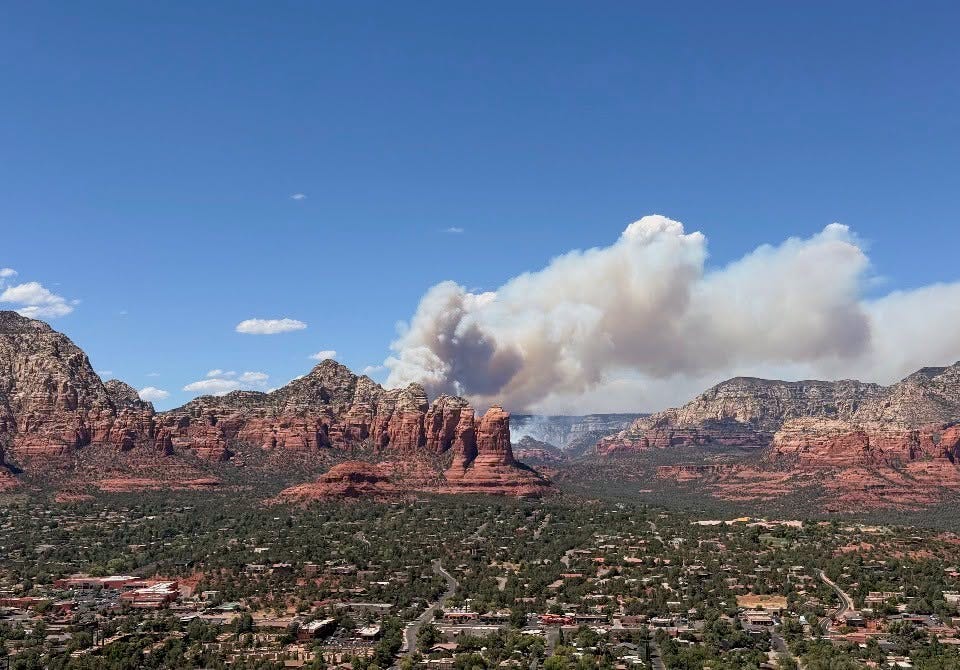
As I write this, over 700 wildfires are burning out of control across Canada, sending smoke as far as New York and Toronto. Oregon and Washington just got hit with nearly 9,000 lightning strikes in two days, sparking new fires across the Cascades and Blue Mountains. Spokane’s air quality climbed into the “hazardous” range this week. And closer to home for me, the Pocket Fire, which is only 83% contained as of this writing, has burned almost 30,000 acres north of Sedona this summer, close enough that Flagstaff issued its first ozone pollution advisory in the city’s history.
I have lived through this in the PNW for years on end. I evacuated my own home in Oregon during a bad fire season in 2020, when I woke up one morning and my entire house was encased in smoke, fires on every side off in the distance. As I looked for flights out, the air quality was terrible everywhere. Idaho was smoked in. Vancouver was smoked in. All of Oregon and California were smoked in. I ended up flying to Vegas because it was the only clear air I could find. We stayed there almost two weeks until the air cleared back home.
I’m writing this because I’ve lived it myself, I absolutely despise the experience, and because I think most people are one wild fire away from realizing they have zero plan.
Wildfire smoke doesn’t stay only outside.
It gets pulled into your home through doors, windows, and HVAC systems, and once it’s in, it lingers.
Homes built for energy efficiency since the 1970s are sealed tight, which is good for your heating bill and bad for air exchange.
What we do know, with real data behind it: this isn’t a minor irritation.
A recent nationwide US cohort study of nearly 25 million Medicare beneficiaries, published in the European Heart Journal in early 2026, found that long-term exposure to wildfire smoke PM2.5 was associated with increased incident stroke risk, and the effect got stronger with longer exposure windows.1
Separately, Yale School of Public Health researchers estimated that PM2.5 from wildfire smoke contributes to over 11,000 non-accidental deaths per year in the contiguous US, with the largest share of those attributable to cardiovascular disease.2
If you’re in perimenopause or menopause, this matters even more. Cardiovascular risk already climbs as estrogen declines. Layering wildfire smoke exposure on top of that shift isn’t a reason to panic, but it is a reason to stop treating your indoor air as an afterthought.
Here’s the piece that I only learned about in depth last year: this isn’t only a lung and heart issue. It’s a hormonal issue too, and if you’re in perimenopause or menopause, your hormones are already under strain.
A 2024 study from the University of Michigan, using data from the Study of Women’s Health Across the Nation (SWAN), followed 1,365 women through the menopausal transition and tracked their estradiol and FSH alongside their annual air pollution exposure. In the transmenopausal window specifically, the two to four years surrounding the final menstrual period, a rise in PM2.5 exposure was associated with a significant additional decline in estradiol, and PM2.5 was also linked to a faster overall rate of estradiol decline through that period. NO2 exposure was associated with lower estradiol as well, and with declining FSH in early transition and postmenopause.3
What this means in plain terms: the same pollutants sitting in your lungs during a smoke event are also circulating and interacting with the hormonal shifts already underway in your body during this life stage. This is an association, not a proven mechanism of causation, and the study can’t tell us that cleaner air prevents hormone decline. But it’s a real, peer-reviewed signal that your environment and your endocrine system are not separate conversations.
There's a broader body of research connecting air pollution to earlier menopause, ovarian reserve, fertility and endocrine-disrupting chemical exposure that I discussed in a podcast episode last year.
I’ve run a Jaspr Air Scrubber in my house for years, through wildfire seasons in Oregon and now in Arizona. I now have a unit in every single room of my home, including every room of my new podcast studio building.
Use code DRTYNA at checkout if not automatically applied.
Jarpr’s CEO, Mike Feldstein, spent years doing mold and disaster remediation after hurricanes and fires before he built the company, and he told me a story on a recent podcast that’s stuck with me: after the LA fires, he tested two Santa Monica apartments in the same building, same layout. One had a Jaspr running the entire time its owner evacuated. The other had nothing. The Jaspr apartment came back essentially untouched. The other, by Mike’s account, tested several hundred times more contaminated, with ash in the window sills and carpet likely unsalvageable. That’s an anecdote, not a controlled study, but it’s the clearest illustration I’ve heard of what a running scrubber does during an actual smoke event.
Most consumer purifiers incrementally improve air, maybe 10 to 20%, which is why you usually can’t tell if one’s working.
A Jaspr Air Scrubber is built to be undeniable, with the same technology used in professional mold and fire remediation.
Mike and I did a whole podcast about it HERE.
And having air scrubbers on hand BEFORE the wild fires hit is the first best strategy. The next best is to order one ASAP.
Mike called me yesterday and told me that through the end of July, he’d like to offer my followers $350 OFF. They are shipping out within 2 days so turn around time is fast. After July 31 the affiliate discount goes back down to $200 OFF.
Use code DRTYNA at checkout if not automatically applied.
Mike was upfront about this on the podcast, and I want to pass it along: if cost is a barrier, don’t buy a cheap plastic purifier that won’t do the job. Build a Corsi-Rosenthal box instead: a DIY filter made from a box fan and MERV 13 furnace filters. I’ve done this in the past and it works. It’s louder and uglier than a manufactured unit, but it genuinely cleans air, and it costs a fraction of the price. This is a legitimate stopgap, especially in a pinch.
If you’re anywhere near active smoke, or you live somewhere fire season is now a guarantee rather than a maybe: get an air scrubber running in your bedroom especially, since that’s where you spend the most consecutive hours breathing whatever’s in the room.
If you have children, please make sure their rooms have scrubbers too! Little brains take bigger hits to toxins than adult brains.
Don’t wait for the smoke to show up to start shopping. Every fire season air filtration companies run out of stock during the exact weeks people need them most.
I highly recommend Jaspr. Mike has been kind enough to offer my followers a huge discount through the end of the month of July.
Jaspr’s stock is low as of this writing so get what you need now.
Use code DRTYNA at checkout if not automatically applied.
https://academic.oup.com/eurheartj/article/47/21/2673/8420905
https://www.pnas.org/doi/10.1073/pnas.2403960121
https://www.sciencedirect.com/science/article/abs/pii/S0048969723069450?via%3Dihub
Comments
Nothing yet. Say the first thing.
Sign in to join the conversation.