
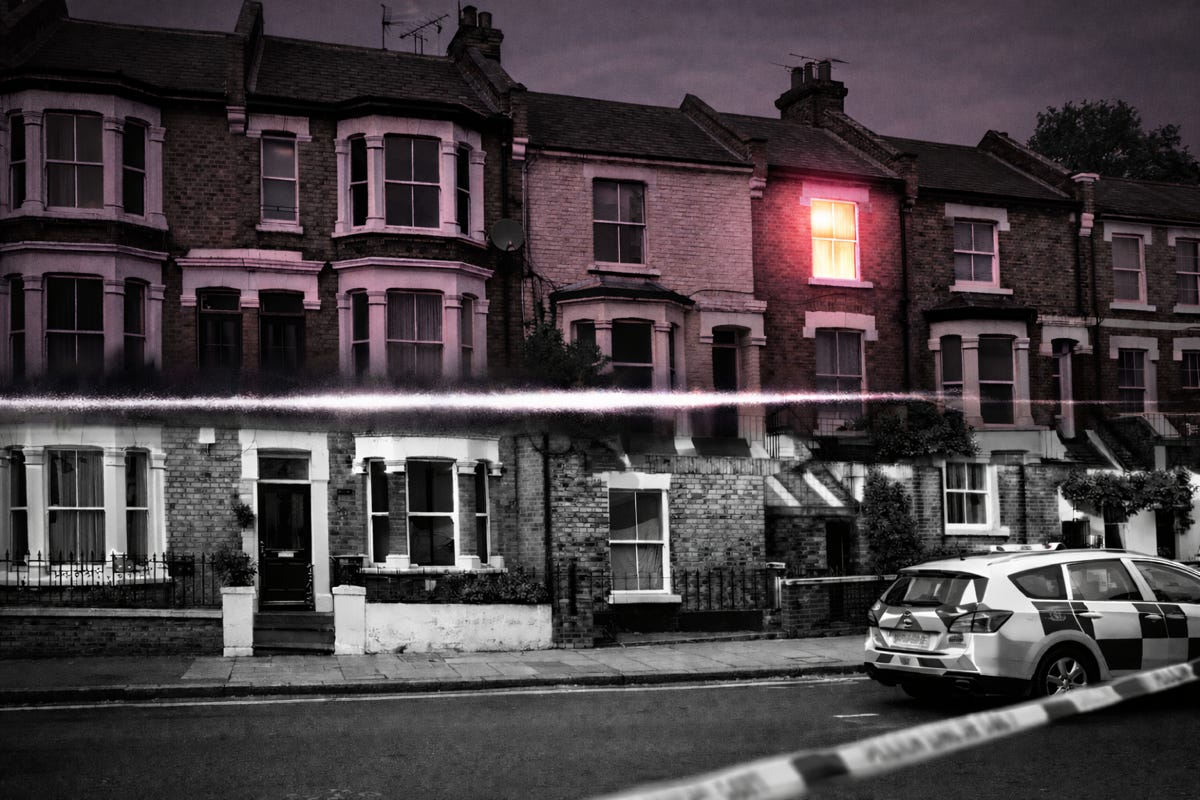
I was walking the dog when I saw a man firing a gun from close range into a house a few doors away.
It was Friday night, at 11:11. He (I assume it was a he, but I couldn’t see their face) was standing on the pavement, in profile, arm extended, shooting through a window or a door or into a person. I couldn’t tell which. I was the only other person on the street.
After the second shot I understood what I was seeing, and by the time I registered it, I had already scooped up Hero, our tiny dog, and started walking briskly toward the high street.
Walking. As though I were two, perhaps three minutes late for something and didn’t want to make a fuss. One daren’t make mountains of molehills in East London in 2026.
The calculations came quickly and without deliberation. Or did they? It seems so in retrospect. Whether they were really what was guiding me at the time, I’m less certain. If I run, and I make noise, does he turn? Am I still in his line of sight? What would he do if he saw there was a witness? Best to stay quiet. Don’t run. These feel like thoughts that I was having at the time, although I wonder if I’m narrating them back into existence after the fact, the way one might reconstruct a dream (isn’t this what all memories are, anyway?). When the shots stopped, the questions began: was he reloading, following, maybe taking aim? Is my wife safe? I made it to the Turkish social club at the end of the road, not even breathless, holding the dog, and the men outside regarded me with the patient scepticism they reserve for outsiders (it’s barely relevant that I’ve lived in London all my life, and in this neighbourhood for the last twenty years). They saw me clearly enough: the man with the ridiculous dog and the costly trainers. I could imagine one of them murmuring, with dry Anatolian humour, that the neighbourhood is going to shit.
I told them there was a man with a gun, and after a few bemused whispers - that felt just that bit too much like disbelief - they called the police. I tried to call my wife, because I needed to tell her to get away from the windows and move to the back of the house. She wouldn’t answer. I tried again and again, no answer. I fumbled, absurdly, trying to remember how to drop in on the kitchen Alexa - the emergency communication system of the gentrifier. Nothing. When I finally made it back to the house, they were fine - my wife and her friend, phones left in another room, chatting in the kitchen, entirely unaware.
The police arrived with dogs and guns and helicopters. The street filled with blue light. Nobody was hurt, apparently. Nobody was caught.
The next morning, the armed police were still there, detectives knocking on doors, forensics units scanning the streets. The crime scene tape neatly transected our patch of the road on both sides, holding everything inside the cordon, including our cars, hostage until the investigations were over. Once we were allowed to, we left at lunchtime to drive out of the city. We’d already planned to spend a few days away (a privilege I’m aware of: the ability to simply remove oneself, to let the blue lights recede in the rear-view mirror, is not available to everyone). It was there, on holiday with my wife and daughter, that I started writing this. I could not stop seeing him firing.
It comes in flashes. The image of the arm, extended. The muzzle flash, if there was one, or the memory of a muzzle flash I’ve reconstructed from films. The sound, which was smaller than I expected, more like a firework. I keep replaying the seconds after I moved, back turned to a man with a gun, waiting for a third shot, perhaps the Last Thing Heard - asking myself why I didn’t run or throw myself behind a van or into a front garden with the dog in my arms. Instead I strolled away at something approximating the rate of an octogenarian taking their morning constitutional; I’m angry at myself for not running immediately, though when I examine it I’m not sure what I did wrong. I assessed, I moved, I got out. But my mind isn’t interested in what I did. It wants to find the failure.
(In case any US readers are wondering what all the fuss is about, this kind of thing is really pretty unusual in London. It happens, sure, but most people can expect never to get caught up in a shooting. And of course I’ve no idea still how bad this really was.)
What I didn’t feel, and this struck me only later, was afraid. Not in any physiological sense. I checked my Fitbit data the next morning: there was no obvious blip, no tachycardia, nothing that would have told a story. There is something faintly comic about this, the impulse to stand in an actuarial relationship with one’s own body, to look for the number that confirms the experience. I went to bed that night feeling, if I’m honest, rather pleased with myself. Proud, even. All those years working in mental health, all that meditation, all that therapy, and here was the evidence: I had assessed, I had moved, I had got out, and my nervous system had apparently taken the whole thing in its stride. The equanimity I’d been cultivating had, it seemed, paid off.
It hadn’t, of course.
24 hours later: I am irritable with everyone. They are all so loud. I feel responsible for their happiness and I resent them for it. I cannot relax. My nerves are frayed in some literal, physical sense: everything is too loud, too bright, too demanding. I’m jumping at the slightest noise. I have nightmares all night and wake exhausted. Throughout the day I keep getting déjà vu, that eerie sense of having already lived through the present moment, as though time has folded and I’m caught in the crease.
I know what this is. Of course I do. I’m a neuropsychiatrist. I literally get paid to study how minds process the anomalous, how belief systems update or fail to update when faced with prediction error. I’ve written a lot recently about ontological shock, the rupture that occurs when something you encounter doesn’t fit your model of what’s possible. But here I am, inside the rupture, and knowing the mechanisms doesn’t help. My limbic system doesn’t care about my publication record.
I’ve been in some dangerous situations. I used to love an adventure. In the mid 2000s I accidentally strayed into the company of armed Islamists in the North-West Frontier Province by the Afghan-Pakistan border and rode with them for miles on the back of a truck, with more bravado than good sense - though I suspect that’s not entirely unrelated to having grown up around fear. You learn either to avoid it entirely or to go looking for it; for a good part of my twenties, at least, I chose the latter. I’m certainly not choosing it these days. Working in front line psychiatry in South London, many of us have had knives pulled on us at work; I’ve had colleagues taken hostage. None of those things left me like this. I don’t know why this one is different. Perhaps because it happened at home. There was no story to it, no reason I was there, no romantic thrill to seek - just a Friday night walk.
The strangest part is the feeling that it should feel worse than it does, combined with the feeling that something is deeply wrong. A dissonance, a horrible kind of internal misalignment. I mentioned all this to a colleague and found myself crying, which surprised me. But then I tell myself I’m making too much of it, that I’m dramatising. Performing distress for some internal audience… and now writing it for an external audience. Then I remember that I saw a man firing a gun five houses from my home and had to phone my wife to tell her to hide, and I think: perhaps this is proportionate. Perhaps the self-accusation of exaggeration is just another way of not feeling it, or about something else entirely.
Because underneath that, there is something older. The feeling of it, the shape of it, reminded me of being young, of when I had a parent who had episodes of sudden, frightening crisis, the kind that upended life at unpredictable junctures. Sometimes the next day there was real physical evidence of something terrible: broken furniture or ornaments, stained carpets, bandages. I had to learn to manage, to function, to protect others or at least not add to the chaos. I suppose I learned something then about holding terror at arm’s length.
What I also remember is what else came after. I would sometimes come downstairs the next morning to find that an omerta had descended overnight. Whatever had happened could no longer be spoken about. No one asked how I was, not really. You simply resumed, and the resuming was the message: this is how it is done. There is no debrief; no post-mortem. Just a permanent sense of aftermath, one that stayed with me for most of my life. I suspect that eventually I learned how necessary it was to put things into words. The compulsion to write increasingly personal things in increasingly public ways is in some sense the painfully slow answer to all those mornings when no one asked.
I’ve worked through that material before, or thought I had. But mostly I hadn’t been able to recall the feeling of it, only the facts. Now the feeling is back and it’s strange beyond belief. I find myself back inside a state I recognised only from the outside, having long since filed it away. It seems that some things can only be accessed from within the state that encoded them; the experimental psychologists call this state-dependent memory, a term I have always loved. The shooting returned me there, somatically, before I had any say in the matter. It has been fascinating and disturbing to see how the cracks have radiated out, forwards and backwards in time, until the experience of almost everything has become both incredibly familiar and also deeply wrong.
The first uncanny detail, in retrospect, was the evening itself. We had spent it watching the new Bruce Springsteen biopic, which was so excruciatingly dull that I announced at the end how upset I was that those were two hours of my life I would never get back, and I hope we could do something more exciting this weekend. The universe, it seems, was willing to do its best to make things more interesting. It was time to walk the dog: I hadn’t particularly wanted to, but my wife’s friend was visiting, and I’d agreed partly out of a vague sense that I don’t do it enough and partly, if I’m honest, to demonstrate what a considerate husband I was being.
I have rarely been so glad of my own smarminess. If I hadn’t gone, it would have been her. And if the dog had had his way, it might have been worse still: he wanted to turn left out of the house, as he sometimes does, but I wasn’t feeling it that night and steered him right while he registered his objection by refusing to move. My wife, on the other hand, habitually submits to his navigational preferences. Had she taken him out, she would in all likelihood have turned left - directly toward where the shooter was, or was about to be.
In the days that followed, the synchronicities proper began to accumulate. Songs on the radio that echoed conversations we’d just finished. Then my daughter deploying, with complete innocence, an obscure word I had been reading privately moments before. The particular quality of these coincidences felt electric, as though the world really was trying to say something. I noticed them accumulating and felt, briefly, the pull of that electric feeling - a kind of sense that meaning was being offered, maybe even proffered, from outside. Again, I know exactly how this sounds.
But then I caught myself… because surely what I was experiencing was nothing more than a miscalibrated salience system; the same computational mismatch that was generating the déjà vu, the same prediction machinery thrown into a state of chronic over-readiness by a single Friday night. A brain that has been genuinely surprised once might start finding significance everywhere. It is, in some sense, doing exactly what it’s supposed to do. Just slightly too much.
The shots were fired at 11:11. This is, amongst my friends and colleagues, something of a running joke - we stop meetings when we notice it, there is a small, private cult of it. Which means that for years I have been selectively attending to that particular configuration of digits. Once you notice the clock reading 11:11, it is almost certain you will notice it again the next day, and the day after, not because it is appearing more frequently but because you are now looking. (I almost suspect that simply reading this will mean that a significant proportion of people encounter 11:11 on a clock within the next twenty-four hours. If that happens to you: I’d invite you to sit with the uncanniness of it for a moment, to feel how it lands in the body even as you register, intellectually, that there is nothing behind it. That gap - between knowing and feeling - is rather the point.)
What has made this week bearable is, in large part, the people around me. My wife, our friends: they ask how I’m doing. They push me for more detail if I’m reticent. They create the conditions in which it becomes possible, almost inevitable, to say what is actually happening. There is a beautiful quality of attention in it that, on my very best days as a psychiatrist, I think I might just match. At unpredictable moments throughout the day, I am overwhelmed by gratitude for this. The contrast with those childhood mornings is not lost on me. I am aware that the habit of speaking about my interiority, which I’m sure some people may find excessive and others may find useful, originated precisely in the absence of anyone to speak to. You develop a voice, in part, because no one was listening.
What strikes me - and I noticed this most clearly in the immediate aftermath, in the strange unhurried clarity of those first minutes - is what my first response actually was. For all the playing and replaying of the event that I’ve done, there is an awful, mortifying fact that I need to own: I was walking at a measured pace because some part of me was worried about appearances. One daren’t make a scene; something both funny and slightly horrifying about that. The British instinct to minimise is, I suspect, a survival strategy; but it is also a species of madness.
There’s an irony here. I’m a psychiatrist, and psychiatry has spent a century trying to convince the rest of medicine that it belongs at the table. Mental disorders are brain disorders. We deal in neurotransmitters, circuits, the biology of suffering, et fucking cetera. And yet, for all its protestations that it is part of medicine, psychiatry is an irredeemably unembodied discipline. Psychiatrists never touch their patients. There are good - very good - reasons for this, historical and ethical, but the result is a field that has learned to hold the body at arm’s length, to translate somatic experience into symptoms, to filter the felt sense through diagnostic categories until what remains is passed off or minimised as somatic hallucination, somatic delusion, somatic hyperawareness, autonomic overactivity and so on, rather than a simple account of what is actually happening in the flesh.
The revulsion with which the field has responded to genuinely somatic therapies tells you something. Even EMDR, which straddles the boundary between mainstream psychiatry and the body-based modalities, is about as far removed from the body as a somatic therapy can get: you move your eyes, you follow a light, but no one touches you and the intervention remains fundamentally cognitive. The glee with which some psychiatrists have torn apart Bessel van der Kolk’s The Body Keeps the Score is revealing. The book has its problems, but the hostility it provokes seems disproportionate, as though something is being defended.
And yet the signs are everywhere that psychiatry should deal with the body. The metabolic syndrome that accompanies so many of our treatments and perhaps the disorders themselves. The strange unexplained physical quirks: the niacin flush test in schizophrenia, the disorders of thermoregulation (we have a paper on this soon), the gait abnormalities that actually seem to have some kind of diagnostic significance. Rosa Ritunnano and Matthew Broome have written beautifully about the embodied nature of delusions in psychosis, highlighting what I think we already know - that beliefs are not merely held in the mind but they are lived in the body, organised around felt senses and motor readiness. The work is there.
As a field, we keep asking the wrong question. We ask: how does this mental disorder affect the body? But surely we should be asking: how does this embodied disorder affect experience?
There’s a line in James Joyce’s Dubliners, from the story “A Painful Case”: “Mr Duffy lived a short distance from his body.” For most of my life, I was Mr Duffy. I knew things about my body: that it was anxious, that it carried tension, that it sometimes produced symptoms I couldn’t explain. But I didn’t inhabit it. I observed it from a slight distance, the way a psychiatrist observes a patient.
Five years ago, on a meditation retreat, I realised this was a problem, and had been for far too long. I’ve worked incredibly hard on this since since, including starting a Buddhist-influenced form of therapy which is ostensibly embodied, though doing it over Zoom limits how embodied it can actually be. But the single greatest change in my life has come from meditation, and within this, from the deliberate training of attention toward somatic experience. Learning to feel feelings rather than label them, and to stay with sensation rather than immediately converting it into narrative or diagnosis.
I sometimes describe it to friends this way: it’s like eating a beautiful, complex dish - a curry maybe, if that’s your thing - and being able to tell you only that it tastes nice. And then, over time, training yourself to eat the same curry and discern a thousand tasting notes, what every herb is doing, the layers of heat and sweetness, the way flavours arrive and fade. That’s the degree of granularity that can be developed. And the effect that can have on one’s life is frankly astonishing.
To live through this new trauma with that kind of discernment is to see it differently. I notice where the feelings sit: chest, throat, the tops of my arms. I notice the quality of the wrongness, the particular texture of the dissociation. The grottiness. (I have an essay in progress about the feeling of ‘grottiness’ as a kind of somatic misalignment syndrome that medicine doesn’t yet pay enough attention to; not quite anxiety, but not quite sickness behaviour). I can feel the way my body braces as each intrusive memory arrives, the slight nausea, the alteration to the waveform of the breath. None of this makes it easier, exactly. But it makes it more legible. I am not observing my body from one foot away. I am inside it, feeling what it feels, even when what it feels is unbearable. Mr Duffy gets there too, in the end. In the final pages of his story he sits above the river in the dark and feels, possibly for the first time, the full weight of what his distance cost. But the tragedy is that it’s too late for him: there is no one left, and nothing to do with it.
This is what psychiatry could be, I think. More than a discipline that asks patients to report their symptoms so we can map them onto categories, it could be one that helps people inhabit their experience with greater fidelity: a medicine of the embodied person, in all their irreducible particularity and peculiarity.
In the literature on trauma, there’s a concept called the shattered assumptions model. It relates to the idea that we walk through the world with implicit beliefs: that we are safe, that the world is meaningful, that we are worthy of protection. Trauma shatters these assumptions, and recovery involves rebuilding them, or learning to live with the cracks.
I’m not sure my assumptions were shattered. I didn’t think my neighbourhood was safe, not exactly. I knew there were stabbings, the rare shootings that happened to others, that it had an edge. What I had was something more like a working model, a predictive framework that assigned a pretty low probability to “gunman on my street while I’m walking the dog.” The model wasn’t wrong, just incomplete. It didn’t have a slot for last Friday night.
The overdetermined nature of causation in psychiatry has been a preoccupation of mine for a long time. It has become increasingly clear to me that there is something like a collective delusion at work when we tell ourselves we can apportion the causes of any individual’s suffering in neat numerical fashion - as though the contributing factors, properly weighted, should add up to a hundred. They never do. The model is always too small for the person inside it. And here I am discovering this again, in my own nervous system, on a street I’ve walked a thousand times.
So much of what is destructive in our mental lives happens when the familiar becomes dangerous. But the street is still my street. I will keep walking it and I’ll keep my stupid, cute dog close and see if the feeling fades or changes, or if it reveals something else underneath. I can’t avoid the spot; it’s where I live. The uncanny quality of it, the way the known place is now overlaid with threat, is something I’ll have to metabolise in situ. There’s no retreat to safe ground, because the unsafe ground is home.
There is something that feels dangerous, unprofessional even, about writing this while I’m so clearly still caught up in the drama. Barely a week out from the event, nerves frayed, sleep-deprived, still panicking unexpectedly (albeit less frequently). The convention is to write about these things afterwards, from the safety of resolution, with the shape of the narrative already known. Not from inside of it.
I think a lot about the degree of self-disclosure that a mind doctor such as myself should engage in, and my thoughts on this have changed drastically over time. Because early in my career I would have found this kind of confessional unthinkable. The psychiatrist as blank screen, as neutral container; immaculately un-selfed. But I’ve come to believe that it is not possible for me to hold space for others while holding the internal misalignment of anxieties that cannot speak their name. The partition doesn’t work because it costs something, and the cost is too much.
I worry, of course, that people due to attend my clinics might google my name and find this. I know they already do. I hope it humanises me. I know that for some it might not be their cup of tea. But I also know that it will make me a far better doctor to think deeply about these things, and to tell people what that thinking reveals. The alternative is Mr Duffy: a short distance from my body, a short distance from my patients, observing suffering from behind glass. I’ve tried that and it didn’t work.
I don’t have an ending for this. As far as I know, the gunman wasn’t caught.
This narrative has no closure. I know, from work done by mentors at my institution, that debriefing doesn’t work, that most people recover from acute stress without intervention, that the intrusive images and nightmares and irritability will fade over the coming weeks, and that what I’m experiencing is a normal response to an abnormal event. Perhaps, as some amazing work fresh out of Cambridge suggests, I should be playing Tetris (I am).
I know this is true and it doesn’t help.
What helps, a little, is writing it down as I am doing now. There is something about putting it in lines, in sentences, in something that has a shape even if it doesn’t have a resolution. But the need I feel to apologise for this is huge.
The Brits are awful at this. Most of us, I think, would rather tell the world that we’re fine than risk putting our vulnerability on display. There is a reason that those most American phrases, “I hear you” and “I see you,” are met with such ridicule by your average Englishman. But they have gained traction because they mean something to so many of us. It’s impossible to even estimate how many people were raised in environments where important parts of them were not seen or heard. Some people find ways to make themselves seen or heard later in life, in ways that are more adaptive or less (sometimes much less). Some never do, and I suspect the pain of going unheard for a lifetime might be unbearable.
There is a particular strand of British cynicism, one that school, university and my youth taught me to reach for instinctively, that likes to take aim at performative vulnerability. I understand how uncomfortable it can make people. But actually, I understand now, there is something grotesque about ridiculing those whose only method of working something out might be to tell it to someone. I don’t think that’s what we need as a society. And I don’t think it’s what I need right now.
The line of sight I was caught in on Friday night was straight: me, the shooter, the gun. But the line of what it does to a life is anything but. It curves back to my parents, to their parents, to some cascade of events and atrocities and inheritances I’ll never fully know, even to the traumas inflicted on the world by the mass slaughter of millions not yet a hundred years ago. It fractures into symptoms: the déjà vu, the flashes, the wrongness, the synchronicities. It refracts through and then surpasses theory, and theorising, through the predictive brain trying to update on evidence it can’t assimilate. And ultimately it passes through the body, where the impacts have always lived, whether I was paying attention or not.
Everything is always aftermath. The shooting is aftermath of whatever brought that man to my street with a gun, of the undoubted trauma and conflict that, like all trauma and conflict, assumes after a certain point an autopoietic quality, a fecundity, and becomes self-generating. I don’t know their story. I don’t want to know what this is the aftermath of.
The body I’m still learning to inhabit is always (and only) aftermath: every posture, every tension, every place where stilled fears have learned to sit. There is no secret origin event, no clean “before” to return to. We are all living downstream of something. The absurdity of cleanly causal attribution of suffering seems so clear to me right now; the foolishness of the impulse to stand in some kind of actuarial relationship with the electric, screaming, pulsating or numbed body. That kind of accountancy is a fantasy.
There is no answer, and there is no vantage point: we are stuck in the fold between then and now, trying and always failing to see clearly from inside the line of sight.
Note: it’s now been a few weeks since the event, but after some deliberation I chose to post this largely unedited, leaving it as it was written just over a week after it happened.
No posts
Comments
Nothing yet. Say the first thing.
Sign in to join the conversation.