
Something very strange happened the other day. It was a Tuesday evening. My daughter, who was on school holidays, was staying at a friend’s house so, unusually, we were watching an early midweek film. We’d ordered pizza.
(The pizza was from East West Pizza, which does Indian-inspired pizzas. Please don’t judge me. I know the idea sounds awful, but they’re actually incredible. They’ve attracted a bit of a cult following in North London.)
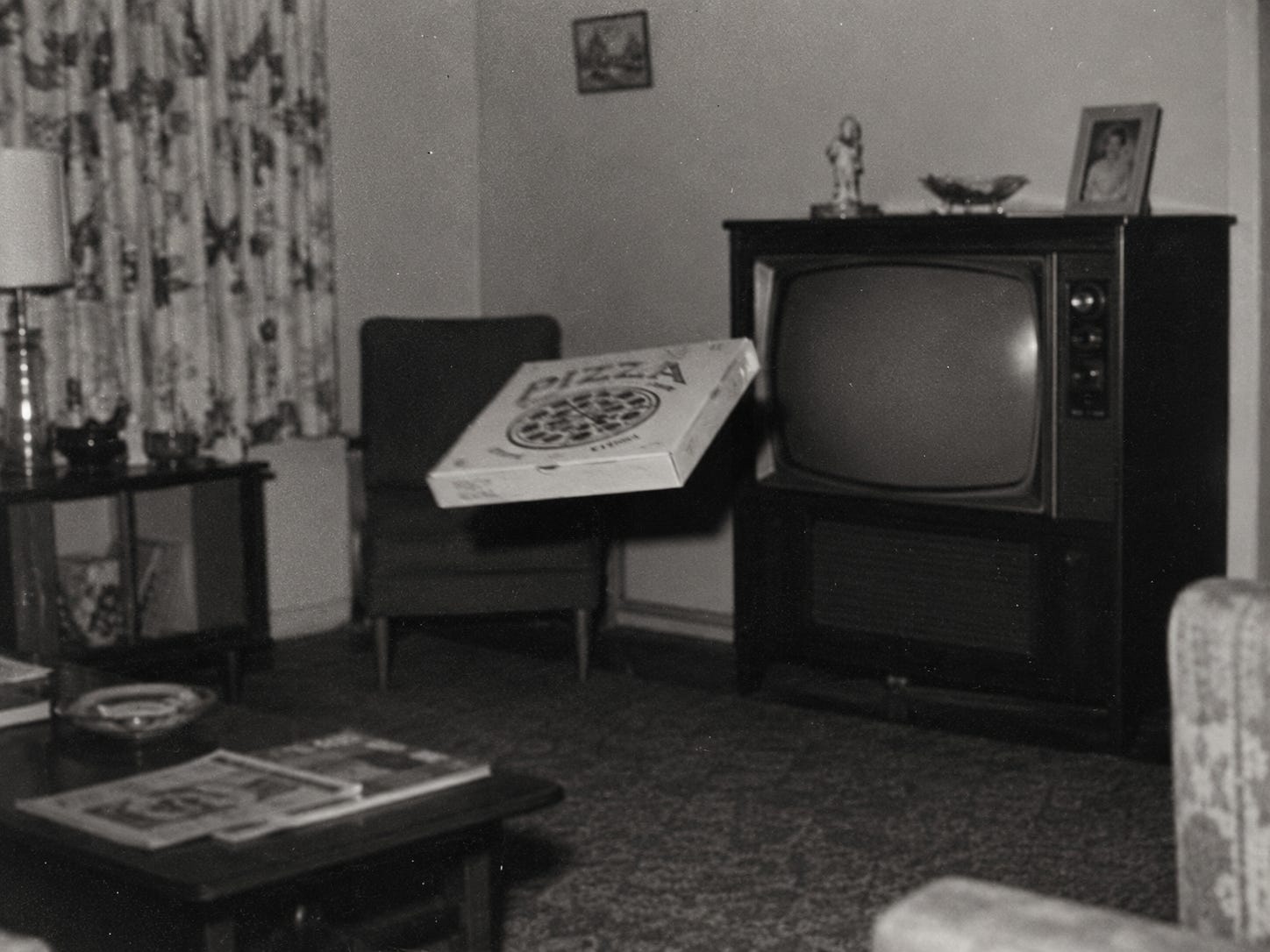
Through some kind of Californian mind-control, Stephanie had convinced me to watch a romantic comedy with her. I can’t say I was loving it, but I was loving having the opportunity to chill out with her and drink a glass of wine. We’d finished with the pizza. About half was uneaten, in a box on a tall, circular wooden table in the living room. We went to watch the rest of the film on the sofa, about five or six feet away.
There’s a bit in the film where the main character is telling a friend on her phone that the guy she’s been dating hasn’t returned her texts or calls, and she says, “Guess who’s officially being ghosted?” (The full sentence is actually, “Guess who’s officially being ghosted by a Hitch wannabe?”, but that slightly detracts from the dramatic impact of what follows.)
At the exact moment that she said the word “ghosted”, the box, which was still half full of pizza, shot off the table, flipped in the air and emptied the remaining slices of my delicious pizza onto the living-room carpet. Neither of us screamed, because it was so weird. We went to investigate, and there was simply no way (that we could figure out) to explain how a fairly heavy box half-full of pizza could have slid all the way across a level and fairly large table and turned sufficiently upside down or onto its side to land pizza-first on the floor.
Our puppy Hero, who is far too small to get anywhere near that table, was in the room on the other side, a long way from it all; so he is innocent. The window was open, but no way could a breeze, or even a gust of wind, have done this. I picked the pizza up, salvaged what I could and we sat there confused, laughing and trying to work out what had happened. One of us jokingly suggested that there might be a poltergeist. The timing of the next bit is not quite so clear, but possibly within something like a minute of our mentioning the possibility of a poltergeist, the speakers in our living room suddenly started blaring - at an impossibly loud volume, so that we had to cover our ears.
The song was September by Earth, Wind & Fire. I looked on my phone to see what app had taken control of the speakers. It was being played via an app that we don’t ever use. As far as I know, Earth, Wind & Fire doesn’t feature heavily in either of our playlists. Certainly not mine. (I’m not sure I can vouch for Stephanie there.) At any rate, smart speakers coming out with weird stuff isn’t that unusual, and it’s not as though similar things have never happened. We weren’t really sure about the significance of the song, except that I was born in September. Anyway, we laughed, had some more pizza and finished the rather disappointing film.
Since then, I’ve had a pretty good anecdote to tell people. What has not happened is perhaps more instructive here than what did happen in the aftermath.
Had I been alone when this happened, I would say there is a non-negligible chance that I would have run outside and refused to go back into the house. Or that by this point I would be neck-deep in reading about poltergeists, or trying to recreate - using increasingly elaborate systems - the exact physical conditions by which a pizza box might somehow go flying off a table.
I would certainly have been in a state of mental anguish, and I suspect that the event having been unwitnessed would have done multiple things to me. It might have made me instinctively double down on the telling, perhaps even do so with a kind of defensiveness or over-elaborate embellishment. I suspect I would have found myself in a kind of uneasy, maybe even paranoid state, unwilling to concede to the sceptical responses that I imagined I would elicit, or that perhaps I would elicit. Maybe I would even have treated people’s rare belief or credulity, when it came, as somehow patronising.
Beyond all else, I think I would probably have felt very lonely. Probably if I had started telling the story and was received by somebody who told me they’d had a similar experience, I would have felt extraordinarily grateful. We might then have shared tales, perhaps even rummaged through our memories for other such experiences, and I think it’s probably fairly likely that, if I had been on my own in the room at the time (and I’m not really sure whether the presence of my puppy Hero counts here, although I suspect it doesn’t) I would now be substantially more likely to believe in poltergeists than I currently am.
As it is, I haven’t really spent much time thinking about whether or not I believe in poltergeists at all. Essentially, I don’t.
But more than that, it doesn’t really bother me. That’s the important thing.
Both my wife and I know what happened. We weren’t intoxicated, except by the glory of East West Pizza’s overpriced but delicious chicken tikka masala pizza. We both saw a pizza box fly off the table, flip in the air and drop pizza onto the floor, and this happened at just the moment that a character on the television was talking about being ghosted, and was shortly followed by a very loud blast of a song that I have always hated.
To be honest, my fear of disco music has always been greater than my fear of poltergeists anyway. I certainly haven’t changed my belief system or my ontology in response to what happened. There is, I suppose, a very small part of me which hopes that we aren’t haunted by a poltergeist, because obviously that would suck, but I can’t say I’m spending too much time thinking about it. I also might feel a little more highly strung than usual on the 21st of September, the day mentioned in the song, this year. But I imagine I’ll get over it.
The whole episode was extraordinarily well-timed because it came just as I had been thinking a lot about how important this idea of being witnessed, or being a co-witness, really is.
I’ve always had a slightly funny relationship to being solitary. It’s something that I always claim I like, but I’m not 100% sure I really do. Particularly if it comes unbidden, I will often find myself hating it. When it is something I choose to immerse myself in, either on meditation retreat or on one of the many, often absurd, far-flung trips that I used to take myself on, it’s something that I can relate to a lot more healthily.
In my working life, things are quite different still. I realised my dislike for being solitary quite early in psychiatry. Once you’re past the intense acute emergency room shifts and general psychiatric ward chaos, you spend a lot of time in outpatient clinic settings, and this means having very intense one-on-one relationships with people. There’s sustained attention and a lot of sustained eye contact. In the early days, I used to have panic attacks because of that intensity; what I found hard was the phase-locked scrutiny more than the content of what people were telling me. In fact, the single best intervention to get over my own anxiety was to remind myself this wasn’t about me and my discomfort, and that there was a real suffering person in front of me who needed my attention and care (this was when I first really ‘got’ Buddhist metta/loving-kindness meditation; it’s astonishing how genuine care for others quite simply vaporises anxious self-concern. A life-changing realisation, one whose full glory became further apparent when I had a baby).
These days, my main clinical encounters are very different, largely by design. The autoimmune encephalitis clinic that I’ve been running for years with neurology colleagues has been built around the fact that, at least until very recently, every patient is seen by both a neurologist and a neuropsychiatrist, me, at exactly the same time.
Things have grown a bit, so we now have two neurologists, two psychiatrists, and two rooms, and in a way that’s even better because it reminds me of those gastro or general medicine clinics that I used to attend as a medical student, where you would be running between different clinic rooms and the registrar would be running between rooms too. I now do that. I get called between rooms. It’s really fun. I love it. And, as long as there is enough running around, the simultaneity actually survives the expansion.
My initial justification for this was really an epistemic one. In the complex end of neuropsychiatry that I have been working in for over a decade, one of the hardest problems is that nobody can ever really agree what they’re talking about. It can be bad enough when there are two psychiatrists involved. But if one person is a psychiatrist and another is a neurologist, then this invites a kind of Rashomon-like fragmentation of perspectives. Things will inevitably get interpreted very differently.
A neurologist’s dysphasia may be a psychiatrist’s formal thought disorder. A psychiatrist’s concerning movement disorder may be a neurologist’s unconcerning physiological tremor, or just something that feels much more within normal limits, or a to-be-expected response to the nasty dopamine-blocking drugs that we like to give our patients.
I realised pretty soon that there’s something really wonderful about not being left in a situation where someone refers a patient to me as somehow atypical and therefore worthy of extensive work-up for immune or other strange organic causes, and then I see them and they appear quite typical. The brain-breaking aspect of this is that one is then left not knowing whether the patient was presenting differently between times, or whether the referrer and I (or indeed the second opinion that I refer the patient to) simply saw or interpreted the same presentation differently.
Clinical reality is highly multidimensional. A single account, a lone witness, leaves that reality with many degrees of freedom. But each additional, independently situated observer reduces those degrees of freedom and locates the event more precisely, making it harder for it to slide around in retrospect.
So I found something deeply protective, epistemically, about simultaneous seeing. I suspect that there is something more fundamental in it too. This epistemic pinning, this commitment to reality being a certain way, is itself a kind of bulwark against loneliness. When two people witness the same thing, that pins a memory down and makes it more real. Try telling people that you saw the face of Jesus in a cloud and it may not end well. But if you and your friend both see it, things may go somewhat differently.
And there’s something very reassuring about being able to speak to a patient knowing that someone else was there too. Everyone brings reality-warping biases and other effects into a clinical encounter with them. But at least when there’s more than one clinician - and in fact this also holds true when the patient is accompanied by someone else - these are at least being counterbalanced by a presumably different set of biases brought by the other person in the room.
One of the reasons that being unwell is so awful is precisely that it entails a set of experiences that are irreducibly private in a way that much else in our shared reality isn’t. Being unwell is lonely-making, almost by definition.
A tingle in the chest, a strange visual distortion, a pain in the jaw. Each of these is Wittgenstein’s beetle in a box. We can talk about them, but we can never show them to other people. Wittgenstein’s point was bleaker still though: because if the thing in the box plays no part in how the word gets used, then that thing drops out of the language game. Altogether. It might as well not be there. What settles whether a symptom counts, or even if it is understood to exist, are the public criteria that have grown up around the name given to it and, maddeningly, those criteria belong to other people. This may be one reason why recent decades have seen such a surge in the popularity of disease-specific online communities. If you can’t show people your beetle, you can at least spend time with people whose private experiences have been gathered under the same diagnostic name.
The particular clinical place that I work - which, broadly speaking, is the intersection of psychiatry, somatic symptoms, functional disorders, immune disorders and the like - is to some extent at the forefront of a very specific and sometimes very nasty battleground, one that I tried to outline in my paper about inflammatory reductionism.
What I have always found depressing is that no matter how carefully I try to find a middle ground, and no matter how much I try to work in the service of intellectual honesty and clarity about my own uncertainty (and what can often feel like an obsession with nuance and not overclaiming) I’ve inevitably been accused by online commentators of denying people’s reality or of engaging in medical gaslighting. That is, I’ve been accused of doing an apparent medical version of exactly the sort of thing to which I am particularly sensitive.
I have written about this in an unpublished essay that I have long been on the verge of putting out there, before changing my mind. I actually think the term gaslighting is a little grotesque in this context, because it implies a wilfulness on the part of the doctor doing the apparent gaslighting. For sure, medical invalidation is real and can be harmful, but it can be that without being gaslighting in the original sense, and I think the use of the term does violence to the lived experience of people who have been subject to the particular psychological torture of actual gaslighting by conflating it with this other category. That said, simply opining that patients are using the word incorrectly would itself be a kind of intellectualisation, evasive at best and insulting at worst. The more important question is actually why patients feel such a degree of hurt from clinicians that they use a term denoting psychological violence. Most of that harm is probably unintentional, but acknowledging the absence of malice does not answer the hurt.
Whether or not the term is right, I am sensitive, and perhaps hypersensitive, to the possibility that I might be perceived in some way as denying my patient’s reality by telling them that they do not have the disorder that they think they have.
This is hard because, increasingly in my practice, I see a very large number of patients who have been misdiagnosed with inflammatory and neuroinflammatory disorders that they almost certainly do not have. I’m enough of a believer in there being something like an objective truth, or at least a relatively objective truth about things, that I feel it’s my duty to tell patients that they don’t have an inflammatory disorder if I truly believe that they don’t.
The difficulty is that this can be heard as something quite different. It may well be heard as an expression of the patient’s symptoms not being real, or that their suffering does not count, or that they’re being pushed back into psychiatry because medicine has failed to find anything better. When, in fact, the truth is that I’m simply reporting that I do not think that this particular mechanism explains their symptoms.
Part of the difficulty is that being given a complex or multi-level explanation still feels very different from being given a simple organic one. I want to live in a world where a patient could receive a correct diagnosis (or, better still, formulation) and leave the consultation relieved rather than burdened. I don’t think we live in that world.
There is something about the potential harms, misunderstanding, and even the recrimination that can occur when there are two people in that room that does not happen in the same way when there are three people in that room. When reality is no longer held between two people, it acquires a solidity.
Being witnessed is not the same as being agreed with: this is important. One can witness the reality of someone’s symptoms while disagreeing about their cause. There is always a danger, of course, that the three-person room can look like a two-on-one pile-on. In my clinic, it very rarely feels like that, in part because patients very rarely attend alone. And it never has been the point of the clinic for the psychiatrist and the neurologist to form a bloc. In fact, we argue so much that I don’t think there’s much danger of this.
I don’t have an internal narrative in the way that most people seem to describe. I apparently belong to the 10% or so of the world who does not. Many of my friends and colleagues are sick of me telling them this. But sometimes, when something notable happens in my life, one of the first things I do is imagine telling someone about it. Not telling myself, but actually telling someone else who I visualise in my mind.
Similarly, I don’t write for myself. I haven’t found the huge joy of writing these essays on Substack to be something that I would enjoy as much if I never hit publish. Like most writers, I think I write at least in part in order to be witnessed. A reader witnesses the account I give of an event. Writing takes that account out of private memory and places it somewhere other people can encounter, remember, question and carry it.
After I was witness to a shooting incident outside of my house a few months ago, which I wrote up in my essay Line of Sight, I wrote about it for exactly this reason. Writing about something can make it real. That is enough to weaken the omertà that can often descend after unspeakably difficult things. If you take something that might otherwise remain private and place it where another person can see it, then something remarkable happens.
This is a different thing to confession. At least, it’s not confession in the old Christian sense. Maybe it’s confession in the Jewish sense. Not in the sense of asking for forgiveness, but closer to the old joke about the man who goes to the rabbi and says that he’s slept with two twin sisters. The rabbi says something about confession and forgiveness, but the man says, “Forgiveness? I don’t need forgiveness. I’m telling everyone.”
Sometimes we don’t want absolution. We just want to tell everyone.
For me, there are resonances in my meditation practice. For years, I’ve found myself longing to have a sangha. It’s a really strange experience to be on retreat, experience something utterly incredible, and then have no one to talk to about it, except perhaps to come back home and bore my wife about the fine-grain phenomenology of possible jhāna states.
The kind of unusual experiences that happen on retreat need some kind of shared language. It’s important to have someone who can say, “Yes, that is a thing,” or, “Don’t make too much of it,” or, “Yes, that is a thing, but be careful what you build around it.” A few days ago, I was accepted into an intensive online practice group, run by Michael Taft, that for years I had hoped I could join, but had always felt I lacked the necessary experience. It feels embarrassing to write, but the relief was so great I cried a bit when I got the email.
Sometimes, when I’m on the bus, I spot one of those very religious people reading their Bible, with those wafer-thin pages. Perhaps their face is serene and joyous, or perhaps it is more serious. Liturgical.
I often wonder, in the solidly Abrahamic world they inhabit, whether they ever truly feel alone. I never really got theistic religion, possibly precisely because the idea of a big bearded man in the sky always felt so patently absurd (I realise that is not always the most useful characterisation). But I often wonder how supportive and beautiful it must feel to go everywhere in the company of a benign presence who has at least some of the qualities that we traditionally associate with persons.
More recently, this problem of witnessing has come into relief for me when thinking about AI. These systems give an illusion, a rather wonderful illusion, of co-witnessing the world, because it can feel like there is another mind there with you helping to fix reality. In this secondary sense, an AI may already perform something like the function of a reader. It can respond to an account, help with formulating it and make private experience more sayable. The difficulty comes when response is experienced as corroboration.
This co-witness is something like an egregore that has emerged and taken form, in part from your own projections, in part from the patterns of everyone else’s language. I worry that it gives you, as the user, an illusion of pinning something down, an illusion of having an X and a Y axis, when in fact you may still only have one.
Much as I am impressed by the interpretations these systems can give (and this really isn’t to say anything about the subjectivity or otherwise of an AI) I don’t think they can yet be witnesses in the same way. They were not there when you witnessed something, or at least did not witness it the way you did. There is no body in the room, no professional risk, no memory of the patient’s face and no capacity to say later with any independent authority that, yes, this is really what happened.
Maybe that will change. It’s interesting because much of the concern about the psychological harms of AI has focused on dyadic interactions. I have started to wonder whether, in a multi-agent future, the anticipated proliferation of agents might allow a kind of triangulation of reality. Because a real witness has alterity. They can say, “No, I saw that differently.” Triangulation - pinning slippery, squirming reality down - depends on those agents occupying genuinely independent positions.
Whether multiple agents could be relied upon to reduce these degrees of freedom, or simply generate more versions of the same perspective, remains unclear, but is at least an angle that I think needs urgent exploration. And I don’t think people have even begun to think properly about the epistemic implications of our multi-agent futures.
What broke the spell for Allan Brooks was not just thinking about stuff harder, or asking ChatGPT repeatedly whether this whole journey was really legit (he did ask, apparently at least fifty times, and was multiply reassured that it was). It was the introduction of a new perspective.
There are perhaps parallels here with the dynamic, one I see again and again with adult survivors of abusive parents, by which toxic family members can stop being so harmful and aggressive once someone new, often a sufficiently self-possessed new partner, comes into the dynamic and essentially says to them, “I see you, I see what you’re doing.” The witness pins it and makes it real. By concretising what’s happening, it can even become workable.
Maybe the same kind of dynamic is there with chaperones and in all sorts of other contexts. Of course, the chaperone exists to protect both parties. That’s the whole point. It’s not about them being there for one person or the other. They alter the situation by being able to say, “I was there too”, even if they never actually have to do so.
Even on those trips to far-off places that I used to take myself on in the delusion that they would somehow be therapeutic, I used to feel a little bit mad by the end. When I was a lot younger on these trips, rather than empty into blissful silence, my mind would fill to the brim with short, TripAdvisor-style review excerpts, accumulating in readiness for my being able to tell my friends and family about all the cool things I saw. Because otherwise, I suppose, it’s not clear I ever really saw them. These days, I can ‘just be’ on my own to an extent I never thought possible. But it took a minute to get here.
It’s not solitude itself that’s the problem. It’s being alone with an unstable reality, and the vertigo that induces. And of course, to pre-empt the objection that people whose realities are unstable should perhaps not go off alone on long trips, or on retreats etc., then I will simply offer what I know to be a truth from my own Buddhist practice: reality is, in essence, unstable.
In medicine, and especially in my disputed borderlands of neuropsychiatry, uncertainty can take many forms. But funnily enough, the antidote to uncertainty might well be disagreement. In a two-person room, disagreement about mechanism can become a disagreement about reality, and disagreement about reality can feel like an accusation. But in that three-person room, disagreement becomes an act of epistemic hygiene.
I really don’t think that we want a world where uncertainty gets abolished. Sylvie Delacroix, the philosopher and a colleague at my university, has written eloquently about the potentially disastrous consequences that happen, or that will happen in an AI-facilitated world, when uncertainty is no longer structurally enabled.
My neurology colleague and I may not always see the same thing. This is precisely the value. The fact that we can both be there with our patients and with their relatives means that uncertainty is no longer mine alone, or the patient’s alone. It becomes something that can be spoken about and prodded.
So the possibility that reality can be held among several people, and in doing so become less easy to distort, weaponise or, at its simplest, deny, matters an awful lot to me. I believe there probably is something like an objective truth, though I have learned to be wary of claiming much familiarity with it. I also know that, wherever it ‘really’ is, it is in constant motion and any one person’s access to it is partial.
So: a pizza box flew across the room in front of my eyes.
All that happened… was that a weird thing happened. I got to share it with my wife. We get to tell friends about it. And I get to write about it.
Can I get a witness? I don’t want to be the only one who has to say what happened.
No posts
Comments
Nothing yet. Say the first thing.
Sign in to join the conversation.