
As previously written, World Council for Health has collated all the monthly English Prescribing Dataset (EPD) data from January 2015 to May 2026 (the latest available) into a useful spreadsheet. We can now present charts of prescription totals and costs individually or grouped together for England (only). The EPD follows the British National Formulary (BNF) drug categories, managed by The National Institute for Health and Care Excellence (NICE).
This is what we found on GP prescribed sex hormones since 2015.
Searching the EPD via BNF Section 0604 (‘Sex Hormones’) we see a two-part rate of prescription increase:
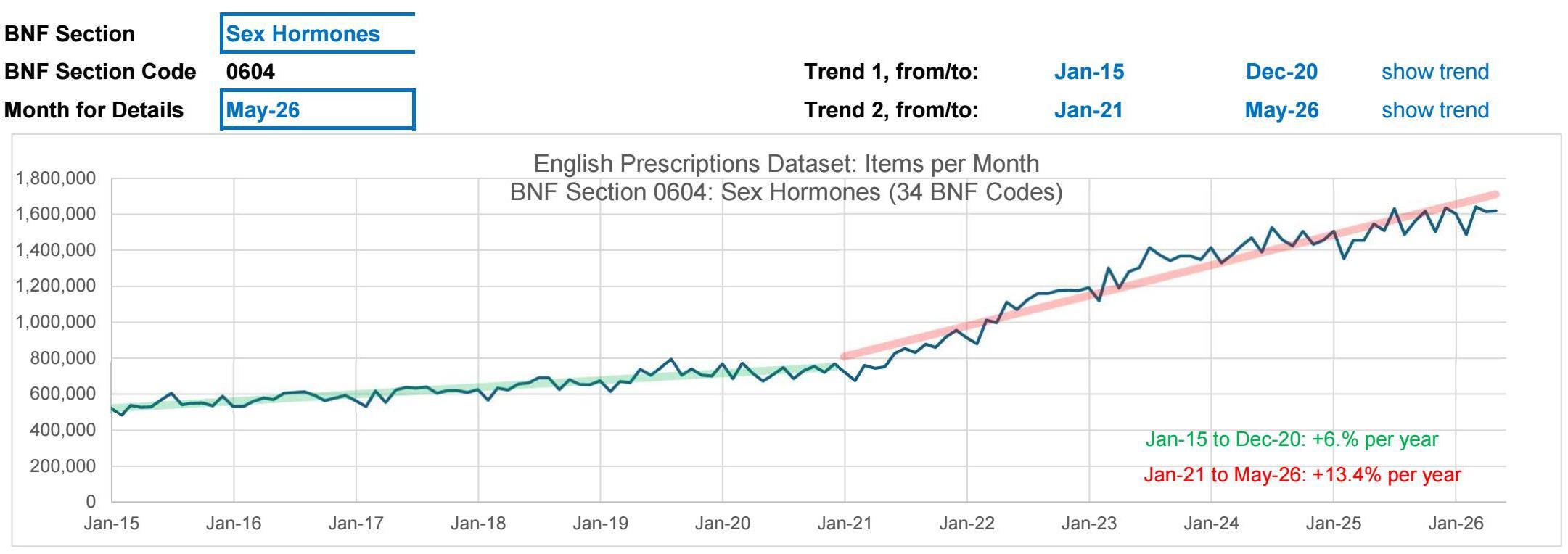
Following a gentle increase averaging 6% per year from 2015, the increase more than doubled to an average 13.4% per year from January 2021. In fact, the increase from January 2021 to January 2023 was much larger (27.9%) and it has since plateaued slightly.
The WCH spreadsheet lists the top ten sex hormone pharmaceuticals in the above BNF Section on ‘Sex Hormones’ as:
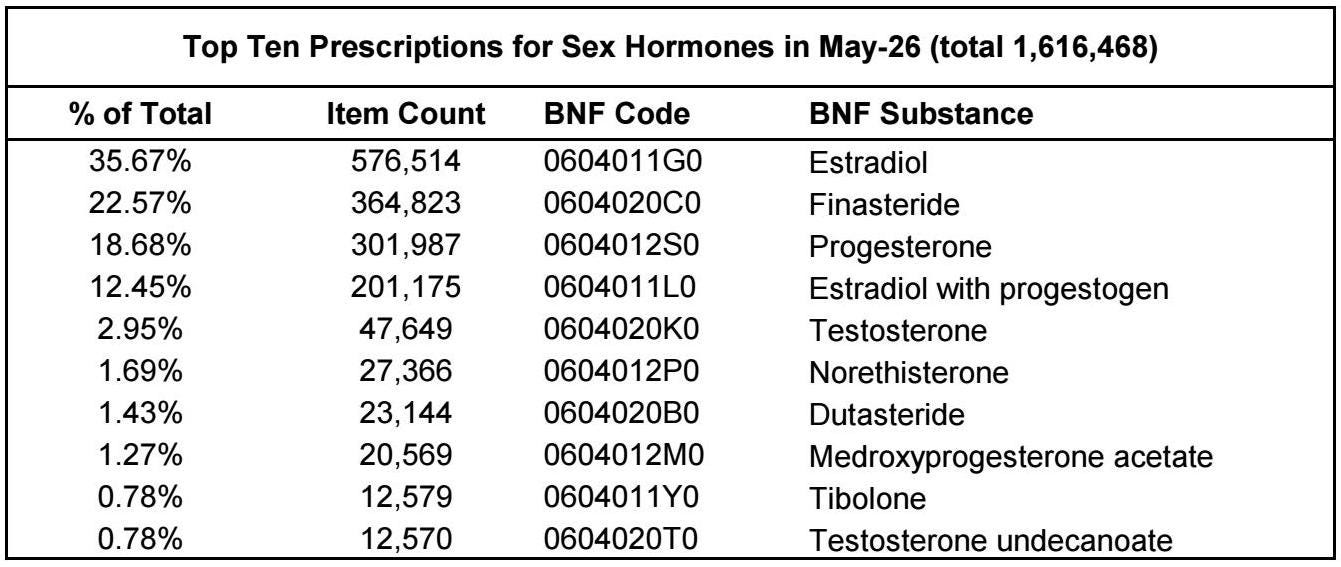
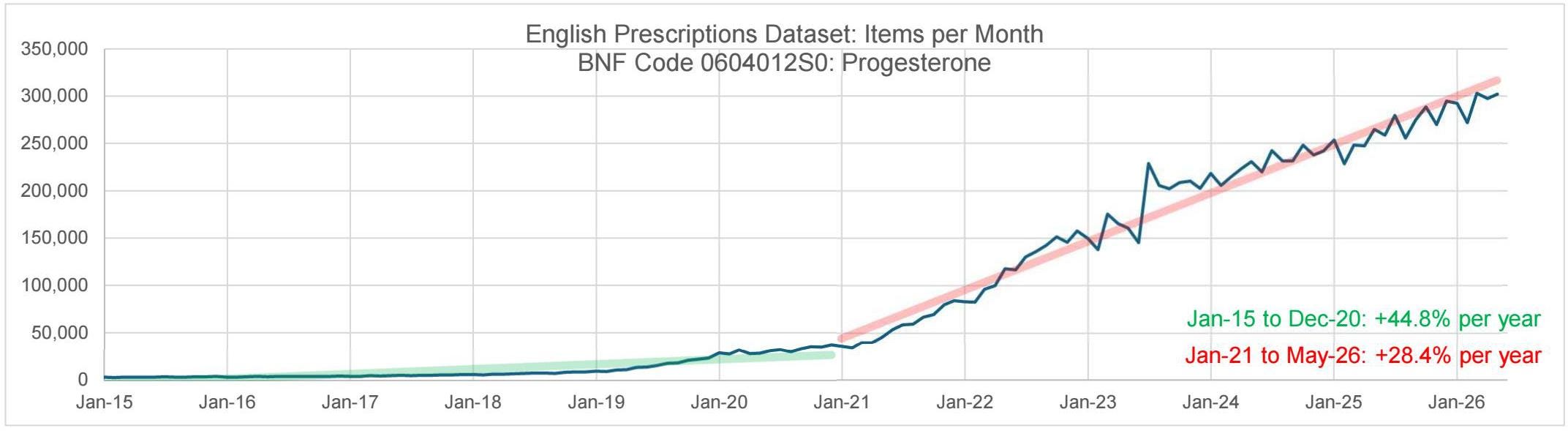
Estradiol and Progesterone make up two thirds of pharmaceuticals in the ‘Sex Hormones’ section. Estradiol at the top of the list is prescribed for Hormone Replacement Therapy (HRT) for post-menopausal women who have had a hysterectomy, but is not usually given alone to women with a uterus due to the risk of cancer. If a woman has a uterus intact, estradiol is supplemented with progesterone. Estradiol is most commonly formulated with progesterone as oral contraceptive agents.
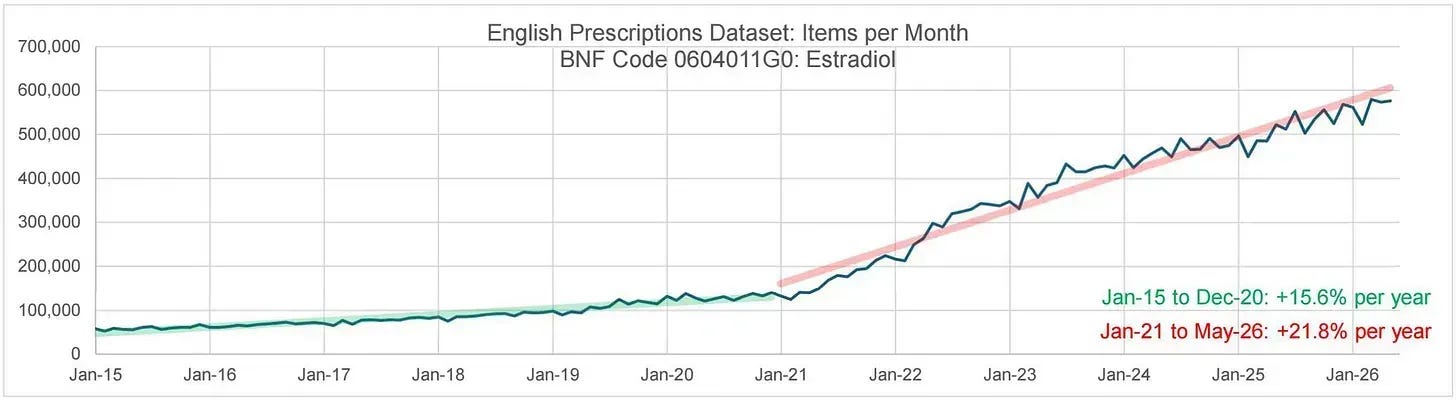
Since the major inflection point is 2021, the graph suggests that the change may have something to do with Covid-19.
Why would prescriptions of mainly female hormones increase at this time? Might this increase be an indication of COVID-19 vaccine adverse effects on the reproduction system of women? For example, an increase in premature menopause (which has been reported to Adverse Event databases) would likely lead to an increase in HRT prescriptions for younger women; an increase in menstrual disorders (heavy or light or absent menstruation) and fertility issues would lead to an increase in hormonal contraception prescriptions to ‘normalise’ menstruation (monthly periods).
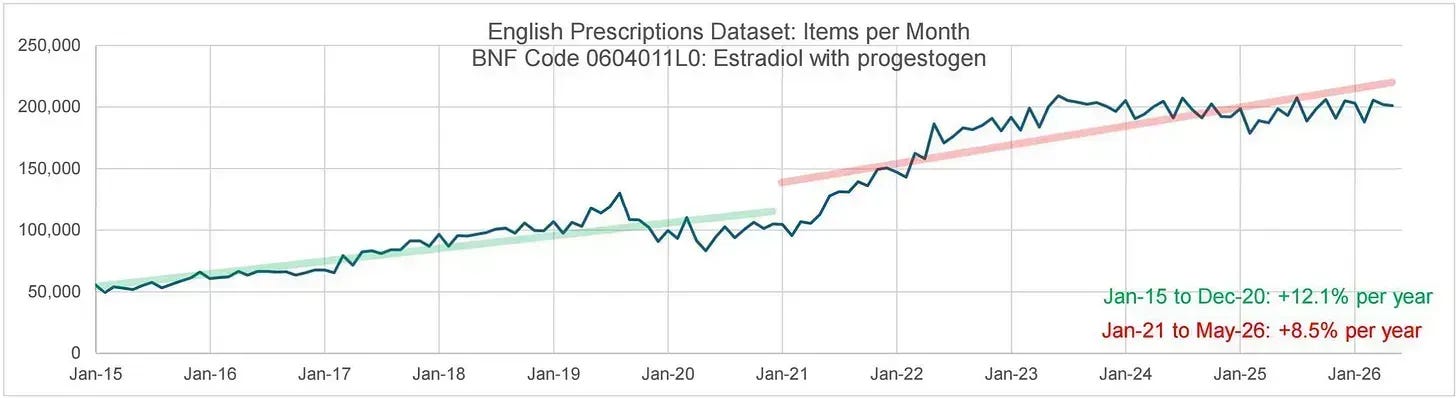
There is another factor to consider. Estradiol is also used in what has been termed ‘trans-feminisation’ – the feminisation of biological males as part of gender reassignment therapy. Transitioning is predominantly male to female. I wonder whether the increase from 2021 might also, or alternatively, be related to the promotion and facilitation of this new and experimental concept, which seemed to begin at the start of the Covid-19 era too?
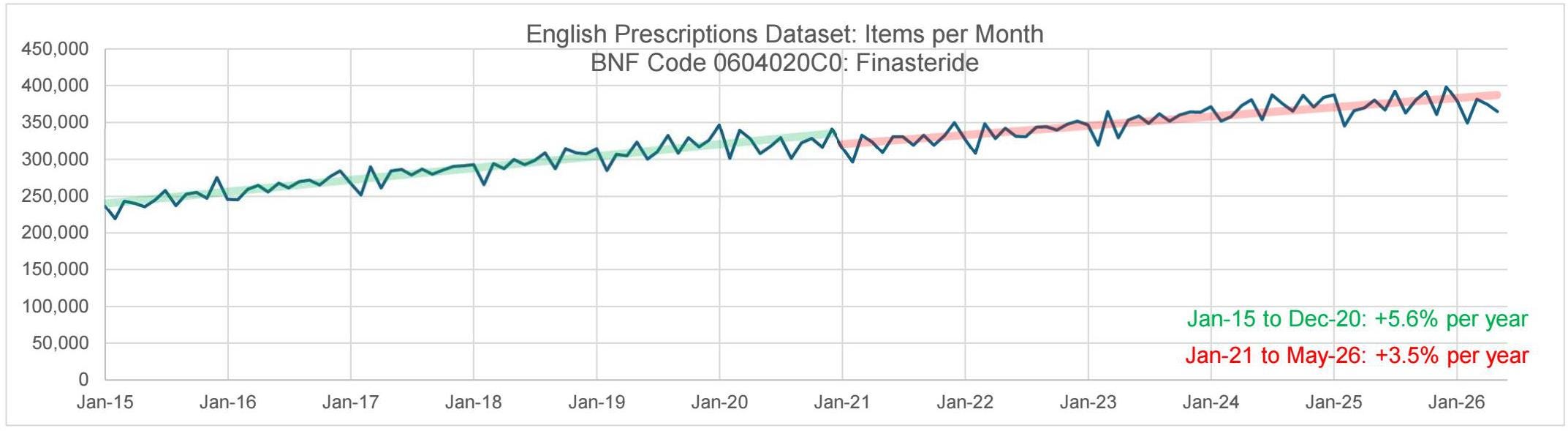
Finasteride (23%) and Dutasteride are anti-androgens I would not personally call these sex hormones, however, they are classified as such in the BNF and have an effect on sex hormones, in particular, testosterone. Common uses of these drugs are conditions where it is considered necessary to reduce testosterone, such as benign prostatic hyperplasia (BPH) – an enlargement of the prostate gland. They are also used to reduce hair loss and, more recently, as androgen-blockers in gender reassignment protocols (male to female). The GP prescribing pattern of these drugs has increased since 2015 but not as much as estradiol and progesterone.
Testosterone. An increase in testosterone prescriptions follows the trend of estradiol, but the totals are low.
Prescribed drugs and/or their metabolites end up in our waste water and potentially, through recycling, in our water supply. Thus, I wonder what the cumulative impact is of this ubiquitous use of prescribed sex hormones on our drinking water?
There is clear evidence that natural and pharmaceutical estrogens can enter wastewater and surface waters. They have been detected in UK sewage effluent and environmental waters. However, the available English drinking-water evidence indicates that treatment reduces these compounds to very low levels, and the DWI says there is currently no evidence of a human-health risk from endocrine disruptors through drinking water.
The DWI says it has specifically investigated 17β-estradiol (E2) in England and Wales.They found E2 in river systems and during periods of low river flow some catchments were considered at increased risk. They also say that the treatment processes used by water companies are effective at reducing E2, where present, to below the proposed guideline levels.
A 2006 scientific article entitled “Are endocrine disrupter compounds a health risk in drinking water?” by Ian Falconer 2006 noted: “The River Thames which flows through London, England, has overall passed through drinking water and sewage discharge 5 times from source to mouth of the river. Under these types of circumstance, any accumulation of endocrine disrupting compounds from sewage or industry potentially affects the quality of drinking water. Neither basic waste water treatment nor basic drinking water treatment will eliminate the estrogens, androgens or detergent breakdown products from water, due to the chemical stability of the structures. Hence a potential risk to health exists; however present data indicate that estrogenic contamination of drinking water is very unlikely to result in physiologically detectable effects in consumers.”
Nevertheless, inadvertent feminisation seems to be happening to fish and frogs. Could sex hormones in the water be contributing to the inadvertent feminisation of human beings too? In men, gynecomastia (breast tissue development) is fairly widespread these days? Fertility issues are increasing. These things are clearly multi-factorial but isn’t it time to consider the potential contributing factors?
Let me know your thoughts below.
You may also be interested in this article:
How safe is your drinking WATER?
·
Jul 15
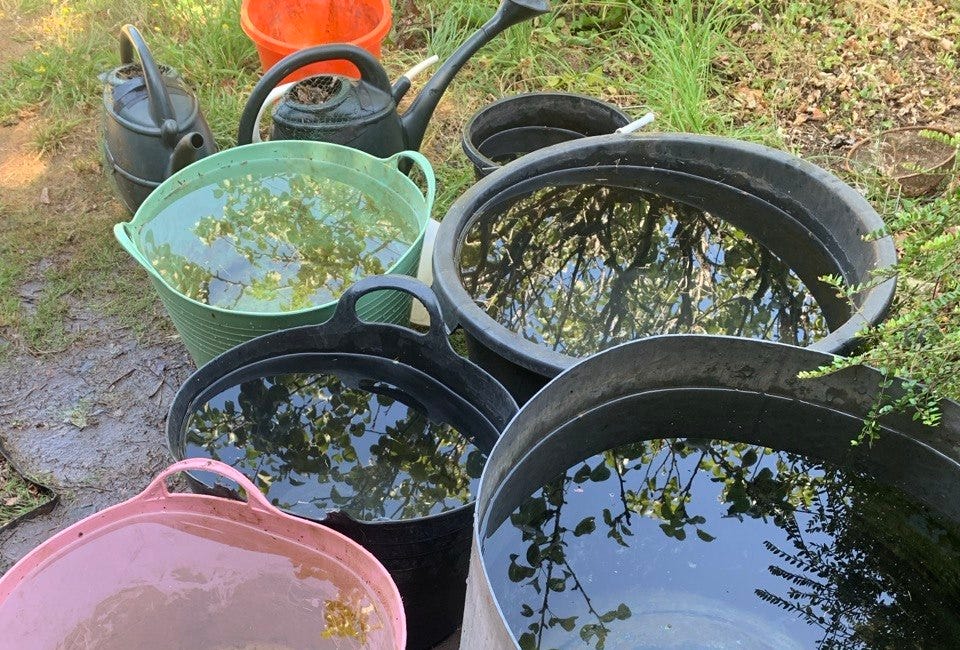
In this toxic period for all life on Earth there are many types of poisons in our lakes, rivers, dams, and aquifers that end up in our water from our taps. These include contaminants, pollutants, pathogens, and toxins - many of which would not have been present 100 years ago.
There’s a Better Way! Thank you for supporting this work so that we can keep on creating it!
No posts
Comments
Nothing yet. Say the first thing.
Sign in to join the conversation.