
If you use custom GPTs in your wellness business, you need to know about an OpenAI change.
Creating and publishing new GPTs may soon no longer be available on personal ChatGPT plans, including Free, Go, Plus, and Pro.
Existing GPTs are not disappearing.
You can still use GPTs shared with you.
The change is about building new ones.
To create new GPTs, you may need access to a ChatGPT Business, Enterprise, or Edu workspace with the appropriate permissions.
For a large organization, that may not be a big deal.
For an independent wellness professional, consultant, gym owner, or other small operator, it could be.
ChatGPT Business may require paying for at least two seats. So something you may have been building as part of your individual ChatGPT subscription is now double the price.
For me, this change has triggered a much bigger project.
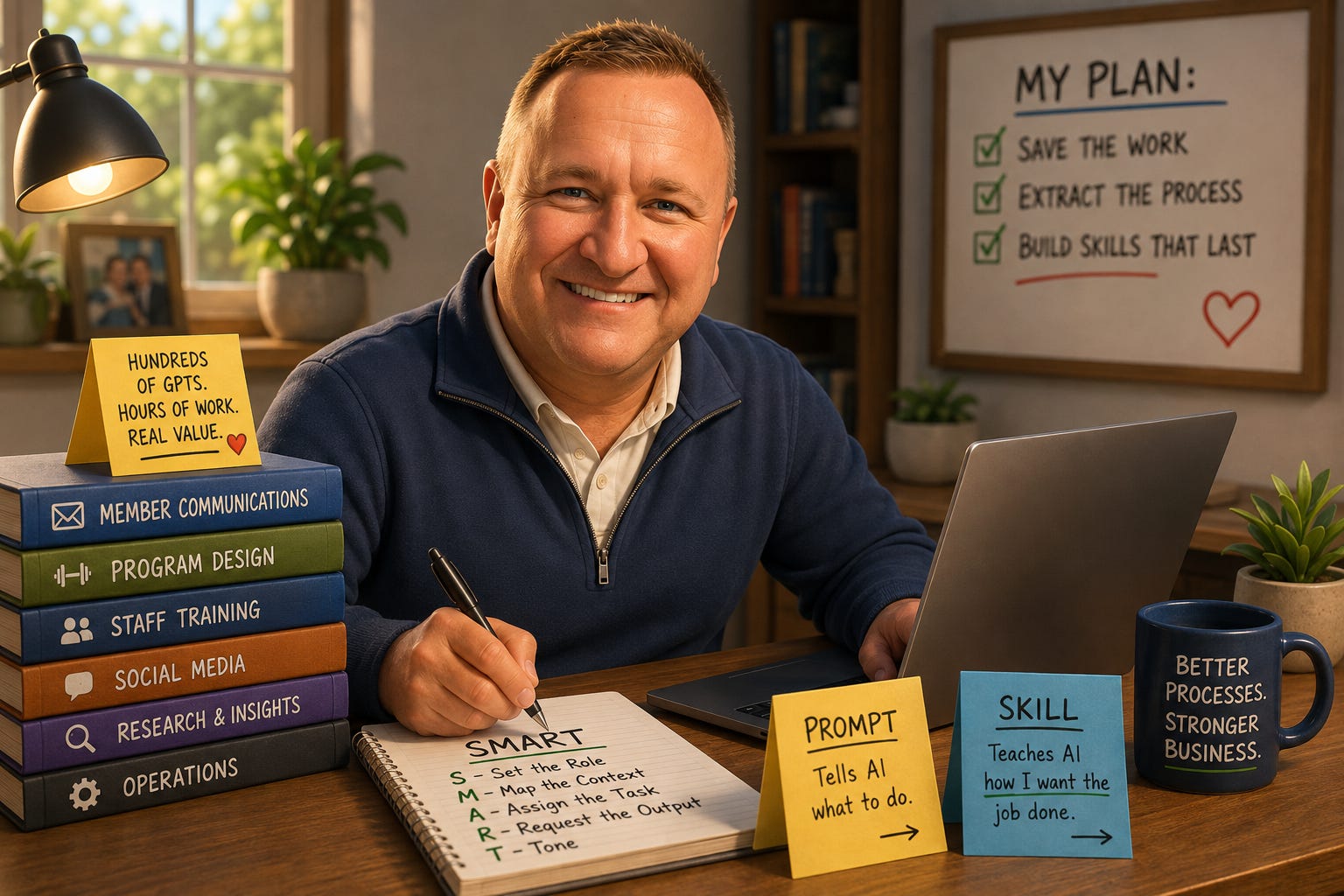
I have created hundreds of custom GPTs.
Now I am going through them one by one.
I am saving the instructions, prompts, knowledge files, and other important material from each GPT into a Google Drive folder that I control (I am saving each as an .MD file).
Then I am asking a simple question:
Do I still need this as a custom GPT, or should I turn the useful part into an AI Skill?
I think we sometimes make AI more complicated than it needs to be.
Here is the simplest way I can explain the difference between a prompt and a Skill.
Think about asking someone to make a peanut butter and jelly sandwich.
A prompt is: “Make me a peanut butter and jelly sandwich.”
That tells them what you want.
A Skill is knowing how to make the sandwich correctly. Get two slices of bread. Put peanut butter on one slice. Put jelly on the other. Put the slices together. Cut the sandwich in half. Put it on a plate.
The prompt says what to do.
The Skill says how to do it correctly every time.
Now let’s put that into a wellness business.
Suppose I run a gym and want to reach out to members who have not visited in 14 days.
I could give AI this task:
“Write an email to a gym member who hasn’t visited in 14 days.”
That’s a prompt.
It tells AI what I want done right now.
But imagine I have developed a specific process (or what I love to call a system) for member re-engagement. Let’s call it my Member Re-engagement Skill.
I want the AI to check how long the member has been away.
I want it to look at the member’s goals when that information is available.
I never want the message to make the member feel guilty about not coming to the gym.
I want the communication to sound like our business.
I want both an email and a shorter text message.
And I want the AI to flag situations where a personal call from a staff member might be more appropriate.
That is the Skill.
Once that Skill exists, my prompt could become very simple:
“Follow up with these 10 inactive members using my Member Re-engagement Skill.”
The AI already knows how I want that job done.
That’s the distinction I find useful:
A prompt tells AI what to do.
A Skill teaches AI how you want the job done.
When I find a GPT worth keeping, I can use my SMART Prompting Method to pull apart what makes it work.
S — Set the Role
Who should the AI be when performing this job?
M — Map the Context
What information does it need to understand before starting?
A — Assign the Task
What exactly should it do?
R — Request the Output
What should the finished work look like?
T — Tone
How should it communicate?
Go back to the member re-engagement example.
The Role is a member-success assistant.
The Context includes the member’s goals, attendance information, and our communication standards.
The Task is to create an appropriate re-engagement message.
The Output is an email and a text message ready for staff review.
The Tone is supportive, personal, professional, and never guilt-based.
Now I have documented how I want AI to perform that job.
That is something I can keep.
That becomes my new skill.
I am going through the hundreds of custom GPTs I have created.
This OpenAI change is a good reminder for anyone using AI in the wellness industry.
Don’t assume today’s AI setup will be tomorrow’s AI setup.
Platforms change.
Plans change.
Features change.
Access changes.
But the processes you have developed for using AI in your business are yours.
Save them.
Document them.
And when they represent work you need done consistently, turn them into Skills.
A prompt tells AI what to do. A Skill teaches AI how you want the job done.
That is the part worth protecting.
Reply and tell me - are you still using Custom GPTs, or will this force you to start using Skills?
No posts
Comments
Nothing yet. Say the first thing.
Sign in to join the conversation.