

Around a year before her death, I was chatting with the late, great Dr. Ruth Westheimer. Not about sex. Not about orgasms. We were talking about her next big (and what turned out to be her last) project… a book on loneliness and its impact not just on our happiness but also on our health.
As a holocaust survivor who lost her entire family, spent considerable time in an orphanage, was divorced twice, and then widowed after marrying the love of her life, Dr. Ruth knew a thing or two about loneliness. As an icon who ultimately became one of America’s most beloved therapists, she also knew a thing or two about the life-changing impact of building connections.
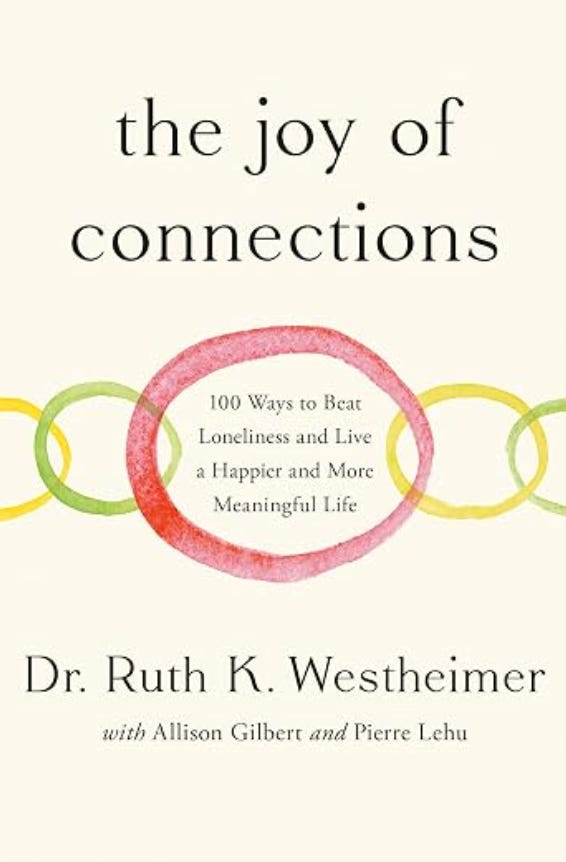
The Joy of Connections: 100 Ways to Beat Loneliness and Live a Happier and More Meaningful Life was published a few months after Dr. Ruth’s death at age 96, but if I were to have a conversation with her today, I suspect she would not be the least bit surprised at the results of a new study that quantified the health impact of loneliness.
Being alone and being lonely are not the same thing.
Social isolation (being alone) is objective and defined as having few social interactions. A lot of people like to be alone and may even prefer it.
Loneliness is an emotional state that occurs when someone feels distressed or sad about a lack of social connections. That can happen in a room full of people or by yourself. You can be surrounded by people at work or in a living situation, yet feel very lonely.
It has been studied and known for some time that loneliness in older men and women contributes to problems in both mental and physical health. In 2023, Surgeon General Dr. Vivek Murthy issued a U.S. Surgeon General Advisory stating that loneliness and social isolation “represented an urgent public health concern”
Until now, most studies regarding the impact of loneliness on health have been skewed towards older populations. A new study of over 21,000 people, recently published in Maturitas, the journal of the International Menopause Society, is the first to examine the health impact of loneliness in men and women aged 40-65.

It’s no surprise that loneliness is associated with depressive symptoms and depression. What is less obvious and really concerning in this younger population is that loneliness is associated with chronic inflammation and a shorter lifespan.
Social isolation and loneliness are associated with
26% greater risk for all-cause mortality
30% increased likelihood of cardiovascular events
50% higher risk of dementia
The message is clear. Loneliness is no longer viewed as just an emotional or mental health problem or a general quality-of-life issue, but as a modifiable health risk factor that is highly associated with medical problems.
So, what’s the solution in a world where people live alone, work from their kitchen table, order groceries online, and go days without being in the same room with another human, much less someone they connect with?
Dr. Ruth came up with 100 strategies to connect with others. Real strategies. Doable strategies.
For example, imagine you’re at a party where you don’t know anyone. Joining a group of people already deep in conversation can feel daunting—almost impossible. My approach is to take the easy way out and pretend I need to go to the bathroom, and then just hide out there for a while.
Dr. Ruth’s suggestion? Walk up to a group, whip out your phone, and say some version of, “The host asked me to get some pictures- gather and pose, please.” And suddenly you are chatting with them and are now part of the conversation.
There are 99 others.
Comments
Nothing yet. Say the first thing.
Sign in to join the conversation.