
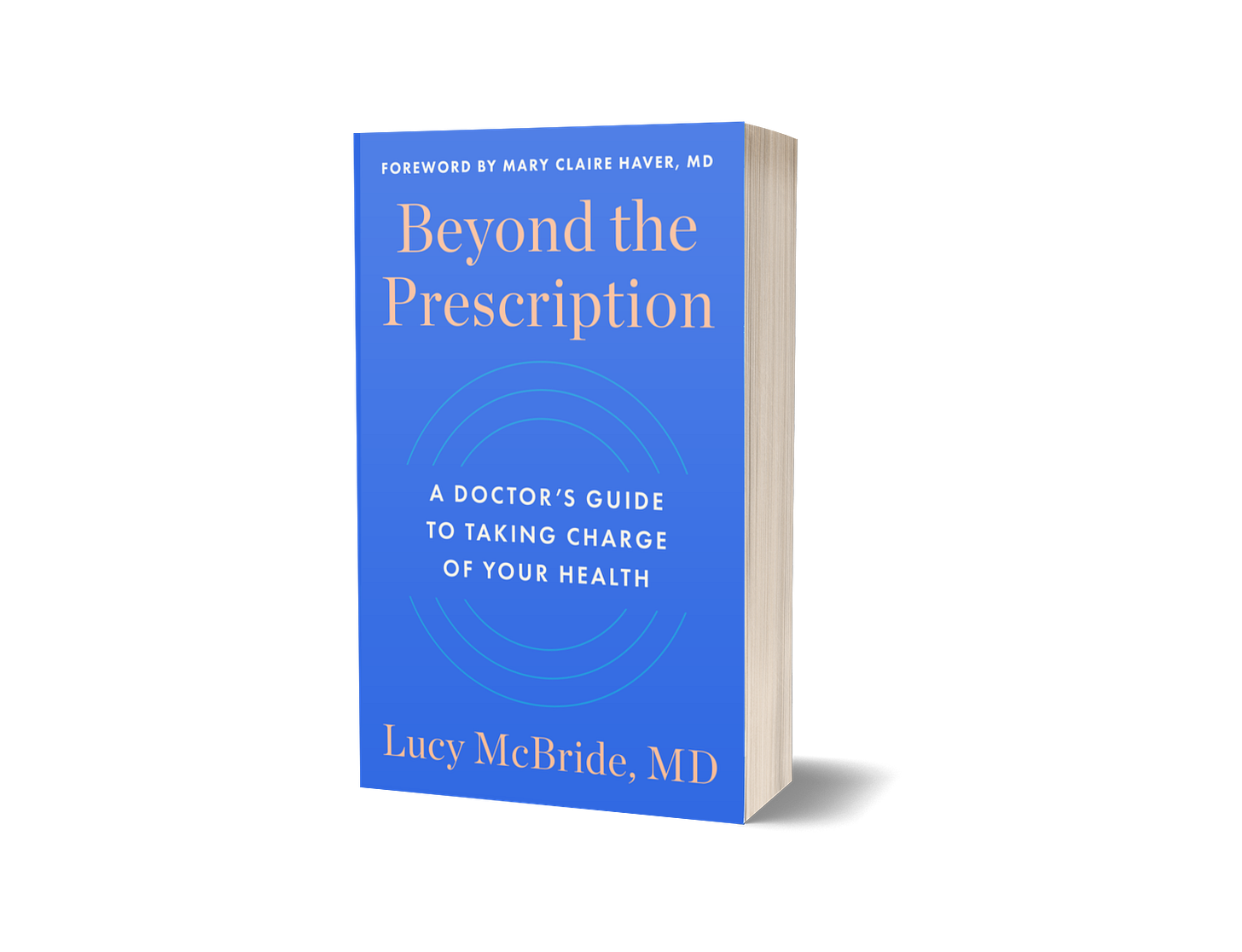
In this Inside Information Substack LIVE, I chat with Dr. Lucy McBride about her new book, Beyond the Prescription: A Doctor's Guide to Taking Charge of Your Health.
Take a listen, or, if you prefer, read the transcript of our conversation below.
“For the few people who are not already following Dr.McBride on her Substack, Are You Okay?, Dr. McBride is a Harvard- and Hopkins-trained internist, primary care physician, who I just learned holds a master’s degree in pharmacology. She practices in Washington, D.C., and has over 25 years of experience.
Lauren, thank you so much for having me. It’s fun to be here.
I’m really excited about this book, which is rare for me. I mean, there’s so much junk out there. But there are two reasons I think everyone needs to own Beyond the Prescription. One is the information. It’s accurate. It’s not crazy. It’s evidence-based. You’re not making false promises. But the main thing is, Beyond the Prescription isn’t just another guide for patients. This is, as you put it, a roadmap to help people become the CEO of their own health. So let me start with this. Why did this book need to be written? I went to Amazon, I searched “how to be a good patient,” and over 200 books popped up.
The difference between this book and all the other books like How to Be a Good Patient is that this is not prescriptive, hence the title. It’s not a do-as-I-say book. It’s here’s how to think broadly about your health and here’s how to get and ask for the help you need.
We are living in this era right now of Information overload, right? Like we have got headlines coming at us. We’re like drinking water out of a fire hydrant with information coming at us online. We’ve got ChatGPT, we’ve got Claude, we’ve got Open Evidence . Patients have more and more information and less and less ability to contextualize it and make sense of it. And to then action information and apply it to their own lives. So I wanted to help the person out there who’s probably listening. This is most people who’s been dismissed or talked over by their doctor through no fault of their doctor. They just don’t have time.
And who has left a doctor’s appointment with a prescription but no plan. And then, of course, goes on the internet to figure out what’s wrong with them. And they end up not knowing who to trust. This book is basically a five-step guide to being an empowered patient, to being your best self-advocate in this dizzying landscape.
I don’t know if you saw it, but there was a study that just came out a couple of weeks ago that looked at when patients are given a prescription and an explanation by a doctor. And in this particular study, they’ve all had GERD and they were also shown a little video and then they followed up with them a month later and one third of them had no idea how to take their prescription.
This is exactly the point. Health is not just about getting more answers. It’s about having space to ask questions of the people responsible for your care. Well, having that space and that time is important and not wasting the time, because you have this five-step roadmap. Practical advice, specific advice.
So, obviously, people need to read beyond the prescription, but as a teaser, I’d like to run through these steps so people get a sense of your approach.
So step one, top of the list.
That’s right. It turns out it’s really important to understand why you’re alive, what your values are. What are you going for? Are you someone, for example, who wants to optimize every body part, every lab test at all costs, even if it makes you anxious and you take unnecessary supplements sometimes and you take prescription medications that could not be employed if you were to change some parts of your life habits? Or are you someone who’s like, oh, natural. Like, I would rather not take medicine at all costs. Like, know who you are, know your goals. And so it makes the relationship between you and your doctor and, frankly, making a decision on whether to get a vaccine or not or whether to take Lipitor or not much easier if you know what your health goals are and what your vulnerabilities are.
How do you approach the person who says, I don’t want to take medicine at all costs, yet they have no problem loading up on all manner of supplements and don’t think of that as medicine?
You need to ask yourself: Is my goal to follow someone else’s definition of health, right? This guru’s advice is definite. So you have to ask yourself, whose playbook are you following? Is it yours? Or are you subscribing to someone else’s definition of health, which for a lot of people is about sort of a body mass index, a number of steps, a certain set of grams of protein? And look, I recognize that exercise and protein are good for you. But what I’m trying to ask patients to do in this step one is to, like, take a minute and understand your own health and what it means to you. What’s your relationship with your own body? What’s your relationship with your doctor? What are your goals? Who are you? In any other profession, as a consultant, me as a doctor, you wouldn’t operationalize a plan around a client without knowing what their goals are. But medicine, if you don’t understand someone’s goals, will default to Lipitor for high cholesterol, Prozac if you’re depressed, GLP-1 if you have stubborn weight. I love Lipitor, Prozac, and GLP-1s. They are wonderful medications. But unless you define your health goals and why you’re alive and what you want, like what are you shooting for?
How do you want to feel in five years or 10 years? What do you want to be doing in five years or 10 years? Medicine will default to factory settings and have you on a prescription for every body part and every symptom. And by the time you’re 80, you’re on a boatload of meds and none of the specialists are talking to each other. So you have to be in the center of that conversation first with yourself and then with the people who are caring for you. Yeah, that makes total sense. All right.
So this is the bulk of the book, is mapping your health ecosystem. We have conceptualized health in the US as a set of lab tests, a normal mammogram, as external metrics. When health is actually much broader, health is about your mental health. How does your stress and your work-life balance or imbalance affect your sleep, and how does your sleep affect your caffeine intake, and how does your stress affect your alcohol intake, and how does that affect your menopause symptoms? We need to think of a much broader sketch of your whole health. We need to think about not just what you eat. Not just how much you drink, but what’s your relationship with food like?
Are you a restrictor because you’re too busy or because you’re dieting to meet someone else’s definition of sort of health? Are you a binge eater to self-medicate uncomfortable feelings or the shame of having to go see your gynecologist and talk about your STDs? What does your whole health map look like?
It’s not just about a set of labs once a year in your doctor’s office.
Your health is not just about winning your appointment with your doctor. It’s about the 364 days a year you’re living your actual life. That’s where health is.
This so resonates with me because an hour ago, I read an article, a study that came out in a journal, which you may not get because it’s a menopause journal called Climacteric, that looked at the impact of loneliness on health. And we have a lot of data with older people and loneliness and the impact, not just on mental health, but on actual heart disease and dementia.. And this particular study looked at younger people, you know, 45, not just older people. They calculated with their algorithm that the impact of loneliness had the same impact as obesity and cigarette smoking. So talk about an ecosystem.
Well, that’s it. I mean, the most important data for your health isn’t always found in lab tests. If you’re grieving, if you’re experiencing loneliness, or if you’re depressed, that doesn’t show up on a CT scan or a lab. That’s a conversation that needs to be elicited with your physician and ideally with yourself.
And the mapping of the health ecosystem- again, the bulk of the book is about asking; it’s prompting people to flesh this out in a visual way. So you can see not just the different components of your health, informatics, inputs, infrastructure, and insight, but also to identify the connections between your loneliness and your cardiovascular health.
The fact that you were bullied on the school bus for your weight and the sort of narratives in your head about worthiness, and then how you eat today.
And those early experiences have later on. I think that there’s really not enough appreciation of the fact that it does have an impact.
And your doctor won't have time to ask you all these questions. Like no doctor, I mean, few doctors have that time. So what I’m asking patients is to put it up, you know, as at the top of the list of what’s important.
So it’s basically saying, like, do the homework, the pre-work so that you can walk around with a more honest and authentic rendering of what your health actually looks like. So then bring that rendering to your next appointment, whether it’s in the ER or your GYN, so that you can say to a doctor, for example, you know, I have a history of sort of minimizing symptoms because I wasn’t taken seriously and I’m a binge eater. And so that’s maybe why my cholesterol and blood sugars are high. I wonder if I need a GLP-1 or if I just need, you know, some self-compassion, right?
Or both. Or both, right?
I love this one because so much of being a good doctor is understanding that there is a lot of different patient personalities and people not only digest information in different ways, but I mean, face it, some people want a lot of information and share in decision making, and we both have those patients who just want to be told what to do. So is that what you’re talking about?
Yeah. So I basically sketch out four archetypes of patient personalities. This is the version of yourself who shows up in the doctor’s appointment when you’re in a vulnerable state. I have a patient personality, too, and that’s neither good nor bad. This is just awareness. So I talk about, are you the optimizer where you’ve conceptualized health as, you know, optimizing every body part and, you know, taking every piece of advice from influencers online and conceptualizing health as, like, willpower equals outcomes, right? Like brute force guarantees health. Are you the person who’s the people pleaser, who just wants to please their doctor and win the appointment, and you kind of live by the notion that if I just don’t make my doctor upset and I kind of get out of there unscathed, then that’s healthy? Or are you the outsourcer who doesn’t want to understand the mechanism? You just want the prescription, the pill, and you just want to get out of there. You’ll just do whatever the doctor wants.
Or are you the internet warrior who comes to the appointment with reams of data and spreadsheets and thinks about health as just more and more and more data accumulated and has sometimes a lot of anxiety? We’re all sort of a Venn diagram of different patient personality types.
The point here isn’t to shame, blame, or pigeonhole yourself, but rather to leverage your strengths and understand your vulnerabilities. So the people pleaser could come into the doctor and say, for example, “ Hey, doc, I tend to minimize my symptoms because I don’t want to bother you. So when I’m telling you that I’m experiencing fatigue,
I want to make sure that we talk about it in a little more detailed way because I’m probably not going to tell you the whole story, right? And I will say you probably know yourself, know yourself, know yourself. And so I don’t know if you’re like me, Lauren, but like, I love it.
It makes my job so much easier when a patient signals that they are interested in a partnership and are owning their role. I also need to own my role. We have patient personalities. Sorry, we have doctor personalities, of course. Right. We definitely do. And that’s a whole separate book to be written.
But I think to signal to your doctor that you’re aware of how you process information, how you receive information, whether or not you’re someone who likes authority or is afraid of it or bucks authority- like that’s good information to tell your doctor. It really is.
It makes all the difference in the world. And speaking of the book that we need to write together to be directed at doctors, this brings me to step four, which is:
The book that you and I need to write together is, quite frankly, how to get doctors to ask better questions.I mean, this is a huge point. You and I both give a lot of lectures to physicians, and one of the things I do is very often give them a new script so they can ask their patients the right questions and get more meaningful answers.
But what you’re talking about is not from the doctor; you’re talking about how patients can ask better questions.
So, for example, the fourth step is to ask better questions to get the help you need, not the help someone else needs. Take, for example, how to get the help you need. Take, for example, the question I get all the time: should I be on hormone therapy? It’s a good question, a great question, but a better question isn’t a should I, because that implies permission-giving; it implies like you’re asking your mom, “ Can I have the car keys, right? A better question is, doc, what are the risks and benefits of hormone therapy for me, and only me,
And what are the risks and benefits of not being on hormone therapy for me, and only me? What that does is flip the conversation from a permission-giving, mom-child kind of maternalism or paternalism to a dialogue about risk and benefit. It acknowledges that you, as a patient, are asking a sophisticated question, with the inherent understanding that every decision has trade-offs and that there’s no right answer. There’s no yes or no. There are very few yeses or nos. It’s about risk on both sides of each decision. And what are you willing to live with? And what are your particular health issues to begin with?
You know, I’m actually in the middle of writing a Substack post about the very common question that I get when it comes to hormone therapy is, do you take hormone therapy? What do you take? And I’m talking about why that’s not the right question to ask.
The right question to ask when you’re talking to an expert who has a lot of knowledge is, if you were me, given my set of symptoms and medical history, what are the pros and cons of me taking hormone therapy? What I do is irrelevant to me because I have a different medical history.
So we’re on the same page with that. And you have a different risk tolerance. You may be someone who doesn’t have any symptoms, and you’re not willing to tolerate the potential downsides of HT, which we know are less than the general public understands. Yeah, I think the goal of this section of the book and the goal in general- it’s not just about the book- is to help people realize that the way they frame their questions really matters. And the person you’re asking the question to really matters, too. So you don’t want to ask a nutritionist necessarily about how to handle your heart disease. You want to make sure you’re asking the right person the right question they can answer. And then you want to make sure you’re asking the question you mean to ask, because no one has time. So you need to come in there like a sophisticated, educated. You don’t have to understand all the medical information. You just need to understand what it is, what you are getting at?
Yeah. Well, you know, my mantra has always been: you give women good information, and they’ll make good choices and ask the right questions. So that’s really. Right. Huge, huge.
Okay, the last thing is, and maybe the hardest, I don’t know. ..
Forget about medicine. How about in life?
Yeah, I mean, acceptance is a bitch, if I can say that out loud. It is the hardest part of being human, accepting the things we can’t control, like mortality and chronic disease. We can’t control every element of outcomes. We can’t exercise and step-track our way out of certain conditions that aren’t under our control.
What I see in my practice all the time is people fighting unwinnable battles. So my patient, who’s in his 50s, for example, comes in every year with a spreadsheet of data and metrics, and he feels healthy and has excellent habits. He also has coronary artery disease that is genetic. It’s not his fault.
It wasn’t a failure of his healthy diet and exercise routine. The only problem he had was thinking that habits were sufficient for health. So he and I have had to work on accepting the fact that he can’t change his genetic predisposition to coronary disease and his willingness to therefore take cholesterol medication, not as a sign of failure, but as a sign of strength, understanding that two things can coexist. You can have excellent habits and still have a disease.
I mean, this comes into play all the time, of course, when we’re talking about life and death decisions, right? Patients have to accept the, you know, Sad reality of their cancer diagnosis and then decide, given that there’s no cure on the menu, how to proceed, right? Acceptance and the process of working on acceptance are really what make us human. And it’s hard, especially in the world we live in right now, where we are talking about longevity and anti-aging, which, by the way, is an oxymoron. And like, you know, living longer.
To be clear, my job is to help people live longer, but it’s also to help people live better, to think about quality, and to consider the invisible aspects of health that you can’t measure.
It doesn’t do you any good to live to 100 if you’re lying in a nursing facility with frailty and bilateral hip fracture.
Or, you didn’t take the time to think about what you wanted at that age and then inform your family members to then make decisions earlier. Right? We have more agency over our health than we think. We don’t have agency over everything.
But the question is, where do you have agency and where do you not? And then let’s put your energy, time, and money into the areas where you have control, which is a lot. I mean, we have a lot of control. It’s just people need to be educated about those levers.
I have about a million more questions, but we are running out of time. So there’s one thing I really want to talk to you about because I did not know until I was reviewing your biography about your additional training in pharmacology, which is huge, because that’s one of the big deficits in medical education.
We need pharmacological tools. We need drugs, right? We need them. What is interesting is to watch the supplement industry grab people’s attention and create this sort of false dichotomy in the public square between natural and pharmaceutical. Remember, cyanide is natural, right?
I always say arsenic, and maybe I’ll stick to cyanide now.
The point is that there’s a bit of an arbitrary distinction between pharmacology and nature, right? And patients are increasingly suspicious of pharmacological interventions, including prescription medications. Don’t get me wrong. Lifestyle, diet, exercise, sleep, managing your stress, those have immense benefits on health, cardiovascular, brain, et cetera.
But there’s still a role for pharmacological intervention. The question isn’t, do you need pharmacology? It’s to what extent do you need it paired with lifestyle? And that’s the art of medicine.
Yeah. But what you bring to the table is that you have an understanding of the nuances of a lot of these pharmacologic agents. . But for most physicians, yes, we know the drugs that we use. We try to learn about them. But the level that someone who’s had pharmacologic training is very, very different. So that is just yet another thing that’s very special about you.
Thank you. It’s a great bonus. And it’s fun to think of a mechanism of action of these drugs, like the GLP-1s. I mean, they’re the most sophisticated pharmacological tool that’s come on the market in my lifetime. And the mechanism of action is really, really cool. And it’s fun to think about it and nerd out on those things.
I wish we could keep talking, but we’re out of time. So, okay. Everyone’s got to buy this book. And thank you. Thank you. Busy week, pub week, lots going on. So thank you for taking the time. And thanks to everyone who joined in.
I’m Dr. Lauren Streicher, and this is Inside Information: LIVE.
More information on Beyond the Prescription
Comments
Nothing yet. Say the first thing.
Sign in to join the conversation.