
“If the law supposes that... the law is an ass—an idiot.”
— Mr. Bumble in Oliver Twist
Today, there are so few state hospital or long-term psychiatric inpatient beds left that many communities in the U.S. do not even have room for voluntary psychiatric patients. People in crisis often wait hours or even days in the emergency department of a general hospital before a psychiatric bed becomes available. When it comes to the seriously mentally ill, whether they are experiencing homelessness or becoming combative with the people they are living with, options become limited if the person refuses to seek help even if there is a bed available. Families can make a request with their county mental health office to compel an examination of a mentally ill family member, but this is time-consuming and difficult. Police officers have the authority to detain a mentally ill person and take them for an evaluation at a facility. A mental health “hold” varies from 24 hours to several days depending on the state; within that time, a psychiatrist must evaluate the patient and, if needed, start the commitment process to keep them in the hospital. The patient appears before a judge within a short period of time to determine if the commitment will be issued. There are many places for this process to break down, and even if the patient is committed, they will need to be released once they cease to meet the criteria, which are always tied to the level of “dangerousness to self or others.” Adequate treatment of those with serious mental illness is limited by two major factors: 1) the difficulty of getting and maintaining a commitment to inpatient treatment, and 2) the sheer lack of longer-term psychiatric beds in the U.S. The latter results in the police charging the mentally ill with nuisance crimes so they can at least be detained in jail. In other cases, the patient’s condition deteriorates to the point that they commit a serious crime, leading to a lengthy jail sentence. Hence, today there are more mentally ill people in jails than in hospitals.
This part of the series will discuss the history of how a fundamental medical decision as to whether a person needs inpatient care for their mental illness (and how long that hospital stay should be) was transformed into a legal decision. Moreover, that legal process, through a series of landmark cases, was deliberately designed to make psychiatric hospitalization difficult and to give state legislators a reason to close their hospitals rather than improve them. It is a tale of legal processes that includes:
The “Dangerousness Standard”
Having the courts establish the standard of care for psychiatric hospitals and the reaction of the political system to the resultant costs
Mandating the “Least Restrictive Environment”
Throughout the 19th and early 20th centuries, involuntary civil commitment to psychiatric hospitals was governed by the doctrine of parens patriae (the state acting as a guardian for those unable to care for themselves). Commitment was primarily a medical decision, and the state could authorize indefinite commitment with minimal oversight from the judiciary. From the earliest days of the state hospitals, these procedure faced challenges. The first volume in Gerald Grob’s series on mental hospitals in the U.S. describes the case of Isaac Hunt, who had been committed to the Maine Insane Hospital in September 1844. In 1851, Hunt wrote Astounding Disclosures! Three Years in a Mad House, the original front page of which is shown below:
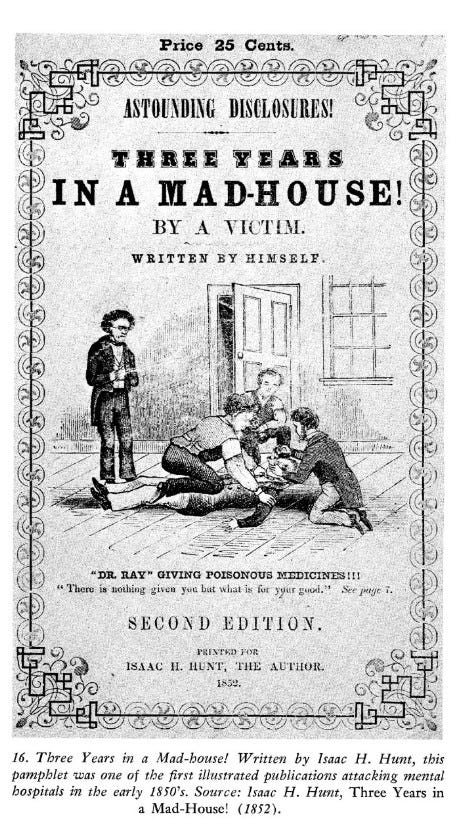
A reprint of Hunt’s book is still available on Amazon. Hunt’s complaints led to an investigation by the Maine legislature. Interestingly, Hunt himself acknowledged his mental illness, writing, “…it is of no use for me to deny, (for of that fact there is abundant proof) that when I was taken to the hospital, I was a perfectly deranged man, laboring under a strong fever of the brain or great and uncontrollable mental excitement, of which, under humane treatment, I should have recovered…” This suggests that Hunt was in the midst of a manic episode. His book is full of flight of ideas, grandiosity, and psychotic analogies. I can find no biographical material as to what happened to Hunt after his release from the hospital. Although he pursued legal action against Isaac Ray, the superintendent of the Maine Insane Asylum, nothing ever came of it.
A more serious case, which clearly involved violations of individual rights, was that of Mrs. Elizabeth Packard. Born Elizabeth Parsons, she was diagnosed at age 19 with “brain fever” and admitted to Worcester State Hospital for six weeks. In 1839, Packard was forced by her parents into marriage with Theophilus Packard. The family moved to Illinois, which in 1851 had passed a law requiring a public hearing before a person could be committed against their will. The exception to this law was that a husband could have his wife committed with neither a public hearing nor her consent. Theophilus was irritated by his wife’s disagreements over his fundamentalist religion as well as her antislavery attitudes. Theophilus, with the help of a local doctor, had her committed to the Jacksonville Insane Asylum for three years. Elizabeth was finally able to secure a trial, which lasted five days, where many neighbors testified that they had never seen mental illness in Elizabeth. The jury deliberated for seven minutes and found Elizabeth sane. The case became nationally known, and Elizabeth Packard continued to be an advocate for more safeguards in the civil commitment process. In 2023, the mental hospital in Springfield, Illinois in which Elizabeth Packard was treated was renamed from the McFarland Center (after the psychiatrist who treated her) to the Elizabeth Packard Mental Health Center.
Even though the legal protections for the patient in the process of commitment to a mental hospital were strengthened, they were rarely used in the first part of the 20th century. In the copious literature on deinstitutionalization, one can find many references to both Hunt and Packard, often with the implication that such cases were frequent and that many people had been inappropriately confined to psychiatric hospitals. As also noted in this series, hospitals were crowded with patients with psychosis (which appeared to be increasing in prevalence) as well as with demented and syphilitic patients. It seems highly unlikely that superintendents of these institutions would have allowed large numbers of otherwise healthy but “socially deviant” individuals to remain.
By the middle of the 20th century, views of the mentally ill changed radically. The widespread use of new antipsychotic and antidepressant medications returned many people to good mental health and made it possible for them to leave the hospital or avoid hospitalization altogether. The unfortunate participation of many prominent German psychiatrists in the Nazi eugenics program discredited the biological model of mental illness. The widespread acceptance and influence of psychoanalytic theory in the period from 1945 to 1980 cannot be overstated. Psychoanalytic theory proposed not only an all-encompassing therapy for mental disorders but also a complete model of the human mind. The 1950s and 1960s were an era very much like that of the 1770s: a revolutionary time when anything was thought to be possible. It was a time of throwing off inhibitions, of “letting it all hang out” and “if it feels good, do it.” As noted by E. Fuller Torrey in his book, American Psychosis, mental health opinion leaders were convinced that all mental illness could be treated by therapy, and that psychoanalytically oriented social policies would prevent the development of mental illness in the future. The community mental health movement would replace the state hospitals. (We will examine this movement in Part 4 of the series.)
The legal system was undergoing its own revolution. Presidents from Franklin Roosevelt to Dwight Eisenhower had appointed many liberal jurists to the federal courts in general and to the U.S. Supreme Court in particular. In a series of decisions, the Supreme Court struck down prayer in schools and racial segregation in public places and education, and it remade the criminal justice system with decisions such as Miranda v. Arizona, which emphasized the individual rights of the accused. The court began to significantly limit state authority in a wide variety of areas. Patient “advocates” and their lawyers began looking for cases to transform the medical aspect of mental health commitment into a rigid legal process that would make it difficult for people to be committed to hospitals.
The “Dangerousness Standard”
Most people today are familiar with the concept of “dangerous to self or others” as a criterion for involuntary commitment to a mental hospital. Mental health commitment laws vary from state to state. In Texas, there is an additional criterion of “evidence of severe emotional distress and deterioration in the Proposed Patient’s mental condition to the extent that the Proposed Patient cannot remain at liberty.” For instance, a psychotic patient may want to sleep outside when the temperature is below freezing or refuse to eat because they believe their food is poisoned. The level of deterioration must be so severe that an imminent threat to the patient’s well-being is present. Sadly, close to this level of impairment is now needed for patients to be voluntarily admitted to a psychiatric hospital, as insurance companies often will not approve the hospitalization unless the stricter criteria are met.
Two landmark cases were critical in establishing the “dangerousness” standard. Both Lessard v. Schmidt (1972) and O’Connor v. Donaldson (1975) are prominently mentioned in any textbook of mental health forensics. The details of these cases and the people behind them are less well known. Alberta Lessard was born in 1920 and was a teacher in Wisconsin. On October 29, 1971, police officers in West Allis, Wisconsin, were called to her apartment building due to reports of erratic behavior. She was running up and down the hallways of the apartment building, banging on doors and shouting. Witnesses said she was stating that communists were taking over the country and that a squad of men directed by President Nixon was coming to get her. She then climbed onto her window ledge, prompting a neighbor to call the police. Police officers brought her down from the window ledge and sought her commitment. This was not Lessard’s first mental health episode. She had been dismissed from several teaching jobs and then continued to harass her employers afterward.
She was diagnosed at the Milwaukee County mental health facility with paranoid schizophrenia and held there involuntarily. From the above description of her behavior, it is clear that the diagnosis was not in dispute. From a hospital payphone, she was able to contact Milwaukee Legal Services, and a class-action lawsuit was filed. In what would become standard legal procedure in mental health cases, attorneys argued that Alberta’s Fourteenth Amendment due process rights were being violated. In short, many of the protections of criminal law would be applied to the commitment process, such that being in a psychiatric hospital was made analogous to being in jail. A three-judge panel for the U.S. District Court for the Eastern District of Wisconsin ruled that involuntary commitment constitutes a loss of liberty that triggers stringent constitutional protections. They created four core mandates:
Mental illness alone is not a sufficient ground for involuntary commitment. The state must establish that the individual is an imminent danger to self or others.
·The District Court wanted a standard of proof beyond a reasonable doubt as the standard for commitment; fortunately, the U.S. Supreme Court lessened this to “clear and convincing evidence” in a later case.
Very strict procedural timelines were put in place, patients were given the right to counsel, and patients were given notice of these rights.
Patients were given a privilege against self-incrimination, which gave them the right to refuse to speak with an evaluating psychiatrist, and hearsay evidence was ruled inadmissible.
As a result, it is virtually impossible to commit an individual for involuntary treatment until their illness is extremely severe and poses a danger not only to themselves but also to the community. This is analogous to recent dilemmas of obstetricians practicing in states where abortion is illegal. They must struggle with the decision to terminate a pregnancy, waiting until the woman is sufficiently ill such that her life is in danger.
Whatever happened to Alberta Lessard? In 2011, The Milwaukee Journal Sentinel did an extensive report on the impact of the Lessard decision and looked at Alberta’s life after the case. She became a well-known person in Milwaukee and Madison, lobbying the legislature and submitting “ditties” about local public officials to newspapers. She was disappointed in her case because she had wanted the court to declare that she herself was not mentally ill. In a delicious irony, she filed a lawsuit against her own attorney in her case, claiming inadequate representation because the ruling did not clear her psychiatric record. In later life, she became homeless and began regularly seeking admission to the very same county psychiatric hospital where her case began. The hospital could not admit her, however, because she was not an imminent danger to herself or others. As noted, this legal standard has now become the clinical standard used by inpatient facilities to determine criteria for admission. Over her lifetime, she experienced more than two dozen hospitalizations when she was in crisis. Her health declined, and her family petitioned for guardianship in 2011 so that she could get care in a nursing home. She ultimately died at age 90.
Had the Wisconsin District Court’s decision that “proof beyond a reasonable doubt” was to be the standard for mental health commitment stood, it might have been nearly impossible to commit all but the most immediately dangerous patients. The U.S. Supreme Court later implemented the lesser standard of “clear and convincing evidence” in the case of Addington v. Texas (1979). Frank O’Neill Addington was a man with schizophrenia who had a history of multiple commitments to the Austin State Hospital. In December 1975, Addington was arrested for assaulting his mother, who then filed a legal petition to have him involuntarily committed for an indefinite period. He was provided with a court-appointed attorney who ultimately took his case to the U.S. Supreme Court. At trial, psychiatric experts testified that Addington suffered from severe delusions and had a history of causing property damage and threatening family members. Presumably through his attorney, Addington conceded that he had a mental illness, but he argued that the state failed to prove he posed a significant danger to himself or others. The Supreme Court ordered that this new standard (clear and convincing) be used for Addington, but it turned out that the state judge in the original case had in fact instructed the jury to use that very standard! Thus, the Texas Supreme Court found that his original commitment should stand. He was not released, and how long he remained in the hospital after that is unknown. Frank Addington has disappeared from history. Quite likely he was released eventually, as courts would later rule that even people who were committed needed to have regular reviews to determine if they still met criteria for commitment; in Texas, an extended commitment can now last a maximum of a year. Few, if any, states allow indefinite commitment.
A companion case to the above is O’Connor v. Donaldson (1975). Kenneth Donaldson was born in the first decade of the 20th century, and his early life appeared uneventful. However, at age 34 in 1943, he suffered a mental health crisis and was hospitalized. He returned home and had no further incidents for over a decade. In 1956, at the age of 47, he was visiting his parents in Florida and told them that a neighbor back in Philadelphia was trying to poison his food. His father filed a petition with the local judge requesting a sanity hearing. As was typical for that time, he did not have an attorney, and the judge committed him to the Florida State Hospital in Chattahoochee. He ended up staying there for nearly 15 years. While there, he refused all treatment, and there were no documented reports of dangerous behavior. Friends offered to help take care of him outside the hospital, but the superintendent (O’Connor) refused to discharge him. It is unclear why the Florida State Hospital would have refused to discharge him. We do not know if this was stubbornness on the part of the hospital medical staff or whether they failed to adequately document their concerns about Donaldson’s behavior. The U.S. Supreme Court reaffirmed that the state cannot constitutionally hold a non-dangerous person even if they are mentally ill.
When students are taught these cases, either in law school or in forensic mental health courses, it is generally taken at face value that all of these individuals were grievously harmed and their liberty denied by being in state hospitals. We can see that in the landmark cases of Lessard and Addington, these individuals were clearly mentally ill and, in fact, were benefiting from their hospitalization. Addington was assaulting his mother—a sad reality for many families whose children, spouses, or parents have a major mental illness. The case of Donaldson is really more of a medical malpractice case. It is not clear why the court could not have simply ordered a second opinion or a rehearing in Donaldson’s case, which would have no doubt resulted in his release. In fact, civil rights attorneys of the era were very clear about what they were doing. The facts of the cases were irrelevant. Ideologically, they wanted to seriously weaken the commitment process, and they knew the judges were on their side because that was the tenor of the times.
There was no significant pushback from the mental health profession at the time because of the widespread belief that long-term hospitalization would soon be unnecessary. It was believed that the new community mental health centers would be curing these patients or preventing psychiatric disease in the first place. Moreover, the idea that mental illness was not real and that the mentally ill were victims of social control was gaining momentum. Despite the implementation of the dangerousness standard, people continued to be committed to psychiatric hospitals; psychiatrists were simply forced to wait until the patient was more severely ill, which inevitably happened. It was not the legal standard of dangerousness alone that did the ultimate damage to the state hospital system. To complete the legal landscape of deinstitutionalization, far worse was to come.
The “Denominator” Strategy and the Final Blow to State Hospitals
The next phase in litigation that greatly accelerated deinstitutionalization came, as it often does, through the unanticipated consequences of a ruling that, at the time, appeared to be a moral necessity. This part of the story involves the Alabama federal judge Frank M. Johnson, Jr., who is truly an American hero. Johnson was appointed to the federal bench in Alabama by President Dwight Eisenhower, and he was involved in some of the most historic civil rights cases of all time. In 1956, Johnson ruled in favor of Rosa Parks, striking down segregated buses. He ordered the Ku Klux Klan and the Montgomery, Alabama police to stop beating Freedom Riders. He protected the rights of activists on the Selma to Montgomery march in 1965. The KKK burned a cross on his lawn after the Rosa Parks decision, and his mother’s house was bombed. He had to be protected by federal marshals for nearly 20 years due to the constant death threats he received, and he was ostracized by many of his neighbors.
It will not surprise you that, at this time, Alabama was known for the atrocious state of both its prisons and social services. George Wallace, the infamous segregationist, was governor at the time. In 1970, the Alabama state legislature reduced the cigarette tax, which was the primary funding source for the Alabama mental health system. This forced a sudden firing of 99 employees of Bryce State Hospital and left only 17 physicians and 21 nurses to care for 5,200 patients. In addition, physical conditions in the hospital deteriorated markedly. Ricky Wyatt was a 15-year-old boy with no history of mental illness who had been placed in a group home for minor juvenile delinquent behavior. He had difficulty adjusting there and subsequently the juvenile court committed Ricky to Bryce State Hospital, a common practice in Alabama. When the Alabama legislature cut funding to the hospital, the laid-off employees went to Judge Johnson seeking to have the funding for their positions reestablished. Here is where things get tricky from a legal perspective. Judge Johnson noted that federal courts had no authority over a state’s hiring decisions. Johnson ruled that there might be a federal issue as to what was the minimum standard required for treatment of people who were involuntarily committed to a state institution. Under this framework, the employees of the hospital could not be the plaintiffs. Here is where fate intervened, as Ricky Wyatt was the nephew of one of the laid-off employees at Bryce. Thus, Ricky Wyatt became the plaintiff representing the whole class of patients, and the case of Wyatt v. Stickney (1971/1972) was born. Since Wyatt was not mentally ill, he was able to testify to the abhorrent conditions at Bryce.
At this point, we will introduce another interesting character, Morton Birnbaum. Birnbaum received his law degree from Columbia in 1951 and then a medical degree from New York Medical College in 1957. He never completed a psychiatry residency but did a fellowship at the National Institute of Mental Health. Throughout his life, he was engaged in pro bono legal work for the mentally ill. It is Birnbaum who developed the concept of a “right to treatment.” Judge Johnson would rule that involuntarily confined patients have a constitutional right to receive treatment but only while in the hospital. He ruled that facilities must provide a humane physical and psychological environment, a sufficient number of staff, and, above all, personalized treatment plans. Judge Johnson explicitly ruled that a lack of funding could not justify failing to meet these standards. In a process lasting over 30 years, Alabama gradually brought its mental health facilities into line with modern standards, but it also closed many of these facilities.
We see in Wyatt v. Stickney the horns of a dilemma in using the federal judiciary to achieve social change. Judge Johnson could not simply order the Alabama state legislature to raise the cigarette tax or any other tax to fund the necessary level of services that the patients needed. In our federal system, that simply cannot be done. Instead, Judge Johnson cleverly developed a ruling that would force the state to improve conditions if it wanted to keep the hospital open. However, this also gave the state a way to wiggle out of the ruling. The state can close the hospital or reduce its census, and since the patients are no longer involuntarily committed, the right to treatment disappears. In fact, the U.S. Constitution does not guarantee a right to any form of medical treatment. The legal minds of the time clearly saw the “right to treatment” as a Trojan horse. They knew states would not commit the resources and that patients would need to be released, treatment be damned. This brings about the “Denominator Strategy.”
As the 1970s wore on, legal advocacy groups brought suits in multiple states based on the framework of Wyatt v. Stickney. Legislators were almost unanimous in their opposition to doing anything to upgrade the quality of care in state hospitals. Moreover, the community mental health movement began to reach its fever pitch. Biologically-oriented psychiatrists believed that modern medication treatment would reduce the need for hospitalization. Many psychiatrists and nonmedical mental health professionals believed that a wide range of social interventions would significantly reduce the toll of chronic mental illness. Once a lawsuit was filed, legal advocates and representatives of the state would simply negotiate a reduction in the census of the state hospital, and, of course, the lawyers would walk away with their fees. It often came down to the following formula:

The ‘Denominator Strategy’ allowed states to satisfy court-mandated per-patient care standards without increasing state funding simply by shrinking the denominator—the hospital patient census. While the formula above was never legally enshrined, it became a simple shorthand for how much states could reduce the census of their state hospitals to resolve litigation.
To cap this all off, courts then went on to find that there was not only a “right to treatment” but a “right to refuse treatment.” The table below shows the major cases in this area:
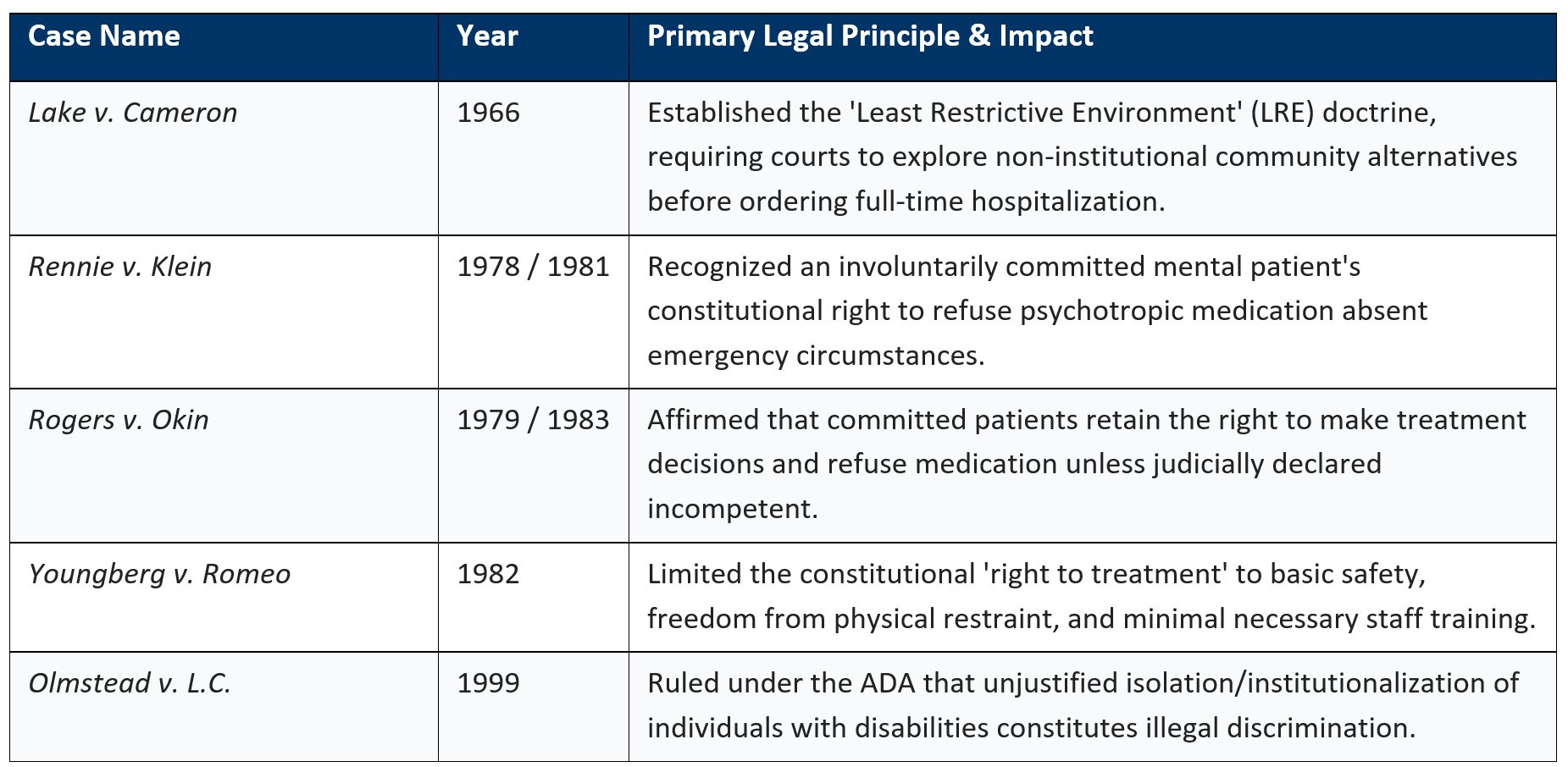
The right to refuse medication meant that after an individual was committed, there were often long delays in implementing what is often the main treatment (medication) that can restore them to sanity. All of this must take place within the “least restrictive environment (LRE).” The least restrictive environment (or alternative) is a concept that predated the litigation discussed so far. Lake v. Cameron (1966) required courts to explore less restrictive community settings before ordering full-time inpatient hospitalization. This was expanded dramatically in Olmstead v. L.C. (1999), where it was held that placement of disabled individuals in an institutional setting constituted legal segregation. Also, LRE has now become a mainstay of special education law, resulting in many very seriously handicapped and mentally ill children being mainstreamed with little real educational support. This will be the topic of a future Substack.
Today, the “right to refuse treatment” far outweighs any “right to treatment.” Indeed, in Youngberg v. Romeo (1982), the Supreme Court limited the “right to treatment” to basic safety, freedom from bodily restraint, and the minimal training of staff required to protect patient rights. At the end of his career, Morton Birnbaum was very disappointed that a constitutional right to mental health treatment never really came to fruition [110 Duq. L. Rev. 554 (1972)]. Civil libertarians, however, were very pleased with their work, as reducing or eliminating involuntary commitment, regardless of consequences, was always their intent (in addition to being immensely lucrative).
The Competency Doom Loop
Pretending that mental illness did not exist did not make it go away, of course. Thousands of patients were released in the 1970s and 1980s, and as the 20th century ended, hundreds of thousands more were never hospitalized. However, the severity of behaviors associated with their mental illness led to a collision with the criminal justice system. Today, approximately 20% of local jail inmates have a serious mental illness; this represents anywhere between 130,000 and 140,000 individuals, exceeding the total population of all state hospitals in the U.S. If one includes anyone with a significant mental disorder, this figure may be between 280,000 and 450,000, nearly equivalent to that of state hospitals before the era of deinstitutionalization (even without adjusting for the growth in population since 1950). When the severely mentally ill are charged with a crime, the immediate question is whether they are competent to stand trial—that is, whether they can understand the charges against them and participate meaningfully in their defense. The assumption of this legal framework is that a person can then be treated and, thus, their competency will be restored. For many patients, however, their mental illness is so severe that they cannot be restored and can potentially end up in the hospital or jail for many months or years. This doom loop has become so severe that many state hospital beds are now tied up with such “forensic patients,” leaving no room for civil commitments.
The Folly of Treating a Medical Illness as a Legal Problem
Alexander Hamilton stated that the judiciary was “the least dangerous branch” of the government, as it held no military power or any other active force. Today, the judiciary is the most powerful branch as Americans look to it to resolve political and social questions of every sort—be it the care of the mentally ill, abortion, healthcare, or economic policy. Even if an election appears to settle an issue, those on the losing side of the issue will go to court to get their way. It is hard to argue with Judge Johnson’s decision in Wyatt v. Stickney since the conditions in the hospital were so bad. There is little doubt that George Wallace and the people of Alabama would have done nothing to improve the conditions at Bryce State Hospital if it weren’t for this decision. Nonetheless, other states (such as Texas) vastly improved their state hospitals in the 1960’s and 1907’s but this did not spare them from lawsuits forcing them to decrease their census. think today, however, we all must share Morton Birnbaum’s disappointment. There was a road not taken because of all this litigation. A robust community mental health system could have provided a firm safety net for people discharged from state hospitals. State hospitals could have been further improved to care for those who truly needed residential care. Why this road was not taken will become clear in Part 4.
No posts
Comments
Nothing yet. Say the first thing.
Sign in to join the conversation.