
The purpose of this series is not to wax nostalgic for the age of institutionalization in the 19th century. As Gerald Grob documented in Mental Illness and American Society, 1875 – 1940, between 1903 and 1940 the number of mentally ill patients in state hospitals increased from 150,000 to 450,000 and conditions began to deteriorate. Was this done at the behest of the psychiatric profession? Was it done because of an intolerant society? As state hospitals began to care for far more patients than they were designed for, there is no doubt that conditions often became inhumane. What destroyed the vision of a small therapeutic community where Moral Treatment would restore the mentally ill to sanity?
Increasing life span and the rise of dementia
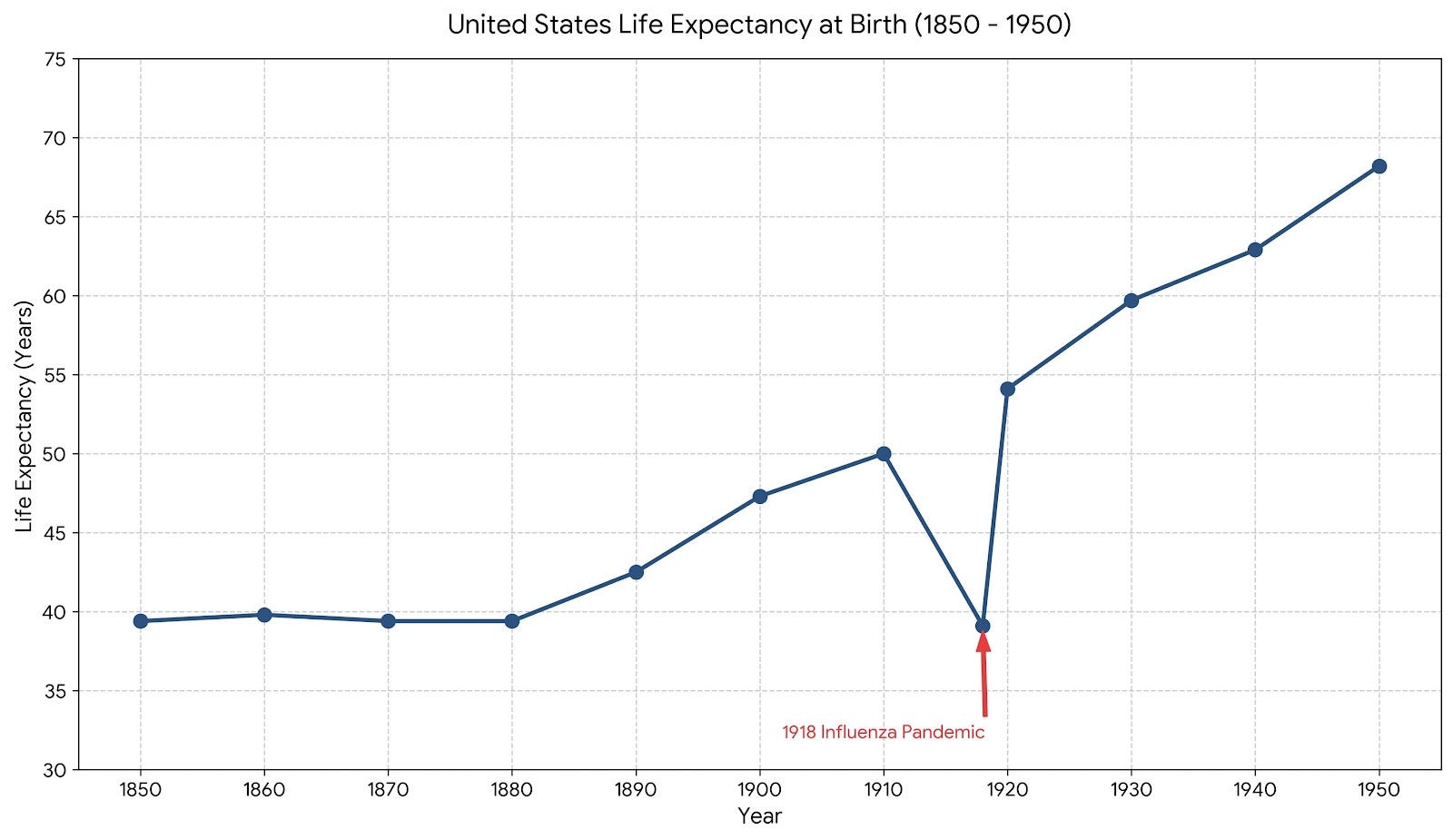
The graph below shows the increase in life expectancy in the United States for the period from 1850 to 1950. A major increase began in 1880 and continued through to the end of the 19th century and into the 20th century, interrupted only by the 1918 influenza pandemic.
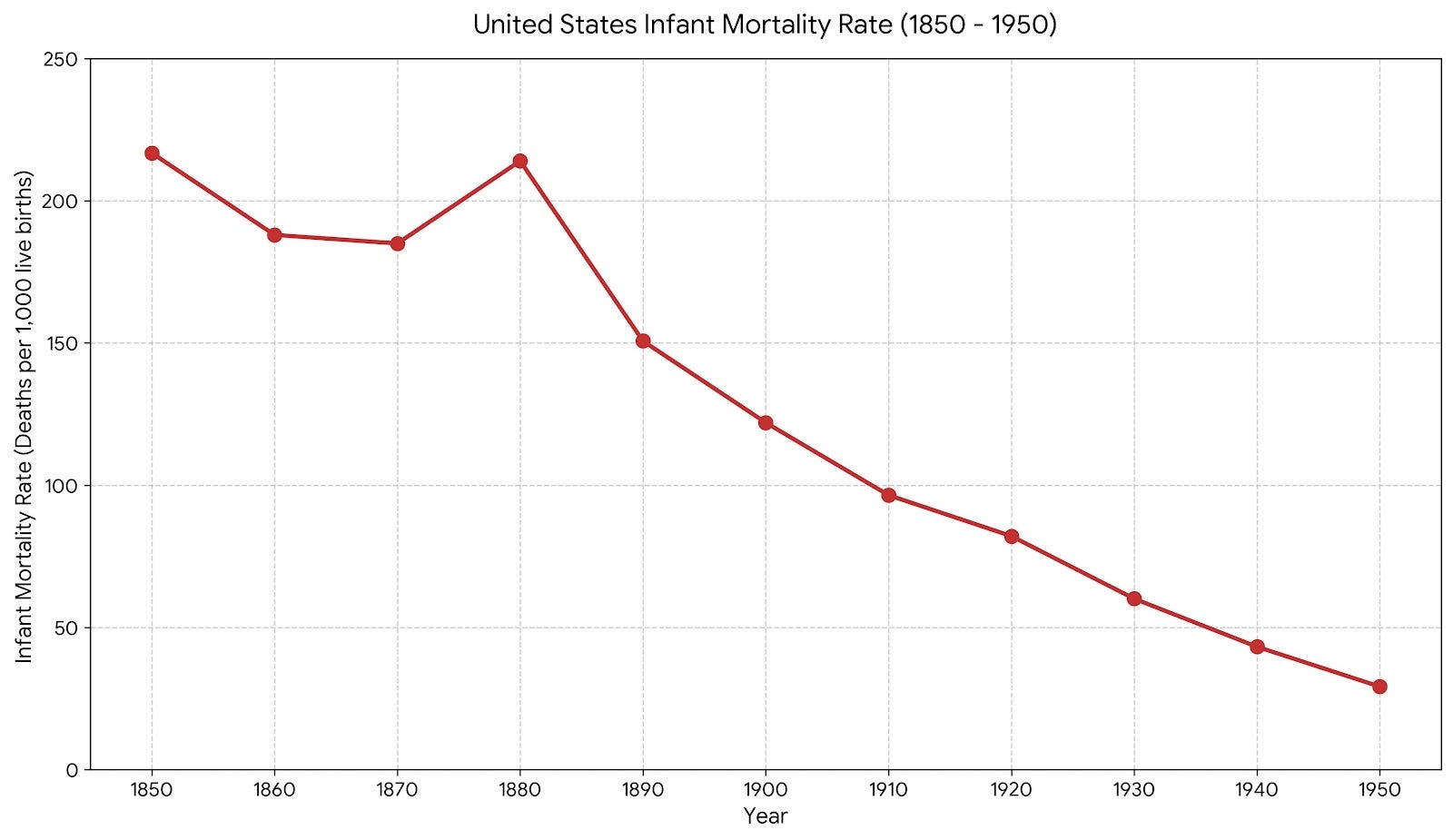
The second graph below the decline in infant mortality, which also started in 1880. These trends were brought about principally by improvements in public health and particularly around improvements in the quality of the water supply, thus reducing the number of waterborne illnesses such as typhoid and cholera.
Obstetrical care also began to be more science based (above, right). The development of anesthesia and the Cesarean section greatly increased the survival of infants. These factors led to the massive increase in the population of the Western world as was discussed in the previous article. For the first time in human history, large numbers of people were living into their 60s, 70s and 80s. Dementia had long been described by ancient physicians; in 1901, the German psychiatrist Alois Alzheimer described his patient Auguste Deter who had the dementia that would ultimately bear his name. Alzheimer followed Deter until she died and then obtained her brain, thus allowing him to identify the amyloid plaques and neurofibrillary tangles that are the hallmark of the disease.
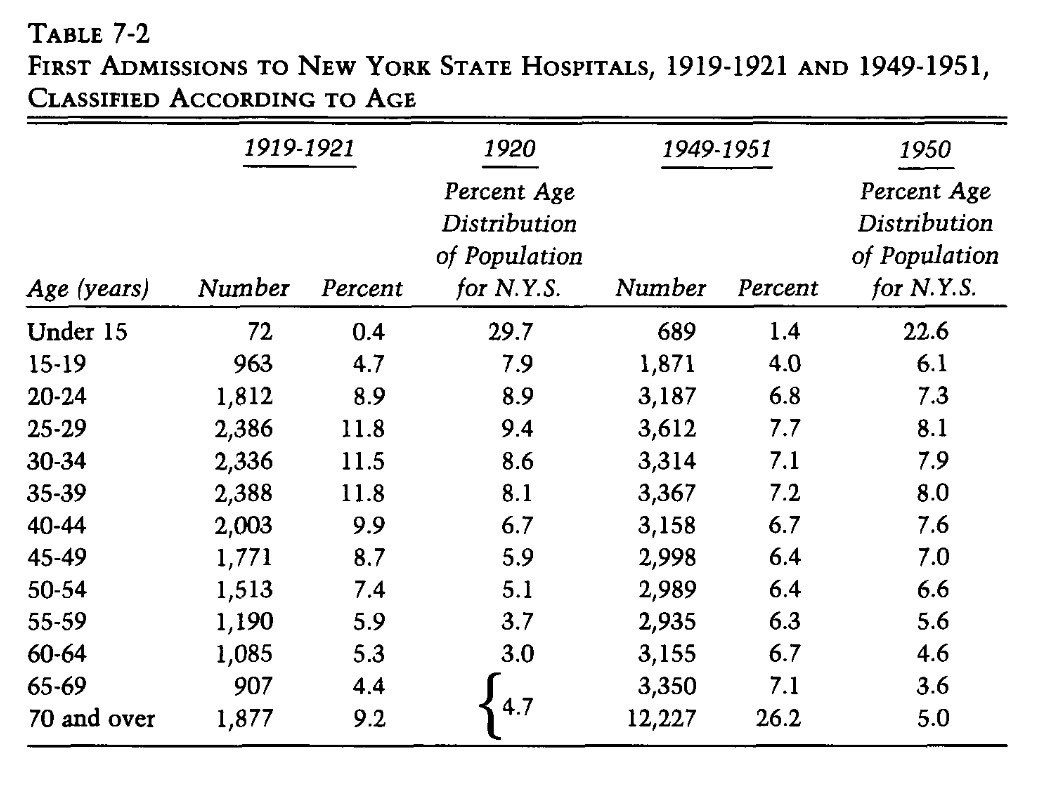
Bear in mind that Social Security only came into existence in the 1930s and Medicare and Medicaid have only been around since the 1960s. Only a handful of employers in the 19th century offered pensions. Thus, when people became unable to work as they aged, they became the responsibility of their adult children. In the 1860 U.S. census, there were only 1.3 million persons over age 60 in the country; this number rose to over 13 million by 1940. In the early part of the 19th century, families sent elderly family members they could not care for to alms (poor) houses, the equivalent of our modern-day homeless shelters. As the 19th century gave way to the 20th century, these institutions began to fade away. While census data shows that 24% of people in almshouses in 1880 were mentally ill, this number fell to 5.6% by 1923. By 1900, the number of aged people with dementia admitted to state hospitals began to climb dramatically. The table below from Grob’s book shows this very clearly, with the elderly comprising 13.6 % of admissions to New York state hospitals in 1919 and 33% of admissions in 1951.
Insert Chart
Grob quotes the psychiatrist Charles G. Wegner of the Binghamton State Hospital in 1900 (pg. 186):
“We are receiving every year a large number of old people, some of them very old, who are simply suffering from the mental decay incident to extreme old age. A little mental confusion, forgetfulness and garrulity are sometimes the only symptoms exhibited, but the patient is duly certified to us as insane and has no one at home capable or possessed of means to care for him. We are unable to refuse these patients without creating ill feeling in the community where they reside, nor are we able to assert that they are not insane within the meaning of the statute, for many of them, judged by the ordinary standards of sanity, cannot be regarded as entirely sane.”
A study of Illinois state hospitals in the early 1930s criticized the state for using state hospitals as shelters for older people with dementia. They noted, “an illustration of the enormity of this difficulty is found in the Chicago State Hospital, with nearly 70% of its 4,000 patients aged or infirm.” As a result of so many elderly patients with dementia, the length of stay at nearly every state hospital increased significantly toward the end of the 19th century. Many aged patients were admitted late in their course of dementia and died not long after admission, thus dramatically increasing the death rate in state hospitals as shown in the chart below (from Grob).
General Paresis of the Insane
The chart above shows that the death rate in state hospitals was quite high, even for younger patients. Is this an indictment of the quality of care of patients? We cannot understand the environment of state hospitals in this era without understanding the incredible effect of infectious disease in general, and syphilis in particular, on the prevalence of severe mental illness at the time. I have a copy of the psychiatric textbook, Modern Clinical Psychiatry by Arthur Noyes, published in 1948. There are four chapters dealing with psychoses secondary to infectious agents, which in the pre-antibiotic era were a major focus of a state hospital psychiatrist’s job. I wish to focus on General Paresis of the Insane (GPI) which is today nearly forgotten but accounted for a very significant proportion of state hospital patients 100-150 years ago. It is important to have a quick review of the stages of syphilis:
Primary syphilis. Syphilis is caused by the bacteria Treponema pallidum which is spread through direct sexual contact. The acute phase lasts 10 to 90 days and consists of single or multiple painless lesions known as chancres. It can be treated effectively with antibiotics today but is highly contagious if an untreated person has multiple partners.
Secondary syphilis. Occurring weeks to a year after the acute infection, a patient may develop a diffuse rash on the trunk, palms and soles, swollen lymph nodes, fever, malaise and arthralgias. The person may believe they simply have a bad case of the flu. They remain infectious during this stage.
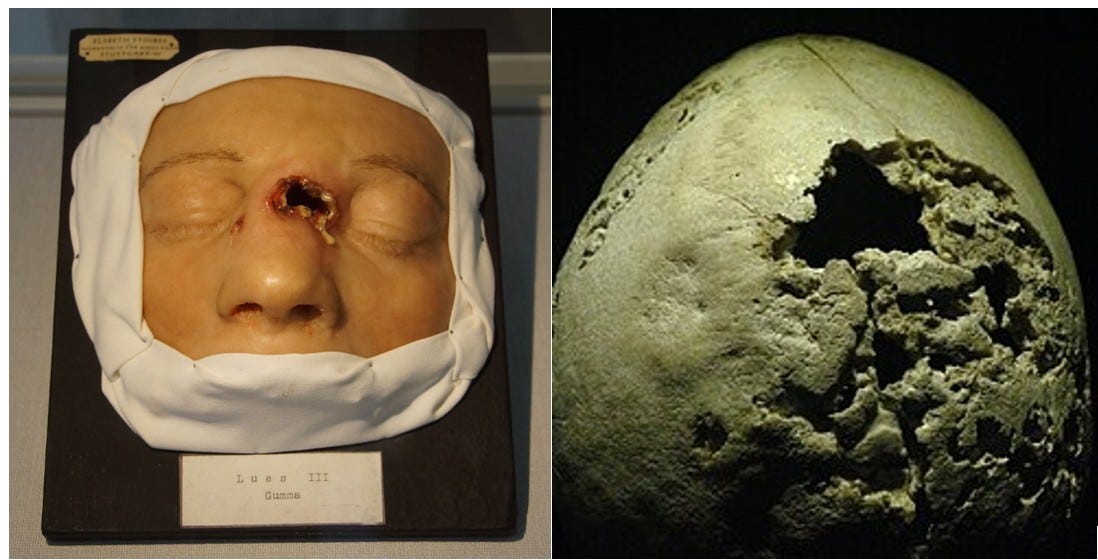
Tertiary syphilis. The disease often enters a latent phase where the person appears to recover but evidence of the infection can be found in the blood. Years or decades later, the individual may develop tertiary syphilis which is quite horrific. As shown below, patients may develop gummas, which are lesions that literally eat away at the skin and bone. The person may develop an aortic aneurysm and many other serious neurological manifestations. Eventually this leads to death.
Neurosyphilis is not a particular stage of the disease but can occur at any time during the illness. In early neurosyphilis, the person may develop meningitis and other neurological symptoms. As it progresses, the individual may present with personality changes, disinhibited behavior, and psychosis. This can then progress to a dementia which is where the term GPI was applied in this earlier era. From descriptions of GPI, the syndrome sounds very similar to frontotemporal dementia or Lewy bodies dementia. The illustration below shows the horror of the condition. Before the invention of antibiotics, this disease was uniformly fatal.
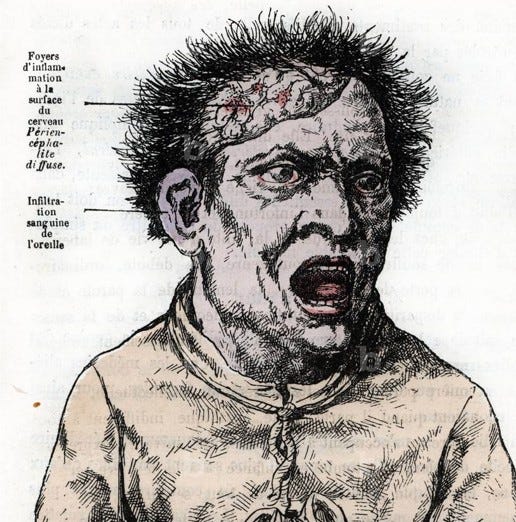
Syphilis was the HIV-AIDS of the 19th century. It affected people at all levels of society. It is thought that Lord Randolph Churchill, the father of Winston Churchill, suffered and died from neurosyphilis, although this is contested. Lord Randolph Churchill was one of the leading politicians of his day and thought to be a future Prime Minister. When he abruptly resigned from his position in the cabinet, he began behaving erratically and ultimately died at age 45. Rudolph, the Crown Prince of Austria also likely contracted the disease. In his 20s, he became increasingly emotionally unstable and began an affair with a 17-year-old girl. Rudolph and his lover killed each other in a suicide pact in 1889.
A more in-depth discussion of GPI can be found at this website describing events at Staffordshire County asylums in England. The Treponema bacteria was discovered by German scientists in 1905, and the Wasserman test was developed in the early 1900s. It is estimated that as many as 7% of the adult population of Britain had some form of syphilis. One third of those adults would progress to neurosyphilis, making it the most common cause of dementia in the first half of the twentieth century. The website cited gives a description of a typical GPI patient from 1859 at Bethnal House Asylum in England:
“a person who is insane shows slight tremors of the lips… And feeble, straddling, or devious gate… He is full of all manners of schemes… And talks of the wealth he fancies his projects have brought him…The world of the spirits increases… Arrived at this pitch, everything becomes invested with immensity, grander, or beauty… Incessantly talking and restless, violent and destructive, tearing everything terrible to shreds… He lies on his bed… Or on the padded floor in his room in a dream of happiness and splendor, which contrasts horribly with his hollow features and emancipated, squalid body. Happily, death is at hand-exhaustion or paralytic, soon closes the scene.”
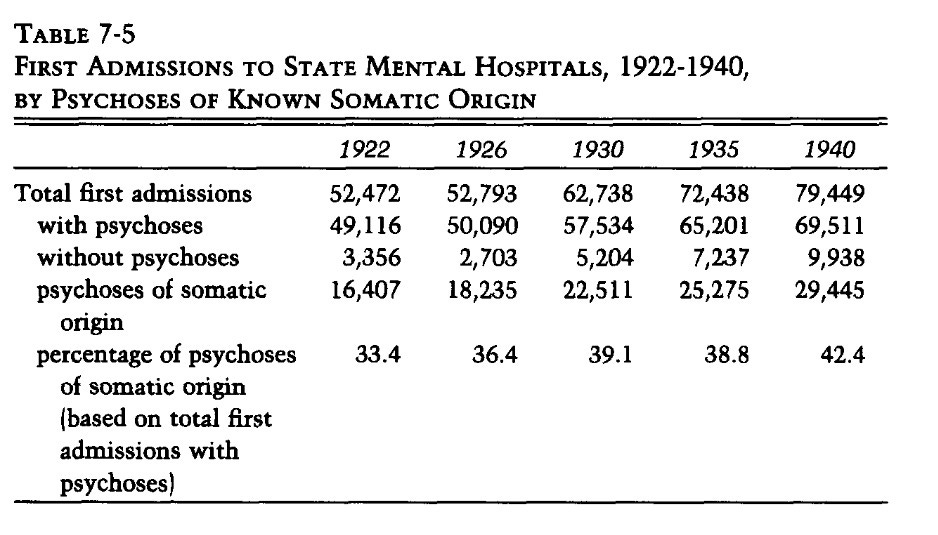
Grob documents that between 1911 and 1919, about 20% of all male first admissions to New York State mental hospitals were cases of GPI (the rate of GPI in females was about one third of this). Grob constructed the table below showing the total admissions in US state mental hospitals from 1922 to 1940. As is shown in the table, up to 40% of admissions were due to psychoses of somatic origin, of which the vast majority would have been due to neurosyphilis. Brain injury through infection from a tubercular or viral meningitis also would have constituted a large proportion of these psychoses.
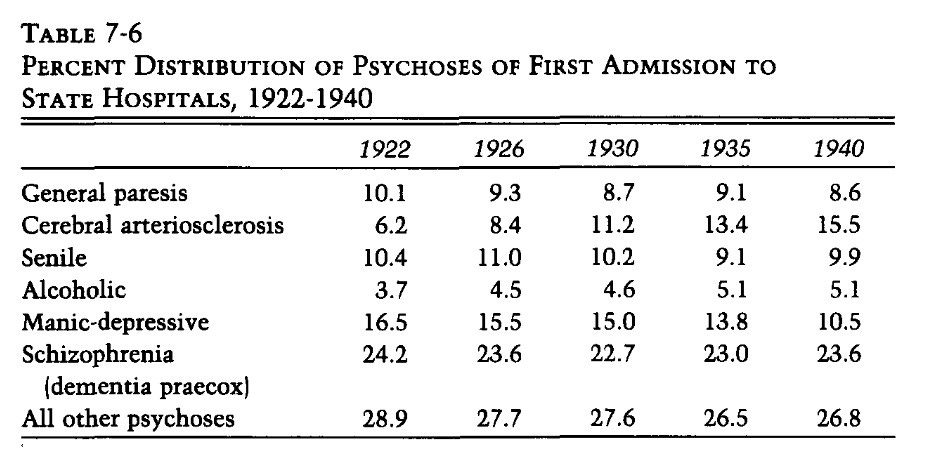
Grob provides more details in the chart below. Again, we can see that physical conditions including GPI, cerebral arterial sclerosis, dementia, and alcoholic psychoses accounted for 40% of these admissions. None of these somatic psychoses could be expected to recover. Manic-depressive illness and schizophrenia together accounted for a little over one third of admissions.
Worse was yet to come. The Great Depression hit in 1929 and the states cut budgets and reduced staff at state hospitals at a time when families’ capacity to care for mentally ill family members was reduced. Then came World War II with its call-up of many men who worked in state hospitals; they were replaced by conscientious objectors, many of whom were appalled by the conditions they encountered.
By 1940, the resident population of state mental hospitals had reached 410,000. That same year, over 100,000 people were admitted to state hospitals (82,000 for the first time) while 59,000 were discharged and 32,000 died. The aggregate state budget in the US for state hospitals was $144 million ($230 billion in today’s dollars). In Andrew Scull’s book, Madness and Civilization (page 366), there is a particularly disturbing photograph. It shows the “male incontinent ward” at the Byberry State Hospital in Philadelphia. It was taken in 1944 by Charles Lord, a Quaker conscientious objector assigned to work as an attendant. In the photo, naked men can be seen walking around an empty room with puddles of urine on the floor. It is difficult to assess the ages of the patients in the photograph though not all of them appear elderly. It is quite likely that many were acutely psychotic; in an era before antipsychotic medicine, there was no effective treatment. Others might be suffering from the somatic psychoses that were discussed.
World War II brought other mental health challenges. Massive numbers of young men were drafted and subjected to not only the stresses of war but dramatic changes in their daily life. Many suffered head injuries, others from what we now call PTSD, while others were drafted at an age when they would have been most vulnerable to a first episode of psychosis. My father was born in 1930, and his maternal uncle was drafted and sent to the South Pacific as a military mailman. From my father’s descriptions of him, it seems his uncle had many of the prodromal symptoms of schizophrenia as a young man. He could not take the stress of being away from home and carrying out his responsibilities as a mailman. He had a severe psychotic break and was returned to the US. His parents were already deceased. My grandmother (his sister) was his closest relative, but she could not visit him in the VA Hospital because at the time only mothers and wives could visit unattended by a male relative. My father was around 14 years old at the time and the VA stated that he could accompany my grandmother. My father describes entering the hospital and walking down a long corridor in which men were in individual rooms, many in straitjackets, and others were strapped to their beds. As they continued down the ward, men were screaming, trying to slam their heads against the wall, and calling for their mothers. When they reached the end of the ward, they found my great uncle, lying in bed, completely unresponsive. Interestingly, my father remembers how clean the sheets were and how it seemed that they were taking very good care of his uncle. My grandmother could not get her brother to respond so she lifted one of his eyelids and repeatedly called his name. My father remembers a tear forming in his uncle’s eyes. My great-uncle ultimately received ECT and this brought him out of his catatonia. Ultimately, he was on antipsychotics, and he lived on a disability pension peaceably with my grandmother until the end of his life. He was fortunate that she was able to offer him this care.
The anti-psychiatry movement portrays the early history of state hospitals as some type of conspiracy by society at large and psychiatry, in particular, to “confine” people who are different. We can see that the huge increase in admissions to mental hospitals in the late 19th and 20th centuries was not planned by a greedy psychiatric profession nor by an intolerant society, but by the inevitable progression of diseases which at that time had no treatment. Nonetheless, people began to look at the conditions in state hospitals and conclude that someone must be to blame.
Two Books and Two Movies
Albert Deutsch was an American journalist during the 1930s who worked as a researcher for the New York State Department of Public Welfare. As part of his duties, he became interested in the plight of the mentally ill and published a history of the treatment of mental illness in 1937. Between 1944 and 1947, Deutsch began investigating the conditions at state hospitals around the country. Many of his interviewees were the conscientious objectors mentioned earlier. His book, The Shame of the States, by and large had the support of the psychiatric establishment. The famous psychoanalyst and psychiatrist Karl Menninger wrote an introduction to it. Deutsch regularly requested and was granted tours of state hospitals by their superintendents, and he frequently quoted physicians and staff at the hospitals. In his book, Deutsch wrote:
“The plain fact is that most of these men welcomed the opportunity to get the true story before the public… They had become increasingly aware of the fact that only an enlightened public opinion could move state administrators to take the measures needed to stave off complete institutional collapse.”
The book is best known for its vivid descriptions of overcrowded and understaffed wards at state hospitals whose censuses had grown into the thousands of patients. Importantly, Deutsch did not call for closing state hospitals but rather described his “ideal state hospital.” He also made a point of not looking for scapegoats but instead called for a public reform movement to address the lack of state funding and to pressure state representatives, whom he saw as a principal cause of the inhumane conditions in these hospitals.
The movie, The Snake Pit, released in 1948, probably had a greater impact on the public than Deutsch’s book. Starring Olivia de Havilland, it told the story of Virginia Cunningham, a married woman who finds herself in a mental hospital. The movie was based on a semi-autobiographical novel by Mary Jane Ward who herself had been hospitalized at Bellevue Hospital and Rockland State Hospital. Ward appears to have been catatonic and suffered from mood swings. Once the movie became popular, however, Ward denied that the movie reflected her own life. Nonetheless, she was hospitalized twice more during her life and her later novels again focused on mental illness. The producers of the movie tried to make it as realistic as possible, and de Havilland herself visited psychiatric hospitals in preparation for her role. Viewing the movie today, the sexism of the mid-20th century is plainly obvious. The movie exploits the trope of the Evil Nurse who is abusive to Virginia. The psychiatrist is portrayed sympathetically, and Virginia participates in psychotherapy with him. Virginia is treated with electroconvulsive therapy (ECT) without anesthesia and it is here that the film becomes melodramatic. When ECT was first developed, it was administered to patients without any anesthesia or muscle relaxant, but the obvious dangers and discomfort of this led almost immediately to the use of anesthesia, which was standard by the 1930s. Given the description of Mary Jane Ward’s condition, it is highly likely that she herself received ECT as it was the only effective treatment for catatonia in those days (and is a very effective treatment to this day). The movie was not only a hit at the box office but received several Academy Awards. It was widely praised by the psychiatric establishment. At the end of the movie, Virginia leaves the hospital much improved, in contrast to the pessimism of the movie title.
The deinstitutionalization movement had already begun in professional and political circles by the late 1940s. Deutsch’s book and The Snake Pit did much to accelerate political support for these movements. In 1962, just one year before the federal Community Mental Health Act was signed, the novel, One Flew Over the Cuckoo’s Nest, by Ken Kesey was published. It was adapted into a Broadway play and ultimately into the well-known film starring Jack Nicholson. The movie probably has been viewed more than the book has been read. The novel received extensive literary acclaim in its day and was a staple of college English classes in the 1970’s. The movie is probably still shown to many mental health professional trainees at one time or another during their education. The movie departed significantly from the novel; indeed, Ken Kesey sued the producers of the movie because he felt they had strayed from his vision. The book cannot really be recommended today because of its many misogynistic and racist tropes. Most notorious, the novel refers to all the African-American attendants as “the black boys” and as in The Snake Pit, Nurse Ratched is portrayed as evil with the added dimension that she seeks to emotionally castrate her male charges (and the “black boys” obey her at every turn). The character Randle McMurphy sexually assaults Nurse Ratched. The novel is narrated entirely in the first person by a stereotypical Native American character, “Chief Bromden.” In contrast, the movie centered on the Nicholson character of Randle McMurphy. A simplistic reading of the plot is that McMurphy and his fellow patients are nonconformists and that the mental health system is oppressing them, subjecting Murphy to ECT (without anesthesia) as a punishment for non-conformity, and finally giving him a lobotomy. It is likely many people’s perceptions of ECT today come from this movie, even if they have not seen it.
From a literary perspective, One Flew Over the Cuckoo’s Nest represented mental illness as an allegory in which the patients represent nonconforming individuals in society and the medical authorities are symbolic of establishment forces. Kesey himself had worked the night shift as an orderly at the Veterans Administration Hospital in Menlo Park, California. He also interestingly was a paid research participant in early studies of LSD and mescaline as part of Project MKUltra. In any case, Kesey was one weird dude, although perhaps not by the standards of 1960s counterculture. He extensively used psychedelics. In 2011, the journalist Paul Krassner reminisced about interviewing Kesey in 1971. Krassner reported finding a card from Kesey on which was written, “The Anal Sphincter: A Most Important Human Muscle,” which “can differentiate between solid, fluid and gas.” Krassner traveled to San Francisco to see Kesey. This is how he described the scene:
“Kesey had been in Palo Alto for a week when I arrived. He was sitting in the backyard at a table with an electric typewriter on it. His parrot, Rumiako, was perched on a tree limb right above him, and whenever Rumiako squawked, Kesey would type a sentence as though the parrot were dictating to him. Kesey looked up at me. ‘Hey, Krassner, I’ve just been sitting here, thinking about the anal sphincter.’ I reached into my pocket, withdrew that message about the anal sphincter that I had transported 3,000 miles and handed it to Kesey. ‘My card,’ I said. It was a mystically appropriate gesture for a new beginning.
Kesey had been reading a book of African Yoruba stories. The moral of one parable was, ‘He who shits in the road will meet flies on his return.’ With that as a theme, we assigned R. Crumb to draw his version of the Last Supper for our cover of The Last Supplement. A pair of black women from the Jehovah’s Witnesses stopped by the garage one day, and within ten minutes Kesey had convinced them that where there’s talk of locusts in Revelation, it was really prophesying helicopters. Actually, he was a practicing Christian who also threw the I Ching every day as a religious ritual. When his daughter Shannon was invited out on her first car date, he insisted that she throw the I Ching in order to decide whether or not to accept.”
In the 1971 Realist interview, Kesey was asked to differentiate between freedom and insanity and he responded as follows:
“True freedom and sanity spring from the same spiritual well, already mixed, just add incentive. Insanity, on the other hand, is dependent on the material fad and fashion, and the weave of one’s prison is of that material. “But I didn’t weave it,” I hear you protest. “My parents, their parents, generations before me wove it!”
People of a literary bent make their living parsing and seeking to understand statements like the one above and trying to discover if some deep wisdom is embedded in it. To a psychiatrist’s eye, many of these behaviors and writings suggest paranoia and grandiosity. In Kesey’s novel, Chief Bromden believes in a “Combine,” which controls not only the hospital but everything outside it. Perhaps such odd cognitions were the product of the counterculture of the 1960s or psychedelic use. The point here is that while Ken Kesey wrote superb and artistic prose, it did not make him an expert on mental illness and his novel should not be taken in any other spirit than a literary one. We also must wonder if Kesey was simply expressing his own paranoia. Unfortunately, the movie’s highly inaccurate portrayal of ECT did its part to decrease the use of this highly effective modality in the decades that followed. Moreover, the book and movie reinforced society’s headlong rush into deinstitutionalization.
Would state hospitals have deinstitutionalized themselves?
Social Security vastly increased the ability of the nation’s elderly to remain independent and in 1956, Social Security Disability Income (SSDI) became available for workers who became disabled. Social Security Income (SSI) became available in 1974 for disabled people who had never worked. As a result, it no longer became necessary to commit a relative with dementia to a state hospital for them to receive care.

Moreover, these programs funded nursing homes and what we today call “memory care.” Elderly patients could be transferred out of state hospitals and vastly fewer patients with dementia were admitted. In the 1950s, the “Golden Age of Medicine” arrived with many new effective treatments for a host of ancient ailments. Penicillin for syphilis was chief among these and with antibiotic treatment, neurosyphilis ceased to be a major contributor to serious mental illness. Also in the 1950s, antidepressant and antipsychotic medications became available which made outpatient treatment of many serious cases of affective disorder and psychosis possible, again reducing the need for hospitalization.
Thus, it is highly likely that even without the political movement of deinstitutionalization, the census in state hospitals would have declined dramatically by the end of the 1950s. As everyone knows, however, hospitals did not discharge only those who could be successfully managed as outpatients, but every manner of seriously ill patient. As we shall see in Part III, this was largely a political movement based on political ideologies having little to do with the welfare of the patient. Understanding that the dramatic increase in state hospital censuses in the 19th and early 20th centuries were due to the unique economic and medical climate of the time is critical to understanding why these hospitals became so overcrowded. The deinstitutionalization movement would use the false narrative of patients deliberately confined and neglected by a hostile state and greedy mental health profession to push their goals. They were aided in large part by well-meaning naïveté on the part of psychiatrists and other mental health professionals about how easy it would be to treat serious mental illness outside a long-term hospital setting.
No posts
Comments
Nothing yet. Say the first thing.
Sign in to join the conversation.