
Lead exposure is often viewed as a problem of the past.
Although lead was removed from gasoline and lead-based paint was banned in homes, it remains present in older buildings, soil, water systems, imported goods, food, and the environment.
Lead serves no biological function and is not metabolized by the body. While some is excreted, the rest accumulates in bone and soft tissue, where it can remain for decades.
This raises a key question: Can long-term, intermittent IV chelation reduce accumulated lead?
This was the focus of my study.
Most discussions about lead address acute poisoning or occupational exposure, which require prompt medical attention but represent only part of the issue.
Many people have no known high-level exposure or history of lead poisoning, yet years of low-level environmental exposure can lead to gradual accumulation.
Research links lead exposure to cardiovascular disease, hypertension, cognitive decline, and increased mortality. Studies also question whether a safe threshold exists.
I aimed to determine if an intermittent calcium EDTA protocol could reduce lead levels without frequent treatments, making the program less time-consuming and costly.
In 2020, Cureus published my study:
“Reduction of Lead Levels in Patients Following a Long-Term, Intermittent Calcium Ethylenediaminetetraacetic Acid (EDTA)-Based Intravenous Chelation Infusions: A Prospective Experimental Cohort.”
The study enrolled 15 healthy, asymptomatic adults who volunteered for IV chelation therapy.
Participants had no history of occupational heavy metal exposure, lead poisoning, diabetes, or significant kidney disease. The median age was 64, with six men and nine women.
Each participant underwent a health evaluation, physical exam, and laboratory testing, including assessment of kidney function before treatment.
Participants received an intravenous dose of calcium EDTA, followed by a six-hour urine collection. The provoked urinary lead measurement estimated accumulated lead.
On average, participants completed 14 calcium EDTA-based IV infusions over 24.2 months, with a goal of one infusion per month.
After the treatment series, each participant repeated the provoked urinary lead test.
All participants had lower provoked urinary lead levels after completing the chelation series.
The average lead measurement decreased from 28.67 mcg/gCr before treatment to 17.4 mcg/gCr after treatment, an average reduction of about 39%.
Statistical analysis yielded a P value of 0.00004, indicating a significant difference between pre- and post-treatment measurements.
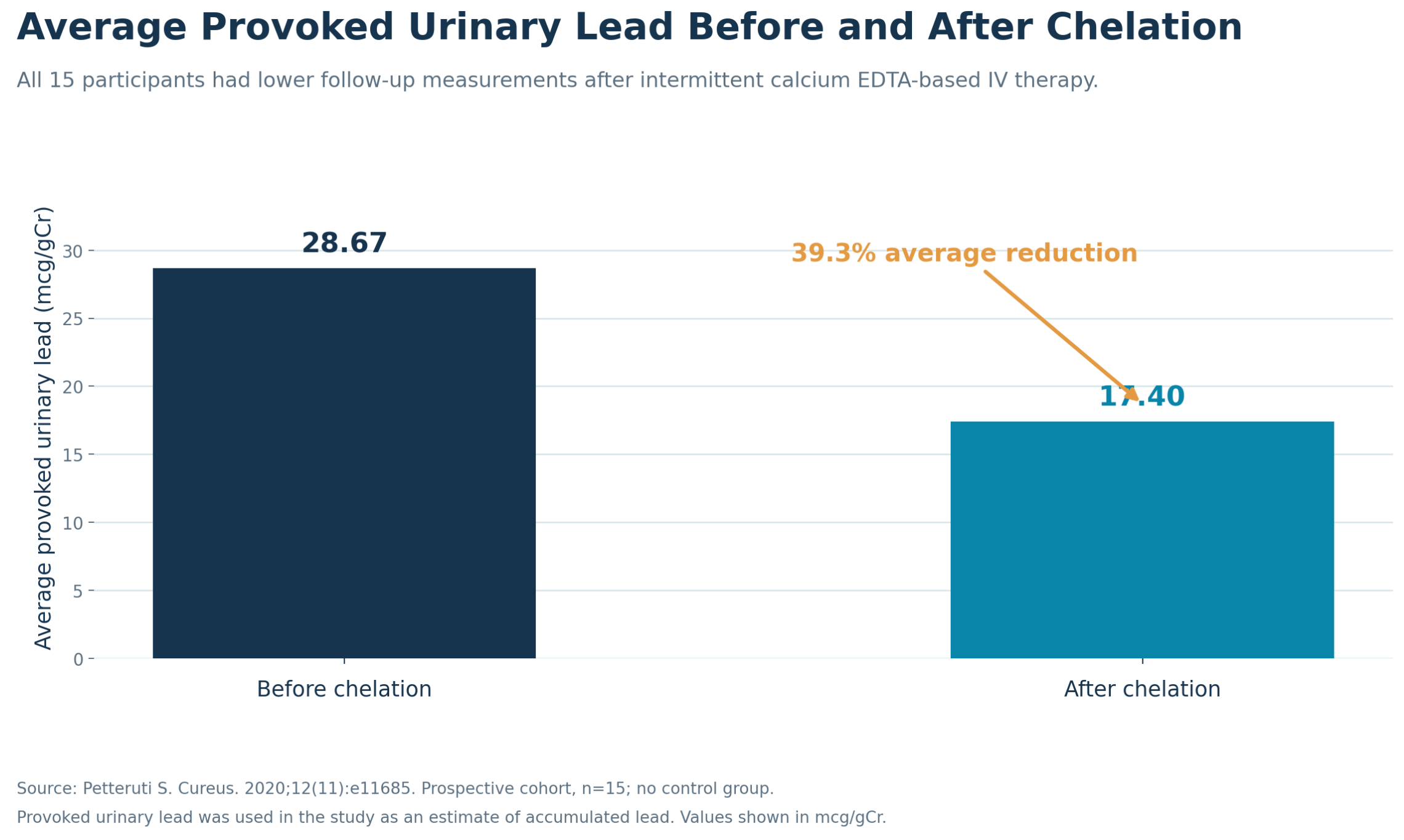
Caption: Average provoked urinary lead measurements before and after long-term, intermittent calcium EDTA-based IV chelation therapy. Source: Petteruti S. Cureus. 2020;12(11):e11685. Used under CC BY 4.0.
15 out of 15 participants had lower follow-up lead measurements.
Participants completed an average of 14 infusions.
The treatment period averaged 24.2 months.
Average provoked urinary lead declined from 28.67 to 17.4 mcg/gCr.
None of the participants reported side effects during or after treatment.
The average creatinine level did not increase during the study.
These results indicate that an intermittent calcium EDTA-based protocol was associated with lower provoked urinary lead measurements in all participants.
This study did not address acute lead poisoning. Instead, it examined whether a practical, long-term chelation schedule could reduce measured lead in individuals without known high-level exposure.
Other chelation studies have used more frequent treatments or more infusions. This study explored a less demanding schedule for patients.
Calcium EDTA was chosen over disodium EDTA because it can be administered in about one hour, compared to the longer infusion time for disodium EDTA, and has a long history of clinical use.
The protocol included vitamin C, magnesium, B vitamins, and glutathione. These were not evaluated separately, so results reflect the complete infusion protocol, not calcium EDTA alone.
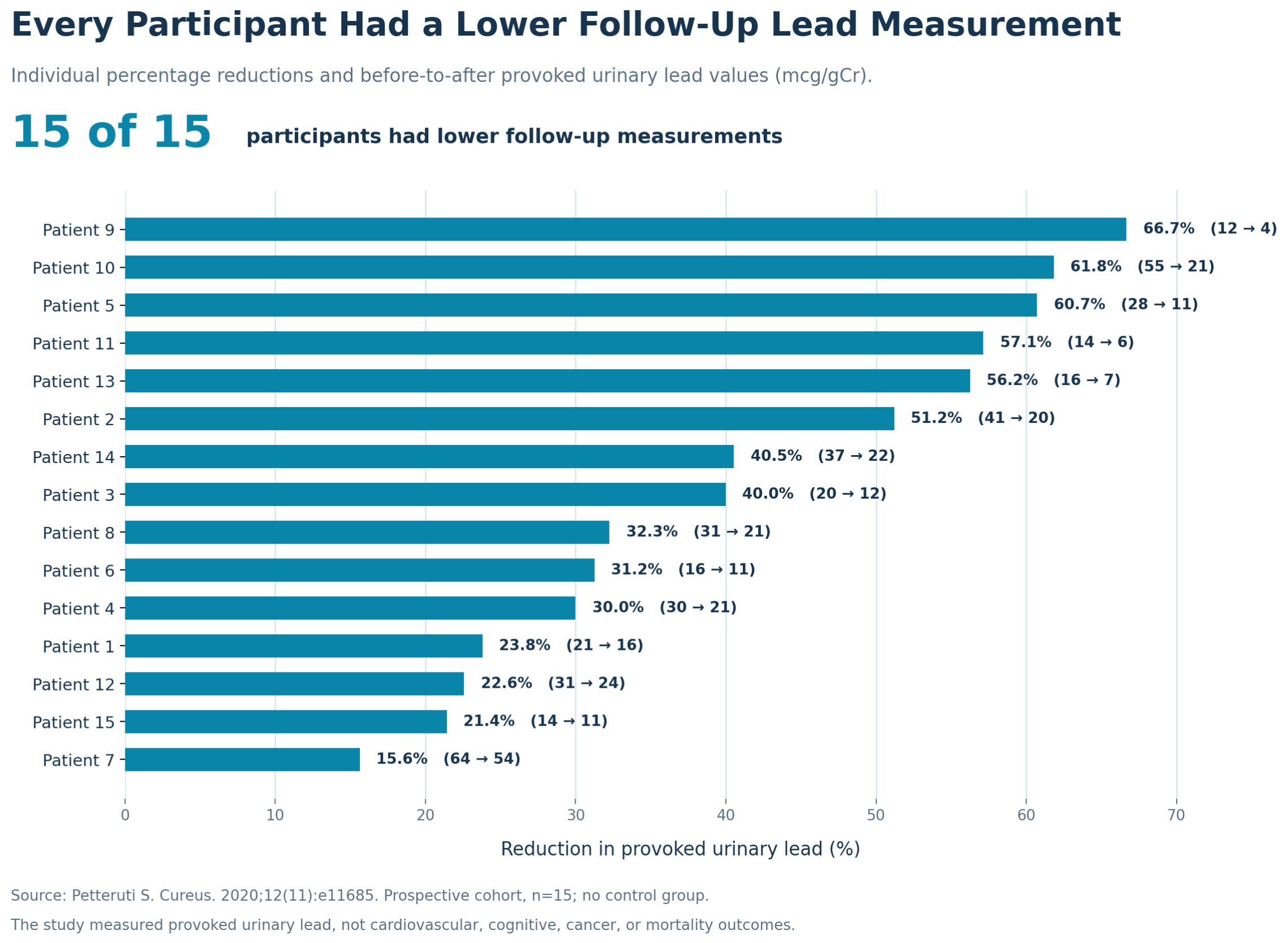
Caption: Individual reductions in provoked urinary lead measurements following intermittent calcium EDTA-based IV chelation therapy. All 15 participants had lower follow-up measurements. Source: Petteruti S. Cureus. 2020;12(11):e11685. Used under CC BY 4.0.
While the results were consistent, this was a small preliminary study.
The study included 15 participants with no separate control group; each served as their own comparison. Infusion number and timing varied.
The study measured changes in provoked urinary lead but did not assess whether lowering these levels reduced heart attacks, dementia, cancer, or mortality.
It would be inaccurate to claim this study proved chelation prevents chronic disease. It showed something more specific: intermittent calcium EDTA-based IV chelation was associated with a significant reduction in provoked urinary lead measurements in all 15 participants.
With decades of experience in preventive, functional, and integrative medicine, I have observed a gap between clinical practice and formal research.
Clinical experience alone is insufficient. Consistent, measurable results should be documented, analyzed, and submitted for scientific review.
I published this study to provide measurable clinical data on lead accumulation and chelation therapy, and to assess whether a less frequent protocol could produce meaningful, practical results for patients.
These findings do not answer all questions about long-term chelation but offer a foundation for future research.
Lead is a persistent environmental toxin. Low-level exposure accumulates over time, with much of it stored in bone and tissue.
In this prospective cohort, 15 patients completed a long-term, intermittent calcium EDTA-based IV chelation program, and all had lower provoked urinary lead measurements at follow-up.
The average measurement declined from 28.67 to 17.4 mcg/gCr, a reduction of about 39%.
The next step is larger research to determine whether reducing accumulated lead improves cardiovascular, cognitive, and other long-term health outcomes.
Read the complete peer-reviewed article: https://pubmed.ncbi.nlm.nih.gov/33262921/
Thanks for reading! This post is public, so feel free to share it.
If you want to learn how to evaluate heavy metal exposure and implement chelation therapy responsibly, the Chelation Therapy Certification for Healthcare Providers covers testing, chelating agents, dosing, infusion protocols, safety, monitoring, documentation, and practice implementation.
Learn more about the Chelation Therapy Certification
If you have an elevated coronary artery calcium score or questions about whether chelation belongs in your health plan, schedule a consultation for an individualized evaluation.
Petteruti S. Reduction of lead levels in patients following a long-term, intermittent calcium ethylenediaminetetraacetic acid (EDTA)-based intravenous chelation infusions: a prospective experimental cohort. Cureus. 2020;12(11). doi:10.7759/cureus.11685
Lanphear BP, Rauch S, Auinger P, Allen RW, Hornung RW. Low-level lead exposure and mortality in US adults: a population-based cohort study. Lancet Public Health. 2018;3(4). doi:10.1016/S2468-2667(18)30025-2
Weisskopf MG, Wright RO, Schwartz J, et al. Cumulative lead exposure and prospective change in cognition among elderly men: the VA Normative Aging Study. Am J Epidemiol. 2004;160(12):1184-1193. doi:10.1093/aje/kwh333
Lamas GA, Navas-Acien A, Mark DB, Lee KL. Heavy metals, cardiovascular disease, and the unexpected benefits of chelation therapy. J Am Coll Cardiol. 2016;67(20):2411-2418. doi:10.1016/j.jacc.2016.02.066
Menke A, Muntner P, Batuman V, Silbergeld EK, Guallar E. Blood lead below 0.48 μmol/L and mortality among US adults. Circulation. 2006;114(13):1388-1394. doi:10.1161/CIRCULATIONAHA.106.628321
No posts
Comments
Nothing yet. Say the first thing.
Sign in to join the conversation.