
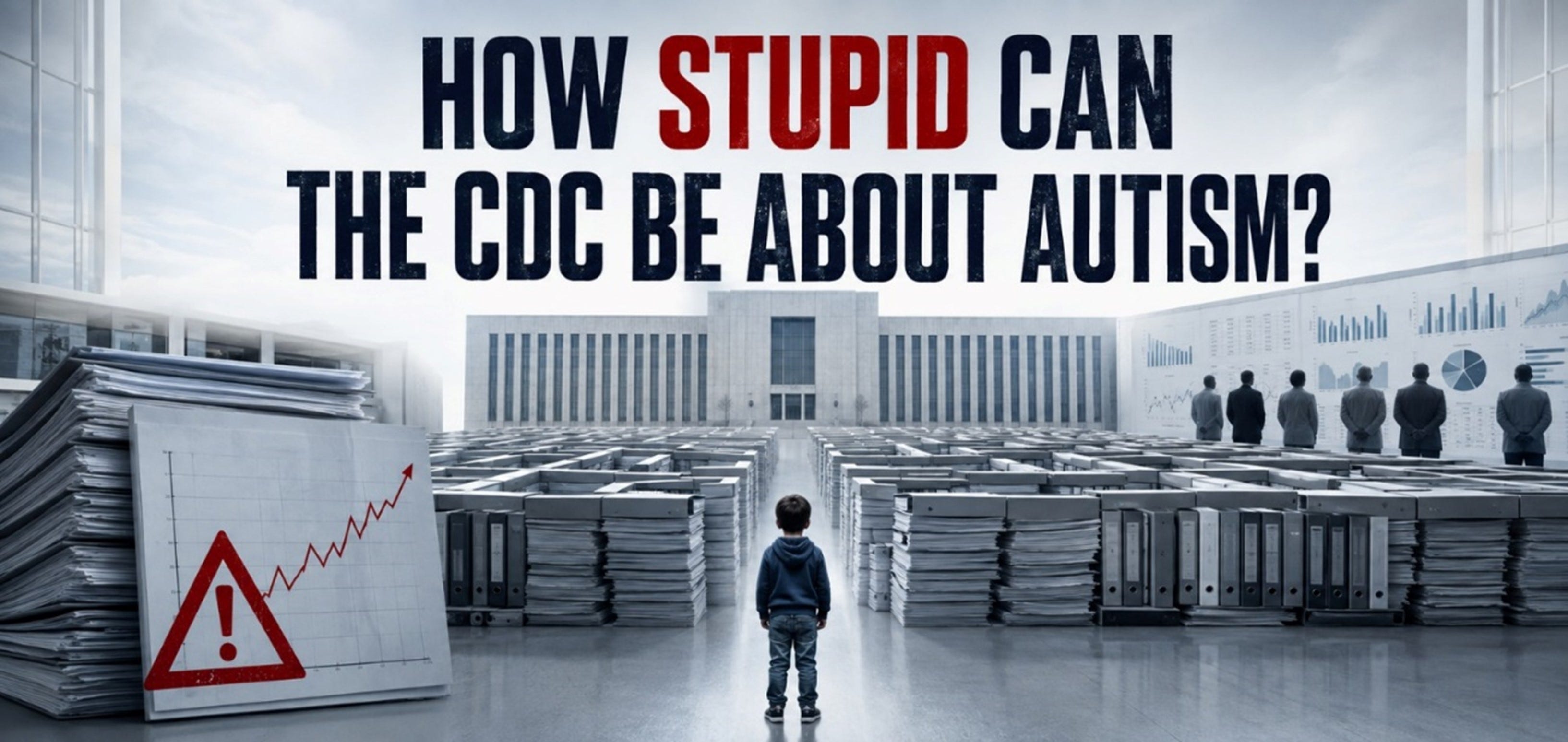
The answer is really stupid. Also, it’s mean, cruel, deceptive, and casts a bad light on the entire US government. You want to understand something about autism? Begin with the baby, not the vaccine schedule.
The research on newborns and young children is unusually consistent on one central point: violence during the first two or three years of life can be biologically and developmentally profound precisely because the child is so young, so vulnerable. There are many forms of violence, but one of them, according to Dr. Paul Offit, a major proponent of vaccines, is the act of vaccination.
The mainstream of medicine either does not understand autism or does not want to understand. There is so much on the line in terms of autism and the suffering it causes families. The CDC and everyone who believes in this corrupt organization takes the position that vaccines definitely do not cause or trigger autism. The known toxicity of vaccines could not possibly be involved, not at all, never in a million years.
This is part of a deep sickness in the modern medical establishment: the denial of any link between autism and vaccines, which is irrational considering all the information, all the indications, all the nightmarish reports from parents about what has happened to their children after receiving multiple vaccines in a single wellness baby visit.
A newborn is not a miniature adult. The brain, immune system, liver, kidneys, intestinal barrier, and inflammation-regulating mechanisms are still developing. Infants differ enormously in genetic resilience, prenatal health, nutrition, metabolism, and capacity to recover from physiological stress. All babies are vulnerable; some are considerably more vulnerable than others, and that vulnerability may not yet be visible.
All babies are vulnerable, but pediatricians, their medical boards, and pharmaceutical companies don’t get that. The younger, the more vulnerable. This is not fringe speculation; it is the founding fact of pediatrics, toxicology, and developmental biology. The blood-brain barrier is immature. The immune system is uncalibrated. The liver’s detoxification pathways—the very enzyme systems that process and clear foreign compounds—are not fully online.
It is scientifically reasonable to ask whether vaccination could trigger a neurological outcome in biologically susceptible children. Serious adverse reactions demonstrate that vaccines are biologically active interventions, not physiologically inert substances. Known severe vaccine injuries make neurological effects biologically conceivable. Neurological effects from vaccines are biologically real, not merely conceivable. Vaccines can provoke fever, inflammation, immune activation, death, and serious neurological adverse events. So the general proposition that vaccination can affect the nervous system in susceptible individuals is established biology, not speculation.
Autism went from being considered a rare developmental disorder to one of the most commonly diagnosed neurodevelopmental conditions of childhood. Whatever ultimately explains that transformation, one fact deserves far more attention than it usually receives: the human genome has not transformed at anything approaching the speed of the autism statistics.
From Rare Disorder to 1 Child in 31
Leo Kanner’s landmark description of autistic children appeared in 1943. For decades afterward, autism was regarded as uncommon. Historical epidemiological estimates from the early 1970s placed diagnosed autism at approximately 1 in 2,500 children, although those early studies used substantially narrower definitions and less comprehensive case-finding than modern surveillance.
The United States eventually developed much better systematic surveillance. When the CDC’s Autism and Developmental Disabilities Monitoring Network began tracking 8-year-olds, the estimate for the 2000 surveillance year was about 1 in 150.
By 2018, it was 1 in 44.
By 2020, it was 1 in 36.
The latest CDC surveillance report, covering children who were 8 years old in 2022, found 32.2 cases per 1,000 children—approximately 1 in 31, or 3.2 percent. That represents nearly a fivefold increase in identified prevalence just between the CDC’s 2000 and 2022 surveillance years.
No posts
Comments
Nothing yet. Say the first thing.
Sign in to join the conversation.