
Alhamdulillah and Hallelujah!
The no-holds-barred struggle that was Michigan’s Democratic primary is over. The vote tally was much closer than polling predicted, but Dr. Abdul El-Sayed eked out a one-percentage-point victory over Congresswoman Haley Stevens. Having been outspent by as much as 11 to 1 — with $60 million or more in outside spending flooding into the race to try to defeat him, an estimated $30 million of which came from AIPAC — even a tight victory is an incredible achievement by El-Sayed.
I had a great conversation about El-Sayed’s victory with Waj on THE LEFT HOOK with Wajahat Ali, and I look forward to hearing your thoughts, as always.
Here, I’ll list five key takeaways from the primary outcome.
Friends, if you appreciate The Debrief, I hope you’ll pitch in to help me continue this work. Please consider becoming a paid subscriber now. You can also leave a one-time donation in any amount. Thank you.
In welcoming his victory, El-Sayed noted that his campaign beat the odds:
You’re not supposed to be able to beat $70 million dollars of outside spending—a record amount of money spent in a campaign against a Democrat in a primary in any campaign. You’re not supposed to be able to beat that. And what we showed is that the power of our many is greater than the power of their money.
AIPAC and corporate donors blanketed the airwaves and social media with ads to influence voters who might be too busy with their daily struggles to dig deeply into the issues and the candidates — but could be influenced by repeated, targeted, negative ads.
El-Sayed made outside spending a galvanizing issue in the race, skillfully using turning the millions spent on Stevens’ behalf into an indictment of her candidacy. He tapped into widespread concern about government corruption, which is shared by substantial majorities of Democrats, Republicans, and independents. Across the political spectrum, voters identify campaign donations from billionaires and big corporations and elected officials being beholden to such special interests as main drivers of corruption. Stevens had no effective response to this line of attack.
AIPAC’s failure to propel Haley Stevens to victory via millions in outside spending (much of it from GOP megadonors) is by no means the first AIPAC defeat of this campaign cycle. It sustained major losses in US House races in New York (with a trio of victories by Brad Lander, Claire Valdez, and Darializa Avila Chevalier), Colorado (Melat Kiros), Illinois (Daniel Biss), and New Jersey (Analilia Mejia and Adam Hamawy).
That said, those progressive victories in deep blue House districts by candidates who are critical of Israel to varying degrees pale in comparison to El-Sayed’s statewide win in a swing state that will play a pivotal role in the 2028 presidential election. If El-Sayed can defeat Republican nominee Mike Rogers in November, he’ll prove that progressive candidates who repudiate unconditional support for Israel can compete beyond deep blue bubbles. That’s why AIPAC will spend big to boost Rogers. As an AIPAC spokesperson commented today, “Our members remain determined to ensure that voters reject Dr. El-Sayed and his radical anti-Israel agenda in November.”
While AIPAC has long boasted that its support for Israel’s right-wing governments is good policy and good politics, the dramatic shift in public sentiment against Israel in response to its destruction of Gaza (widely characterized as a genocide) has reversed that. Sixty percent of all Americans — including 80 percent of Democrats — have an unfavorable view of Israel.
Accepting support from AIPAC is increasingly a political liability, and Democratic Members of Congress are taking actions that were only recently unthinkable, like voting in large numbers against $3.3 billion in military aid for Israel negotiated in the 10-year Obama-Netanyahu Memorandum of Understanding. AIPAC could do little besides quietly end its online fundraising for 15 House Democrats it had endorsed who took that vote.
AIPAC will double down, from a position of weakness.
Despite much protestation by moderates who warned in dire terms of an El-Sayed victory (see, for example, Paul Begala and James Carville), Senate Minority Leader Chuck Schumer and the Democratic Senatorial Campaign Committee have quickly endorsed him. Haley Stevens and Mallory McMorrow, El-Sayed’s competitors in the bruising primary, admirably pledged their support. Michigan resident and likely 2028 presidential contender Pete Buttigieg endorsed the entire Michigan Democratic ticket.
Michigan Senator Elissa Slotkin, whose politics (including on Israel-Palestine) are more centrist than El-Sayed’s, underscored the stakes in her call for unity in order to keep Michigan’s second Senate seat in Democratic hands. In her words, “There is nothing more important than the mission of the next 90 days: uniting keeping this seat blue, flipping the House and Senate, and providing a real check on President Trump.”
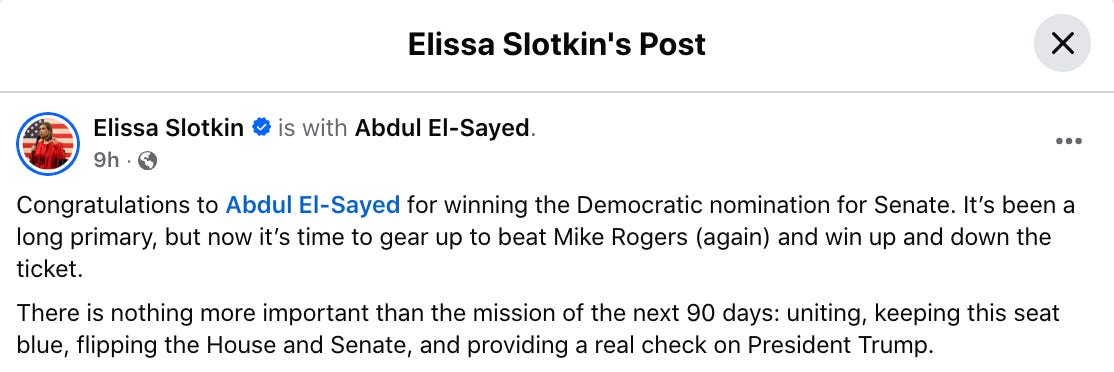
She is, of course, correct. The stakes couldn’t be higher. It’s time for all democrats (big D and little d) to unite across ideological differences. The initial signs are encouraging.
Jewish legacy organizations are apoplectic: this includes AIPAC of course, but also others, including the American Jewish Committee and the Anti-Defamation League (once upon a time, a respected civil rights organization).
The chair of the Michigan Democratic Jewish Caucus, which endorsed Haley Stevens in the primary, is keeping the door to an endorsement open but says El-Sayed must become “a better bridge maker versus kind of a bridge burner” and that “it’s his responsibility to initiate.” Jewish Democratic Council of America, which had endorsed Stevens, congratulated El-Sayed but didn’t endorse him, stating that it was “disappointed” by the primary election result.
Of course, there are Jewish Michiganders who supported El-Sayed in the primary — including former Congressman Andy Levin, who lost his seat to a heavily AIPAC-supported Haley Stevens four years ago. Waj and I spoke about Levin at length. As a self-described Zionist who introduced legislation to align US policy with a two-state solution, Levin’s views on Israel-Palestine differ from El-Sayed’s. Nonetheless, Levin argues:
I think it would be better for Israel and for the United States to have the Muslim community, the Arab American community, the progressive community have authentic voices, clear voices in Congress… And the movement for justice for Palestinians needs leaders in America like Abdul El-Sayed, who is truly not antisemitic, and who is deeply sensitive about Judaism and Jewish people.
Abdul El-Sayed will become the first Muslim ever elected to the US Senate if he prevails over Mike Rogers in November. That’s an exciting milestone and an encouraging sign for America’s embattled democracy. As I noted to Waj, Jews have been significantly overrepresented in Congress and we must welcome people from different communities who have not enjoyed such representation — if we truly believe in the democracy under which our community has flourished.
A few weeks ago, I had the pleasure of speaking with Abdul El-Sayed on The Debrief and asked him about the prospect of becoming the first Muslim US Senator. This was part of his response:
Predictably, Republicans wasted no time in rolling out their trademark Islamophobia. A new National Republican Senatorial Committee ad pulls a “Barack Hussein Obama” maneuver by referring to Abdul by his full name — Abdulrahman Mohamed El-Sayed. This is, no doubt, a first taste of a deluge of Islamophobia to come.
I would love for Jewish Americans to see this as a great opportunity for Jewish-Muslim solidarity.
El-Sayed shared with me his commitment to fighting antisemitism:
You will not find somebody who’s going to be more of a lion against anti-Semitism who doesn’t share your faith. As somebody who understands what it’s like to share a faith that is disfavored by some people. Because we have to live in an America where there are no disfavored people. And I’m looking forward to building that together.
Are Jews prepared to return the favor? I certainly hope so. This is an opportunity for bridge-building and for honest exchanges — like the one I had with Waj about recent language Abdul used. The stakes are extremely high and I hope that we’ll rise to the occasion.
I look forward to hearing what you think!
Bring your questions to Office Hours! They could be about anything from Abdul El-Sayed’s primary victory to AIPAC to Israeli elections to the wars in Iran and Lebanon. Or perhaps you’d like to debrief about the important podcast I did on Monday with Dalia Hatuqa on the situation in the West Bank. Or, who knows, maybe you want to ask me about parenting neurodivergent kids. Most things are fair game.
Office Hours are open to paid subscribers. If you haven’t already, I hope you’ll become a financial supporter now and join us!
Defiance & the Fight for American Democracy — with Miles Taylor
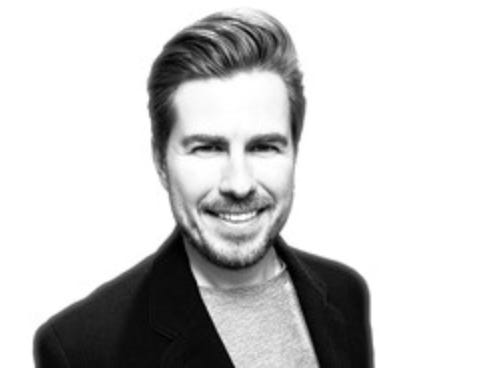
Miles is the founder of Defiance.org, a NYT bestselling author, and the anonymous writer of a 2018 NYT op-ed on being part of the resistance inside the first Trump administration. In April 2025, claiming that Miles’ actions could be treasonous, Trump issued a presidential memorandum ordering senior staff in his administration to launch an investigation against him.
For those of you who enjoyed my recent conversation with Ami Fields-Meyer, co-author of On Courage: How to Be a Dissident in an Age of Fear — you’ll love this podcast with an American dissident who put his career (and more) on the line to warn Americans about Donald Trump.
Thanks for watching and reading, folks!
I’m looking forward to hanging out with folks tomorrow in Office Hours.
Warm regards,
Debra
Comments
Nothing yet. Say the first thing.
Sign in to join the conversation.