
Recently, the 2025 Ligonier study found that 47% of evangelicals affirm that “God accepts the worship of all religions, including Christianity, Judaism, and Islam.” This means that of the Christians they surveyed, nearly half think that God accepts worship even when it is directed toward a “god” other than Himself. Despite Christianity’s insistence on monotheism (belief and worship of one God), this confusion has prevailed.
To understand this deeper, we can examine four of the tenets of other mainstream religions – Buddhism, Hinduism, Islam, and Judaism to understand how they understand the divine.
The chart “Basic Beliefs of Major Religions” shows that all religions, even by their own claims, differ from one another, having their own specific ideas of who God is (or is not) and how salvation may be attained. Many criticize Christianity for its exclusivity, but Christians are not the only group claiming to have the truth.
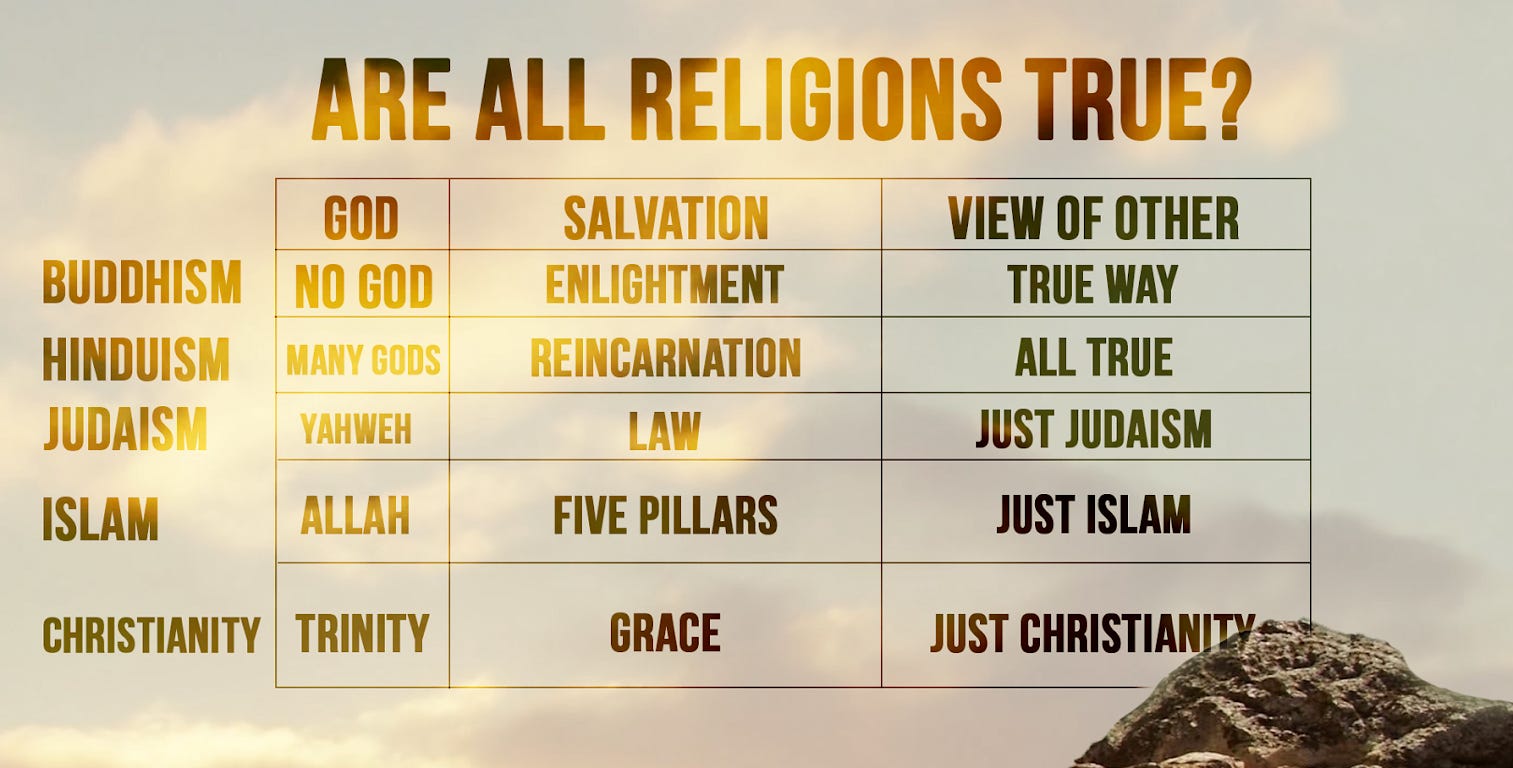
Notice in the chart “Basic Beliefs of Major Religions” the attitudes of each religion toward the others. Four of the five religions claim exclusivity. They believe that all other religions are false. Hindus often do not claim exclusivity. In fact, many are happy to say that Christianity is true. But the key is what they mean by it. Hindus believe all religions are true when they are subsumed within the Hindu system. In other words, Christianity is one medium by which people can experience reincarnation.
But Hindus don’t believe that Christianity is true on its own terms. So, like adherents of all other religions, Hindus actually believe Christianity is false, thereby joining every other religious group (including atheists and agnostics) in the belief that their belief system is exclusively true.
And yet, in another sense, Christianity is the most inclusive religion of all. Christ invites all unto himself. Unlike Mithraism, which apparently excluded women, or Mormonism, which formerly excluded black people from the priesthood, the message of Jesus has always been for everyone. Colossians 3:11 says, “In this new life, it doesn’t matter if you are a Jew or a Gentile, circumcised or uncircumcised, barbaric, uncivilized, slave, or free. Christ is all that matters, and he lives in all of us.” Christ makes no human distinctions—he died and rose again so that all people could have a personal relationship with the living God.
The inclusiveness of Christianity is one reason we see followers of Jesus in nearly every culture of the world. Buddhism is mainly an Asian phenomenon. Hinduism is mostly found in India. Nearly all Jews live in the U.S. or Israel. And yet Christians are found in significant numbers in virtually every culture (and ethnicity) of the world. Except for Antarctica, Christians are found in large numbers in every continent in the world. It is the most universal religion because Jesus died for everyone and invites everyone to believe.
Christianity excludes no one who will believe, yet Christ himself offers the only way to be reconciled with God.
No posts
Comments
Nothing yet. Say the first thing.
Sign in to join the conversation.