
As followers to these posts know, I’ve been somewhat occupied with things other than writing lately. However, this afternoon, I decided to get back to work on Meetings with Remarkable Men: and A Few Others—a book (allegedly-in-progress) that has been lingering on my periphery for too long.
Here’s today’s addition:
I have always been a serious eater.
Wait.
A small correction.
My mother often explained that, sometime before my second birthday, I had nearly died. “Bronical newmonya,” she called it. Whatever it really was (and however it was spelled), the disease caused me to be off my feed for a week or two. She was convinced that I had been making up for it the rest of my life.
But she might have been right—it would explain why the main driving force in my life has been my appetite. She cooked huge meals, but they were never enough to sate my adolescent hunger. I watched, in rapt anticipation, as she assembled lofty lasagnas and humongous holiday dinners, but never considered learning to cook for myself.
Until I went to college.
When I got my first off-campus apartment, I needed to cook for myself. I had recently discovered Japanese food… but, with only a student income, travel to the city and Japanese restaurants were not options. Instead, I found cookbooks and began to cook dishes like Sekihan, Tsukimono, and Yaki Mo for myself. Gradually, I became interested in cooking other than Japanese.
None of my friends shared my culinary enthusiasm.
The sixties were a time of gastronomic puritanism. “Fancy” food was a no-no—suitable only for the Bourgeoisie. We, who imagined ourselves to be radicals—proletarians who only wore blue-collar in solidarity with working-class people we never met—ate what we imagined the down-trodden masses ate.
Things like Anadama Bread. Brown rice. Tabouli.
Naturally, I wouldn’t own a television. I did, however, watch TV when I visited my parents. Only PBS, of course—none of the televised effluent that Newton Minow had derided, back in 1961, as “a vast wasteland.”
One of the shows I always watched featured a tall woman, with a funny voice, who stood behind a kitchen counter—apparently in her home. Behind her, an entire wall was covered with pegboard, from which were suspended more pots and pans than I had ever seen in my life. Watching her cook French dishes I’d never tasted—never even heard of—I was spellbound.
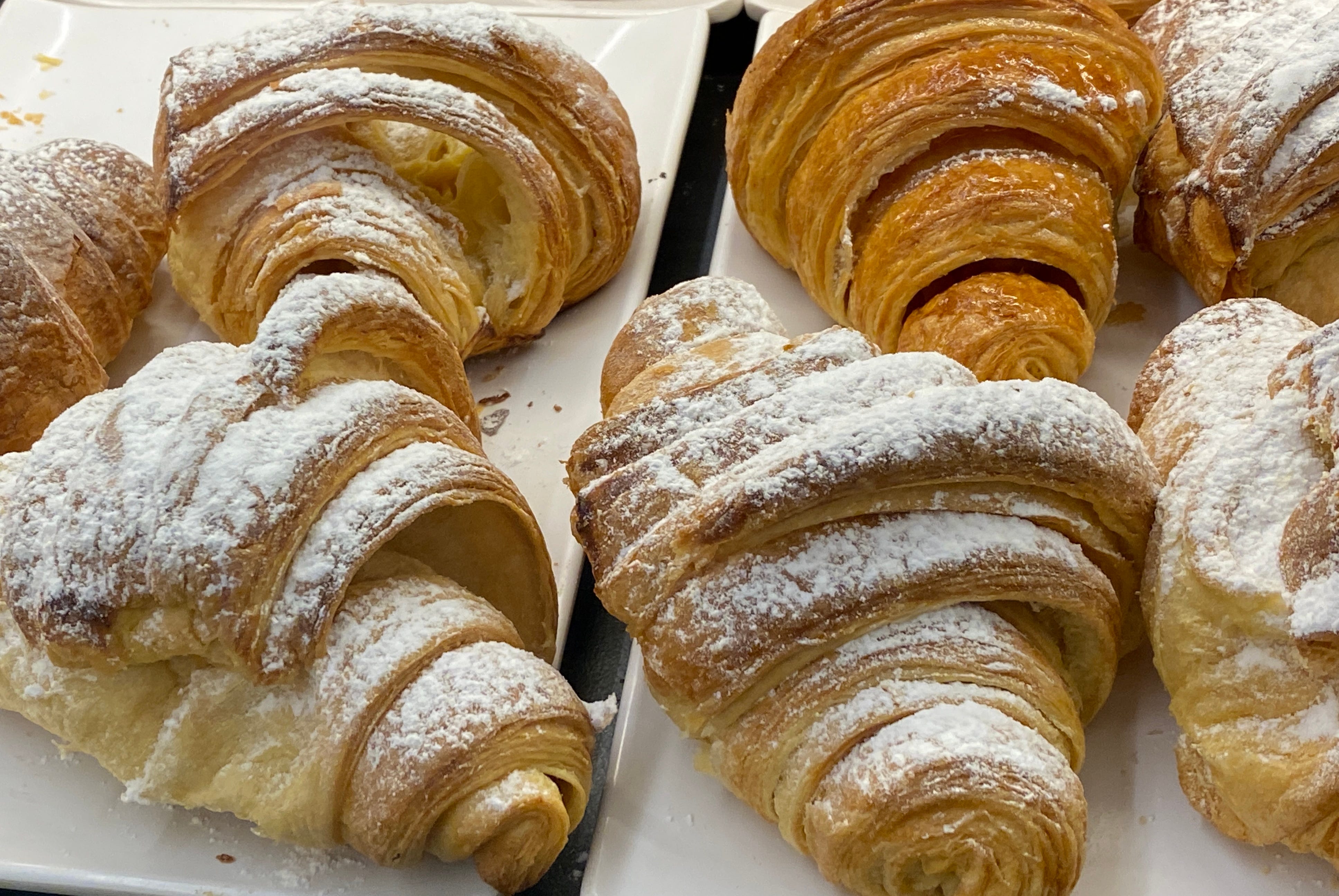
I went home and, for the first time, began the process of rolling out freshly-yeasted dough, layering it with cold but slightly softened butter, then folding in thirds, rolling again, folding in thirds, then rolling again, folding in thirds. With waiting time between each stage. After about twelve hours, the rolled-out dough was cut into triangles and rolled up. The croissants-to-be went into the oven.
Minutes after they emerged—golden brown and redolent of warm butter and what I now know to be Maillard browning—about half of the town’s hippies showed up to sample them. They were gone in minutes.
Wolfed down with homemade wild strawberry preserves, the very first croissant I had tasted—one that I baked, myself, had become a memory.
Decades later, while I was working at The Culinary Institute of America, I got to meet Julia Child a couple of times. Once, while she was signing my copy of The Way to Cook, I got to thank her.
“What for?” she asked.
“For saving me from a lot of brown rice and seaweed in the late sixties and early seventies.”
“Oh my god!” She exclaimed in unfeigned horror. “You ATE that?”
No posts
Comments
Nothing yet. Say the first thing.
Sign in to join the conversation.