

Did you hear about the Spanish woman named Carmen Jiménez who pretended to be blind for 28 years? Not because of an illness or accident, but because she couldn’t stand small talk. “I was tired of seeing people and stopping to say hello,” Carmen was quoted as saying. “I’ve never been very social, and pretending to be blind has avoided many social commitments.”

It turns out the story originated on a satirical Spanish website whose tagline translates to “Don’t believe everything on the internet.” Completely made up — and yet it racked up hundreds of thousands of likes and shares. Perhaps it spread so fast because it was so relatable.
It’s not just introverts who dread small talk. A recent survey found that most Americans (70%) prefer silence to small talk and reach for their phones to avoid what they see as needless chitchat. A friend confesses she often pretends to be on her phone when she spots acquaintances on the sidewalk, just to avoid a conversation about the weather. Another entirely relatable strategy.
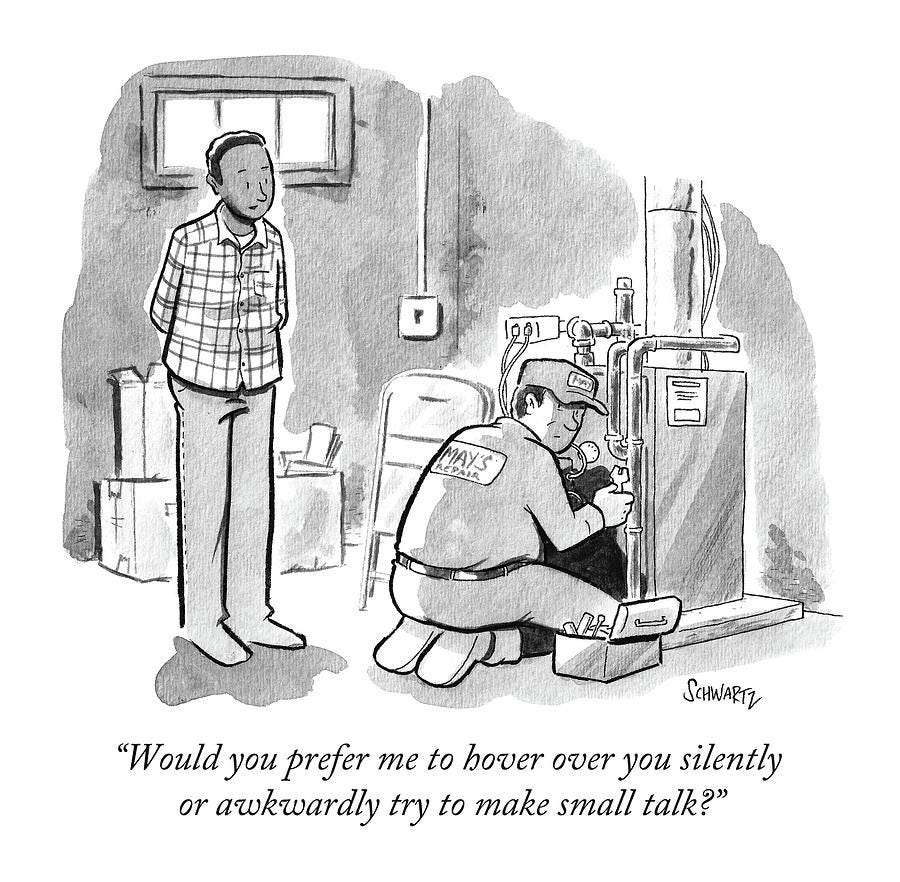
But is our aversion to small talk costing us more than we realize? Every conversation we sidestep — the neighbor in the elevator, the acquaintance on the sidewalk, the colleague at the coffee machine — is a moment of potential connection we’ve decided in advance isn’t worth having. Our screens make it easier to act on that instinct.
A new study published in the Journal of Personality and Social Psychology by Elizabeth Trinh, Nicole Thio, and Nadav Klein found that when it comes to predicting whether a conversation will be enjoyable, we are systematically and reliably wrong. Across nine preregistered experiments involving 1,800 participants, people consistently underestimated how enjoyable and interesting conversations about mundane subjects would be.
The prescribed discussions ranged from World Wars and the stock market to cats, vegan diets (a particular doozy in my opinion), and Pokémon. Participants predicted how much they’d enjoy a conversation, had it, then reported back. The gap between prediction and experience was striking and remarkably consistent. It held across virtual and in-person settings, with friends and strangers, and even when both people in the conversation found the topic boring.
Put simply, however dull the topic sounds, the conversation will almost certainly be better than you expect. In every case, the social connection outweighed the dullness of the subject. “We tend to assume that if a topic sounds dull, the conversation will be dull too,” said Elizabeth Trinh, a doctoral student at the University of Michigan and lead author of the research. “But that’s not what people actually experience.”
The problem is that we’re evaluating the wrong thing. We judge conversations based on what we can predict in advance, the topic or the person. But what actually determines whether a conversation is enjoyable is something we can’t predict or preview: engagement.
Conversations have two kinds of components: static and dynamic. Static components are things you can assess before you open your mouth, like the topic or whether you already know the person. Dynamic components are what emerge once you’re actually talking, such as the back-and-forth, the unexpected detail someone shares, or the moment a conversation takes a turn you didn’t see coming.
If the topic sounds dull (the neighbor’s fantasy football league, a colleague’s sourdough obsession) we conclude the conversation will be too. But the topic is only the starting point. Once people start talking, the interaction takes over.
Conversations capture attention and stimulate the mind through asking questions, sharing personal experiences, and responding to each other’s emotions. They activate empathy, curiosity, and learning; absorbing experiences that fully occupy the mind, regardless of whether the topic is sourdough or Spinoza. The feeling of engagement only arrives once you’re in the conversation. It can’t be previewed.
So we forecast without it, the topic misleads us, and we end up underestimating what’s about to happen.

You might think that one surprisingly enjoyable conversation about something you’d dreaded (tax law, say, or fantasy football) would change our expectations. It doesn’t.
Even after a positive first conversation, people still underestimate how much they’ll enjoy the next one; even when it’s about a different boring topic with a different person.
Like Bill Murray waking up to the same alarm every morning, the boredom bias just resets. One good experience doesn’t inoculate you against the next prediction error.
The boredom bias isn’t just a minor glitch in our thinking. It has real consequences. Every time we decide a conversation isn’t worth having before it’s even started, we miss a chance to connect.
So instead of asking “Will I enjoy this?” before a conversation, try asking “What might I learn?”
Shifting attention from the topic and the person’s apparent interestingness to genuine curiosity about what might emerge can disrupt the bias before it takes hold.
One practical approach is to place yourself in conversations about topics you wouldn’t initially choose. Structured workplace get-to-know-you exercises often do this by design, and people tend to enjoy them more than anticipated. The same holds whether it’s a colleague you’ve been avoiding or a stranger at a dinner party who wants to talk about their model train collection.
Get in the conversation. The engagement takes over from there.
Carmen Jiménez didn’t exist, but the impulse she supposedly embodied is very real. Most of us opt out of small, seemingly pointless exchanges every day, convinced in advance that they aren’t worth our time.
What the research tells us is that this instinct is built on a prediction error. The boring conversation you’re dreading is almost certainly going to be better than you think. Not because the topic transforms into something fascinating, but because talking with another person — really talking, listening, responding, being heard — is absorbing in ways that can only be experienced, never previewed.

Leidy Klotz's In a Good Place makes a compelling argument that where we spend our time matters as much as how our spaces either support or undermine our deepest needs. Dana Perino's Purple State is a warm reminder that genuine connection can still bridge our deepest divides. And Emma Grede's Start With Yourself challenges the cultural conditioning that keeps women playing small.
Comments
Nothing yet. Say the first thing.
Sign in to join the conversation.