
Tier 1 – System Design Gap (Clinical Impact: 5/5)
Educational and mental health systems are structurally organized around mutually exclusive identification pathways. A student is routed toward either an ADHD evaluation-and-services track or a Gifted identification-and-enrichment track. The system is not designed to hold cognitive profile, regulatory capacity, and attachment organization in a single integrated frame. This design failure produces repeated misidentification, fragmented intervention, under-challenge of high-ability dysregulated students, and over-application of external control strategies.
Tier 2 – Clinical Micro-Blind Spot (Clinical Impact: 5/5)
Premature Meaning-Making combined with the Helpful Agenda Leak. When a high-ability student becomes dysregulated, adults frequently move within seconds to explanatory labeling (“That’s his ADHD” or “She’s gifted and bored”). This rapid interpretive move collapses the relational space. The adult’s need to resolve diagnostic uncertainty becomes more urgent than the child’s need for regulated presence. Most trauma-informed, gifted-education, and ADHD literature does not name this specific micro-sequence or its cumulative effect on the child’s internal working model.
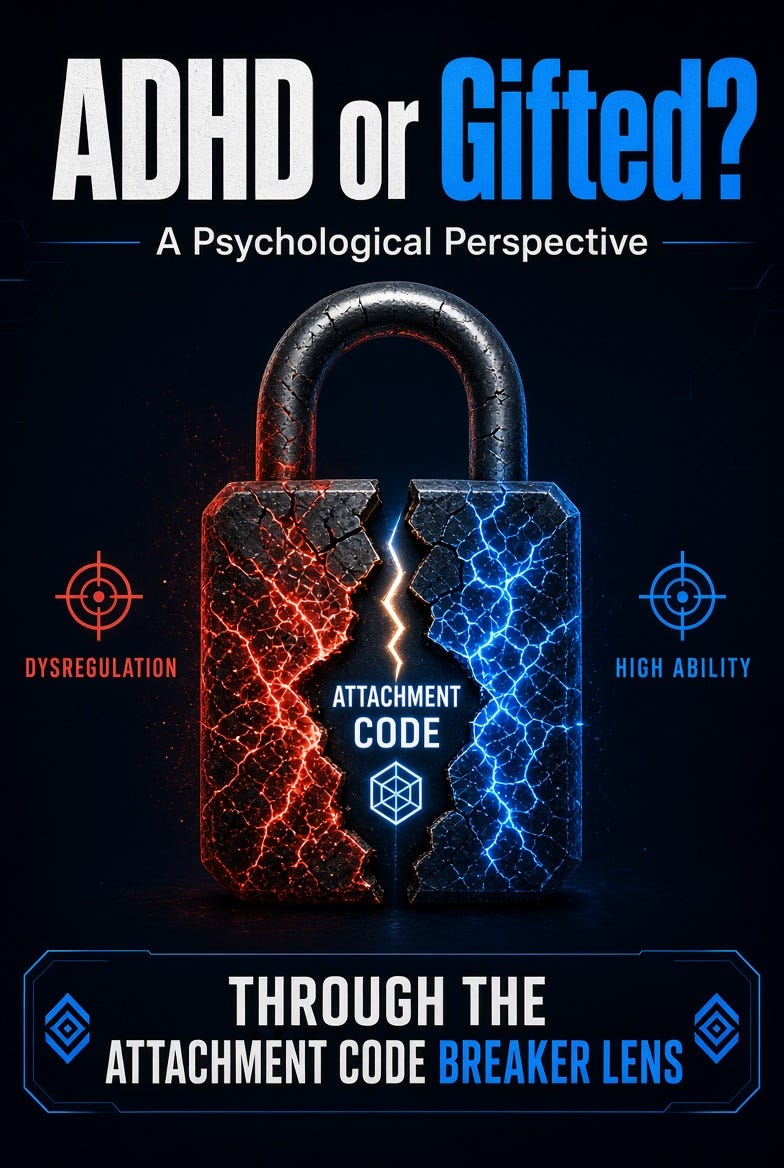
A Psychological Perspective Through the Attachment Code Breaker Lens
Dr. Franklin Edward Shoemaker, PhD, LMHC-QS, TF-CBT, Adoption Competent
Tonya A. Sharrett-Shoemaker, MA, Certified Professional Educator
The question “ADHD or Gifted?” continues to organize educational and clinical decision-making, yet it rests on a false binary. High cognitive ability and attention/regulation difficulties frequently co-occur, and both are powerfully shaped by the child’s attachment organization. This article examines the intersection of cognitive profile, regulatory capacity, and internal working models. It identifies specific Tier 2 clinical micro-blind spots that undermine even well-intentioned adult responses and advances a Snapped → Shifted → Solid reorientation for educators and clinicians working with this population. The central claim is that diagnostic labeling used as a substitute for regulated presence reinforces the very patterns the system claims to address.
Contemporary educational practice still treats ADHD identification and Gifted identification as largely separate tracks. Evaluation processes, service delivery models, and classroom interventions are organized accordingly. A student who displays both high cognitive ability and significant regulatory difficulty is frequently forced into one primary explanatory category. The alternative category is then minimized or ignored.
This binary sorting creates predictable clinical and educational costs. High-ability students with regulation difficulties are often under-challenged once an ADHD label organizes adult perception. Students whose cognitive strength is recognized may have their regulatory struggles reframed as boredom, lack of motivation, or willful noncompliance. In both cases, the adult response is shaped more by the dominant label than by real-time observation of the child’s nervous system state and relational need.
A purely cognitive lens and a purely behavioral lens are each insufficient. What is missing is a framework capable of holding cognitive profile, regulatory capacity, and attachment organization simultaneously.
High cognitive ability does not protect a child from dysregulation. In many cases it complicates the presentation. Verbally fluent, rapid-processing students can generate sophisticated compensatory strategies that mask underlying regulatory vulnerability. Intellectualization, humor, verbal dominance, or rapid problem-solving can temporarily reduce felt threat while leaving the child’s capacity for sustained co-regulation underdeveloped.
Conversely, students whose primary identification is ADHD may possess significant fluid reasoning, creative capacity, or conceptual strength that remains under-detected when adult attention remains fixed on deficit behaviors. When these strengths are not recognized and deliberately engaged, the student experiences the environment as both demanding and dismissive of competence.
The clinical task is not to decide which label is more accurate. The task is to observe how cognitive resources and regulatory capacity interact under conditions of relational and academic stress.
Attachment organization functions as a hidden amplifier or dampener of both cognitive and regulatory presentations.
A securely organized student with ADHD-type traits can more readily use adult co-regulation and recover after rupture. An insecurely or disorganized student with high cognitive ability often deploys intellect as a primary threat-management strategy. These students may appear oppositional, arrogant, overly controlling of adult attention, or “too smart for their own good.” In reality, cognitive competence is being recruited to manage relational uncertainty.
When adults respond to the resulting behavior with residual frustration, increased control, or rapid diagnostic explanation, the child’s internal working model is confirmed: adults are either controlling, emotionally unavailable, or both. The compensatory strategies intensify. The cycle tightens.
Two micro-blind spots appear with particular frequency in this population.
Premature Meaning-Making occurs when the adult moves too quickly from the child’s activated state into interpretive language. The explanatory label is offered before regulated presence has been re-established. The child experiences the adult as needing the moment to resolve faster than the child’s nervous system can tolerate.
The Helpful Agenda Leak occurs when the adult enters a potential connecting moment already carrying the intention to teach, reframe, or “use” the interaction for progress. The child’s nervous system detects the agenda. What might have been an Attachment Re-entry Window becomes another low-grade performance demand.
Additional high-yield micro-blind spots include Residual Physiological Charge (the adult’s calm words delivered from a still-activated body) and Emotional Neutrality as Absence (flat regulation experienced by the child as unavailability rather than safety). These micro-sequences are rarely named in standard ADHD or gifted professional development, yet they exert cumulative influence on the child’s expectation of adult reliability.
Snapped
The false binary that forces students into competing identification tracks must be rejected. Equally, the adult habit of using diagnostic language as a substitute for regulated presence must be discontinued. Labels may organize services; they cannot replace nervous-system availability.
Shifted
Adults must move from the question “Which label fits?” to the more precise clinical question: “What is this child’s regulatory capacity under relational stress, and how is my nervous system affecting it in real time?” Assessment and intervention must hold cognitive profile, regulation, and attachment organization in the same frame. When the student is activated, regulation and relationship take sequencing priority over instructional differentiation or behavioral correction.
Solid (6–18 month markers)
Educators demonstrate increased tolerance for diagnostic ambiguity without collapsing into premature explanation.
Students show greater willingness to use adult presence during frustration rather than defaulting solely to cognitive compensation or shutdown.
Classroom responses consistently prioritize co-regulation before academic or behavioral intervention.
Fewer students are placed on restrictive or purely deficit-based pathways solely because their high-ability + dysregulation combination was misread.
Effective work with this population requires a change in sequencing, not merely additional strategies. When a high-ability student is activated, the first clinical task is the restoration of regulated adult presence. Instructional differentiation, enrichment, or behavioral plans applied on top of an unrepaired relational field frequently intensify the cycle.
Assessment processes should be designed to gather data across cognitive, regulatory, and relational domains rather than forcing sequential or competing evaluations. Educators need practical ways to monitor their own residual charge and agenda leakage in the moment. Any framework that increases adult cognitive and emotional load without providing recovery structures fails the Primary Instrument Integrity Check and will ultimately produce more of the micro-blind spots it aims to reduce.
The question “ADHD or Gifted?” is clinically incomplete. It organizes systems more effectively than it organizes understanding of the child. A more accurate and useful stance holds cognitive ability, regulatory capacity, and attachment organization as interacting variables that must be observed together.
There is no magic wand. Insight without implementable structure leaves educators overwhelmed. Structure without regulated adult presence becomes another source of Loop Fuel. The work requires both clear clinical seeing and the disciplined protection of the adult nervous system as the primary intervention instrument.
Compressed Branding Block
Dr. Franklin Edward Shoemaker, PhD, LMHC-QS & Tonya A. Sharrett-Shoemaker, MA
Dr. RAD The Attachment Code Breaker | SNAPPED → SHIFTED → SOLID™
Crack it. Shift it. Own it. | DrRADTheAttachmentCodeBreaker.Substack.com
Comments
Nothing yet. Say the first thing.
Sign in to join the conversation.