
I spent eight years in an emergency department working at a trauma center in New York City.
You learn things there that do not show up in journals.
One of them is this: by the time a family brings someone in because Mom left the stove on again, the disease is not new. It is decades old. It has been quietly rearranging her brain since she was in her forties, back when she was running a household and a job and nobody was measuring anything.
Nobody walked her through her blood pressure at 46. Nobody checked her hearing at 55. Nobody warned her about toxins to avoid. Nobody told her that the years she was too busy to think about her own health were the exact years that mattered most. Yes, sorry I said it.
In 2024, the Lancet standing Commission on dementia published its updated analysis. They looked at fourteen modifiable risk factors across the whole lifespan and calculated how much dementia would theoretically disappear if we eliminated all of them.
Forty-five percent. Nearly half. Forty-five percent of dementia cases worldwide are attributable to those fourteen risk factors, so eliminating all of them would mean roughly 45% of cases never happen.
Not half of dementia cured. Half of dementia prevented, or at minimum pushed so far back that you die of something else first at 94, sharp as a tack, annoying your grandchildren.
One caveat, because this is where most wellness content goes off the rails.
Forty-five percent is a population attributable fraction. Translation: it counts cases across everyone, not risk inside one person. It also assumes every risk factor gets eliminated completely, which never happens. Your personal number is not 45 percent. Nobody’s is.
But here is what does not change: the direction of the arrow. Every serious line of evidence we have, observational and randomized, points the same way. This is not a disease you passively receive. It is a disease with a construction phase.
And you are standing in it.
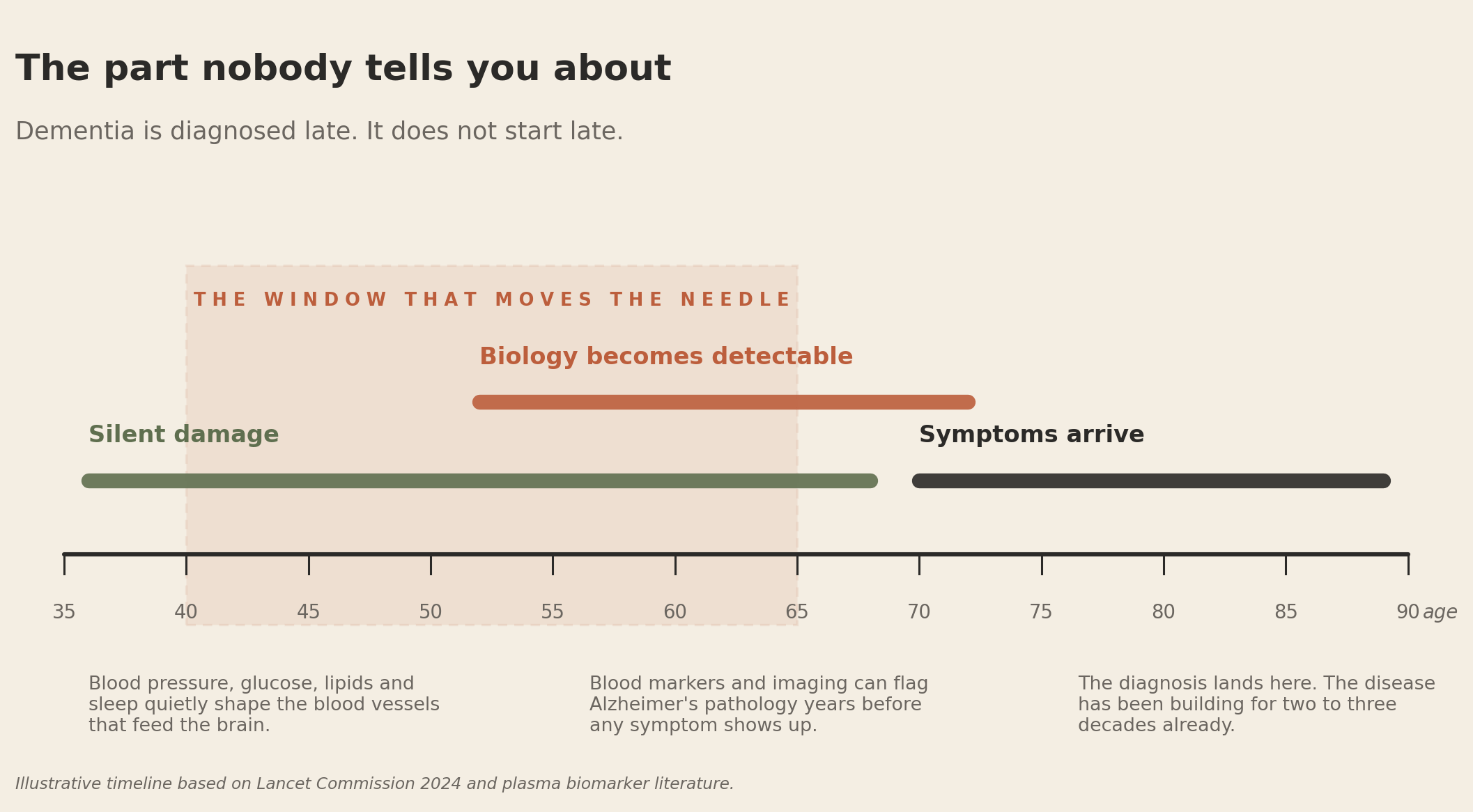
Alzheimer’s pathology builds for twenty to thirty years before anyone notices a symptom. Vascular damage builds even longer.
So the person who gets diagnosed at 78 was accumulating risk at 48.
Which means every prevention conversation we have with an 80-year-old is a conversation we are having roughly three decades late. Yes, LATE! We need to be having these conversations in our thirties and fourties.
The good news, and it is genuinely good news, is that we finally have a randomized trial to point at. US POINTER, published in JAMA in 2025, took over 2,000 older adults at elevated risk and put them through two years of structured lifestyle intervention: exercise, diet, cognitive challenge, social engagement, and cardiometabolic monitoring. Both intervention arms improved cognition. The more structured, more accountable arm improved it more.
It is the first large-scale trial in the US to show that a multidomain lifestyle program can protect cognitive function. In people who were already in their sixties and seventies.
Now imagine starting at 45.
Here is the part I find most useful clinically, and most surprising to patients.
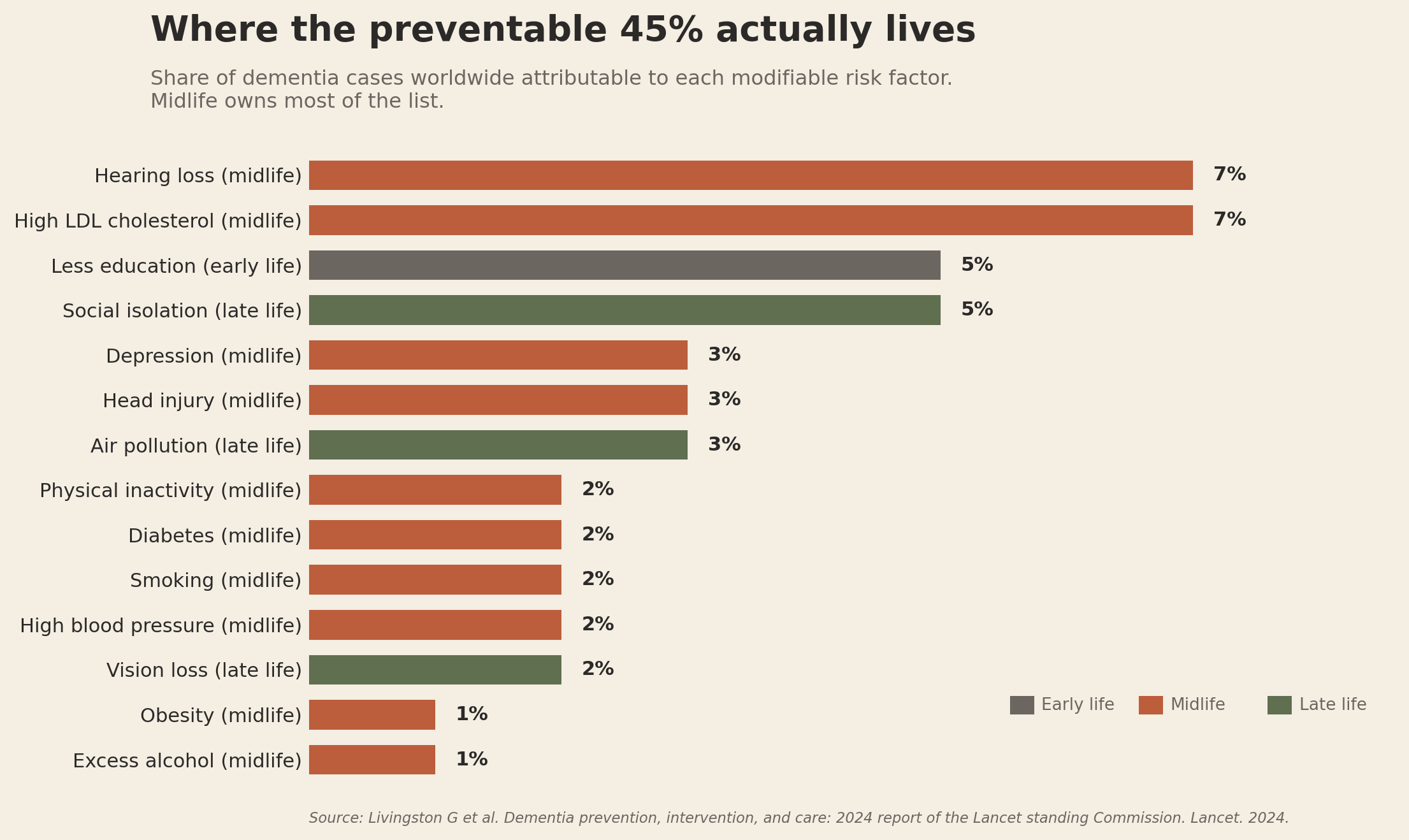
Look at what sits at the top of that list. Not the things you would guess.
Hearing loss. Really? Who would have thought!
Nobody’s brain health influencer is talking about hearing aids. It is not sexy. It does not sell a supplement.
It is also tied for the single largest modifiable contributor we have identified.
Ranked roughly by what I think returns the most per unit of effort in a normal human life.
1. Get your systolic blood pressure under 130, and get it there in your forties. This is the least glamorous item on the list and possibly the most important. High blood pressure damages the small vessels feeding your brain silently, for decades, with zero symptoms. Over 9,000 adults randomized to a systolic target under 120 versus under 140. Tighter control produced 19% less mild cognitive impairment and 15% less of the combined MCI-or-dementia outcome. Buy a validated home cuff. Measure sitting, feet flat, arm at heart level, twice, morning and evening, for a week. Bring the numbers to your doctor. One in three adults with hypertension does not know they have it, and the ones who do often are not treated to target. So get on top of this, especially if you have a family history.
2. Test your hearing. Actually do it. Especially if you have difficulty hearing the TV o or cant hear as well in crowded, noisey places. The ACHIEVE trial randomized nearly 1,000 older adults with untreated hearing loss to hearing intervention or health education. In the total group, no effect. But in the people already at highest risk of cognitive decline, hearing aids cut three-year decline by 48 percent,
I want to be honest that the overall trial was negative and this is a subgroup finding. But it is a prespecified subgroup, the biological rationale is strong, and the intervention is a hearing aid. The risk-to-benefit math here is not close. If you turn the TV up, if you struggle in restaurants, if you ask people to repeat themselves twice a week, get an audiogram.
3. Build cardiorespiratory fitness. Fitness is the closest thing we have to a master lever. Higher fitness in midlife tracks with lower dementia risk, lower blood pressure, better glucose, better sleep, better mood. It buys down four other items on this list at once. You do not need to become a runner. You need to be able to hold a conversation while walking uphill, and you need to be doing something that makes you breathe hard a few times a week.
4. Lift heavy things twice a week. Muscle is metabolic real estate. It is where you store glucose. It is also what keeps you from falling and hitting your head at 75, which is its own item further down this list. Two progressive sessions a week is the floor, not the goal.
5. Catch insulin resistance before it becomes diabetes. .Insulin resistance builds for years before HbA1c crosses 6.5. Ask for fasting insulin alongside your fasting glucose and HbA1c. If your fasting insulin is creeping and your triglyceride to HDL ratio is climbing, that is information you can act on now, and it is information most people never get handed.
6. Treat your LDL like it matters, because it does. This was the big addition in 2024, based on cohort data in over a million people plus Mendelian randomization across 27 studies. High midlife LDL is tied for the largest single contributor in the model. Know your ApoB or your LDL-C. If it is high, treat it. The word “midlife” in that risk factor is doing a lot of work, and it is not describing your seventies.
7. Protect seven hours of sleep, and screen for apnea. In the Whitehall II cohort, roughly 8,000 adults followed for 25 years, persistently sleeping six hours or less through midlife was associated with about a 30 percent higher dementia risk. Observational, and reverse causation is a real concern the authors themselves raise. But we also have mechanism: the brain clears metabolic waste during deep sleep, and untreated sleep apnea fragments exactly that. If you snore, if you wake unrefreshed, if your partner has ever elbowed you at 3am, get tested.
8. Count your alcohol honestly. Not moralizing here. Just arithmetic. Most people underestimate their intake by roughly half, and the “one glass” that is actually a generous pour into a large bowl is closer to two. Heavy drinking is on the list. The protective-red-wine story has not survived better methods. If you drink, know the real number.
9. Protect your head. Traumatic brain injury carries the same weight in the model as depression. Wear the helmet. Cycling, skiing, horses, all of it. And take fall prevention seriously starting in your sixties, which loops directly back to strength and balance work in your forties.
10. Keep real people in your life, and keep learning hard things. Social isolation carries a 5 percent attributable fraction, which puts it above smoking, diabetes and hypertension in the global model. Cognitive and social engagement showed up as core components in US POINTER. To be clear about what the evidence supports: this means friendships, community, difficult new skills, real conversation. It does not mean a brain training app. The app studies are underwhelming and I am not going to pretend otherwise.
Smoking is not on my list of ten because it should not need to be. If you smoke, it is number one and the other nine can wait.
Vision loss is worth naming too. Untreated vision loss carries a 2 percent attributable fraction, and cataract surgery is one of the highest-yield interventions in all of medicine. Get your eyes checked.
And diet: the MIND pattern was the one used in US POINTER. Leafy greens, berries, olive oil, beans, nuts, whole grains, and omega-3s. On omega-3s, oily fish is the usual recommendation, but algal oil, walnuts, chia and flax get you there too, and algal oil in particular delivers DHA directly without needing a fish in the middle of the supply chain.
Two thirds of people living with Alzheimer’s are women.
For years the explanation was simply that women live longer. That explanation is looking increasingly incomplete.
Brain imaging work out of Weill Cornell, where I spent eight years on faculty, has shown that the menopause transition itself involves measurable changes in brain structure, connectivity and energy metabolism. Women in their forties and fifties show shifts that men of the same age do not. Some of those changes appear to be temporary and the brain reorganizes. Some may not be.
The perimenopausal window is the single most common moment when women in my practice deprioritize their own health, at precisely the age when the evidence says it counts most. So please please pay attention to your health, even more so after age 35.
Not this decade. This month.
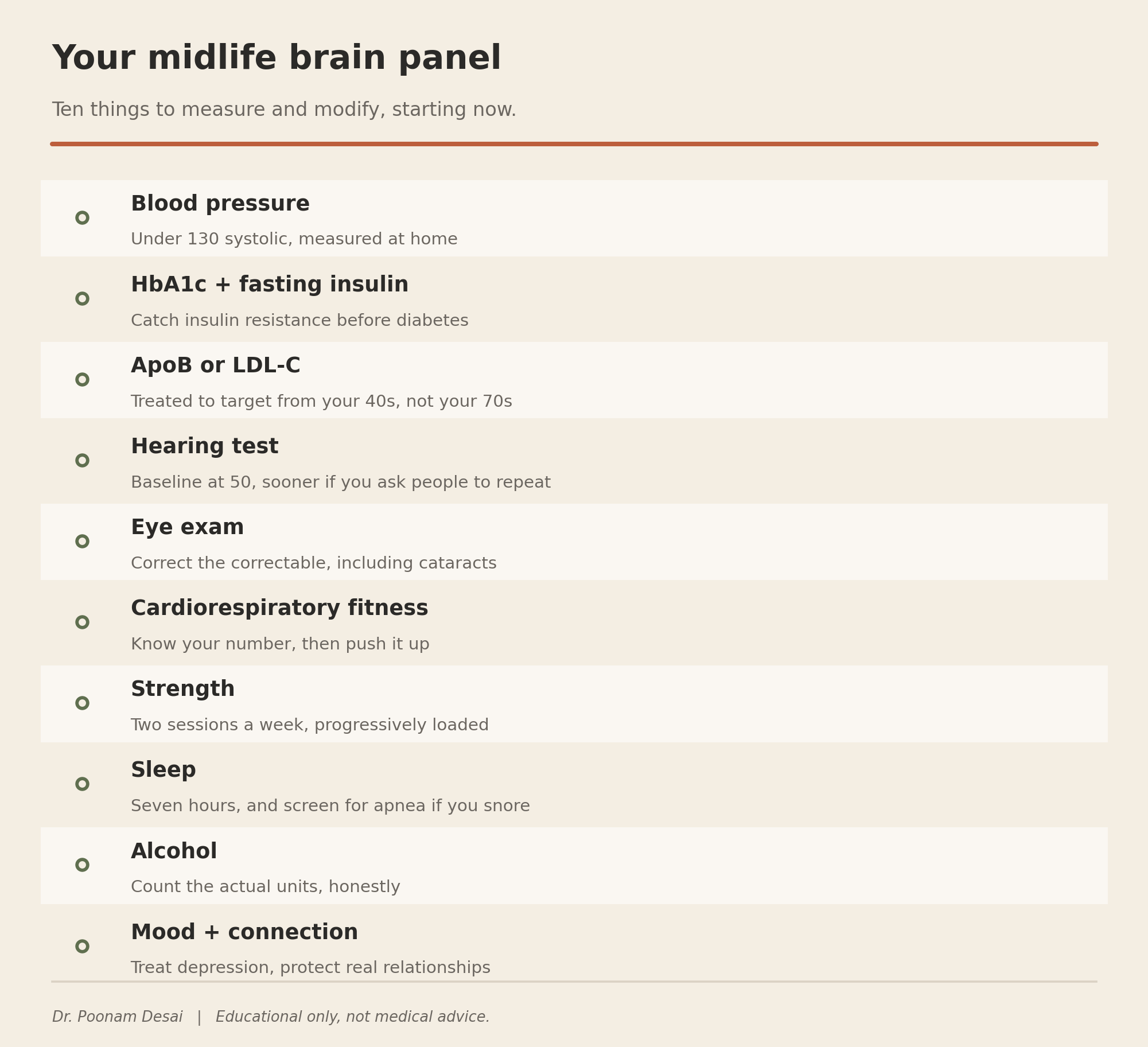
Pick three. Not ten. Three.
Most people who try to fix everything on a list like this fix nothing, and I would rather you nail blood pressure, sleep and strength for a year than perform enthusiasm at all ten for a fortnight.
Blood tests like p-tau217 can now flag Alzheimer’s biology years before symptoms, and the anti-amyloid drugs have finally reached real patients. Both are genuinely exciting. Neither is a reason to wait.
Because if a new therapy does turn out to be the one, the person it will work best for is the person who arrives with clean vessels, good metabolic health, decent fitness and an intact brain to protect.
The best time to start was twenty years ago.
The second best time is before you close this tab. Ok go get on it! :)
If someone you love is in their forties or fifties and has not had their blood pressure checked this year, forward this to them. That is the whole ask.
Subscribe for evidence-based longevity medicine, written by a physician, with the hype removed.
This newsletter is for educational purposes and is not medical advice. It does not create a physician-patient relationship. Please talk to your own doctor before making changes to your medications, supplements or health plan.
Thanks for reading Longevity Newsletter by Dr. Poonam Desai! This post is public so feel free to share it.
Until Next Time,
Dr. Poonam Desai
No posts
Comments
Nothing yet. Say the first thing.
Sign in to join the conversation.