
The US and China have just entered a new era of cooperation. This is massively bullish for the world economy. It marks a watershed moment that is transformational for both superpowers and the world.
Why did it happen? Terror. Between the US, China, and Russia alone, nuclear weapons now amass to about as much as 4 million kilotons of TNT. Hiroshima was less than 4 kilotons. 4 vs 4 million. Ummm. We need to stop analyzing the US-China Summit in terms of which side “won” and which “lost”. Humanity is being saved, and that’s all that matters. In an era of hypersonic nuclear missiles, AI-driven cyber weapons, orbital strike systems, nuclear weapons that will destroy Earth many times over if deployed, and total economic interdependence, the binary became undeniably clear. The choice is stark. The superpowers can choose to go to war against people (call it the Star Wars scenario) or to go to war against problems (call it the Star Trek scenario). Both sides know they cannot choose Star Wars because a kinetic war against people with today’s modern weapons systems would mean the end. They are so powerful that the superpowers would risk annihilating not just each other but all of humanity and the planet as well.
A superpower war will not look like Ukraine’s slow, grinding, land war. It will be sudden and catastrophic, involving weapon systems that do not allow for limited war between peers. Americans are about to celebrate the nation's 250th anniversary. In spite of the separation between Church and State, many Americans still prefer to see things in a Christian context and biblical terms. It’s a matter of angels and demons. If we choose a superpower war, we destroy everything. We are demons. If we choose love (yes, love of humanity), we are angels. A kinetic clash between the U.S. and China, or Russia, would be over in minutes, with consequences measured in billions of lives and centuries of setbacks. The economic costs would dwarf any short-term political gain. Geopolitics has thus become too expensive for both sides.
Both also see that scarcity is now being converted into abundance. American and Chinese engineers are telling their bosses alike. We can now make fertilizer without oil, and thus grow whatever we need anywhere. We have captured the power of a nuclear star in a box (Small Modular Reactors), which can now safely power our society indefinitely. The list of such advances is now endless. Why destroy everything now when we are on the brink of having enough for all?
No Signing Ceremony
So, we have to understand that the old framing of geopolitics is not just wrong. It is dangerous. This is not a matter of China winning or the US winning. Both have agreed to accept the conditions to allow humanity to win. We are witnessing a historic hug between the leaders who represent half the world’s GDP and all our futures. This is why, in my view, they did not conclude the summit with the usual signing ceremony. It was not a transaction. It is not a contract. Instead, the two leaders went to two sacred sites: the UNESCO Heritage site, the Temple of Heaven, the mysterious core of Chinese power. The extraordinary symbolic meaning of this is not understood, or reported, by the Western press, as we shall see.
In fact, most of what mattered at the Summit was not reported, such as the simultaneous arrival of the Head of the CIA in Havana, where he negotiated with Castro’s grandson amidst a total energy blackout. Cuba has no gasoline, no diesel, no lights, and now, no reliable friends. It is either going to be embracing the US or seeing its leader, the grandson of Fidel Castro, facing a Maduro scenario (i.e., facing extraction and charges). Trump is considering offering Venezuela statehood. The word is that Cuba and Venezuela are both considering entry into the US legal system within the American sphere of influence (little investment will happen unless they formally come under the halo of US law). Secretary of War Hegseth canceled a major deployment of 4,000 US troops to Poland as he sat two seats away from the Chinese Premier, thus signaling America’s firm intention to pull troops out of Europe in anticipation of a peace deal over Ukraine that the US and China intend to pursue together. The first ship got through the Strait of Hormuz. Of course, it was Chinese. The Yuan Hua Hu, a Chinese tanker carrying 2 million barrels of oil, is now expected to arrive in Zhoushan in eastern China on June 1st. America hasn’t just lifted its blockade of the Straits. It is now going to guard and protect China’s energy lifeline, even offering to supply China directly with oil via Alaska. In return, Xi made it clear that China now views the IRGC as a problem that needs to be shut down. Xi said, “If I can be of any help at all (on brokering a peace deal in Iran (or getting rid of the IRGC problem), I would like to be of help.“ He was explicit in his agreement with Trump. “Iran”, he said, “cannot have a nuclear weapon”. He said this knowing that the US has 50,000 troops on standby with two Strike Carrier Groups at the ready. While Xi was clear that he doesn’t want the Strait militarized by the US, he also accepts that the US can and will only leave when the IRGC stops holding China and the world to ransom there. Now that the IRGC has struck a plant in the UAE, resolve will harden. Trump said, “There won’t be anything left of them”. Meanwhile, China will now be shifting its supply chain to the US, buying more oil and gas from Alaska. The two superpowers also silently blessed two geopolitical solutions. North Korea, now the last standing member of the old Axis of Evil after Iran, will be dealt with by a quiet joint effort by the US and China. As I said in my last Substack, the Chinese are preparing to absorb North Korea and contain the problem. The US has no doubt signaled support for this effort.
America also significantly shifted its stance on Taiwan. The day after the summit, Trump made it clear on Hannity that the US is not going to fight a war over a place that is 9500 miles away and implied that Taiwan would be stupid for trying to “go independent”. This has been the position of every American President, but none said it out loud before because, as one observer put it, “Every single one chose to paper over that asymmetry with vague ‘strategic ambiguity’ because the political cost of saying it out loud was higher than the cost of pretending it wasn’t true.”
Nobody noticed that Taiwan and China had already begun to normalize their relationship in quiet and subtle ways. On May 13, the very day the summit opened, the first group of tourists from Shanghai arrived in Kinmen, one of the Taiwan-controlled islands lying just a few kilometers off the mainland coast. For the first time in years, Beijing has resumed both group and individual travel to Kinmen and Matsu. These former flashpoints of military tension are now being gently reconnected through people-to-people exchanges and tourism. Remember that these islands were the epicenter of two serious crises between the US and China in 1954 and again in 1958. Since then, the US refused to defend these Taiwanese islands on the grounds that they were too close to China. Quemoy (now known as Kinmen) is only 2 km away from China’s mainland.
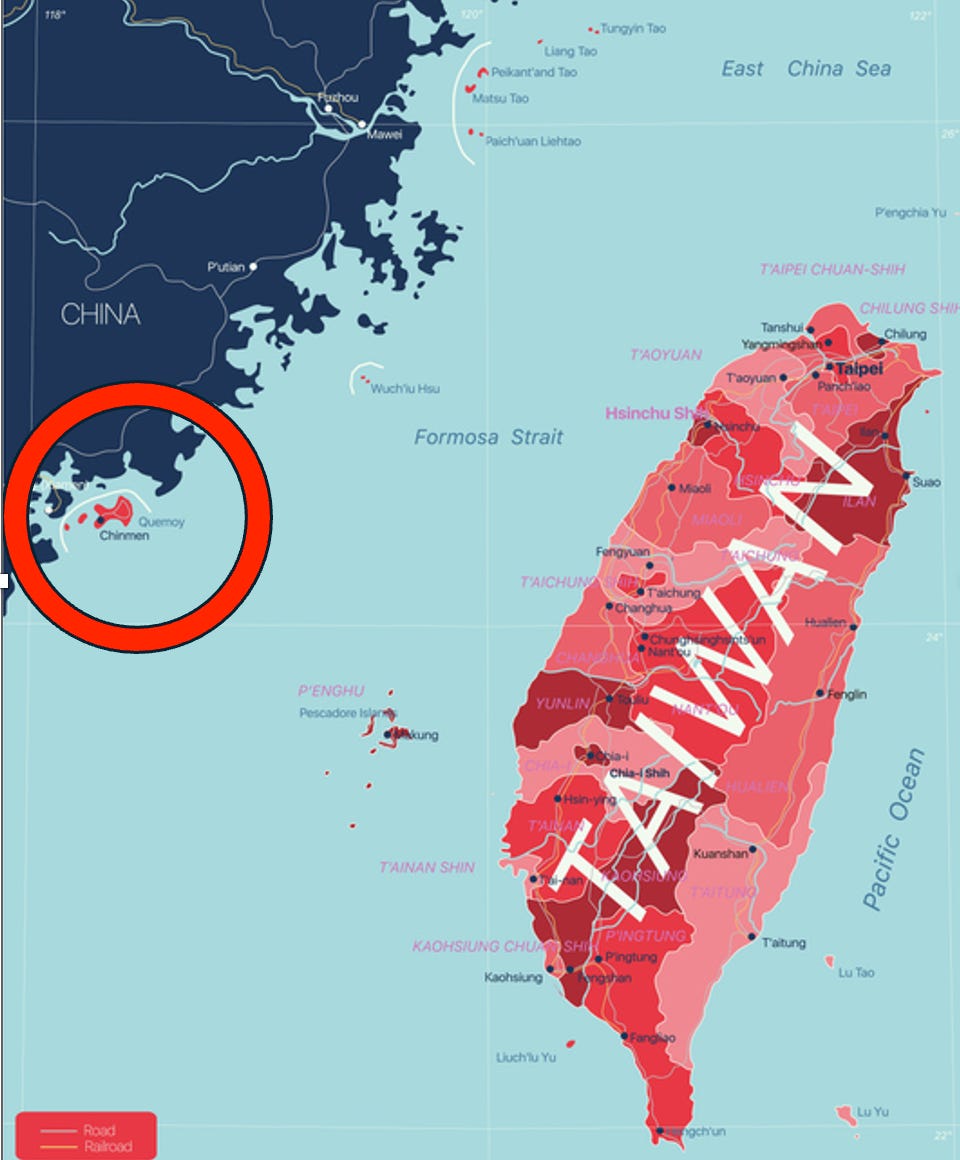
Few paid attention to the fact that U.S. Army Green Berets from the 1st Special Forces Group, 2nd Battalion, Alpha Company have maintained a continuous training presence on Taiwan’s outlying islands of Kinmen, Matsu, and Penghu since early 2024 (as announced by the US and confirmed by Taiwan), as authorized under the 2023 National Defense Authorization Act. These small, rotational teams of special operators have been serving as advisors and trainers to Taiwan’s elite 101st Amphibious Reconnaissance Battalion and Airborne Special Service Company. Their mission includes joint exercises in asymmetric island defense, amphibious reconnaissance, guerrilla tactics, and the operation of advanced systems such as the Black Hornet Nano UAV. Taiwan’s Defense Minister Chiu Kuo-cheng publicly confirmed the deployment in March 2024, describing it as a “learning opportunity” for Taiwanese forces while underscoring its role in strengthening deterrence against potential incursions. But, one wonders. Has this perhaps been the place where Americans, Chinese, and Taiwanese could quietly meet to discuss the future? What does this tourism announcement tell us about the planning that’s gone into the Summit? This is a multi-President, multi-year strategy.
Shadow America
Trump also repositioned Taiwan by re-emphasizing that they “stole” semiconductor chip production that rightfully belonged to the US. Why? Is Trump just swapping Taiwan for Cuba? No, there are deeper layers of the problem here. Trump’s language is about acknowledging that Taiwan has long been effectively an outpost of a faction of the US intelligence community (CIA), a faction that is causing America endless problems at home through its actions abroad. China and Russia alike are observing carefully as Trump makes ongoing efforts to shut down America’s shadow self, the parts of the American establishment that have been financing and fomenting color revolutions and forever wars, and treating certain locations as states of their own, from Ukraine to Taiwan. Trump said, “Taiwan would be very smart to cool it a little bit” because they now have neither the US Government nor the American Deep State reliably behind them. The US will now indefinitely delay delivery of arms to Taiwan. Instead, Trump has repositioned Japan as Taiwan’s regional protector, which is why Japan’s Prime Minister got the first call from Trump after he was wheels up on Air Force One. The President’s Oval Office joke about Japan not warning about Pearl Harbor makes more sense now. The US wants Japan’s military skills. The US wants them to protect Taiwan and to ease the way into a transition that all can live with. (Watch for Poland to play the same role with respect to Ukraine soon). The US is clearly handing off primary protection responsibilities to partners to ensure it is not always drawn into “forever wars”.
Guard Dragons
It is not that the US is abandoning Taiwan. Nor is the American withdrawal of troops from Poland and Germany an abandonment of Europe. The message is not one of abandonment but of enticement. It is, “there’s a deal to be had IF China can become more like Taiwan,” and “there’s a deal to be had if Russia can stop lobbing advanced weapons systems at Ukraine,” and “there’s a deal for the IRGC if they can stop blocking teh Strait and aiming missiles at nuclear power plants”.
The message is the same in each case. The old approach will now be more harshly punished, while embracing America will bring rich rewards. China can hardly argue against the offer. Their economy is substantially underperforming what it is capable of. Foreign Direct Investment has dried up. Yes, they have made immense technological advances, but the general population is increasingly agitated by the debt problem and the inability to find a job or to trust banks to return their savings. Beijing, Shenzhen, and Shanghai are fine, but the beneficiaries in smaller, secondary, and tertiary cities are far fewer. So, there’s no deal if China wants to crush Taiwan as they were seen to have done in Hong Kong. There’s a great deal if China becomes more like Taiwan. In the meantime, the US passes the night watch to Japan. They are closer and now extremely militarily capable. They’ll be guarding Taiwan like a temple dragon, meaning fiercely.
The same conversion dynamic has now unfolded in Venezuela. The U.S. has already agreed and implemented a comprehensive oil framework with interim President Delcy Rodríguez. Washington now controls all crude sales and revenue accounts, Venezuelan budgets are subject to a monthly U.S. audit, and funds must be spent on U.S. goods and services. More than 80 million barrels have already been delivered under these terms. Yesterday’s adversary has become a stakeholder who benefits from the new order. This is exactly the model Trump and Xi are applying on the global stage.
The IRGC is next up. They’ll convert when the financial and status offers are good enough, especially now that they've lost their best client (China’s oil demand will now be met via Alaska). That’s a lesson. Don’t cut off the energy supply of your biggest backer! The IRGC can see they are also losing all their best friends. The old Axis of Evil is fading away. Cuba is now negotiating to become part of the US, whether through statehood or another form of relationship. NPR wrote, “Cuba has confirmed multiple rounds of secret and official meetings with senior U.S. State Department officials, including a delegation that visited Havana in April 2026 (the first U.S. government aircraft landing there since 2016)”.
It’s pretty clear that something is in motion for North Korea as well. I’m betting the Armistice that’s been in place since 1953 will probably be lifted with Xi and Trump sharing the glory (see my last piece on North Korea). This is exactly how the conflict in Northern Ireland ended. The value of being a part of the new world starts to exceed the cost of remaining in the old world.
4th of July Deadline
In case you are still wondering why now, let’s be reminded that both the US and China know we are living in an era of extraordinary scientific and technological advances that will allow us to cure diseases, extend longevity, grow food more easily, and achieve virtually free energy. We can also now harness the power of atomic energy to destroy humanity in a nuclear flash or to power a much brighter future with new TRISO-fueled nuclear power stations that bring no meltdown risks. China has already industrialized the mass production of such power plants. Huge progress is being made by both countries on nuclear fusion as well. The target date? July 4th, 2026, America’s 250th Anniversary. Trump wants to show the world that he has delivered (virtually) free energy to the world. That’s a whole new kind of fireworks. A Star in a Box, as I called it in a previous substack, is nuclear power in a container half the size of a car, powered by half a handful of TRISO pellets that can power 5000 homes almost indefinitely. This tech can be used to illuminate humanity's future or destroy Earth altogether. We can go light or go dark. So, it is now civilizationally essential that the superpowers agree that this kind of power will be used for peace and not for war.
Kardashev Scale
This is a Kardashev step change moment. To remind, a Type I (Planetary) civilization can harness and utilize all the energy that reaches its home planet from its parent star. At this stage, humanity would control all natural forces, including the weather (see Weather as a Force Multiplier), earthquakes, and volcanic activity. A Type II (Stellar) civilization is capable of directly harnessing all the radiant energy output of its star. This level would likely involve engineering mega-structures, like a Dyson Sphere, to capture a star’s entire energy output or a Star in a box. A Type III (Galactic) civilization can control and channel the energy of an entire galaxy. Such a society would span across multiple star systems and utilize the combined power of billions of stars.
Both sides are well aware that each has the ability to deliver energy from the atmosphere and pace. Just check out Quicksink. It lets the US blast ships to smithereens from above. The Russians have been blasting their satellites to smithereens to create deadly debris fields that are slowing everybody’s ascent into the unlimited riches of space. Chinese and American satellites have been at war for some time, well outside the public’s view. Just because there are no journalists in space doesn’t mean there’s no conflict there.
Given a choice between annihilation and abundance, there is no choice. Two countries remain willing to threaten nuclear annihilation – Russia and North Korea. They remain the central problem. Iran may still get the headlines. But, silent North Korea and noisy Russia are bigger problems for the world.
Russia
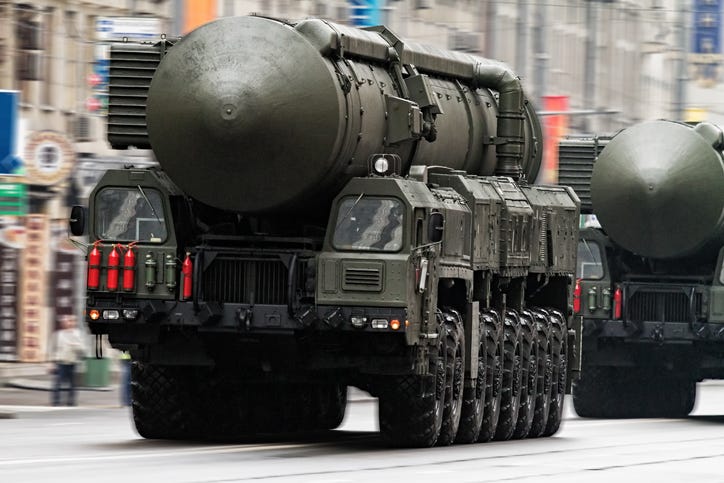
Sadly, as America and China embraced, Russia chose the opposite path, publicly threatening the world on May 12th, one day before the summit, with its most advanced nuclear systems, including the Sarmat “Satan II” ICBM, the Poseidon underwater drone, and the Burevestnik nuclear-powered cruise missile (known as Skyfall). Putin pointed out that the combined power of its individually targeted warheads is “more than four times that of any of its Western counterparts.” One Satan II missile can deliver more explosive power than the entire Allied bombing campaign of World War II in under 30 minutes. Its MIRV (Multiple Independently Targetable Reentry Vehicle) technology allows a single missile to carry 10 to 15 heavy nuclear warheads, each of which can be directed to strike different, geographically separate targets all at once. The Poseidon is a 65-foot-long nuclear torpedo that can carry up to a 100-megaton warhead. Putin highlighted is engineered for a different but equally apocalyptic form of destruction. It does not strike cities directly; instead, it detonates offshore to generate a radioactive tsunami-like surge, designed to flood coastal regions with radioactive seawater and turn ports, naval bases, and entire metropolitan areas into uninhabitable radioactive zones for generations. The Burevestnik’s real terror multiplier is not raw yield alone; it is stealth plus unlimited endurance. It can fly for days or weeks, change course unpredictably, and strike from any direction after loitering indefinitely, thus defeating early-warning radars and missile defenses. It’s a nuclear-powered missile. The Satan II, Poseidon, and Burevestnik make any kinetic exchange between superpowers an act of civilizational suicide.
As the talks in Beijing began, Russia also unleashed one of the largest aerial assaults of the entire war in Ukraine. Overnight on the 13th, Russia sent a massive saturation barrage of over 1500 projectiles, including 800+ Shahed-type drones plus ballistic and cruise missiles across 20 regions, pounding Kyiv’s Darnytsia residential district, collapsing apartment buildings, and killing at least six people. At least 31 were injured in the capital alone. Ukraine’s Foreign Minister, Andrii Sybiha, called the timed assault “barbaric,” noting it came precisely while the world’s most powerful nations gathered in Beijing hoping for peace.
This was the geopolitical equivalent of slamming the door in a fit while everyone else is hugging. The strikes in Ukraine during the summit were a kinetic punctuation mark. Putin’s message was clear. “While you talk peace, I remind you I can still impose costs.” He had offered to meet President Zelensky only a few days before. It was an ultimatum dressed up as an olive branch. By saying “This should be the final point, not the negotiations themselves,” Putin made it clear that he was only agreeing to a signing ceremony for a deal on his terms, not for actual negotiations or talks. He is not offering a hug. President Zelensky isn’t offering one either. He said, “We’re not giving up on diplomatic efforts… but the most effective tools are those that can physically stop the Russians.” Ukrainian drones are now aiming at Moscow directly. The risk of escalation is escalating.
Ukraine
We have to understand that Ukraine is where Trump started and where he wants to finish. His efforts to forge a hug with China did not arise in spite of the war in Ukraine—they arose because of it. Trump has long viewed the grinding conflict in Europe as the single greatest drag on global stability, markets, and American interests. Ending it quickly and cleanly is not a side issue for him; it is America’s strategic north star. Trump seized on the fact that the US and China share the same iron-clad position on Ukraine: no nukes. The earliest clear public statement came on November 4, 2022, when Xi told visiting German Chancellor Olaf Scholz: “The international community should … jointly oppose the use of, or threats to use, nuclear weapons, advocate that nuclear weapons must not be used and nuclear wars must not be fought, in order to prevent a nuclear crisis in Eurasia.” It was Beijing’s most direct rebuke of Moscow’s nuclear rhetoric to date.
This shared red line is not abstract. It is the leverage point. Only China can constrain or entice Russia into a more amenable position on Ukraine. Beijing is now Moscow’s economic lifeline because China purchases roughly half of Russia’s oil and gas exports and supplies 90% of the dual-use technology that keeps the Russian war machine running. China provides the financial and diplomatic cover that sanctions have failed to sever. China can constrain Russia by dialing back those flows or tightening the terms. It can entice Russia with even deeper energy partnerships, investment guarantees, and a face-saving role in a new Eurasian security architecture. China is also moving into Russia’s East, preparing to build much-needed infrastructure across Siberia and the Pacific coast. These will include ports, railways, highways, and communications links. No other power, not the United States, not Europe, holds the leverage that China does.
The idea that the United States and China are effectively deciding the fate of Ukraine feels jarring to Russia and to many observers. It seems to sideline the very nation whose territory and future are at stake. Yet geopolitics today operates like a quantum phenomenon: everything is entangled. A handshake in Beijing instantly alters the calculations in Moscow and Kyiv. Supply-chain decisions made in Shenzhen ripple into battlefield realities in Donbas. Markets in New York price in the probability of peace the moment the two largest economies signal cooperation. In this hyper-connected system, the US-China axis is not “deciding” Ukraine’s fate in the old imperial sense. It is creating the only gravitational field strong enough to pull the entire entangled geopolitical system toward resolution. Anything that gets in the way must be sacrificed. That includes President Zelensky.
Corruption scandals are now moving dangerously close to President Zelensky himself, steadily eroding both his domestic legitimacy and his ability to remain in power. The 2025 Energoatom scandal, the largest scandal in his presidency, directly implicated his long-time business partner from the Kvartal 95 television company, Timur Mindich, and forced the resignation of his most powerful aide, Chief of Staff Andriy Yermak. Another, Oleksandr Kabanov, is dead. Mindich seems to have fled to Israel. He was not just a casual associate. He was one of the inner-circle “old friends” from Zelensky’s pre-presidential life. The fact that he fled while senior officials close to the president (including former Chief of Staff Andriy Yermak) were also being investigated has significantly damaged the perception that Zelensky’s team is clean. Leaked recordings and court documents have shown senior officials boasting about their ability to influence the president, creating the perception that the inner circle has treated wartime reconstruction contracts as personal enrichment opportunities. Earlier revelations, including the 2021 Pandora Papers that exposed offshore companies tied to Zelensky and his closest partners, already painted a picture of a leader who arrived in office with the same elite networks he once criticized. Combined with repeated defense procurement scandals involving overpriced food, defective ammunition, and drone kickbacks, these cases have convinced many Ukrainians and key Western donors that corruption is systemic rather than incidental. In a country at war, where billions in aid flow through the government, this perception is politically lethal: it weakens Zelensky’s moral authority, fuels opposition calls for early elections or a negotiated exit, and makes it far harder for him to maintain the unified domestic support he needs to negotiate any peace deal with Russia.
Trump is treating the resolution of the war in Ukraine exactly like the complex property deals that defined his career. In real estate, you do not get a skyscraper built by negotiating with only one tenant. You bring every interested party to the table. Landowners, banks, regulators, neighbors, anchor tenants, but also the mayor and the mob are gathered around the table. You construct a deal in which everyone walks away feeling they won something valuable. No one loses face. Everyone gets a piece of the upside. That is precisely the framework he is applying now: get the United States, China, Russia, Ukraine, and Europe all aligned so the final agreement leaves every capital with tangible wins. So, he has to entice Russia with the prospect of what Hong Kongers call, “Make Money-La”.
Make Money-La
China is the key to solving both the North Korean problem and the problem of Russia and Ukraine. That is why Trump has been carefully pursuing a strategy to bring China to the negotiating table first. By cutting off the energy and cash flows from the Mexican cartels, Venezuela, Iran, and America’s Deep State, and by threatening to
close the Malacca Straits too, the US created the pressure that compelled China to not just talk but to reconsider its domestic economic strategy. The current centralized control approach is not just glitching the Chinese economy. It is glitching the world economy. The US hardly has to say that any attempt by China to repeat what happened in Hong Kong will not be acceptable to the US or, more importantly, healthy for China. In other words, the US is asking China to return to its entrepreneurial roots and restore the Deng Xiaoping view of the world, which is to accept that it does not matter if the cat is black or white as long as it catches mice. The strategy is what Hong Konger’s call “Make Money-La”. So, the choice is stark. End humanity or make Money-La. China’s very DNA is to make Money-la. This will be even easier now in a world dominated by dollar-convertible stablecoins and Bitcoin.
Thus, the offer is not about the deals the press reported on. Yes, Nvidia will now sell more of its chips to China. Yes, China will also buy 200+ more Boeing’s and a bunch more boatloads of soybeans as well. But something much more consequential is now in play.
Rock and Roll, Burgers, Blue Jeans and Brands
Remember that culture ended the Cold War. Not missile exchanges. It was Rock and Roll, burgers and blue jeans. As a reality TV expert, Trump understands modern culture well. He said at the summit, “Just as many Chinese now love basketball and blue jeans. Chinese restaurants in America today outnumber the five largest fast-food chains in the United States, all combined. That’s a pretty big statement.” So, the two sides agreed to create a Board of Investment to discuss future Chinese investment in non-sensitive U.S. sectors. That means everything from stuffed toys to fast food, fast trains. We can expect sales of cultural exports and imports between the US and China to soar. The Chinese once sent live pandas to the US as a sign of friendship (remember Ling-Ling and Hsing-Hsing?). Now they’ll send their fast-food chains and top retail brand names.
China needs to do this. They have only created two truly global brands – Huawei and Haier – in spite of the size of China’s economy. Haier did this by moving production into the US back in 2016. They were so successful at manufacturing inside the US that they ended up buying GE’s home appliance business, which they still run. China’s firms need to meet the most discerning consumer on earth, the American retail market, if they are going to create the kinds of brands that can truly lift national incomes.

The era of competing on cheapness is over. Now they must compete on quality and produce not just in China but globally. Haier is already a Harvard Business School case study for becoming a great manufacturer in the US (see here for their famous sledgehammer strategy). The question is, who is next? Hisense? Midea? TCL? Gree? Luckin Coffee? Wallace?
The Invisible Bridge
Instead of trying to pick which firm is going to win here, try to frame it as a bridge that many such firms will cross. This is the start of an invisible bridge from “Made in China” to “Owned by China”. This is a bridge that can lift the next several hundred million Chinese citizens into high-income status without creating the political pain that arose from the export-led strategy. This is exactly what Western Europe did in the 1970s. BMW and Mercedes did not just sell to America. They became American brands in the eyes of American buyers. It’s the same with Toyota, Honda, Sony, Samsung, and LG. This bridge has been crossed before. By Japan. By South Korea. By Europe. Now China, too, begins its crossing, stepping confidently into the future. Instead of being merely the cheapest employees of the global capitalist system, they have done a management buyout and have now become owners of it.
America wants China to know that there are treasures awaiting on the other side of this bridge, including magical devices like NVIDIA’s Blackwell chips and the Vera Rubin platform. The drama around Jenson Huang’s presence mattered. Had he not joined the President’s plane in Alaska, China might never have been allowed to buy the (lower-grade) magical keys to the technological Kingdom of Abundance, such as NVIDIA’s 50 petaflop Blackwell chips and the Vera Rubin GPUs. They would have continued to rely on smuggled versions. This is far from ideal for big businesses. But he made the plane, which means direct sales of NVIDIA chips are set to expand, even if certain conditions still need to be met. One of these conditions is in the realm of spy games.
Spy Games
To cross the bridge, China must agree to stop using spy games like Salt Typhoon to wage war with the US. This means the American spy games need to shift gears, too. This shift is not just for China. It is also for Russia. Putin’s biggest concern is about America’s Deep State. Trump may have good intentions, but the dark shadow of the Deep State is extremely powerful. Being a spy himself, Putin understands very well how these spy games work. He needs a lot of proof that he won’t have to keep going into battle with America’s dark side. Remember that Putin’s complaint is often characterized as anger about NATO expansion. But his bigger issue is the Western intelligence communities’ turbocharged efforts to meddle in politics on Russia’s borders. He says the war in Ukraine was created by America’s Deep State.
Trump does not disagree. He is shutting down all the means by which the Deep State engaged in color revolutions in Eastern Europe, like USAID. He is going after the NGOs that facilitated all this. The DOJ just charged the Southern Law Poverty Center, an organization backed by the glamorous donors on the left, from Soros to Clooney, which seems to have been bankrolling leaders and members of extremist groups. They’ve been charged with “wire fraud, bank fraud, and money laundering “. Secretary Bessent just announced that the IRS is going after all those who facilitated cash transfers to terror groups. This includes the Minnesota day care scandal but will no doubt become part of the broader effort to shut down such NGO’s.
Trump is calling it out. After the Summit, on Air Force One, he was asked whether he had confronted Xi about spy games and cyber espionage. He was extraordinarily blunt, saying, “I did. And, he talked about the attacks we did in China. You know, what they do, we do too. We spy on them, too.” He went further, saying, “we do a lot of stuff that you don’t know about and you’re doing things to us that we probably do know about”. He positioned the situation with pragmatic realism, acknowledging that both are operating in the same dangerous but necessary strategic terrain. The message is clear. We both need to end the spy games and focus on the real work. America’s CIA and spy agencies will continue to do their work, but the darker meddling side that operates without Presidential approval or in spite of Presidential wishes will now be constrained.
The message is clear. China (and Russia) can access America’s treasure chest of valuable tools if China crosses the bridge. But, America has its own bridge to cross. Spygames on the American side are going to stop, or at least abide by new rules, too.
Bitcoin and Digital Rails
America’s rapid shift onto Bitcoin, stablecoins, tokenized real-world assets (RWAs), and programmable digital rails (via the CLARITY Act, GENIUS Act, Strategic Bitcoin Reserve, and BlackRock/Goldman/Visa/Mastercard infrastructure) is part of the hug.
By moving the global monetary order onto US Dollar-based blockchain rails that the U.S. and its tech/finance allies largely control at the protocol level, Washington creates a situation in which everyone else has to play ball. Beijing can either plug its own digital infrastructure (including its mBridge CBDC ambitions) into the new American-led programmable dollar system on U.S. terms or risk being relegated to a slower, less liquid, less programmable parallel sphere while the West builds the next-generation financial architecture around it. The American Deep State will find it much harder to move money around in a vastly more transparent world, too. There is much more to be said about all this, but we’ll leave that for another Substack.
Cosmic Order
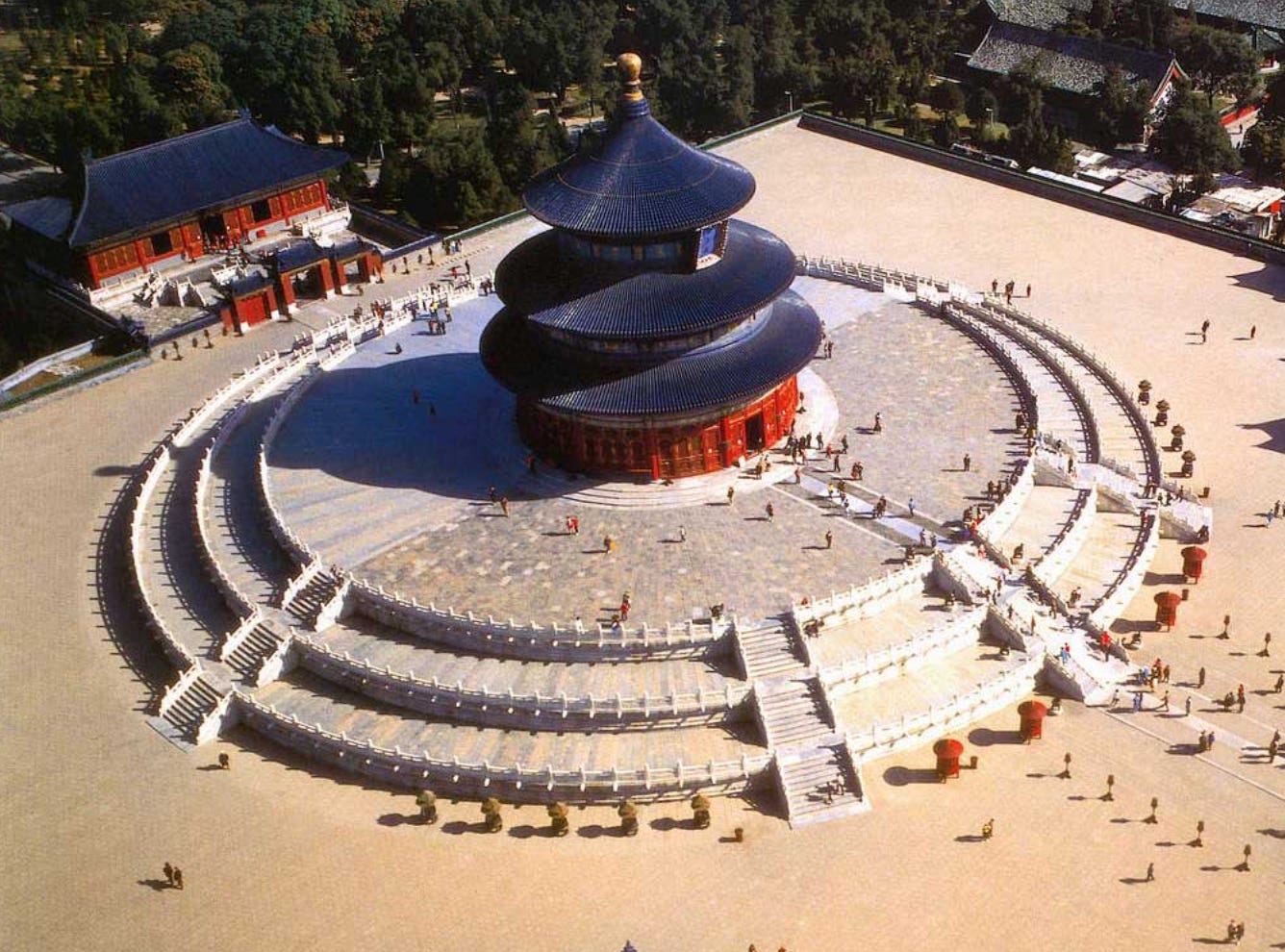
You can be sure the intelligence community understands the symbolism of the Temple of Heaven, even though the press and the public are clueless. They understand that Trump and Xi did not conclude this historic event with a signing ceremony, pens, and documents on a table because it was not about a transaction or a contract. Instead, they went together to the Temple of Heaven, the ancient complex built in 1420 by the Ming Emperor Yongle. It is the exclusive circular imperial altar on a mound dedicated to abundance. For over six centuries, from the Ming and Qing eras, till now, emperors have come here each spring to pray explicitly for bountiful harvests, which has always been the ancient Chinese measure of national prosperity, food security, and economic well-being. “Good harvests” meant fertile fields, stable grain prices, thriving trade, and the material flourishing of the people. The hall’s very name, Qinian Dian, translates directly to this prayer. Its architecture, with pillars representing the seasons, months, and solar terms of the agricultural calendar, was engineered as a cosmic instrument to secure “feng tiao yu shun” (风调雨顺), which means favorable weather and timely rain, so that abundance flows.
This temple’s circular, triple-eaved design includes blue tiles symbolizing the vault of Heaven, four central pillars for the seasons, twelve middle pillars for the months, and twelve outer pillars for the hours of the day. This architecture and design embody the ancient cosmogony that Heaven is round and Earth is square. The circular halls representing Heaven resting on square bases representing Earth symbolize the harmonious relationship between the human world and the cosmic order. The emperor alone mediated between the two realms to maintain cosmic harmony and the Mandate of Heaven itself.
Abundance is the keyword. China and the US both see a world that is shifting from scarcity to abundance. Both see this as a Kardashev level spiritual elevation for humanity. The temple’s very architecture, including the circular halls representing Heaven resting on square bases representing Earth, symbolizes the harmonious relationship between the human world and the cosmic order. For centuries, it was the place where the emperor, as “Son of Heaven,” mediated between the two realms to ensure peace, prosperity, and legitimacy. In choosing this sacred site over the usual protocol, the two leaders sent a message louder than any communiqué: this hug is not a transactional deal. It is a restoration of cosmic order. It is an invocation of harmony and shared prosperity for the generations to come.
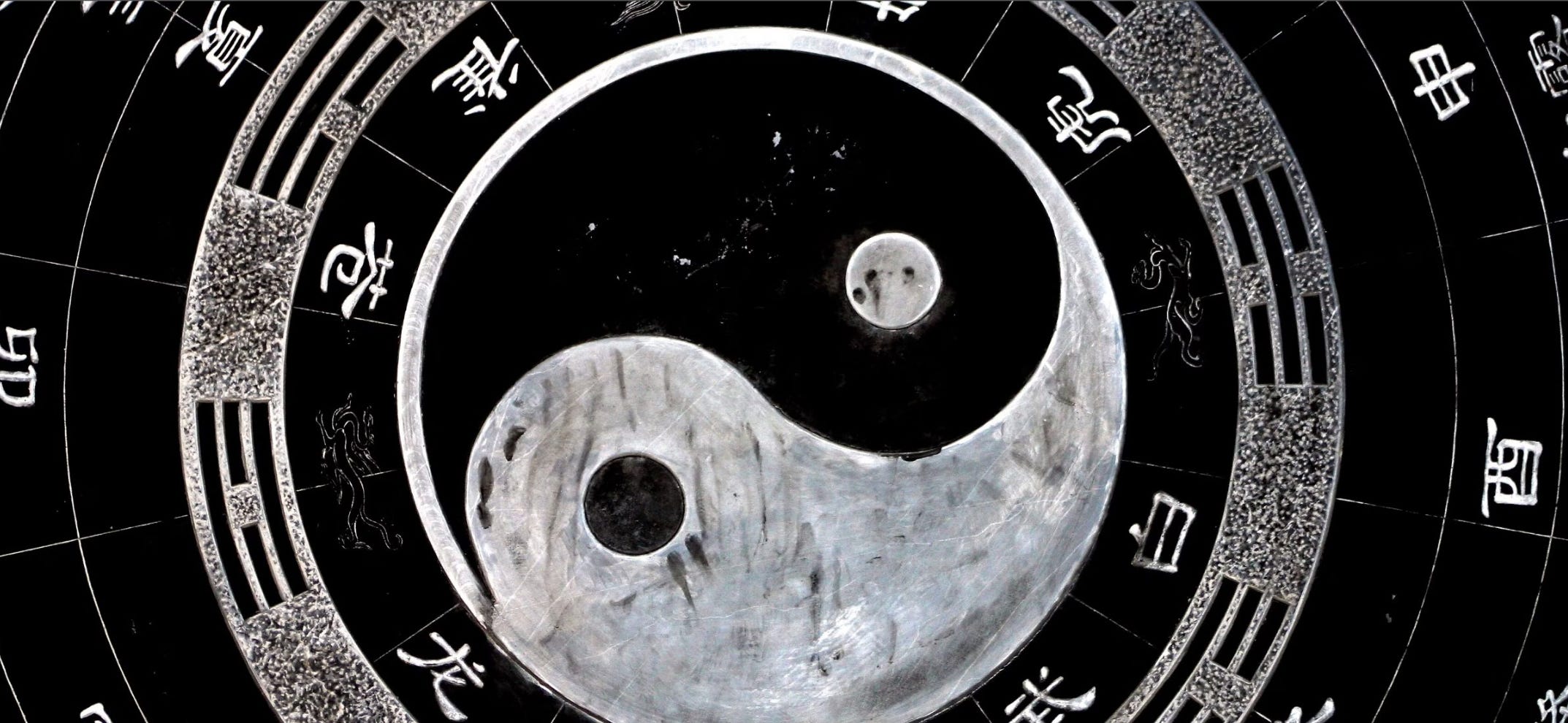
It is a Taijitu (太极图). In the quantum geopolitics of our time, where everything is entangled, the image of Trump and Xi walking side-by-side through the Temple of Heaven is itself the most powerful agreement of all. Each acknowledges the other as the greatest leader in history, hence all the over-the-top mutual compliments.
What makes this choice of location even more extraordinary for China is its own modern history. During the Cultural Revolution, countless ancient temples and sacred sites were deliberately destroyed as symbols of feudal superstition. The Temple of Heaven survived largely intact. It stands as a living reminder of a heritage once rejected and now being reclaimed. By bringing President Trump here, President Xi publicly reconnects contemporary China to the ancient cosmology of the Mandate of Heaven, the idea that legitimate rule flows from alignment with a higher cosmic order. By choosing this sacred ground over a formal signing ceremony, both leaders implicitly submitted to something greater than themselves: the higher cause of human survival. Just as emperors once humbled themselves before Heaven to secure good harvests and harmony, Trump and Xi subordinated rivalry, ideology, and short-term gain to the imperative of preventing kinetic war in the nuclear age and of achieving what is now possible - abundance. In that moment, the hug was no longer merely diplomatic. It was a ritual restoration of cosmic order. In the quantum geopolitics of our time, their appearance at this specific temple site marks an agreement to move from petty geopolitics towards civilizational wisdom.
An Army of Industrialists
The presence of more than a dozen top U.S. CEOs, including Elon Musk (Tesla/SpaceX), Tim Cook (Apple), Jensen Huang (Nvidia), Larry Fink (BlackRock), Stephen Schwarzman (Blackstone), Boeing’s Kelly Ortberg, and many others, turned this from a mere presidential photo-op into a strategic industry endorsement. Their presence, representing a $4.7T contribution to the world economy, tells us that this is not just one man’s view. It is the American industry’s view. That’s America’s Army, too. A war with America’s armies, whether in uniforms or in sneakers, would glitch the global supply chains, shatter markets, and destroy the very prosperity these companies have built. Cooperation is the only rational and solvent path forward. President Xi agrees. Xi led the way at the summit by calling for “partnership over rivalry,” and “a new era in US-China relations.” These leaders understand economics and history. They know that collaboration on trade, technology, AI governance, climate, and global stability is not surrender. It is survival. It is the only way to deliver the growth their citizens demand and the security their nations require. The presence of Musk’s 6-year-old son also sent a meaningful message. This is an America that is making a commitment to future generations.
Jung’s Shadow
If Carl Jung were to analyze the meaning of this particular event in this particular temple, Grok tells me he’d say this is where the light meets the dark. It’s where heaven meets earth. It’s where China’s communal Yin meets America’s individualistic Yang. What has occurred at the Temple of Heaven is a moment of profound archetypal significance. It is nothing less than the meeting of the shadows on the world stage, and the beginning of a coniunctio oppositorum — the sacred marriage of opposites — between America and China.
America, for decades, has lived as the great Yang: outward, expansive, rational, solar, masculine in its drive to conquer, to innovate, to project power and light into every corner of the globe. It is the archetype of the Hero, the Explorer, the Builder. Yet every hero carries a shadow. America fears limits, dreads decline, and suffers from the repressed knowledge that endless expansion eventually exhausts itself. Moneymaking by itself has left America in what the philosopher John Vaervake calls a meaning crisis.
China, by contrast, has long embodied the great Yin: inward, containing, receptive, lunar, feminine in its capacity to absorb, to endure, to hold the patterns of the cosmos within itself. It is the archetype of the Wise Old One, the Mother of Ten Thousand Things. Yet its shadow, too, has been heavy. China has rejected its own ancient soul during the Cultural Revolution, suppressing the very Mandate of Heaven that once gave it legitimacy, having a deep fear that its own depth and tradition might render
it weak in the modern world.
Circumpunct

This Chinese temple, The Temple of Heaven, is where opposites cease to be enemies and become partners in a greater wholeness. Tensions can remain, of course. But the civilizational step can be made together. We are talking about squaring a circle. It’s an Axis Mundi. Leonardo da Vinci’s Vitruvian Man (c. 1492) is the iconic Renaissance drawing that shows the ideal human figure inscribed simultaneously in a circle (symbolizing the divine, heavenly, or cosmic proportions) and a square (the earthly, material world). It portrays the human as the microcosm of the universe, a living axis mundi (world axis) bridging the two realms, much like the emperor’s ritual role at the Temple of Heaven.
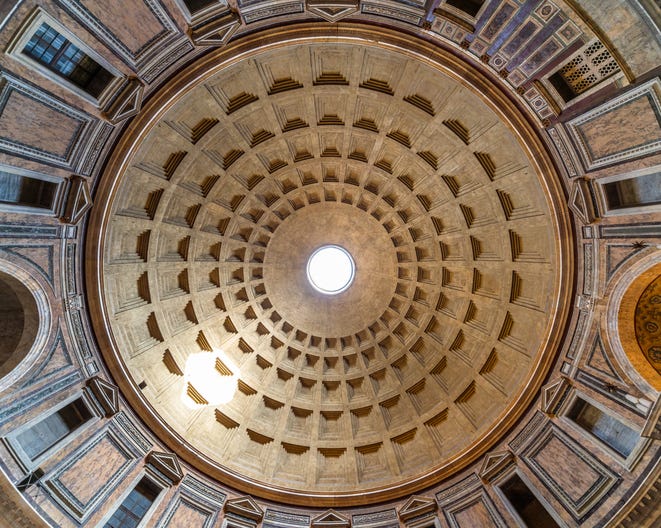
Another close architectural parallel is the Pantheon in Rome, a classical Western temple whose massive dome (representing the heavens) features a central oculus, which is an open “eye” to the sky, directly connecting the earthly interior to the divine realm above, symbolizing cosmic order and communication with the gods. A circumpunct is where the individual meets the infinite.
Notice the shape of a tokamak or stellarator nuclear energy chamber. That is circumpunct, too, and one that has placed us all at the center of this current geopolitical dilemma.
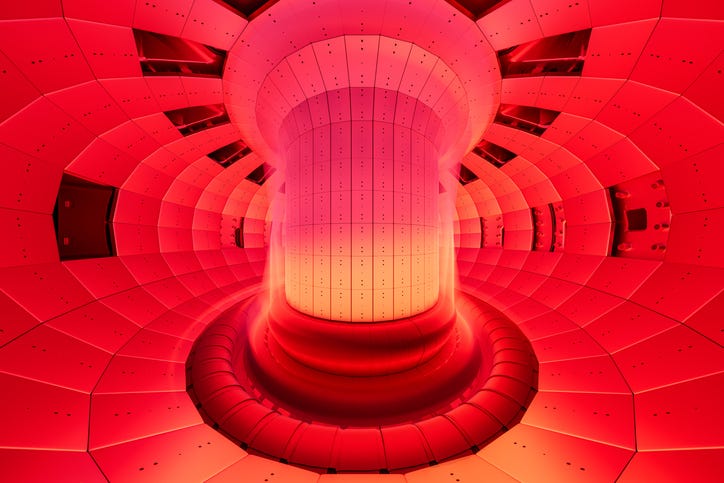
A single dot, or tiny square, perfectly centered inside a circle. It’s the philosopher’s stone in alchemy. It’s a universal symbol of unity, the microcosm inside the macrocosm, and the divine spark at the heart of the cosmos.
All this integration only happens when we meet our shadow. It is not enough for Trump to say “we’ll get our Deep State under control”. He has to prove it. So, he was blunt: “We spy like hell on them too. We do a lot of stuff to you that you don’t know about.” And, yet there they stand together at the center stone. That single candid acknowledgment, Trump’s own words after the summit, is pure Jungian gold. It is the moment the ego admits the shadow exists and thereby begins the work of integration.
So, what happened as they met? Trump has been bringing the hammer down on the Deep State.
Notice that the American pharmaceutical companies were not at the summit (here) with one notable exception. Illumina’s CEO, Jacob Thaysen, was the only life-sciences representative in the 17-CEO delegation because the company sits at the exact intersection of the hug. Precision medicine and genomics are now seen as strategic as semiconductors or AI. Including Illumina (while Big Pharma CEOs were absent) shows the summit prioritized high-tech, high-value supply-chain stabilization over traditional pharma. China had just banned Illumina’s gene sequencing equipment in response to Trump’s punitive tariffs. Its inclusion and the exclusion of the others is thus not random. Trump hit pharma with TrumpRX. Essentially, pharma agreed to stop charging Americans a multiple of the prices they charge international customers. Pfizer, AstraZeneca, Eli Lilly, Novo Nordisk, Amgen, Bristol Myers Squibb, Johnson & Johnson, Merck, Novartis, Sanofi, GSK, Gilead, Genentech, Boehringer Ingelheim, AbbVie, and others all agreed. But, that’s not the most important blow.
It was convenient timing that the US started bringing charges against Anthony Fauci’s team at the National Institute of Allergy and Infectious Diseases (NIAID) just before the summit. David Morens, Fauci’s former right-hand man, is the first of (probably) many who now have to explain why they made certain decisions around the COVID virus (like why he bragged about being able to destroy evidence if a FOIA request was ever made).
COVID Origin Story
What’s the relevance? The narrative on the proximal origins of the COVID virus and the motivation behind the vaccines is about to change. This is part of the summit deal. The US will and must tell the world that China is not entirely to blame for the COVID virus or for the now well-documented ill consequences of the novel vaccines that were created to treat it. On May 12th, the day before the summit, Dr. Ralph Baric announced his retirement. He is the Fauci-backed virologist who is said to have developed the COVID virus which he then sent to the level 4 lab in Wuhan (illegally or incorrectly using NIH funds), asking the team there to add the spike protein (gain of function) which would make it more easily able to infect a human. Coincidence? The Department of Health and Human Services (HHS) had already suspended Baric, a tenured professor at the University of North Carolina (UNC) at Chapel Hill and a member of the National Academy of Sciences (NAS), and barred him from receiving further money for his virology studies on May 7th. HHS has now begun formal debarment proceedings. Baric calls the charges “bullshit”, but one guesses he must be worried now that Presidents Xi and Trump are sharing insights into the true origin of COVID.

A CIA whistleblower testified under oath to Congress on May 13th, the opening day of the Summit, saying the Fauci team found multiple ways between 2021 and 2023 to bury the lab-leak story even though they knew it was true. NIAID, a military entity, and USAID appear to have been at the heart of it. All this is about setting the stage for a new narrative that reallocates the blame away from China and toward the American Deep State. This problem of blame allocation has been a major driver of tensions between the US and China (see my article Pishi and Porcupine from November 2022). If it wasn’t entirely China’s fault, the world needs to know. Now they will.
All this is also going to open the door to unraveling the links between American biological weapons programs and other efforts to create and release viruses as a “more humane” approach to warfare than war itself. Start here with Mike Benz’s shocking analysis here.
Biolabs
All this now opens the door for the US to at least partially vindicate Russia’s claims about American-built (Black and Veatch) biolabs in Ukraine. The New York Post exclaimed on May 11th that, “the Director of National Intelligence, Tulsi Gabbard, is investigating more than 120 biological laboratories abroad that were funded by US taxpayer dollars for decades, as part of an effort to end potentially risky experiments with viruses pursuant to President Trump’s Executive Order, prohibiting ‘gain-of-function” research”. These are the labs that Victoria Nuland (former Under Secretary of State for Political Affairs and US Ambassador to NATO) testified not only exist but are not secured. In Congressional testimony, and in response to a question from Senator Rubio, she said, “Ukraine has biological research facilities, which, in fact, we are now quite concerned Russian forces may be seeking to gain control of. So, we are working with the Ukrainians on how they can prevent any of those research materials from falling into the hands of Russian forces should they approach.” If the blame is allocated away from China and it can be shown that Russia was right about American biolabs in Ukraine all along, it allows a rapprochement between the US, China, and Russia.
To remind you, you won’t read about these bio stories in the mainstream press because pharma has been the largest single source of advertising revenues. They simply can’t report on this without sacrificing their revenue streams. This is why Trump made such a huge effort to get certain media firms into friendlier hands before the upcoming midterms. This is why Dina Powell was in Beijing representing Meta. She is Trump’s close ally. It is also why the Ellisons (also close Trump allies) took control of CNN. We can expect stories that are friendlier to Trump to begin filtering into mainstream media as we get closer to the midterms (though the LA Times reports, “Two press freedom groups that own shares in Paramount Skydance are demanding to see the company’s books and internal documents, citing allegations that the company’s leaders may have promised favors to the White House to win approval for Paramount’s deal ”.
If true, China and Russia will then be positioned very differently in mainstream media. We’ll see a conversion. The “bad guys” won’t just be Russia and China anymore (at least on these issues). Western scientists and pharma firms will be forced to bear some share of the blame.
The American Deep State sees this imperative very clearly and continues to fight against it. Those most associated with the Deep State are doubling down.
Comments
Nothing yet. Say the first thing.
Sign in to join the conversation.