
A few years ago, if someone told me they were trying to lose weight or get healthy, I’d ask:
“How much protein are you eating?”
Today, if someone tells me they’re trying to change their diet, I have to ask:
“How much protein are you eating... and how much else are you ignoring?”
Because somewhere along the way, modern diets went completely off the rails. Protein went from being a basic, essential daily nutrient to becoming a full-blown personality trait. Everywhere you look on social media, someone is obsessively adding…
protein to coffee, protein to cookies, protein to ice cream, and protein to foods that already had perfectly fine protein levels!
At this point, I’m expecting someone to launch protein toothpaste 😭
Protein is absolutely critical. It helps preserve muscle, improves satiety, supports your metabolism, and plays a massive role in healthy aging. Most Indians historically haven’t gotten enough of it in their daily routines.
But whenever a single nutrient becomes a blind internet trend, balance is always the first casualty. And that’s exactly where the invisible danger begins.
Your liver is one of the hardest-working organs in your body. It processes nutrients, manages energy storage, handles toxins, and quietly cleans up after every bizarre dietary experiment you discover on reels.
Yet right now, a staggering 38% to 39% of Indian adults are estimated to have fatty liver disease (medically known as Steatotic Liver Disease). That is roughly 120 million people walking around with a clogged internal engine.
Most of them have no symptom at all
There is no sharp pain
No dramatic symptoms, and
No warning siren
Just a silent buildup of fat cells inside the liver tissue
This happened for two reasons:
Alcoholic Fatty Liver (from heavy drinking) or
Non-Alcoholic Fatty Liver Disease (driven by a sedentary lifestyle, diabetes, and deep-fried junk food).
But today, we are seeing a strange paradox: people who go to the gym, track their macros, and eat massive amounts of protein are still showing up at with fatty liver.
Why? Is the protein secretly turning into fat?
Not at all.
Medically speaking, protein is completely innocent. In fact, clinical studies show that high-protein diets actually help the liver suppress fat absorption and clear out existing fatty deposits!
Protein is getting blamed for crimes committed by the rest of the lifestyle. When I review patient food diaries, I don’t see a protein problem. I see a balance problem. People are treating protein powder like a magical shield that protects them from bad habits.
They concentrate only on consuming protein but then:
They completely avoid eating green vegetables.
They only sleep four or five hours a night.
They spend the remaining 23 hours of the day sitting completely still at a desk.
Your liver cannot protect you if protein is the only health goal you care about while the rest of your lifestyle is a mess.
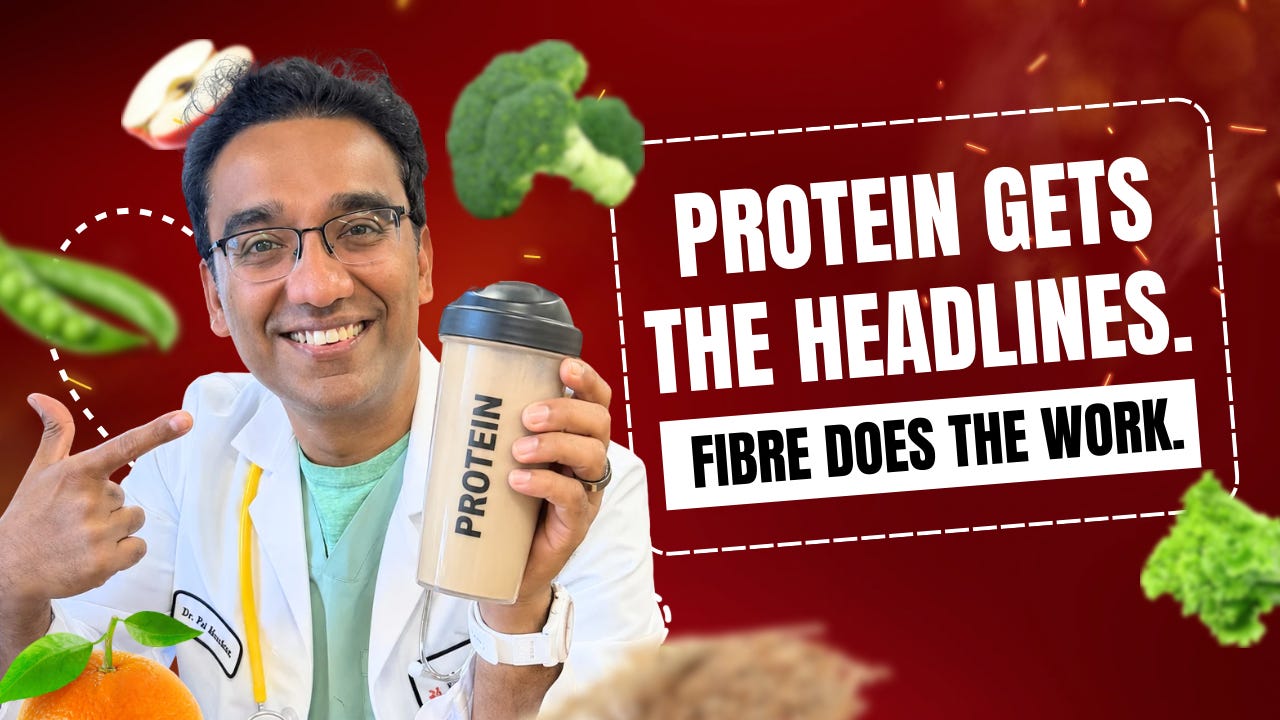
If I had to pick one nutrient that doesn’t get enough headlines, it wouldn’t be protein. It would be FIBRE. Protein gets the glamorous magazine covers, but fibre does the actual heavy lifting.
Your gut microbes love fibre. Your metabolism benefits from fibre. Your liver relies on fibre.
Many people are following modern high-protein, low-fibre diets and wondering why they still feel bloated, constipated, tired, or constantly hungry. A protein shake cannot compensate for a missing vegetable. You know, I’m a gastroenterologist, I’ve checked inside!
Chasing only the protein target while dropping daily fiber target below 25-30 grams.
Swapping real-food protein sources for synthetic, chemical-heavy processing powders.
Over-consuming protein bars packed with hidden emulsifiers and industrial trans-fats.
Mixing whey supplements with fructose-heavy fruit juices that trigger immediate liver fat.
Eating your largest, heaviest protein meal right before going to bed, forcing your liver to work a stressful shift while you sleep.
Instead of asking, “How do I eat more protein?”, try asking, “How do I build a plate my liver will thank me for?”
Aim for 1 Gram: Keep protein baseline to 0.8–1g per kg of ideal body weight unless lifting heavy.
Double the Fiber: Ensure every single protein meal includes a serving of live, green vegetables.
Keep Carbs Complex: Do not cut carbs entirely; your liver requires clean glucose to process amino acids.
Hydrate Continuously: Flush out the extra nitrogen and urea by increasing water intake.
Enforce a Sleep Window: Shut down your kitchen 3 hours before bed to let the liver rest.
Protein alone cannot magically fix a broken lifestyle problem.
Your liver doesn’t care about fitness trends or internet reels. It cares about daily patterns. And the healthiest patterns are usually the least exciting ones. Real whole food, good sleep, consistent movement, less stress, more fibre, and just enough protein. Not too much, not too little.
Sometimes the most powerful health advice is also the most boring. And surprisingly, that’s exactly why it works.
Signing off,
Dr. Pal
P.S. If you’ve recently started increasing your protein intake, ask yourself one question: Did your fibre intake increase too? Your gut already knows the answer
No posts
Comments
Nothing yet. Say the first thing.
Sign in to join the conversation.