
0:00
-6:05
Two years ago I was in the public library looking at art books. I leafed through a large volume of Klimt, admiring the long-limbed gods and goddesses. I looked at El Greco, especially at the clouds, dark gray, full of expectation and drama. The last book I read was a collection of Bruegel’s paintings, a 16th century Flemish artist.
I turned the page and saw the mega-work called The Triumph of Death, painted in 1562 [click to view a high-res image from The Prado]. The scene is too wide to take in at one glance, and so inevitably one is forced to pick an area and then work around the painting, assisted by closeups.
This is a hellscape, a vision of death taking over the world. A world where every possible thing has gone wrong. Death is not personified by an individual skeleton like the Grim Reaper, but by an army of skeletons, as numerous as a school of fish or a swarm of ants. They have many methods but one mission, and that is to kill.
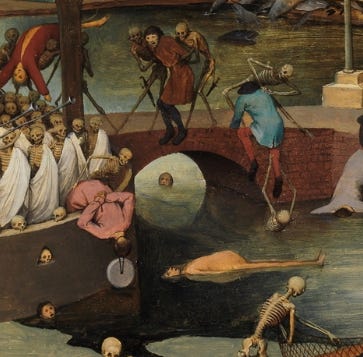
The scene shows us water deaths, drowning, being caught in a
net, being pushed into the water with a millstone around the neck, being pulled into the water by a skeleton. You see a dead woman being nibbled on by a dog while she holds her baby. You see the insult and suddenness of one who trips and falls off a cliff.
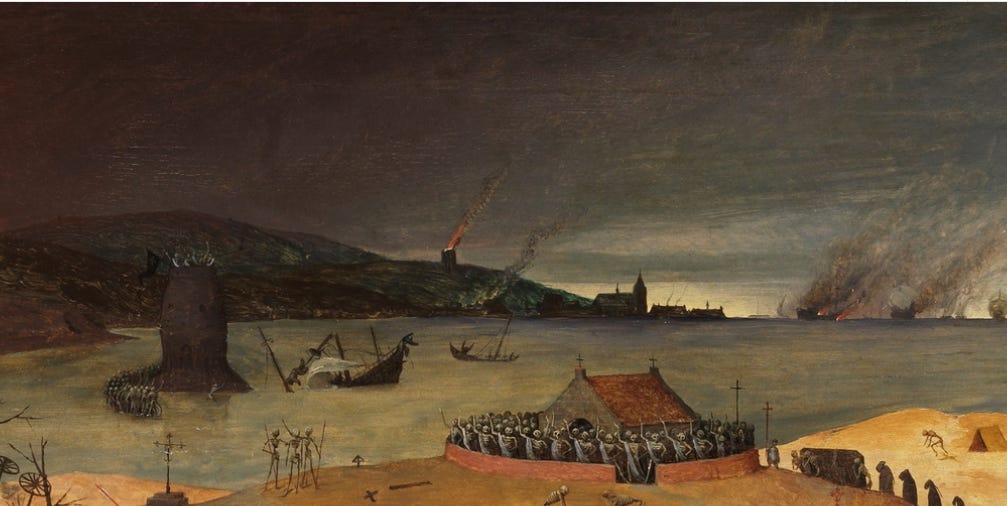
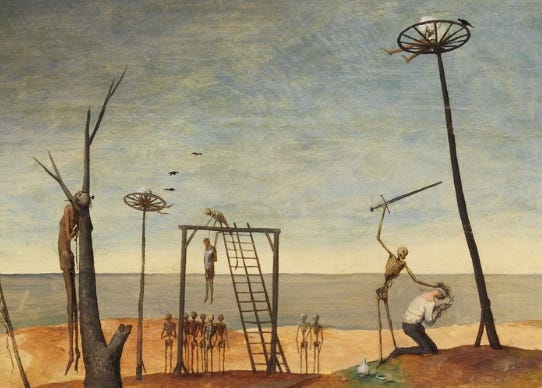
As you glance around the painting and catch the beautiful background, your eye gives thanks for the air and refuge towards the top of the painting- an escape. But upon closer inspection, you see ships are catching fire, their inhabitants burned alive, soldiers are dying in battle, people are put to death by the wheel, by hanging, by arrow, by sword, blindfolded while kneeling and holding the cross.
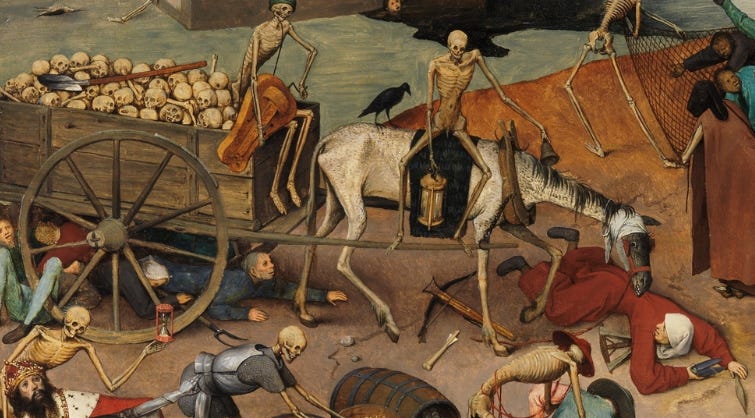
Once you are drawn into an area, the detail is overwhelming. A cartload of skulls is pulled by a horse, the cart is driven by a skeleton holding a creepy lantern. People are crushed underneath the cart while trying to take cover from the chaos. One desperately tries to escape being trampled under the horses hooves, she looks backward in horror knowing that this is the end.
All over the painting, people are removed from their social pedestals by the brutal egalitarianism of death. No king is safe, no noble is unscathed. Riches and gold are meaningless. The skeletons scoop the coins in glee, and try on the armor of the defeated knights (the concept of a skeleton wearing armor is itself absurd), coins spill on the ground as they have no value. A meal of nobles is interrupted by a massacre, the court jester is still in his costume in an expression of terror, trying to duck under the table and save himself.
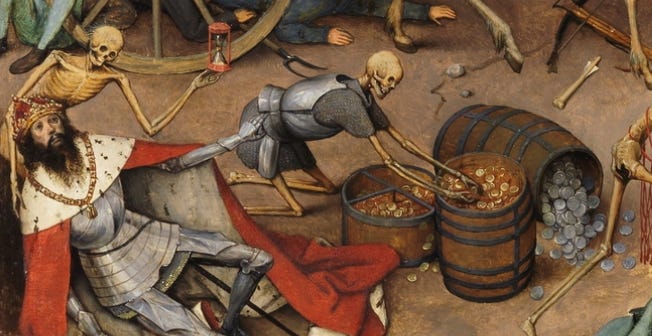
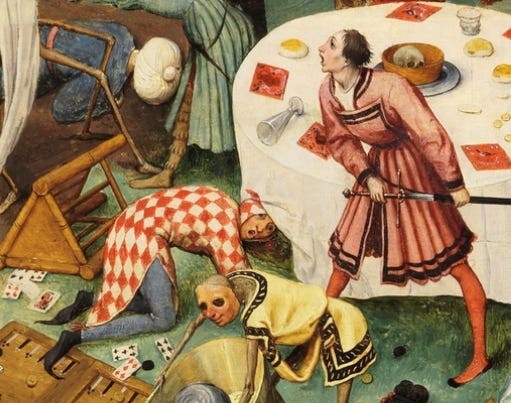
Bruegel has given us a menu. A 15-page menu like the kind you see at a local diner, with every kind of death you could possibly imagine. If one’s attention wanders, there are umpteen more kinds of death to view, look at, investigate, consider, there simply is no escape. No matter where you look, there it is, in impeccable detail, so precise and beautiful that you cannot look away, another intricacy, another absurdism.
Legions of skeletons wait in the wings to replace their colleagues in the battlefield. Instead of shields, they hold coffins with grim crosses on them. Skeleton-commanders ride starving horses, their diagonal presentation galloping through the painting, the skeletons astride them wielding their scythes like demented Vikings. Instead of harvesting grain, the scythe is used for execution.
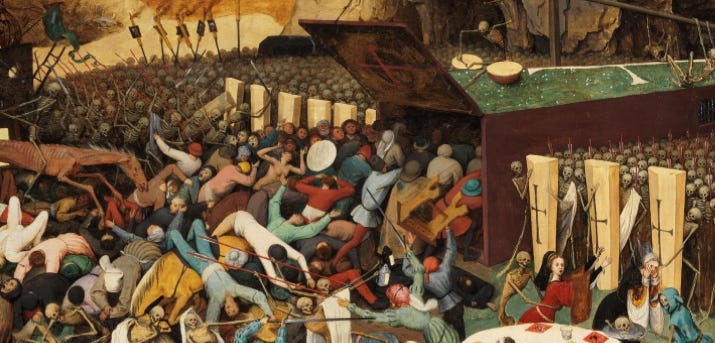
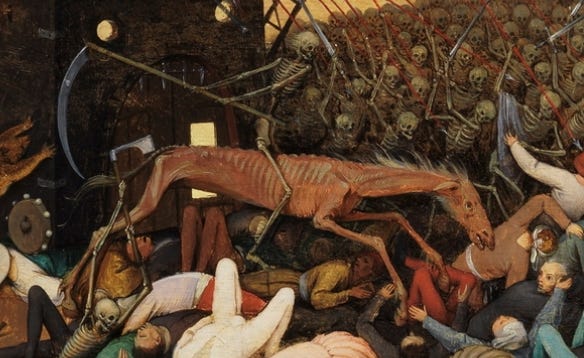
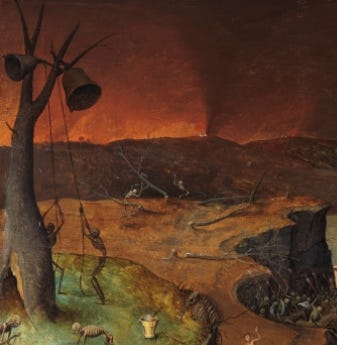
Ravens hover over the scene and patrol the mayhem. Even the beauty of nature becomes a servant of death. Two skeletons ring large brown bells as a kind of massive funeral for all present.
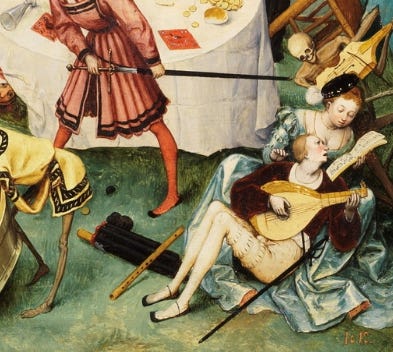
At the lower right hand corner, in the only non-horrific scene of the painting, a couple sings together. This is the only area of the painting not inhabited by loss and killing. But even in this sacred corner, a skeleton accompanies the couple on a stringed instrument, and I imagine him pitching in with the harmony, a macabre trio.
Bruegel puts images to our worst fears. He doesn’t hold back, he doesn’t try to “think positive”. He leans into the gore, the disgust, the despair, the wrongness of it, and never apologizes for his depiction. No indignity is hidden, there is no trigger warning on this medieval painting. This entire painting is one gigantic trigger. It is a reminder that the worst can and does happen.
A reminder that the saying about “death and taxes” is true.
A reminder that everything we love will die.
But Bruegel gives us a little match flame to hold inside our cupped palms.
And perhaps if we are lucky, we will find the island of peace inhabited by the lovers, and we will manage to sing together with death despite it all.
See more of my work at www.drordesigns.com and on Instagram @drordesigns. If you're interested in creating something unique for your special occasion, my 3-session illustration package is available. Let's make something meaningful together.
Sources:
Art Reflects the Times. Bruegel- The Triumph of Death. Art Meets Geoff
Wisse, Jacob. “Pieter Bruegel the Elder (ca. 1525–1569).” In Heilbrunn Timeline of Art History. New York: The Metropolitan Museum of Art, 2000–. http://www.metmuseum.org/toah/hd/brue/hd_brue.htm (October 2002)
No posts
Comments
Nothing yet. Say the first thing.
Sign in to join the conversation.