
Imagine having an itch on your head but being unable to scratch it. Or wanting a drink, but needing another person to stand beside you and hold it for several minutes. For someone with a significant mobility impairment, completing one of these actions can restore a small but meaningful piece of independence.
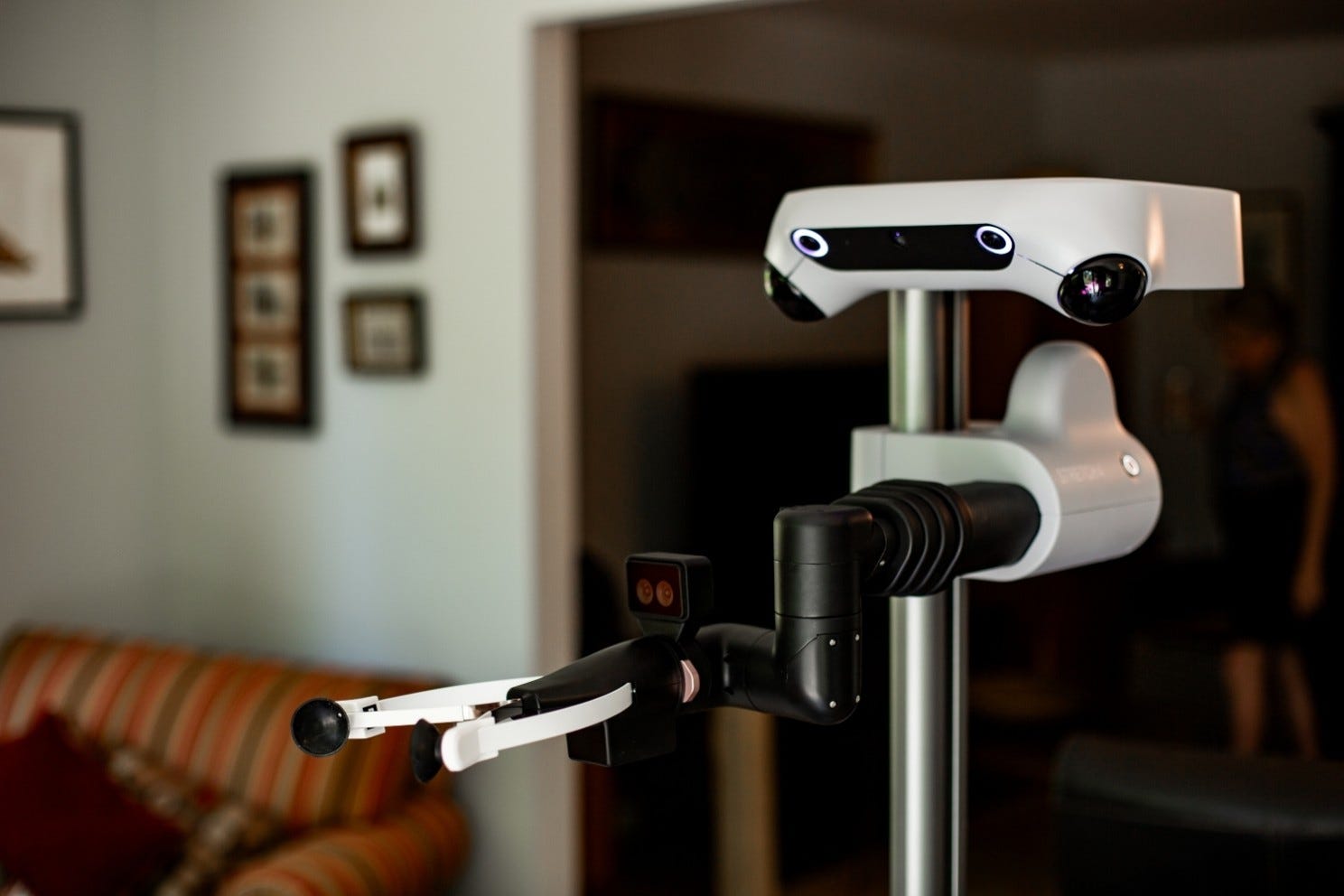
Hello Robot is working toward a future in which robots give people greater independence in their everyday lives.
The California robotics company expresses that mission in two short phrases: “Robots with purpose” and “Technology with empathy.”
Hello Robot’s Stretch platform has become a widely used tool for robotics research and development. But one of the clearest expressions of the company’s purpose can be found in its assistive robotics work with people with disabilities, older adults and their care partners.
I recently spoke with Hello Robot co-founder and CEO Aaron Edsinger about the company’s path from the research lab into real homes.
Stretch does not look like the humanoid robots currently attracting much of the robotics industry’s attention. It moves on a compact wheeled base. A vertical mast allows it to reach different heights. Its telescoping arm extends into the surrounding environment, while cameras and sensors help it understand what is happening around it.
In one pilot Edsinger described, a person wanted to use Stretch to scratch an itch. In another, a participant wanted the robot to hold a drink so that a caregiver would not need to remain beside them throughout the process.
“These are very simple tasks, but they’re achievable today,” Edsinger said. “And they provide immense value to the people who are working with the robot.”
The value extends beyond completing the task itself. Each action gives one person greater agency while giving the care partner more freedom.
Assistive technology is often evaluated according to what it can do for the person receiving care. Hello Robot considers the care partner part of the equation.
Edsinger spoke about an aunt who is bedbound and alone at night. If she needs water, getting up without assistance could be dangerous.
A robot does not need to function as a fully autonomous butler to help in that situation. It could bring a drink, connect her with a remote caregiver or allow someone to perform a safety check. Relatively simple capabilities could support the existing care network rather than attempting to replace it.
Hello Robot is also participating in research involving older adults and people with cognitive impairments.
Researchers at the University of New Hampshire have placed a socially assistive version of Stretch in the homes of people with dementia and their care partners. The robot combines its onboard capabilities with smart-home sensors to provide reminders, support daily routines and monitor certain safety concerns.
In one deployment, the robot helped remind a man with dementia to eat, drink, exercise and complete parts of his daily hygiene routine.
Because the robot can move, it can bring its screen and reminders to the person at the appropriate place and time. A tablet left on a bedside table cannot do that if it has been misplaced, forgotten or left uncharged.
The research remains at an early stage. Stretch is not yet a consumer caregiving product, and Hello Robot is careful not to present it as one.
But home deployments help researchers understand what people genuinely need from a robot, what they will accept in their homes and which capabilities are reliable enough to create value today.
For an older adult, that value could mean remaining at home longer. For a family member, it could mean being able to leave the house without constant worry. For a professional caregiver, it could mean having help with routine activities while preserving more time for human care.
Edsinger has extensive experience with humanoid robots. He studied at MIT with Rodney Brooks, spent more than a decade working on humanoids and previously founded a humanoid robotics company. He later served as director of robotics at Google, where he began thinking seriously about what it would take to place robots in homes.
His conclusion was that the industry needed a different approach.
After seeing research from his longtime collaborator and eventual Hello Robot co-founder Charlie Kemp, Edsinger became interested in a minimal robot with a telescoping arm.
“It has to be more like a Roomba with an arm than a large humanoid clomping around in your house,” he recalled.
The company’s rejection of the humanoid form is closely connected to its assistive mission. A useful humanoid must be large and powerful enough to balance, reach counters and manipulate objects. That size, weight and force introduce risks when the robot is working near children, pets, older adults and people who cannot easily move away from it.
“Safety is not something you just figure out later,” Edsinger said. “Particularly for the home and working with people who are maybe more vulnerable, older adults, you have to think about safety from the get-go.”
Hello Robot designed Stretch around those physical realities. The goal was a machine that would be simpler, safer, more practical and easier to place in a real home.
Edsinger calls the resulting design philosophy “robotic cubism.” The company took capabilities associated with the human body and rearranged them into a different form.
But robotic cubism is not an artistic exercise. It is a practical response to the people and environments the robot is meant to serve.
Hello Robot has sold approximately 330 earlier-generation Stretch robots across 23 countries. The machines are being used by universities, research laboratories, startups and other organizations exploring robotics applications.
The platform’s software is open source, allowing researchers to build applications, publish their findings and share code with the broader Stretch community.
That community has explored robots that retrieve walkers for people with Parkinson’s disease, help locate misplaced objects, support physical therapy, assist with bathing, bring medication and enable people with severe motor impairments to manipulate objects.
The research platform serves a practical purpose for Hello Robot. It allows many teams to investigate different needs while helping the company learn what Stretch is good at, where it fails and which applications could eventually support a sustainable product.
Stretch 4, launched in May, represents the company’s largest redesign of the robot so far. It includes more extensive sensing, improved reliability and features intended to support pilots outside traditional robotics laboratories.
The current Stretch 4 remains a research and development platform. It is not yet a household appliance that someone can purchase, unpack and use without technical support.
The company is now working through the difficult questions required to bridge that gap: How will these robots be supported? Who will pay for them? Which tasks provide enough value to justify their cost? How much autonomy is necessary, and where should a person remain in control?
When I asked Edsinger what we might be discussing a year from now, he did not predict a humanoid breakthrough or a general-purpose robot capable of handling every household chore.
He hopes we will be talking about successful pilots, real deployments and a clearer path to bringing robots into homes.
“What we know is that there’s a real demand, there’s a real need there,” he said.
In this one-minute excerpt, Edsinger explains “robotic cubism,” why Hello Robot chose not to build a humanoid and why safety must be considered from the beginning.
#robotics #physicalai #embodiedai
Comments
Nothing yet. Say the first thing.
Sign in to join the conversation.